
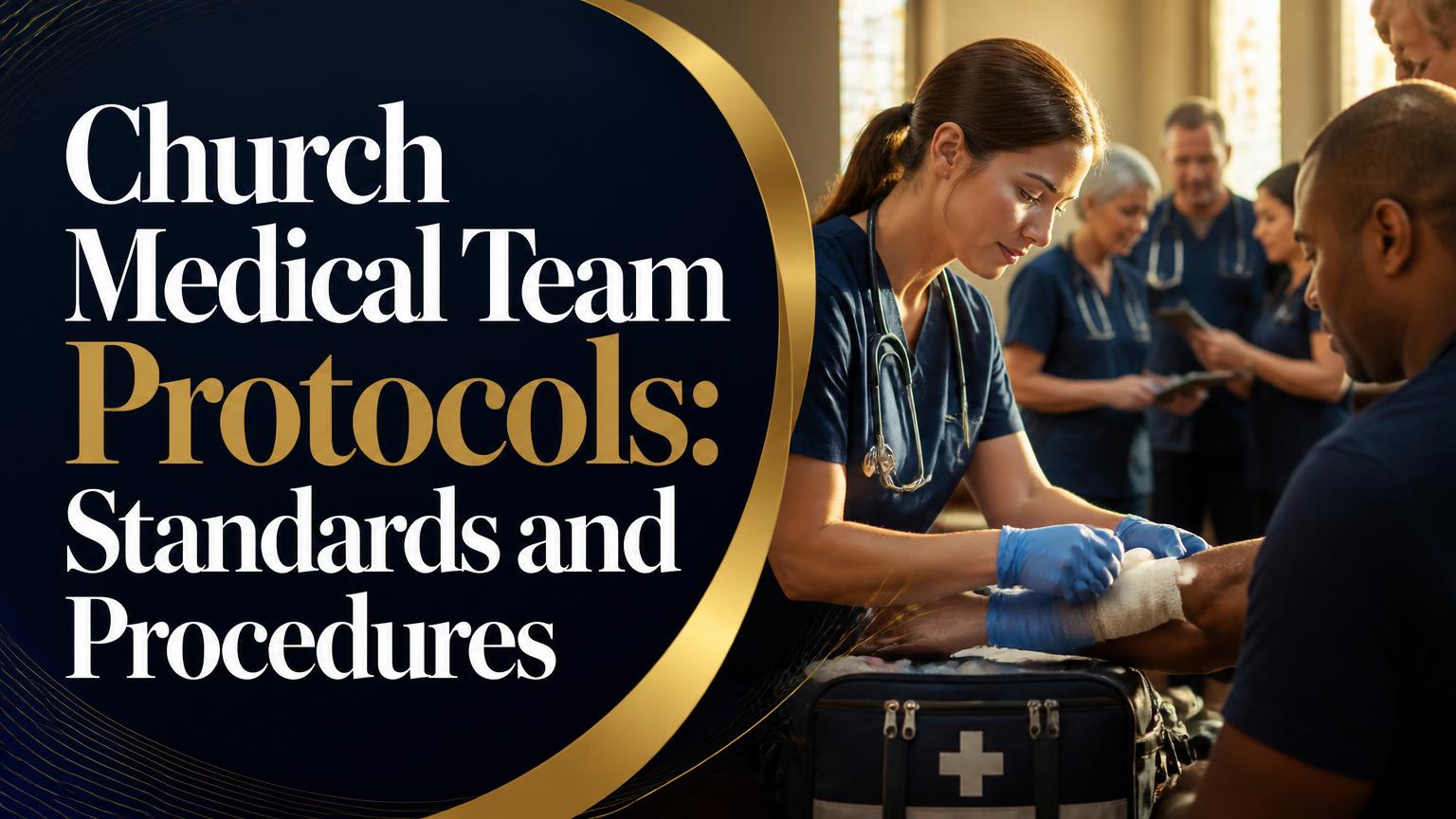
Church medical team protocols give volunteers a consistent way to prevent harm, respond to illness or injury, protect dignity, and transfer care to emergency professionals. A church team is not a substitute for an ambulance service, licensed clinician, or formal medical director. Its role is usually to recognize danger, provide appropriate first aid within its training, activate emergency services, and support the person until higher-level care arrives. Effective protocols also address consent, child protection, privacy, documentation, equipment, training, and post-incident review.
Church Medical Team Protocols
A useful protocol should be simple enough to follow under stress but detailed enough to remove uncertainty. It should identify who acts, what happens first, when emergency services are called, how information is protected, and where supplies are located. Every procedure should be adapted to the church’s size, activities, building, local law, insurance requirements, and available personnel.
Define the Team’s Mission and Scope
The medical team’s primary responsibilities are prevention, immediate assessment, basic first aid, emergency activation, and coordination with arriving responders. Team members should work only within their current training, legal authority, and personal competence. A person with clinical credentials may have additional skills, but credentials do not automatically authorize every treatment in every setting.
The team should not diagnose complex conditions, prescribe medication, perform invasive procedures, transport seriously ill people in private vehicles, or delay emergency services while attempting to manage a crisis internally. A written scope of practice should state what volunteers may do, what requires a licensed professional, and which situations always require emergency medical services.
Compassion remains central to the work. The Good Samaritan’s care for an injured stranger in Luke 10:25–37 illustrates practical mercy, but compassionate service also requires wise boundaries. Prayer, emotional support, and spiritual care may accompany first aid; they should never be used to pressure someone to reject appropriate medical treatment.
Prepare Before Anyone Needs Help
Preparation begins with a written emergency action plan. The plan should identify the church address and best entrance for emergency vehicles, AED and first-aid-kit locations, accessible exits, areas with poor phone reception, severe-weather shelter locations, and procedures for events held away from the main building.
A basic risk assessment should consider the congregation’s age range, children’s programs, sports or outdoor activities, cooking, construction, stairs, water features, extreme temperatures, large crowds, and people with known accessibility or medical needs. The team should also know how to contact parents or guardians and how to reunite children with authorized caregivers after an incident.
Before each major service or event, a coordinator should confirm:
- Which trained responders are present
- Who will call emergency services
- Who will retrieve the AED and first-aid supplies
- Who will meet and direct arriving responders
- Which staff member handles children, family communication, and crowd control
- Whether access routes and emergency equipment remain unobstructed
Respond to a Medical Emergency
A standard response begins with scene safety. Volunteers should look for hazards such as fire, electricity, traffic, violence, structural damage, bodily fluids, or unsafe crowds. They should use gloves and other available protective equipment and should not enter a dangerous scene until it is safe or trained authorities take control.
The basic sequence is:
- Assess responsiveness and immediate danger.
- Ask someone to call the local emergency number and retrieve the AED and first-aid kit.
- Check breathing and other obvious life threats according to current training.
- Provide CPR, use an AED, control severe bleeding, or give other appropriate first aid within the responder’s competence.
- Continue monitoring and supporting the person until emergency personnel arrive.
- Give responders a clear handoff, including what happened, what was observed, and what care was provided.
Do not leave a critically ill or injured person alone unless doing so is necessary to obtain help. One volunteer should remain with the person while another manages communication and access. If the person’s condition is unclear, calling emergency services is generally safer than waiting for symptoms to worsen. Volunteers should follow the dispatcher’s instructions and the protocols taught in their current training.
Manage Consent, Privacy, and Safeguarding
Whenever possible, explain who you are, what you observe, and what you intend to do before providing care. Ask permission from a conscious adult and respect a refusal unless another legally recognized basis for intervention applies. In a life-threatening emergency involving an unresponsive person, implied consent may apply, but the precise legal rules vary by jurisdiction. The church should obtain local legal and insurance guidance rather than relying on a generic assumption.
Children and vulnerable adults require additional safeguards. Follow the church’s child-protection policy, involve a parent or authorized guardian when practical, and avoid unnecessary one-on-one isolation. If immediate treatment is required and a guardian is unavailable, emergency personnel and local law determine the appropriate course.
Medical information should be shared only with people who need it to provide care, protect safety, fulfill a legal duty, or manage the incident. Do not discuss a person’s condition in public areas, post details in group chats, or announce private information from the platform. Even well-intentioned prayer requests should omit identifying medical details unless the person or family has clearly authorized disclosure.
Coordinate Roles and Communications
A medical response becomes less chaotic when responsibilities are assigned in advance. A small church may have one responder covering several functions, while a large congregation may use a coordinated team. Typical roles include a medical-team lead, first-aid responders, emergency caller, AED and supply runner, entrance guide, children’s-program liaison, and incident recorder.
Communication should be direct and factual. The emergency caller should provide the exact location, access point, number of patients, apparent condition, hazards, and a callback number. Another person should wait at the designated entrance to direct responders, since emergency crews may lose time searching a large campus.
Radio or phone communication should avoid unnecessary personal details. A simple phrase such as “medical assistance needed in Room 204; send the AED and call emergency services” is usually better than broadcasting a diagnosis that has not been confirmed.
Training, Equipment, and Readiness Standards
Training should match the congregation’s actual risks rather than consist only of general first aid. At minimum, designated responders should receive current instruction in CPR, AED use, basic first aid, severe bleeding control, scene safety, and emergency communication. Churches serving children should add pediatric considerations, child safeguarding, and procedures for contacting guardians. Training should be renewed according to the certifying organization, equipment manufacturer, and applicable local requirements.
Volunteers should practice the emergency plan through realistic drills. A tabletop exercise can reveal missing phone numbers or unclear responsibilities; a practical drill can show whether someone can reach the AED, unlock the building, guide an ambulance, and manage a crowd. Drills should be announced or unannounced according to the church’s safety policy, but they must not create unnecessary fear or imitate a real emergency in a way that could cause harm.
Maintain Essential Supplies
A church first-aid station commonly includes disposable gloves, hand sanitizer, protective breathing barriers, gauze, adhesive bandages, dressings, medical tape, antiseptic supplies, scissors, instant cold packs, triangular bandages, blankets, flashlights, and incident forms. A bleeding-control kit may include pressure dressings and a tourniquet, but volunteers should use such equipment only as trained.
An AED should be visible, accessible during all occupied hours, and inspected according to the manufacturer’s instructions. The church should monitor battery condition, electrode-pad expiration dates, alarms, software notices, and post-use replacement requirements. First-aid supplies should be inventoried on a defined schedule, with expired or damaged items replaced promptly.
Medication policies require particular caution. Churches should not casually store or administer prescription drugs. If the church assists with an individual’s emergency medication, such as a person’s prescribed epinephrine auto-injector, the procedure should address authorization, training, storage, documentation, and emergency activation. Local law and the church’s liability adviser should guide any program involving stocked medications or naloxone.
Create a Written Emergency Procedure
A concise procedure should be posted where responders can find it and included in volunteer orientation. It should state:
- How to activate emergency medical services
- The church’s exact address and responder entrance
- Where the AED, first-aid kits, gloves, and emergency forms are located
- Who may provide care and within what limits
- How to respond to cardiac arrest, severe bleeding, choking, allergic reaction, seizure, diabetic emergency, heat illness, and serious injury
- How to protect children and vulnerable adults
- Who communicates with family members and church leadership
- How to document and review the event
The procedure should use plain language rather than a long clinical manual. During a crisis, volunteers need a reliable sequence and clear decision points, not a document that requires extensive interpretation.
Documentation, Handoffs, and Post-Incident Review
Documentation protects the person receiving care, the volunteers, and the church. An incident report should record the date, time, location, people involved, observable symptoms or circumstances, actions taken, emergency services contacted, witnesses, and the time care was transferred. It should distinguish observations from conclusions: “person was difficult to awaken” is more reliable than “person overdosed” unless that fact is known.
Reports should be stored securely and accessed only by authorized individuals. They should not be kept in an open first-aid cabinet or circulated by ordinary email. Retention periods depend on local law, insurance requirements, organizational policy, and the nature of the incident, so the church should establish a formal records policy.
After emergency responders take over, the team should replace used supplies, secure any contaminated materials, preserve relevant information, and notify the designated church leader. Family communication should be compassionate and limited to appropriate facts. Public announcements should protect privacy and avoid speculation.
Review What Happened Without Blame
A short debrief should occur after significant incidents. The team can ask whether the emergency was recognized promptly, whether equipment was accessible, whether communication worked, whether anyone exceeded the scope of training, and what barriers delayed care. The purpose is improvement rather than automatic blame.
The review may lead to practical changes such as relocating an AED, adding signage, revising a children’s check-in process, changing volunteer coverage, repairing a locked entrance, or scheduling additional training. If a responder or witness is distressed, church leaders should provide appropriate pastoral support while recognizing that serious incidents may require professional mental-health care.
Common Mistakes Church Medical Teams Should Avoid
Several errors repeatedly weaken otherwise well-intentioned programs. The first is treating medical ministry as informal rather than operational: keeping supplies without assigning trained people, or assuming that someone will know what to do. The second is delaying emergency services because the team hopes the person will improve. Calling for help early does not prevent volunteers from providing first aid; it starts the response process while care continues.
Other mistakes include allowing untrained people to administer medication, failing to inspect AED equipment, moving an injured person unnecessarily, crowding the patient, discussing private information publicly, and documenting opinions instead of observations. Churches should also avoid presenting a volunteer’s personal experience as a substitute for current training.
A sound program balances readiness with restraint. Volunteers should act quickly for life-threatening conditions, remain within their competence, communicate honestly, and transfer care promptly. They should not attempt heroic procedures simply because professional help has not yet arrived.
Conclusion
Church medical team protocols should provide a clear bridge between an unexpected health emergency and professional medical care. The essential standards are preparation, scene safety, rapid emergency activation, competent first aid, consent, privacy, child and vulnerable-adult protection, accurate documentation, and continuous review. A church does not need to imitate a hospital to respond responsibly. It needs trained people, accessible equipment, defined roles, rehearsed procedures, and the discipline to recognize both what volunteers can do and when they must call for more capable help.