
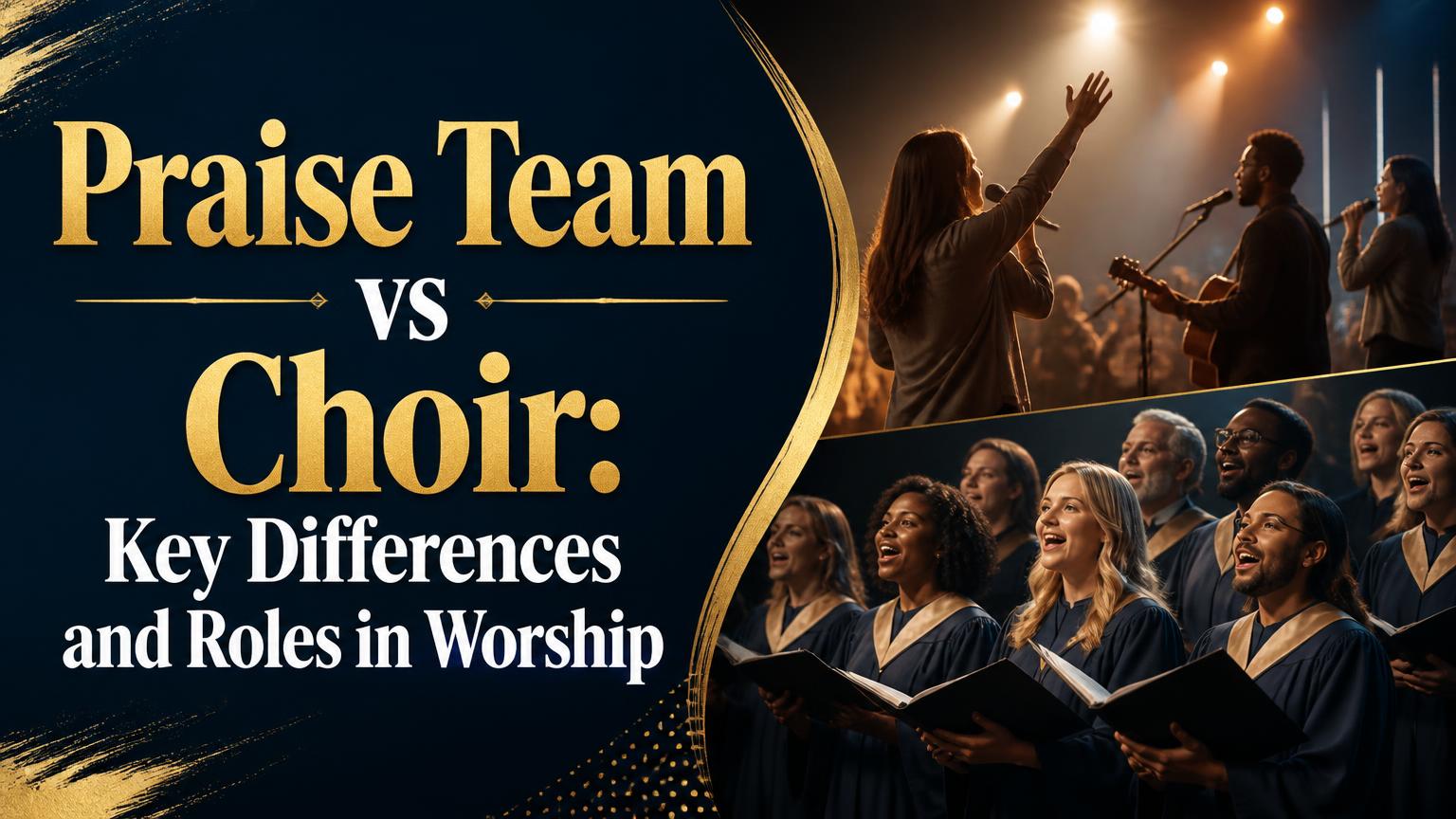
Praise Team vs Choir is primarily a distinction of structure, musical function, and ministry practice—not a ranking of one group over the other. A praise team is usually a smaller, flexible group that leads congregational singing, often alongside a worship band. A choir is typically a larger vocal ensemble organized around multiple parts, rehearsed harmony, and choral direction. Churches use these terms differently, and either ministry can serve the congregation faithfully in contemporary, traditional, or blended worship.
Praise Team vs Choir: What Is the Difference?
The clearest difference is that a praise team is usually designed to lead the congregation directly, while a choir is organized to present unified, layered vocal music as an ensemble. A praise team may include several singers, instrumentalists, a worship leader, or all three. A choir normally refers specifically to a body of singers divided into vocal sections such as soprano, alto, tenor, and bass.
Neither definition is absolute. A large praise team may function like a choir, and a choir may lead congregational songs from the front of the church. The most useful comparison concerns how each group is arranged, how it rehearses, and what role it normally plays during worship.
Basic Structure and Vocal Arrangement
A praise team commonly consists of a lead vocalist supported by background singers. The singers may share lead responsibilities from song to song, harmonize around a melody, or provide vocal responses that reinforce the worship leader. The group is often accompanied by guitar, keyboard, drums, or other instruments, although the term “praise team” can refer only to the singers.
A choir is usually organized into vocal sections, with each singer assigned a musical part. Instead of depending on one lead vocalist, the choir creates its sound through combined voices. A choir may sing in four-part harmony, unison, call-and-response, or more complex arrangements directed by a choir leader or conductor. This structure gives the ensemble a broad, blended sound but generally requires more formal preparation.
Leadership and Congregational Participation
Praise teams are normally positioned to help the congregation sing. The worship leader may introduce a song, set its tempo, speak between verses, adjust the arrangement, and invite the church to repeat or respond to a particular line. The team’s vocal and instrumental choices are therefore closely tied to congregational participation.
A choir can also lead congregational worship, but its role may be broader. It might sing a congregational hymn, present a choral anthem, support the worship leader, or sing during prayer, communion, or a special service. In many churches, the choir is not simply a group that performs for an audience; it serves the church by giving musical leadership and helping the congregation express shared faith.
Musical Repertoire and Rehearsal
Praise teams often work with current worship songs, simple repeated structures, and arrangements that leave room for spontaneous transitions or extended sections. Their rehearsals may focus on chord charts, song order, vocal microphones, instrumental cues, and how the group will support the lead worshiper. This does not mean praise-team music is musically simple; effective teams require strong timing, listening, harmony, and restraint.
Choirs usually rehearse vocal parts separately and together. Their preparation may include diction, breathing, blend, dynamics, entrances, cutoffs, and interpretation of a written arrangement. Choir repertoire can include hymns, gospel music, spirituals, anthems, classical works, and contemporary worship songs. A choir’s musical form is not determined solely by age or tradition; many choirs use modern arrangements and amplified instruments.
Ministry Identity and Worship Context
A praise team is often associated with a worship ministry built around direct leadership, flexibility, and a band-oriented sound. A choir is often associated with communal singing, disciplined ensemble work, and a distinctly collective vocal identity. These are tendencies rather than rules.
The important question is not which group appears more expressive or more impressive. It is whether the ministry helps the church worship with understanding, participation, order, and love. A small praise team can become overly focused on stage presentation, while a choir can become disconnected from the congregation. Either group serves well when musical ability supports the spiritual and communal purpose of worship rather than replacing it.
How Praise Teams and Choirs Can Overlap
The distinction between these ministries is useful, but the categories are not mutually exclusive. Churches frequently combine their strengths. A choir may sing behind a worship leader during a contemporary song, and a praise team may use carefully written harmonies that resemble a small choral ensemble.
A Choir Can Lead Contemporary Worship
A choir does not have to sing only traditional hymns or formal anthems. It can lead modern worship songs, gospel arrangements, or energetic congregational music while retaining its sectional vocal structure. In this setting, the choir may provide powerful harmonies, reinforce repeated phrases, and create musical contrast between verses and choruses.
Its larger sound can also support congregational confidence. When people hear a group singing the melody clearly and consistently, they may find it easier to join. The choir remains most effective, however, when its volume, staging, and arrangement leave room for the congregation rather than turning worship into a presentation by specialists.
A Praise Team Can Use Choral Techniques
A praise team may use multiple vocal parts, planned dynamics, antiphonal responses, and carefully arranged harmonies. Some teams include enough singers to create a rich ensemble sound while still maintaining the flexibility associated with contemporary worship leadership.
This model requires the singers to understand their function. Background vocalists should usually support rather than compete with the lead. They may sing fewer notes, reduce their volume, or remain silent during a verse so that the arrangement has shape. Good teamwork involves musical judgment as much as vocal ability.
The Biblical Purpose Behind Both Ministries
The New Testament does not prescribe one universal worship staffing model called either a praise team or a choir. Scripture gives principles for worship: believers sing to God, teach and encourage one another, use their gifts to serve, and conduct gathered worship in an orderly way. Churches apply those principles through different musical forms.
Congregational Singing Is the Shared Goal
Ephesians 5:19 describes believers addressing one another with psalms, hymns, and spiritual songs, while Colossians 3:16 connects singing with teaching and mutual encouragement. These passages present singing as more than musical decoration. Words carried through song can help a congregation remember truth, express gratitude, confess faith, and encourage fellow believers.
That purpose applies to both a praise team and a choir. The group should help the church sing, not merely sing instead of the church. A choir may lead through a strong choral arrangement; a praise team may lead through a simpler song with repeated congregational participation. In both cases, the measure of success includes whether the music communicates truth and invites meaningful worship.
Skill Should Serve Love, Unity, and Order
Scripture also treats musical ability as something to steward rather than display for personal status. First Peter 4:10 urges believers to use their gifts to serve others, and 1 Corinthians 14:40 calls for gathered worship to be conducted properly and orderly. These principles address attitude, preparation, and responsibility.
A choir’s disciplined rehearsal and a praise team’s flexibility can both reflect faithful service. The danger arises when technical excellence becomes a substitute for humility, or when spontaneity becomes an excuse for poor preparation. Christian worship ministries need both preparation and dependence on God, both musical excellence and concern for the congregation.
Choosing a Praise Team, Choir, or Both
The best model depends on the church’s size, worship tradition, available musicians, congregational culture, and ministry goals. A church should not adopt a format merely because it is popular elsewhere. It should choose an arrangement that allows people to participate and enables its members to serve responsibly.
Choose a Praise Team When Direct Leadership Is the Priority
A praise team may be especially suitable when the church wants a small group to lead a band-oriented service, introduce newer songs, or provide flexibility from week to week. It can work well when the congregation benefits from a visible worship leader who guides song transitions, keys, tempos, and repeated sections.
This model also requires clear expectations. Team members need to understand whether they are leading, supporting, or alternating roles. Without that clarity, several voices may compete for attention, arrangements may become confusing, and the congregation may struggle to know when to participate.
Choose a Choir When Ensemble Singing Is a Central Strength
A choir may be the stronger choice when the church has many singers who want sustained musical formation, when choral harmony is central to its tradition, or when the congregation values a broad communal sound. It can provide musical leadership for weekly worship as well as special services, seasonal celebrations, funerals, weddings, and outreach events.
A choir also creates a meaningful ministry community. Members learn to listen to one another, sing parts that are not always prominent, and contribute to a unified result. That communal discipline can be spiritually valuable when it is shaped by service rather than competition.
Use Both When Their Functions Are Clearly Defined
Many churches benefit from both ministries. A praise team can lead the primary congregational songs while a choir contributes an anthem, supports selected choruses, or sings during particular seasons. Another church may have a choir as its main worship leadership group with a smaller team providing instrumental or vocal direction.
The arrangement works best when leaders define responsibilities in advance. They should decide who selects songs, who leads transitions, how the choir and team share the platform, and how the volume and musical texture will support congregational singing. Combining groups without clarifying those roles can produce clutter rather than richness.
Common Misunderstandings About Praise Teams and Choirs
A Choir Is Not Automatically More Traditional or More Formal
Although many choirs serve in traditional settings, the word “choir” describes an ensemble structure rather than a fixed worship style. A choir can sing gospel, contemporary worship, spirituals, modern arrangements, or unaccompanied music. Its defining feature is the organized group of vocal parts, not the age of its repertoire.
Likewise, a choir’s formal rehearsal process does not make its ministry less spiritual. Learning music carefully can be an act of consideration for the congregation and fellow singers. Preparation helps the group communicate clearly and avoid distracting mistakes.
A Praise Team Is Not Automatically More Contemporary or More Authentic
Praise teams are often linked with modern worship, but their presence does not guarantee meaningful congregational participation. A team can become overly performance-oriented if its sound, movement, or stage presence draws attention away from the words and the gathered church.
Conversely, a praise team can lead with humility, musical discipline, and theological depth. Its smaller size may allow it to respond quickly to the congregation and adapt arrangements without losing focus. The ministry’s spiritual quality depends more on purpose, character, and practice than on its instruments or visual style.
Conclusion
The difference between a praise team and a choir usually lies in organization and function. A praise team is commonly a flexible leadership group built around direct congregational guidance, while a choir is a structured vocal ensemble built around shared parts and blended sound. Those distinctions help churches plan rehearsals and worship services, but they should not become rigid labels. Either ministry can lead faithfully when it serves the congregation, communicates sound truth, and treats musical ability as a gift for service. The right choice is the one that best supports the church’s people, worship context, and calling.