
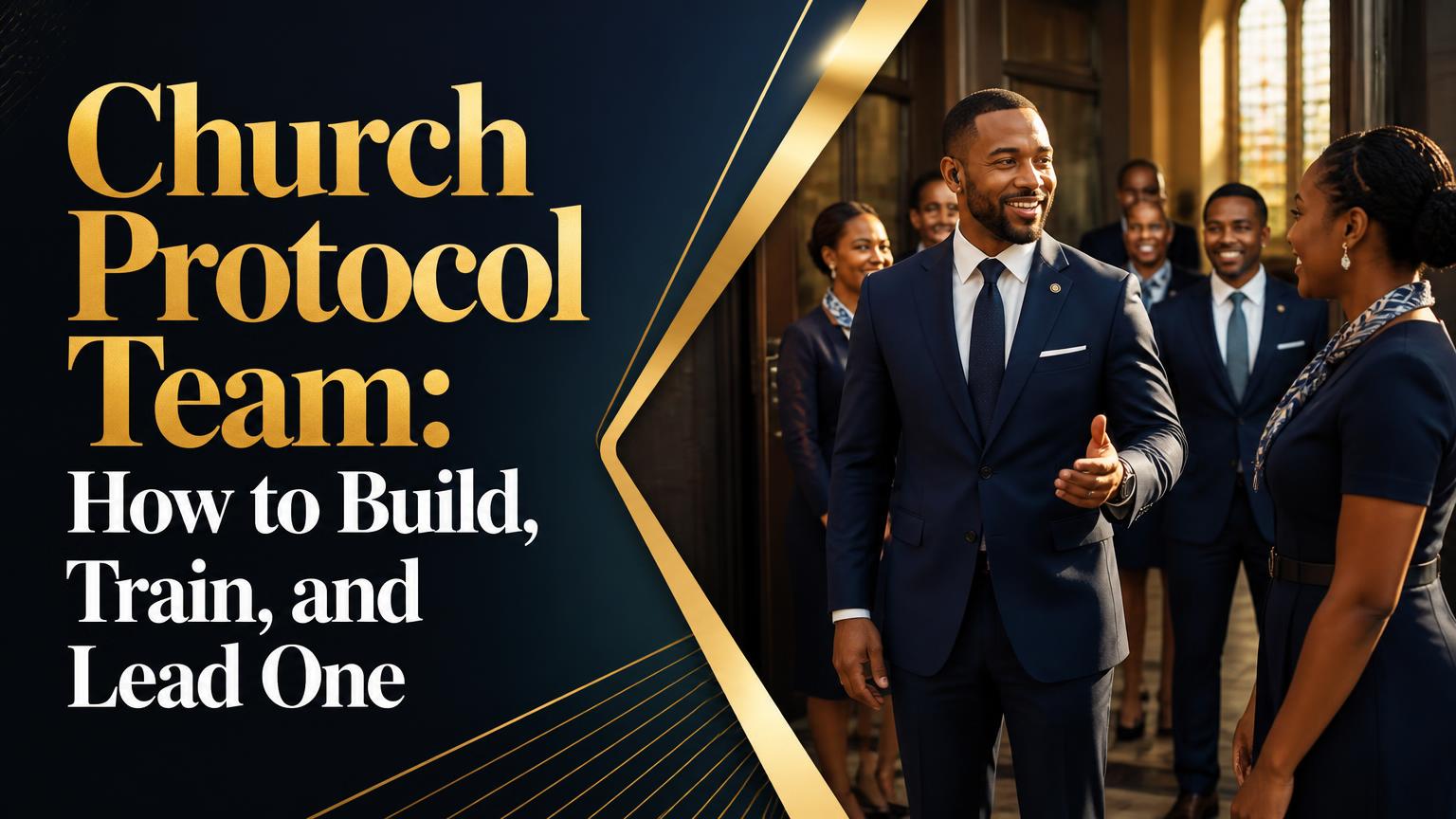
A church protocol team coordinates the practical details that help worship services, conferences, ceremonies, and special gatherings run in an orderly, welcoming, and respectful manner. Its work may include receiving guest ministers, coordinating leaders, managing seating and movement, preparing service transitions, communicating with ministry departments, and responding discreetly to unexpected needs. A strong team does more than protect appearances or give special treatment to important people. It creates conditions in which worshipers, guests, leaders, volunteers, and staff can participate with clarity, dignity, and care.
Church Protocol Team: Purpose, Structure, and Responsibilities
A church protocol team is a ministry-support team responsible for planning and managing people, movement, communication, hospitality, and service details around church gatherings. The exact assignment differs by congregation. In one church, protocol may focus primarily on guest speakers and formal events; in another, it may coordinate the entire service-day experience for pastors, worship leaders, ministry heads, and visitors.
What a Church Protocol Team Does
The team turns plans into coordinated action. Before a service, members may confirm arrival times, prepare reserved areas, review the program, check access routes, coordinate with ushers, and communicate changes to relevant leaders. During the gathering, they may escort participants, manage transitions, solve logistical problems, and ensure that scheduled responsibilities occur without unnecessary disruption.
Protocol also involves relational awareness. A guest minister may need clear directions, a private place to prepare, information about the service order, or assistance with transportation. A senior pastor may need timely communication about a change in schedule. A first-time visitor may need help finding childcare, accessible seating, or a ministry representative. The team serves each person appropriately without turning the church into a rigid production.
How Protocol Differs From Ushers, Hospitality, and Security
These ministries overlap, but they are not identical. Ushers commonly help with seating, offerings, congregation movement, and order inside the worship space. Hospitality teams often focus on welcome, refreshments, guest care, and fellowship. A protocol team usually works more broadly across departments and may coordinate leaders, guests, event schedules, formal courtesies, backstage movement, and communication.
Protocol is also different from security. Security personnel handle threats, access control, emergencies, and safety procedures according to their training and legal responsibilities. Protocol members should not pretend to be security officers or physically intervene in situations beyond their competence. Clear boundaries reduce confusion: protocol coordinates service logistics and respectful care, while trained safety personnel manage security and emergency risks.
Core Responsibilities Before, During, and After Services
A useful protocol team usually works through three phases:
- Before the gathering: Confirm the schedule, participants, locations, arrival instructions, seating plans, dress expectations when relevant, equipment needs, transportation, accessibility arrangements, and contact information.
- During the gathering: Welcome assigned guests, communicate discreetly, guide transitions, monitor timing, assist leaders, respond to reasonable needs, and coordinate with ushers, worship, media, children’s ministry, facilities, and security.
- After the gathering: Help with departures, return equipment or materials, document unresolved issues, thank volunteers, follow up with guests, and record improvements for the next event.
The team should not attempt to control every detail. Its purpose is to remove avoidable confusion while leaving worship leaders, pastors, and ministry departments free to perform their own responsibilities.
Biblical and Ethical Foundations
First Corinthians 14:40 instructs the church to do things “decently and in order.” In context, Paul is addressing the conduct of gathered worship, not creating a universal organizational chart. The principle supports thoughtful coordination, but order must serve edification rather than impressiveness or control.
Jesus also redefined leadership through service. In Mark 10:42–45, he contrasts domineering authority with servant leadership. That principle should shape protocol: team members use access and information to help people, not to elevate themselves. James 2:1–9 warns against favoritism, so special attention to a guest speaker or church leader must never communicate that ordinary worshipers matter less. Hospitality should remain courteous, fair, and attentive to real needs.
How to Build a Church Protocol Team
Building the team begins with a clear ministry assignment rather than simply recruiting people who appear organized. Leaders should determine what protocol means in their congregation, which events require it, and where responsibility begins and ends. A written ministry description prevents the team from becoming an undefined group expected to solve every operational problem.
Define Scope and Reporting Lines
Write down the team’s responsibilities, authority, and limits. Specify whether it serves weekly worship, conferences, weddings, funerals, ordinations, leadership meetings, or only events involving outside guests. Identify the leader to whom the team reports and the ministry departments with which it must coordinate.
A practical structure may include a protocol coordinator, service-day leads, guest-care representatives, communication support, and assigned liaisons for facilities, worship, media, children’s ministry, and security. Not every church needs all these positions. The important point is that someone owns each responsibility and knows who makes final decisions when plans change.
Select Character, Competence, and Availability
Protocol members need more than confidence or social polish. Look for reliability, discretion, emotional maturity, humility, punctuality, situational awareness, and the ability to receive instructions without becoming defensive. Because members may hear private information about schedules, pastoral care, travel, or leadership concerns, trustworthiness is essential.
Recruit according to actual workload. A small church may begin with four or five well-trained volunteers rather than a large team with unclear duties. Consider availability, physical ability, language skills, familiarity with the building, and the ability to assist people with disabilities. No volunteer should be placed in a role requiring skills they have not been trained to use.
Create Simple Operating Procedures
Written procedures should be practical enough to use on a busy service day. They might include a guest information form, arrival and departure process, service itinerary, contact tree, seating or access plan, emergency escalation process, and post-event review. Procedures should identify who confirms details, who meets the guest, who communicates changes, and who handles expenses or transportation.
Avoid building a manual that no one reads. Use checklists, short briefing documents, and role cards for recurring events. Protect personal information and share it only with people who need it for the assignment. Procedures should also account for accessibility, child-protection requirements, photography preferences, dietary needs, and local safety policies where applicable.
How to Train and Lead the Team
Training should combine ministry character with operational skill. A person may be warm and spiritually committed yet still create confusion by giving conflicting instructions, arriving late, or improvising beyond their authority. Conversely, an efficient volunteer may need guidance in empathy, confidentiality, and servant leadership. The strongest teams develop both dimensions.
Essential Training Areas
Core training should cover church values, the team’s scope, service flow, guest reception, professional communication, confidentiality, cultural sensitivity, accessibility, safeguarding, and emergency procedures. Members should learn the church building well enough to direct people confidently and identify alternative routes, restrooms, prayer spaces, childcare areas, and accessible entrances.
Use realistic practice scenarios. A training exercise might involve a guest arriving at the wrong entrance, a speaker requesting a schedule change, a reserved seat being occupied, a member becoming distressed, or a service running behind schedule. Role-play teaches volunteers to remain calm, communicate briefly, and involve the correct leader instead of making unnecessary promises.
Service-Day Communication and Decision Making
Communication should be brief, accurate, and routed through agreed channels. Before the gathering, the team can hold a short briefing covering the program, assignments, known sensitivities, changes, and escalation points. During the service, radios, messaging groups, or designated runners may be useful, but sensitive information should not be broadcast where it can be overheard.
Teach members to distinguish urgent matters from merely inconvenient ones. A safety concern, medical issue, safeguarding concern, or serious conflict requires immediate escalation. A minor timing change may be handled by the assigned lead. When information is uncertain, volunteers should say that they are checking rather than guessing. Accurate uncertainty is more trustworthy than confident misinformation.
Care, Boundaries, and Crisis Response
A protocol team should be attentive without becoming intrusive. Ask before touching personal belongings, entering private spaces, changing arrangements, or sharing information. Do not promise special access, financial assistance, transportation, or pastoral outcomes unless authorized to do so. Treat private conversations as confidential, except where safety or safeguarding obligations require reporting.
Crisis response begins with recognition of limits. Volunteers should know whom to contact for medical emergencies, suspected abuse, disruptive behavior, fire, missing children, severe weather, or threats. They should follow the church’s established emergency plan and local requirements rather than inventing procedures during a crisis. A calm handoff to trained personnel is often the most responsible action a protocol member can take.
A Practical Service-Day Workflow
A repeatable workflow makes the ministry dependable. Several days before an event, the coordinator should confirm the program, participants, arrival details, transportation, room assignments, accessibility needs, and interdepartmental contacts. The team should then distribute only the information each person needs and identify any unresolved decisions.
On the day, members can complete a venue walk-through, check signage and reserved areas, verify that assigned leaders are present, and conduct a short briefing. One person should monitor the overall flow while others remain available for guest care, transitions, and communication. If the schedule changes, the team should inform affected leaders promptly and avoid creating multiple unofficial versions of the plan.
Afterward, the team should assist with departures, return rooms to order, secure documents, and record notable issues. A ten-minute review can ask what worked, where confusion occurred, whether any guest or volunteer need was missed, and what should change next time. This converts experience into institutional knowledge instead of making every event depend on individual memory.
Common Mistakes to Avoid
One common mistake is treating protocol as status management. Reserved seating, escorts, private rooms, and special greetings may be appropriate for practical or formal reasons, but they should not create a culture in which prominent people receive unlimited attention while ordinary members are ignored. Explain arrangements respectfully when needed, and preserve a welcoming experience for the whole congregation.
Another mistake is allowing protocol to become a parallel authority structure. Team members should not override pastors, service leaders, ushers, safety personnel, or department heads simply because they have access to a schedule. Written reporting lines prevent power struggles. The team should coordinate decisions through the responsible leader and document recurring conflicts for leadership review.
Churches also weaken protocol when they rely on improvisation, neglect training, or measure success only by whether a celebrity guest was satisfied. A better evaluation considers punctuality, clarity, hospitality, accessibility, confidentiality, safety coordination, volunteer sustainability, and the congregation’s experience. Effective protocol is often nearly invisible: people encounter fewer avoidable obstacles, and the service remains focused on worship and ministry.
Conclusion
A church protocol team is best understood as a servant-coordination ministry. It brings order to services and events by preparing people, information, movement, hospitality, and communication in advance. Building one requires a defined scope, dependable volunteers, simple procedures, practical training, and clear boundaries with ushering, hospitality, security, and pastoral leadership.
The team’s spiritual credibility depends on how it uses responsibility. Protocol should honor guests without practicing favoritism, support leaders without seeking control, and protect orderly worship without becoming rigid or performative. When guided by servant leadership, wise planning, confidentiality, accessibility, and respect for every person, a church protocol team can make ministry gatherings calmer, clearer, safer, and more welcoming.