
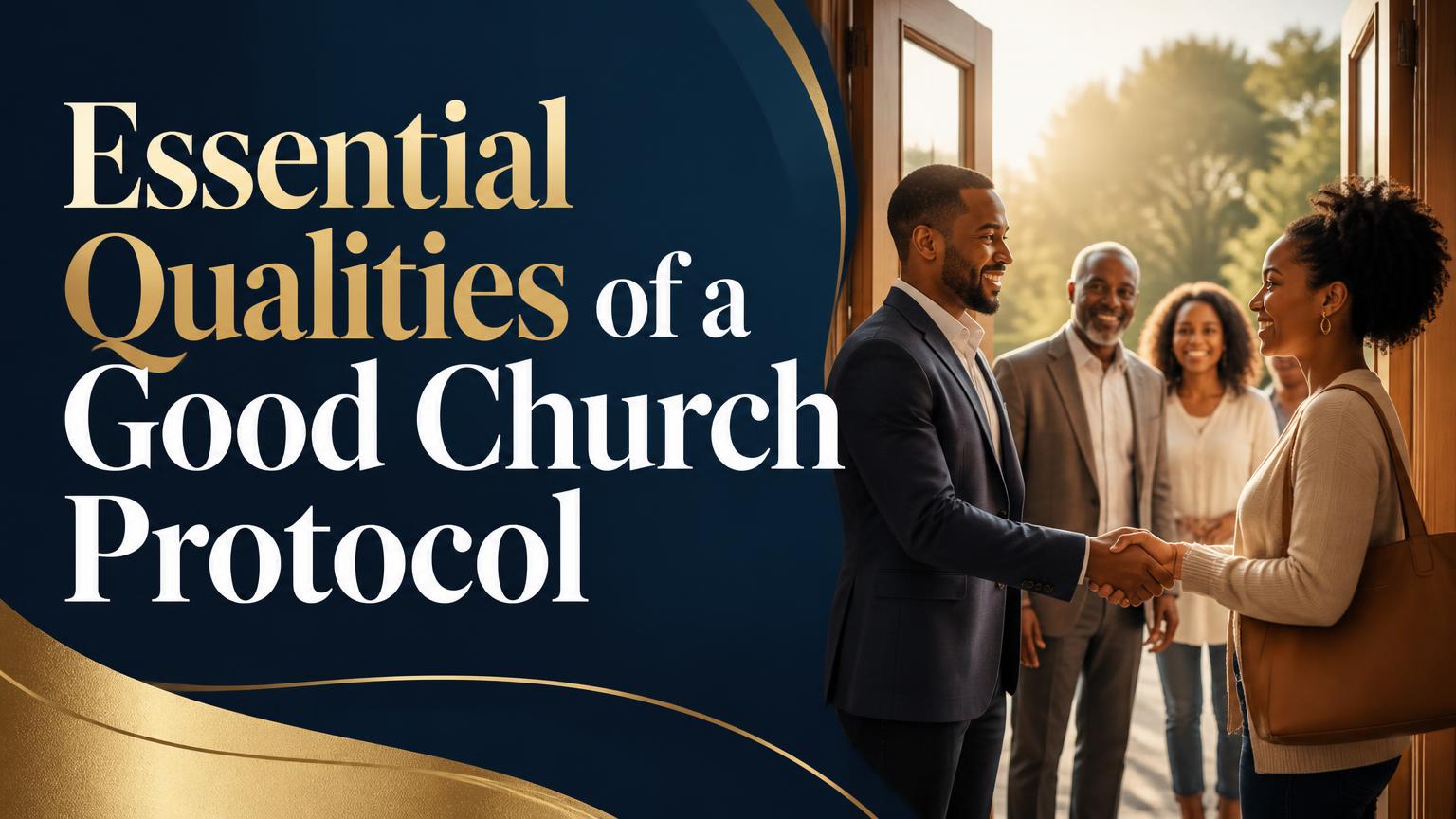
Church protocol is the collection of principles, procedures, and patterns that guide how a congregation worships, communicates, makes decisions, serves people, and handles sensitive situations. The qualities of a good church protocol determine whether these practices promote peace and ministry or create confusion, favoritism, and unnecessary control. Effective protocol should reflect biblical convictions, protect people, clarify responsibilities, and remain flexible enough to serve the church’s actual mission and local context.
Qualities of a Good Church Protocol
A good church protocol is more than a list of formal rules or expected manners. It provides a dependable framework for worship services, leadership responsibilities, membership practices, pastoral care, special events, conflict resolution, and communication. The strongest protocols bring order without suppressing spiritual maturity or reducing relationships to procedures.
Biblical Alignment and Mission Focus
A church protocol should be consistent with Scripture and with the congregation’s stated beliefs and mission. Biblical alignment does not mean attaching a Bible verse to every administrative detail. It means that the protocol reflects principles such as truthfulness, humility, justice, hospitality, servant leadership, and care for the vulnerable.
First Corinthians 14:40 instructs the church to do things “decently and in order,” showing that order can support healthy ministry. However, biblical order is not the same as rigid control. Jesus connected leadership with service rather than status in Mark 10:42–45. Therefore, a protocol should help the church worship God and serve people rather than protect the preferences or authority of a few individuals.
Clarity and Accessibility
A useful protocol states what should happen, who is responsible, when action should occur, and how exceptions are handled. Vague instructions such as “leaders should communicate appropriately” are difficult to apply consistently. A clearer approach might identify who contacts a family after a death, who approves public announcements, and how urgent pastoral concerns are escalated.
Accessibility also matters. Members, volunteers, ministry leaders, and visitors should be able to understand the relevant expectations without needing insider knowledge. Key procedures should be written in plain language, organized logically, and available in the places where people need them. A protocol that technically exists but is difficult to find cannot provide dependable guidance.
Order With Appropriate Flexibility
Good protocol creates predictability while allowing wise responses to changing circumstances. A worship service may require a clear order of service, yet a pastoral emergency may justify adjusting that order. A volunteer schedule may establish responsibilities, but illness or an unexpected family crisis may require substitution.
This balance prevents two opposite problems. Without enough structure, ministries may become chaotic and responsibilities may be overlooked. With excessive rigidity, leaders may follow procedure while ignoring genuine human need. A strong protocol identifies which elements are essential, which are preferred, and who has authority to make a reasonable exception.
Respect, Hospitality, and Dignity
Church protocol should make people feel welcomed, safe, and respected rather than judged by status, age, wealth, ethnicity, disability, family situation, or familiarity with church culture. Romans 12:10 and Romans 12:13 connect Christian community with honoring others and practicing hospitality. That principle should shape greeting practices, seating arrangements, communication, accessibility, and responses to newcomers.
Respect also applies to correction and disagreement. Protocol should discourage public embarrassment, gossip, unnecessary disclosure of personal information, and dismissive treatment of people who ask questions. A congregation can maintain standards while speaking to people with patience and dignity. Hospitality is not merely a friendly greeting; it includes removing avoidable barriers to participation.
Fairness and Impartiality
A good church protocol applies standards consistently while recognizing legitimate differences in responsibility and circumstance. James 2 warns against showing favoritism, and that concern extends to leadership decisions, volunteer opportunities, financial assistance, discipline, and access to ministry roles.
Fairness does not always mean treating every situation identically. For example, a child, a new volunteer, and an ordained leader may have different responsibilities. Fairness means that distinctions are relevant, explained, and applied without favoritism. Procedures should also identify how a person can raise a concern or appeal a decision, especially when those in authority may have made an error.
Accountability and Safeguarding
Church protocol should establish appropriate checks on power, money, information, and access to vulnerable people. Responsible procedures may cover background screening, supervision of children, transportation, financial approvals, confidential records, online communication, reporting suspected abuse, and responses to allegations of misconduct.
Accountability protects both the congregation and its leaders. It should not assume that trusted people are incapable of wrongdoing, nor should it treat every person as automatically suspect. Instead, it reduces situations in which one individual has unchecked authority or private access without oversight. Confidentiality must also be handled carefully: pastoral privacy is important, but it does not justify concealing abuse, threats, or serious danger.
Clear Roles and Shared Participation
Protocol works best when people know who is responsible for each task and where authority begins and ends. Confusion often occurs when pastors, elders, deacons, staff members, ministry directors, and volunteers assume that someone else is handling an issue. A protocol can clarify reporting lines, approval processes, meeting responsibilities, and communication channels.
At the same time, church protocol should not concentrate every decision in one leader. The New Testament presents the church as a body with different members and gifts, not as an audience dependent on one person for every function. Shared participation strengthens accountability and helps develop new leaders. Delegation should include both authority and responsibility; assigning a task without the ability to complete it is not genuine delegation.
Practicality and Proportion
A protocol should be realistic for the congregation’s size, staffing, resources, and ministry setting. A small church may need a simple process with a few clearly assigned roles, while a larger congregation may require written departments, documentation, training, and formal review. Copying a large institution’s procedures can burden a small congregation without improving safety or ministry.
Rules should also be proportionate to the risk they address. High-risk activities require more careful controls than ordinary decisions about room setup or announcements. Excessive procedures can discourage volunteers, slow ordinary ministry, and shift attention from people to paperwork. The goal is dependable practice, not administrative complexity for its own sake.
What Church Protocol Should Cover
The exact contents depend on the congregation, but a well-designed protocol commonly addresses several connected areas. Worship procedures may explain service leadership, public participation, communion or baptism practices according to the church’s doctrine, announcements, music, technology, and emergency responses. Leadership procedures may cover meetings, decision-making authority, records, succession, and conflicts of interest.
People-centered procedures are equally important. These may include welcoming visitors, receiving members, pastoral visitation, prayer requests, benevolence, complaints, discipline, weddings, funerals, and communication with children or vulnerable adults. Financial protocol should clarify authorization, counting, deposits, reimbursement, budgeting, and reporting. The purpose is not to anticipate every possible event, but to provide a responsible response to recurring or high-consequence situations.
Church Protocol, Tradition, Policy, and Legalism
These terms overlap, but they should not be treated as identical. A tradition is a customary practice passed through a congregation or denomination. A policy is an adopted rule or organizational standard. A protocol usually describes the practical steps used to carry out responsibilities. Legalism is different: it treats human rules as a measure of spiritual worth or imposes requirements beyond what the church can rightly demand.
A church may have a traditional order of worship without claiming that the order is universally biblical. It may also create a safeguarding policy because responsible care requires specific procedures, even though Scripture does not provide a modern administrative manual. Healthy leadership distinguishes divine commands, denominational commitments, local wisdom, and temporary preferences. This distinction prevents personal habits from being presented as unquestionable Christian obligations.
How to Develop and Review a Church Protocol
Developing protocol should begin with a real ministry need rather than a desire to produce documents. Leaders can identify recurring confusion, preventable risks, inconsistent decisions, and areas where people lack clear support. They should then consult the church’s governing documents, doctrinal commitments, relevant leaders, ministry workers, and, when appropriate, people affected by the procedure.
Each protocol should answer a few practical questions: What situation does it address? What outcome is desired? Who is responsible? What steps should be followed? What information must remain private? What exceptions are allowed? How can a concern be reported? Who reviews the process? Testing a draft with the people expected to use it often exposes unclear language or unrealistic requirements.
Protocols should be communicated and taught, not merely stored in a handbook. Volunteers need enough training to apply procedures confidently, and leaders should model the values behind the rules. Review should occur after significant incidents, leadership changes, ministry expansion, or changes in legal and safety requirements. A protocol that no longer serves its purpose should be revised rather than defended simply because it is old.
Signs of a Weak Church Protocol
A weak protocol often produces predictable warning signs. People receive different answers depending on whom they ask, responsibilities are assumed rather than assigned, and decisions depend on personal relationships. Members may fear raising concerns because no transparent process exists, while leaders may feel overwhelmed because every issue requires an improvised response.
Other warning signs include rules that are difficult to understand, procedures that ignore vulnerable people, exceptions granted only to influential members, and policies that are enforced selectively. A protocol may also be unhealthy when it focuses heavily on appearance, rank, or ceremony while neglecting truth, compassion, safety, and accountability. The right response is not always to add more rules; sometimes the church needs clearer values, better communication, or wiser leadership.
Conclusion
The essential qualities of a good church protocol are biblical faithfulness, clarity, fairness, hospitality, accountability, role definition, flexibility, and practical wisdom. Such a protocol gives the congregation enough structure to act consistently without turning human preferences into spiritual law. It protects people, supports worship, strengthens shared ministry, and helps leaders respond to difficult situations with integrity. The best protocol serves the church’s mission: it brings order that promotes peace, authority that remains accountable, and procedures that express genuine love for God and neighbor.