
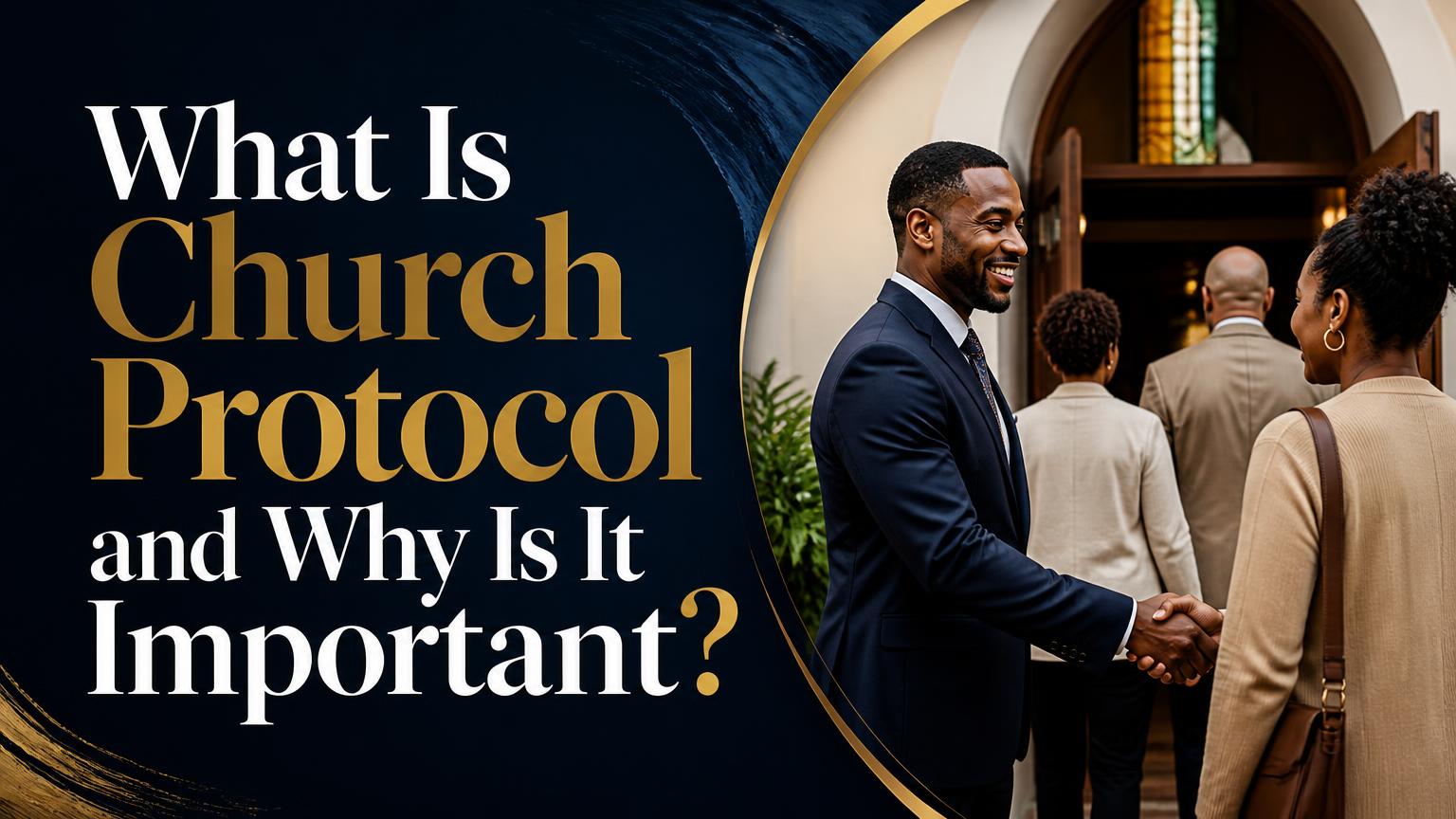
Church protocol is the agreed order, conduct, and procedures a congregation uses to organize worship, ministry, leadership, and special events. It may include how services are structured, how communion or baptism is administered, how guests are welcomed, how leaders are introduced, and how members respond during formal occasions. Protocol is not a universal rulebook for every Christian church; it develops from a church’s theology, denomination, culture, governing documents, and practical needs. Healthy protocol creates order without replacing biblical principles, sincere worship, or servant-hearted ministry.
What Is Church Protocol?
Definition and Scope
Church protocol refers to the established practices that guide how people conduct themselves and how ministry activities are carried out in a church setting. It provides a shared understanding of what normally happens, who has responsibility, and how participants should respond during worship services, ceremonies, meetings, and official gatherings.
For example, a church may have protocol for welcoming first-time visitors, seating honored guests, introducing a visiting minister, receiving an offering, handling announcements, or moving from preaching to prayer. Protocol can also govern more sensitive matters, such as who may administer baptism, how communion is distributed, or how a church responds when a public leader visits.
Protocol is usually practical rather than doctrinal. It helps people act consistently, but it should serve the church’s mission rather than become an end in itself.
What Church Protocol Commonly Covers
The content of church protocol differs from one congregation to another, but it often includes several connected areas:
- Worship services: the order of songs, prayers, Scripture readings, preaching, offerings, communion, and dismissal.
- Leadership responsibilities: who opens the service, welcomes guests, leads prayer, introduces speakers, or makes announcements.
- Special ceremonies: procedures for weddings, funerals, baptisms, ordinations, confirmations, dedications, and installations.
- Hospitality: how ushers, greeters, ministry leaders, and members receive visitors and assist people with practical needs.
- Formal occasions: seating arrangements, processions, introductions, attire, recognition of guests, and the use of titles.
- Church governance: procedures for meetings, voting, handling disagreements, recording decisions, and communicating official actions.
- Safety and safeguarding: appropriate supervision, child-protection procedures, emergency responses, and boundaries for ministry workers.
Some protocols are written in a handbook or constitution. Others are informal customs learned through participation. Written procedures are especially useful when several leaders share responsibilities or when a service involves people unfamiliar with the congregation.
Protocol, Etiquette, Policy, and Tradition
Church protocol overlaps with several related ideas, but the terms are not identical. Etiquette concerns courteous behavior, such as greeting others respectfully, silencing a phone, dressing appropriately for a particular occasion, or avoiding unnecessary interruptions. Policy consists of formal rules adopted by church leadership, often relating to governance, finance, safety, or eligibility for ministry. Tradition refers to practices passed down over time, whether or not they are formally required.
Protocol is broader than etiquette because it includes the order and coordination of an event. It is narrower than the entire body of church policy because it usually focuses on conduct, roles, and procedure. A tradition may become part of a church’s protocol, but age alone does not make a practice biblically required.
This distinction matters because a customary practice should not automatically be presented as a command from Scripture. A congregation may prefer a particular order of service without claiming that every church must follow it.
Why Protocol Differs Among Churches
There is no single form of church protocol shared by all Christian traditions. A Roman Catholic Mass, an Eastern Orthodox Divine Liturgy, a Baptist worship service, a Pentecostal gathering, and a Quaker meeting may follow very different patterns because their theology, sacramental practices, leadership structures, and worship traditions differ.
Even churches within the same denomination may use different procedures. A small rural congregation may need only informal coordination, while a large church may require detailed systems for multiple services, volunteers, security, parking, children’s ministry, and visiting speakers.
Cultural setting also affects protocol. Practices considered respectful in one community may appear distant or unnecessarily formal in another. Healthy church protocol therefore preserves essential convictions while allowing wise adaptation to the congregation, occasion, and people being served.
Why Church Protocol Matters
It Creates Order Without Eliminating Participation
A clear protocol helps people know what will happen and how they can contribute. Ushers know where to direct visitors, musicians know when to begin, ministry leaders know when they are expected to speak, and the congregation can participate without confusion. This is particularly valuable during baptisms, funerals, communion services, conferences, and large public gatherings.
The principle is reflected in 1 Corinthians 14:40: “Let all things be done decently and in order.” In context, Paul addresses the responsible use of spiritual gifts in gathered worship. The verse does not demand lifeless uniformity; it connects order with edification. Protocol is useful when it helps people hear, pray, worship, serve, and receive care more effectively.
It Protects Dignity, Hospitality, and Fairness
Protocol can communicate that people matter. A well-prepared welcome, accessible seating, clear directions, and thoughtful treatment of guests reduce anxiety and help people participate. Procedures can also protect vulnerable people by establishing boundaries for children’s ministry, pastoral counseling, transportation, and public communication.
At the same time, protocol should not create a hierarchy in which wealthy, influential, or socially prominent people receive excessive honor while ordinary members are ignored. James 2:1–9 warns against showing favoritism in the assembly. Recognition and courtesy may be appropriate, but Christian hospitality must remain consistent with the equal dignity of people before God.
It Clarifies Responsibility and Prevents Confusion
Many service problems arise because responsibilities were assumed rather than assigned. A worship leader may think the pastor will give announcements; the pastor may expect an usher to receive a guest; a visiting speaker may not know how much time is available. A simple protocol resolves these uncertainties before the gathering begins.
Clear roles also reduce the risk of inappropriate access or rushed decisions. For example, a church can specify who approves public statements, who handles offerings, who receives visiting ministers, and who responds to emergencies. Good procedure is not a lack of trust. It is a way of exercising responsible stewardship.
Biblical Principles for Evaluating Church Protocol
Order Should Serve Worship and Edification
The New Testament supports orderly gatherings, but it does not present one universal service format. Paul’s instructions in 1 Corinthians 14 emphasize intelligibility, peace, and the strengthening of the church. The underlying question is therefore not simply, “Is this our usual procedure?” but, “Does this practice help the congregation worship and build one another up?”
Protocol becomes unhealthy when people follow it mechanically while ignoring the needs of the congregation. A rigid schedule may need adjustment when someone requires pastoral care, a crisis occurs, a child becomes distressed, or a visitor needs assistance. Order should provide stability without preventing wise and compassionate responses.
Humility Should Shape Leadership and Recognition
Jesus taught his disciples that leadership in his kingdom is expressed through service, not the pursuit of status or control (Matthew 20:25–28). That principle should shape how churches handle titles, platforms, seating, introductions, and public recognition.
Showing proper respect does not require treating leaders as spiritually superior or making ministry appear like a performance. A pastor, guest speaker, musician, usher, or volunteer should understand that a visible role is a responsibility to serve. Protocol is most consistent with Christian character when it directs attention toward God and the needs of people rather than toward prestige.
Hospitality Should Be More Than Formal Courtesy
Biblical hospitality involves welcoming and caring for people, including strangers and those who may have little social influence. Hebrews 13:2 encourages believers to show hospitality, while Romans 12:13 connects hospitality with practical participation in the needs of others.
Consequently, church protocol should address more than who sits where or who speaks first. It should ask whether newcomers can find the entrance, understand the service, access needed facilities, and identify someone who can answer questions. A polished ceremony that leaves visitors confused or excluded has followed external form without fulfilling the purpose of Christian welcome.
How to Develop Healthy Church Protocol
Begin With Scripture, Mission, and Actual Needs
A church should first identify which principles are nonnegotiable and which procedures are simply preferred. Scripture may establish commitments to truth, order, hospitality, impartiality, accountability, and servant leadership. The congregation then decides how those commitments should be expressed in its particular setting.
The process should include practical questions: What regularly causes confusion? Which ministries involve safety risks? Which ceremonies require coordination? What do visitors misunderstand? Which responsibilities are unclear? Protocol built around real needs is more useful than a long document copied from another church.
Make Expectations Clear, Proportionate, and Flexible
Written procedures should state who is responsible, what normally happens, and what to do when circumstances change. A service plan might identify the order of events, approximate timing, transitions, speakers, music, offerings, and emergency contacts. It should not attempt to script every spiritual or human interaction.
Flexibility is essential. A protocol can establish a normal pattern while allowing the pastor or designated leader to respond to pastoral needs, unexpected events, or legitimate cultural differences. The goal is dependable coordination, not control over every detail.
Train People and Review Procedures
Protocol works only when the people responsible for carrying it out understand it. Ushers, worship teams, children’s workers, administrators, deacons, and event volunteers need more than a document; they need orientation, practice, and an opportunity to ask questions.
Church leaders should also review procedures periodically. A policy may have worked when the congregation was small but become inadequate after growth. A practice may unintentionally exclude people with disabilities, create unnecessary delays, or place too much responsibility on one individual. Reviewing protocol allows the church to correct problems before they become accepted as permanent customs.
Common Misconceptions About Church Protocol
One misconception is that protocol means formality, elaborate ceremonies, or special treatment for important people. In reality, a small church can have excellent protocol through simple, consistent practices, while a highly formal service can be poorly organized or inhospitable. Protocol concerns clarity and responsible conduct, not prestige.
Another misconception is that every established church practice has biblical authority. Some practices are direct applications of biblical principles; others are denominational traditions, cultural preferences, or administrative choices. Wise leaders explain the difference rather than using spiritual language to make personal preferences unquestionable.
Protocol also should not be confused with spiritual control. Leaders may establish appropriate procedures for safety, order, and accountability, but they should not use protocol to silence legitimate concerns, prevent all spontaneity, protect a favored person from scrutiny, or demand unquestioning obedience. Christian leadership remains accountable to truth, humility, and the well-being of the congregation.
Conclusion
Church protocol is the agreed pattern of conduct, roles, and procedures that helps a congregation organize worship and ministry. It can cover service order, ceremonies, hospitality, leadership responsibilities, governance, and safety. Its value lies in serving people: reducing confusion, protecting dignity, clarifying responsibility, and creating space for worship and mutual care.
The best church protocol is neither careless informality nor rigid ceremonialism. It is shaped by biblical principles, adapted to the congregation’s real circumstances, explained clearly, and applied with humility. When protocol supports order, hospitality, fairness, and servant leadership, it strengthens church life without pretending that every custom is a universal Christian command.