
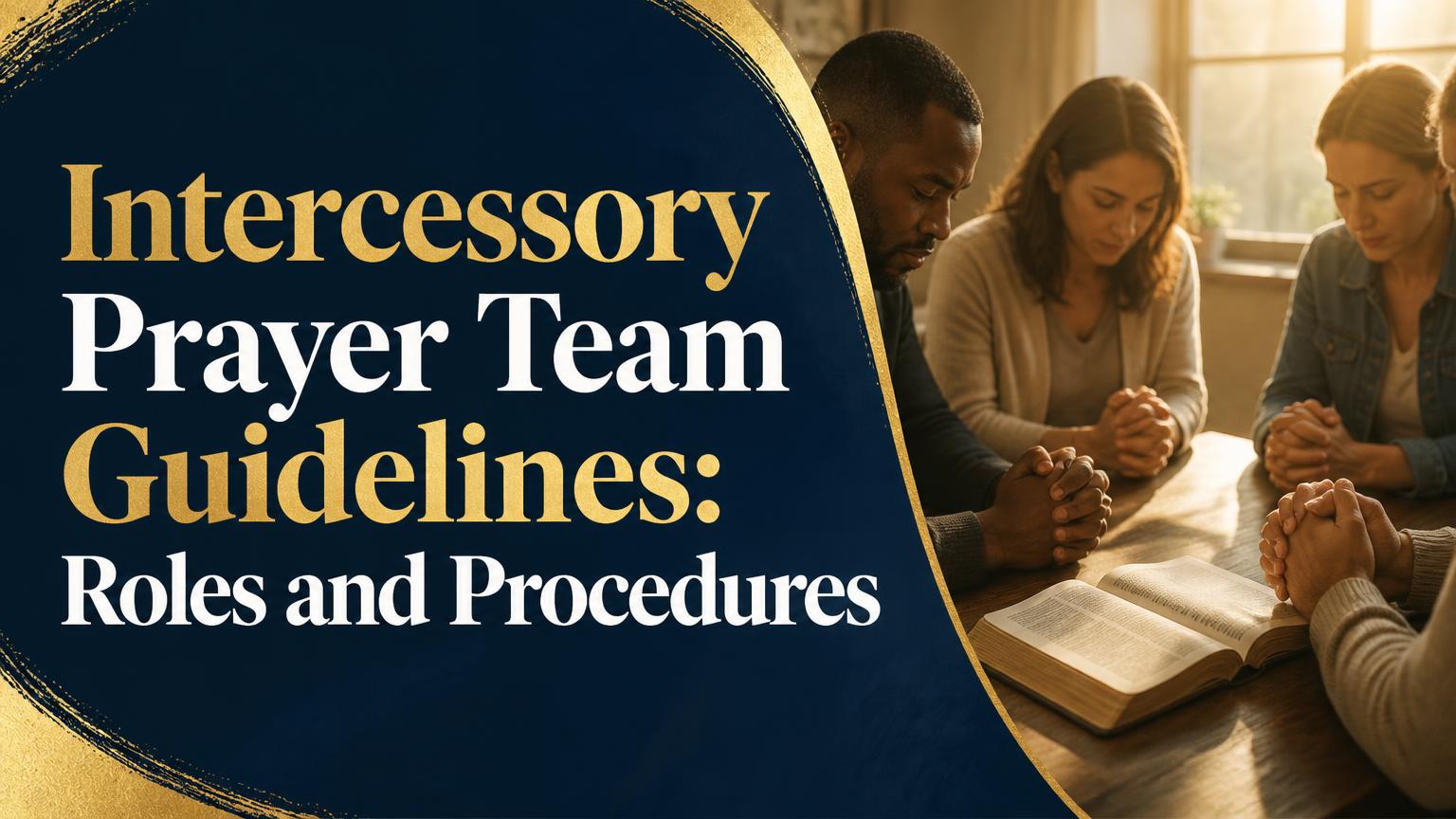
Intercessory prayer teams serve by bringing the needs of individuals, the church, and the wider community before God with humility, consistency, and biblical wisdom. Effective ministry requires more than sincere concern. Teams need clear roles, reliable procedures, confidentiality standards, spiritual discernment, and safeguards for situations involving illness, abuse, mental-health crises, or immediate danger. The following intercessory prayer team guidelines provide a practical framework for organizing this ministry while keeping prayer centered on God rather than on the team itself.
Intercessory Prayer Team Guidelines
An intercessory prayer team should operate as a trusted ministry of prayer, not as a channel for control, speculation, or unauthorized counseling. Its purpose is to listen carefully, pray faithfully, encourage people appropriately, and refer needs to pastors or qualified professionals when prayer ministry alone is not sufficient.
Define the Team’s Mission and Spiritual Boundaries
Begin with a written mission statement. For example: “The intercessory prayer team prays for individuals, families, the church, and community needs while honoring Scripture, protecting confidentiality, and cooperating with pastoral leadership.” A clear mission prevents the team from becoming an informal problem-solving committee or an alternative to pastoral care.
The team should also define what it does not do. Intercessors do not diagnose illness, guarantee healing, offer legal or financial advice, investigate allegations, replace licensed counselors, or promise that a particular outcome will occur. Prayer may accompany medical treatment, therapy, emergency assistance, or pastoral care, but it should not be presented as a substitute for them.
Biblical intercession includes pleading for others, asking for wisdom, seeking mercy, and aligning requests with God’s character. Abraham’s intercession in Genesis 18, Moses’ prayers for Israel, Jesus’ prayer for His disciples in John 17, and Paul’s repeated prayers for churches illustrate both compassion and dependence on God. These examples do not give intercessors authority over other people’s lives; they model faithful service on their behalf.
Establish Roles and Responsibilities
A small team may combine several responsibilities, but assigning them explicitly improves accountability. A coordinator usually schedules meetings, maintains communication with church leadership, confirms that team members understand the guidelines, and responds when a sensitive issue needs escalation.
A prayer leader guides meetings, keeps the group focused, and ensures that participation remains orderly. Request stewards receive or organize prayer requests, clarify consent when necessary, and share only the information required for prayer. A pastoral liaison connects the team with a pastor or ministry leader when a request involves crisis, abuse, serious conflict, spiritual confusion, or ongoing pastoral care.
Every member shares responsibility for confidentiality, respectful speech, theological humility, and dependable attendance. No individual should present personal impressions as unquestionable revelation or claim special authority because of spiritual experience. A healthy team welcomes discernment, correction, and appropriate oversight.
Follow a Clear Prayer Request Procedure
A consistent request process protects both the person asking for prayer and the team receiving the information. Requests may come through a designated form, email address, phone contact, in-person ministry, or a pastor. The method matters less than having a known process and limiting access to sensitive information.
A useful procedure includes these steps:
- Receive the request carefully. Record the basic need, the preferred level of privacy, and whether the person has consented to sharing it with the wider team.
- Clarify urgent concerns. Ask whether anyone faces immediate danger, medical emergency, suicidal intent, or ongoing abuse. Such circumstances require prompt referral to emergency services, safeguarding personnel, or qualified professionals.
- Share minimally. Give the team only the information needed to pray. Avoid unnecessary names, diagnoses, family details, or speculation.
- Pray according to the request and Scripture. Ask for help, protection, wisdom, repentance, healing, comfort, justice, or reconciliation without dictating how God must act.
- Follow up appropriately. Confirm that the request was received and ask whether continued prayer is welcome. Do not pressure people to disclose more than they wish.
- Close or review the request. Remove outdated information and avoid retaining sensitive records indefinitely.
This procedure also prevents “prayer gossip,” in which private information is circulated under a spiritual label. A prayer request should never become a vehicle for discussing another person’s failures, behavior, diagnosis, or family conflict.
Practice Confidentiality, Discernment, and Safety
Confidentiality is a ministry obligation, but it is not an absolute promise to keep information secret under every circumstance. Team members should explain that information may need to be shared with appropriate leaders or authorities when someone is in immediate danger, a child or vulnerable adult may be abused, or a serious safeguarding concern exists. Local laws and church policies should guide these decisions.
Pray about people without exposing them. Instead of describing a person’s private history to the entire team, an intercessor might say, “Please pray for wisdom and protection for a family facing a serious private situation.” If more detail is necessary, it should be shared only with those responsible for responding.
Discernment means testing impressions rather than treating every thought, emotion, dream, or perceived message as divine instruction. A team should ask whether a proposed prayer is consistent with Scripture, appropriate to the request, respectful of the person’s agency, and confirmed by wise leadership. Statements such as “God told me you must leave your job” or “You will definitely be healed by a certain date” can cause serious harm and should not be presented as authoritative.
Build a Sustainable Team Rhythm
Reliability matters more than dramatic intensity. Establish a regular meeting schedule, a defined start and end time, and a method for handling requests between meetings. Meetings may include worship, Scripture reading, brief updates, focused intercession, silence, and a closing prayer. The format should serve prayer rather than become a lengthy discussion about problems.
Teams should also create boundaries around availability. A rotating on-call arrangement may be better than expecting every member to respond constantly. Leaders can review attendance, workload, emotional strain, and unresolved requests periodically. Intercessors need permission to rest, decline a request, or seek support when a situation becomes personally overwhelming.
Regular evaluation helps answer practical questions: Are requests being handled promptly? Are confidentiality standards understood? Are people receiving appropriate referrals? Is the team praying for the whole church rather than only for crises? A sustainable ministry protects its members from burnout and keeps prayer from becoming performance.
Biblical Foundations for Intercessory Prayer
Christian intercession is grounded in love of God and neighbor. First Timothy 2:1 urges believers to offer “supplications, prayers, intercessions, and thanksgivings” for others, while Philippians 2:4 directs Christians to consider the interests of others. These passages present intercession as an expression of solidarity: the team carries another person’s need before God without claiming ownership of that person’s outcome.
Scripture also balances boldness with submission. Hebrews 4:16 encourages believers to approach God’s throne with confidence, yet Jesus prays in Gethsemane, “Not my will, but yours, be done” (Luke 22:42). Therefore, confident prayer does not mean demanding a guaranteed result. It means approaching God honestly while remaining willing to receive wisdom, endurance, comfort, correction, or an answer different from the one requested.
The Lord’s Prayer in Matthew 6:9–13 provides a useful pattern: honor God’s name, seek His kingdom, ask for daily provision, pursue forgiveness, and request protection from evil. Intercession should therefore include more than requests for immediate relief. It can ask for transformed character, wise decisions, reconciliation, justice, strength to endure, and deeper trust in God.
A Practical Intercessory Prayer Meeting Pattern
A 45- to 60-minute meeting can follow a simple structure. Begin with a brief welcome and a reminder of confidentiality. Read a relevant passage of Scripture, such as Psalm 46, Romans 8:26–27, Colossians 1:9–12, or Ephesians 3:14–21. The Scripture gives the meeting a theological center and helps the team pray in language shaped by the Bible rather than by anxiety alone.
Move from general to specific prayer. The team might pray first for the church’s mission and leaders, then for families and individuals, followed by community, national, or global concerns. For each request, identify the central need, pray concisely, and allow room for other members to contribute. Avoid repeating unverified details or turning prayer into a conversation about what someone should do.
End by thanking God, noting any follow-up responsibility, and confirming how information will be handled. If the meeting surfaces a safeguarding issue, do not attempt to resolve it through prolonged prayer discussion. Refer it through the church’s established process. A prayer meeting is strongest when it combines spiritual attentiveness with practical responsibility.
Common Mistakes Intercessory Teams Should Avoid
One common mistake is confusing intensity with maturity. Loud, lengthy, or emotionally charged prayer is not automatically more faithful than quiet, focused prayer. Another is treating every request as public information. A person may ask one trusted intercessor to pray without authorizing the team to share the matter with a congregation, group chat, or social-media audience.
Teams should also avoid spiritualizing every problem. Someone facing depression may need prayer and professional mental-health care. A family affected by domestic abuse may need prayer and immediate protection, not advice to remain in danger for the sake of reconciliation. A person with a medical condition may seek prayer while also needing diagnosis and treatment. Wise intercession supports appropriate action rather than discouraging it.
Finally, do not use prayer to pressure people into decisions. Intercessors should not manipulate someone by claiming that God requires a particular donation, relationship, treatment, church role, or personal choice. Prayer ministry should strengthen a person’s relationship with God and access to wise support, not create dependence on the team.
Training and Accountability for Team Members
Training should cover biblical intercession, listening skills, confidentiality, safeguarding, crisis referral, cultural sensitivity, and the church’s specific procedures. Role-playing common situations can help members practice receiving a request without interrogating the person, responding to emotional distress, and recognizing when a matter exceeds the team’s competence.
Leaders should explain the difference between encouragement and direction. An intercessor may say, “We are praying for wisdom and peace as you seek counsel,” but should be cautious about saying, “God has told you exactly what to do.” Members also need instruction in how to pray for people with different theological backgrounds or levels of faith without shaming them.
Accountability may include periodic reviews with pastoral leadership, confidential supervision for difficult cases, refresher training, and a clear process for reporting concerns about team conduct. Leaders should respond promptly to breaches of confidentiality, manipulative behavior, discriminatory comments, or unsupported claims of spiritual authority. Trust is built when standards apply to every member, including experienced leaders.
Conclusion
Intercessory prayer team guidelines should unite spiritual devotion with wise structure. A faithful team prays with compassion, follows a clear process, protects private information, recognizes its limits, and refers serious needs to appropriate pastoral, medical, legal, or emergency support. Its members do not control outcomes or speak for God without humility; they serve by bringing people and circumstances before Him while acting responsibly toward those involved. When prayer is shaped by Scripture, accountability, discernment, and love, the team becomes a dependable ministry of care rather than a source of pressure or confusion.