
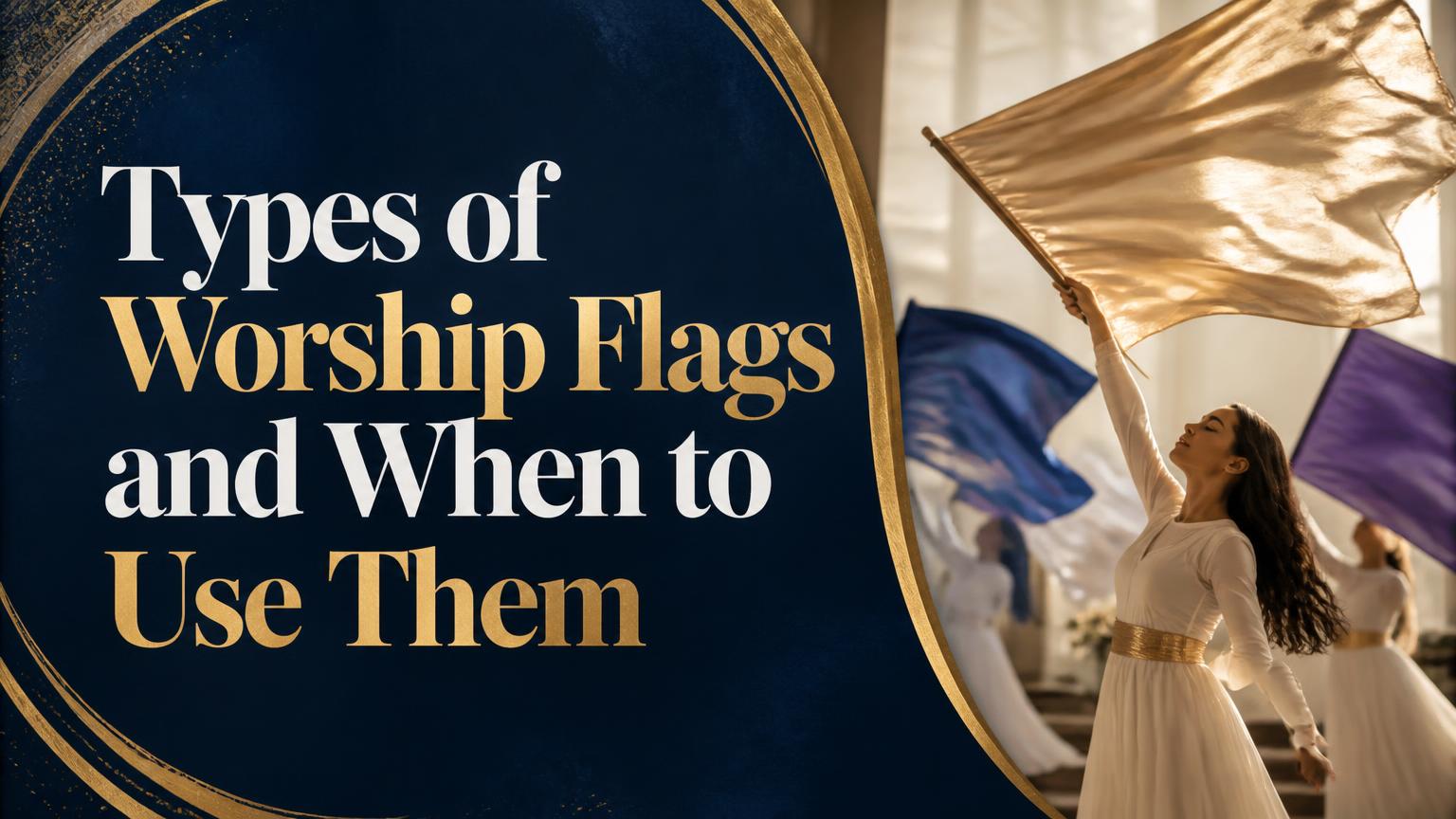
Worship flags are fabric banners or handheld streamers used by some Christians as a visual and physical expression of praise, prayer, proclamation, celebration, or intercession. The main types differ by size, shape, movement, construction, and ministry purpose. There is no universally accepted classification system, and a flag does not possess spiritual power by itself. Its value depends on the worshiper’s intention, the church’s theology, wise interpretation, and orderly use within the gathered community.
Types of Worship Flags and When to Use Them
Worship flags can be classified by their physical design or by the ministry purpose assigned to them. A single flag may fit more than one category: for example, a small silk flag could be used for personal worship, while the same color or symbol might communicate joy, repentance, victory, or prayer in a particular congregation.
Single-Panel Worship Flags
Single-panel flags are the most common type. They usually consist of one piece of lightweight fabric attached to a short or medium-length pole. The fabric may be rectangular, tapered, triangular, or shaped with a curved edge. Silk and similar materials are popular because they respond visibly to small movements and create flowing patterns in the air.
These flags work well for individual worship, small teams, and congregations with limited space. A worshiper can lift, wave, circle, or hold the flag still without requiring the broad range of motion needed for larger equipment. Single flags are particularly suitable for reflective worship, prayer ministry, altar responses, and moments in which movement should remain expressive without becoming visually overwhelming.
Double Worship Flags
Double flags use a pair of matching or coordinated flags, one in each hand. They create symmetry, broader visual movement, and more physical involvement than a single flag. Some worshipers use identical flags for unified patterns, while others combine contrasting colors to represent themes such as surrender and victory, grief and hope, or darkness and light.
Double flags are most appropriate when there is enough room for the worshiper to extend both arms safely. They can accompany celebratory praise, processional movement, choreographed worship dance, or a song with strong rhythmic changes. They are less suitable in crowded aisles, near seated congregants, or in rooms with low ceilings and fragile lighting equipment.
Streamer and Ribbon Flags
Streamer flags have long, narrow pieces of fabric that trail behind a handle or pole. They may be used singly or in pairs and are designed to emphasize flowing, sweeping, and circular movements. Because the fabric remains in motion longer than a compact flag, streamers can create an impression of continuity, procession, or release.
These flags often fit worship songs that build gradually or invite sustained movement. They may also be used in processions, outdoor gatherings, and dance-oriented presentations. Streamers require careful spatial awareness: the fabric can reach farther than the user expects and may cross into another person’s space, obscure sightlines, or catch on stands and fixtures. Their beauty depends as much on controlled movement as on size.
Small Hand Flags and Mini Flags
Small hand flags are designed for limited spaces, children’s ministry, personal prayer, or congregational participation. They may have short handles, compact fabric panels, or soft edges that reduce the risk of striking nearby people. Some churches provide them during special worship services so that participants can respond physically without requiring formal dance training.
Their smaller scale makes them useful where aisles are narrow or the congregation is seated closely together. They can also help beginners understand how fabric responds to movement before they use larger flags. Leaders should still provide clear guidance, because “small” does not remove the need to respect personal space, accessibility needs, and the visual focus of the service.
Banners and Standard Flags
Large banners and standard flags are often mounted on longer poles or displayed from a fixed position. Unlike handheld flags that emphasize continuous movement, banners may communicate a stable declaration through words, colors, symbols, or emblems. They can identify a church, represent a biblical theme, mark a processional route, or provide a visual focal point during prayer.
These are best used when the congregation needs to see a message or symbol clearly over a longer period. A banner bearing a Scripture phrase such as “The Lord Is My Shepherd” functions differently from a flowing praise flag: its primary role is proclamation rather than motion. Large banners need secure poles, appropriate storage, and enough clearance to prevent damage or injury.
Purpose-Based Flags: Praise, Intercession, and Warfare
Some worship ministries classify flags according to intended use. Praise flags may use bright colors and energetic movement during celebration. Intercession flags may be used during prayer for people, communities, or situations. Flags described as “warfare” flags typically symbolize spiritual resistance, God’s authority, or victory over evil.
These labels describe a ministry’s interpretation rather than universally recognized biblical categories. A flag does not defeat spiritual opposition through its fabric, color, or motion. In Christian theology, spiritual victory rests in God and is expressed through faith, prayer, obedience, and the work of Christ. A warfare flag may help a congregation embody confidence and hope, but it should not turn symbolic action into superstition or theatrical combat.
Color, Symbol, and Scripture Flags
Some flags are plain and rely on movement; others use colors, crosses, Hebrew or Greek lettering, Scripture phrases, crowns, doves, flames, or other symbols. Their meaning may be stated in a ministry’s teaching materials or interpreted during a particular service. For example, white might represent purity in one setting, peace in another, and surrender in a third.
Color symbolism is not standardized across Christianity. The Bible uses colors and images meaningfully, but it does not establish a complete code assigning one fixed spiritual meaning to every color used in modern worship flags. Churches should explain their symbolism clearly and avoid presenting personal interpretations as universal biblical commands. The purpose is to direct attention toward God, not toward decoding an object.
How to Choose the Right Worship Flag
The best flag is determined by the worship setting, the intended message, the available space, and the skill of the person using it. A larger or more elaborate flag is not automatically more spiritually meaningful. Effective use combines expressive freedom with restraint, safety, and sensitivity to the congregation.
Match the Flag to the Space and Movement
Measure the usable area rather than assuming that an open-looking platform is large enough. Account for ceiling height, lighting rigs, music stands, cameras, instruments, chairs, aisles, and people who may be standing nearby. A double flag or long streamer can require several feet of clearance in every direction.
Movement should also match the service. Quiet prayer may call for a stationary banner or slow, narrow gestures, while a celebratory song may accommodate broad sweeps and turns. The same flag can support different forms of worship, but its movement should serve the moment rather than compete with preaching, congregational singing, or another ministry action.
Consider Fabric, Pole, and Construction
Lightweight silk creates fluid motion and is often chosen for expressive dance. Polyester and other synthetic fabrics may offer greater durability, color stability, or affordability. A flexible fabric can be visually graceful but harder to control in drafts or outdoor settings. The pole should be smooth, secure, appropriately weighted, and free from splinters or loose fittings.
Construction matters because a broken handle, exposed fastener, or detached fabric can injure someone or interrupt worship. Flags should be inspected regularly and stored without crushing or tangling them. Leaders should train users in basic handling before introducing them into a public service.
Use Symbolism With Clarity and Humility
If a church assigns meanings to colors or symbols, those meanings should be taught as interpretive aids rather than guaranteed spiritual formulas. A red flag might represent Christ’s sacrifice, fervent praise, or spiritual passion depending on the ministry context; none of those associations should be imposed on every Christian congregation.
Clear explanation prevents confusion and protects worshipers from feeling that they must understand a secret visual language to participate. It also keeps the emphasis on the God being worshiped rather than on the technical skill, costume, or symbolic object used in the service.
Biblical Context and Ministry Discernment
The Bible uses the language of banners, standards, and signs in military, communal, and worship settings. Moses built an altar and called it “The Lord Is My Banner” after Israel’s victory over Amalek (Exodus 17:15). The Psalms connect rejoicing and salvation with banners (Psalm 20:5), while Psalm 旗? no, avoid typo. Other passages refer to lifting a standard or displaying a sign among the nations. These texts establish that banners can carry communal and symbolic meaning, but they do not provide a detailed manual for modern worship flags.
Scripture also records physical expressions of worship. Miriam led women with tambourines and dancing after the Red Sea crossing (Exodus 15:20), and David danced before the Lord when the ark came to Jerusalem (2 Samuel 6:14). Such passages support the possibility of embodied celebration, but they do not require every congregation to use flags. Christian traditions differ in how they understand movement, symbolism, spontaneity, and public ministry.
Discernment therefore involves more than asking whether a particular flag is attractive. Churches should consider whether its use honors God, serves the congregation, communicates truth, and remains orderly. Paul’s instruction that worship should be conducted “decently and in order” (1 Corinthians 14:40) applies to visual ministry as well as speech and music. Flags should invite worship rather than pressure people to imitate a movement they do not understand or cannot safely perform.
Using Worship Flags in a Church Service
A healthy flag ministry prepares before the service, remains attentive during it, and evaluates its effect afterward. Training may include basic movement, spatial awareness, fabric care, theological purpose, and how to respond when a leader changes the order of worship. Formal choreography can be appropriate for a planned presentation, while unplanned congregational movement requires additional restraint.
During worship, flag users should avoid blocking the pulpit, obscuring lyrics, striking another person, or drawing attention away from a central ministry moment. They should respect children, wheelchair users, older adults, people with sensory sensitivities, and anyone who needs clear pathways. Participation should remain voluntary; worshipers should never be shamed for standing still.
Church leaders can establish practical guidelines for where flags may be used, who may lead, what sizes are permitted, and how symbolic meanings are explained. They may also decide that certain services—such as communion, solemn prayer, or teaching—call for less movement. These boundaries do not oppose spiritual expression. They help ensure that expression remains loving, intelligible, and beneficial to the whole body.
Conclusion
The main types of worship flags include single-panel flags, double flags, streamers, small hand flags, banners, and purpose- or symbol-based designs. Each serves a different combination of movement, visibility, space, and ministry intention. The right choice depends less on appearance than on whether the flag supports the worship moment safely and clearly. Biblical banners and embodied praise provide meaningful context, but Scripture does not establish a universal flag system or give fabric spiritual power. Worship flags are best understood as optional visual tools that can express praise, prayer, proclamation, or celebration while remaining subject to truth, love, wisdom, and order.