
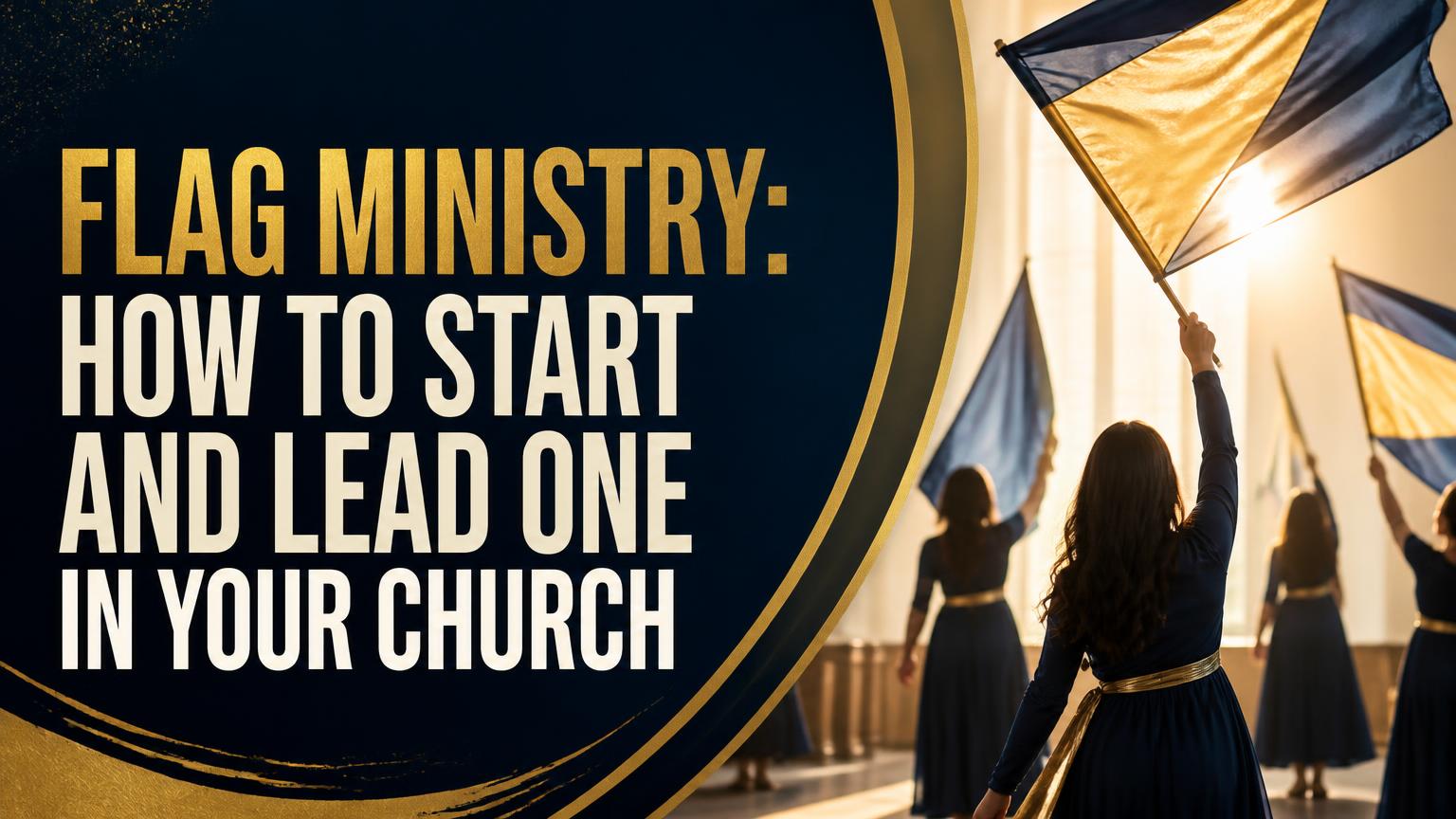
Flag ministry is a church-based worship ministry that uses flags, banners, streamers, movement, and sometimes choreographed dance to express praise, prayer, intercession, celebration, or spiritual themes. It can help make worship visible and engage people who communicate naturally through visual art and movement. However, the Bible does not prescribe a formal “flag ministry,” assign it a universal structure, or guarantee that particular colors and motions carry fixed spiritual meanings. A healthy ministry therefore operates under Scripture, pastoral oversight, careful training, humility, and concern for the whole congregation.
How to Start and Lead a Flag Ministry
A flag ministry should be developed as a ministry of worship rather than as a stage performance or independent prophetic authority. Starting well requires more than purchasing flags. The church needs a clear purpose, appropriate leadership, trained participants, safe procedures, and a way to evaluate whether the ministry is genuinely serving the congregation.
Define the Ministry’s Purpose
Begin by writing a short purpose statement. For example, a church may describe its flag ministry as a visual expression of worship that supports congregational praise, prayer, and biblical themes without distracting from the preaching, singing, or celebration of the Lord’s Supper. This statement gives the team a standard for making practical decisions.
The purpose should also clarify what the ministry is not. Flags are not magical objects, spiritual weapons that operate independently of faith, or proof that a person has special authority. A flag minister should not claim that every color, movement, or design represents a message from God. If a movement is intended to communicate a specific biblical theme, that meaning should be explained carefully and tested by church leadership.
Seek Pastoral Oversight and Congregational Agreement
A flag ministry should begin with approval from the pastor, elders, worship leader, or other recognized church authority. Church leadership should determine when the ministry may participate, what spaces it may use, what standards apply, and how concerns will be addressed. This protects the congregation from confusion and protects participants from having to make theological and disciplinary decisions alone.
Congregational agreement matters because worship is shared rather than privately controlled. Some Christians welcome expressive movement, while others come from traditions where it is unfamiliar or inappropriate. A church does not need unanimous enthusiasm for every ministry, but leaders should explain the ministry’s purpose, listen to concerns, and ensure that participation remains voluntary. Romans 14:19 and 1 Corinthians 14:26–40 support the broader principles of peace, edification, and order.
Recruit and Train the Team
Recruit people for spiritual maturity, teachability, reliability, and respect for church leadership—not merely for athletic ability or artistic skill. Physical coordination matters, but a talented performer who seeks attention can damage the ministry more quickly than an inexperienced person who serves humbly.
Training should include basic flag handling, movement technique, spatial awareness, worship etiquette, prayer, biblical discernment, and the church’s safety procedures. Beginners should learn with lightweight practice flags before using large flags or long staffs. Rehearsals should take place in the actual worship space whenever possible, because ceilings, chairs, platforms, lighting, sound equipment, and congregation placement affect safe movement.
Establish Clear Ministry Standards
Write simple standards before public ministry begins. These may cover clothing, attendance, rehearsal expectations, approved music, communication with the worship leader, use of the platform, handling of spontaneous movement, and procedures for responding to mistakes. Written standards reduce uncertainty and help the team serve consistently.
The leader should also decide whether the ministry will use set choreography, guided improvisation, or both. Choreography offers predictability and helps the team work safely as a unit. Improvisation can allow a more spontaneous response to worship, but it requires mature participants who understand boundaries and can remain attentive to the congregation. Spontaneity should never mean disorder.
Integrate Flags With the Church’s Worship
Coordinate every appearance with the worship leader rather than entering the service independently. The team should know which songs, prayers, Scripture readings, or transitions involve flags, where participants will stand, and how they will exit. A visual ministry generally works best when it reinforces what the congregation is already doing.
The flags should not block sightlines, interfere with congregational singing, cover the pulpit or communion table without a clear reason, or draw attention away from the central purpose of worship. If the congregation is listening to a sermon, receiving pastoral prayer, or responding to an invitation, movement may need to stop. Good leadership recognizes that the ministry’s value includes knowing when not to perform.
Biblical and Theological Foundations
The biblical case for flag ministry should be stated accurately. Scripture contains references to banners, standards, public movement, artistic expression, music, and embodied worship. Those passages can provide principles and imagery, but they do not establish a mandatory New Testament ministry model or a universal code for flag colors and choreography.
Understand What Scripture Does and Does Not Say
The Bible uses banner language in several ways. Psalm 20:5 speaks of lifting banners in the name of God, Psalm 60:4 refers to a banner for those who fear the Lord, and Exodus 17:15 calls the Lord “my banner.” Numbers also describes tribal standards used in Israel’s camp. These passages show that banners can represent identity, allegiance, celebration, and communal gathering.
They do not, however, give churches a detailed command to conduct worship with flags. David’s dance before the Lord in 2 Samuel 6:14 and Miriam’s celebration with tambourines in Exodus 15:20 demonstrate bodily and artistic responses to God, but neither passage creates a required format for Christian worship. The responsible conclusion is that flags may be a permissible expression of worship for some churches, provided their use is consistent with biblical principles.
Keep Christ, Not the Symbol, at the Center
A flag is a tool of expression, not an object of spiritual power. It can point toward praise, surrender, victory, lament, unity, or prayer, but the fabric itself does not produce blessing, protection, healing, or breakthrough. Treating a flag as spiritually charged can move the practice toward superstition and obscure the biblical focus on God’s character and work.
Colossians 3:16 describes worship that teaches and encourages believers, while 1 Corinthians 14 emphasizes intelligibility and order when the church gathers. These principles apply to visual ministry as well as spoken and musical ministry. A flag presentation should help people direct their attention toward God, Scripture, prayer, and the gathered body—not toward the perceived spiritual status of the person carrying it.
Use Discernment With Colors and Prophetic Claims
Some churches assign meanings to colors, such as red for sacrifice, blue for heaven, or green for life. Those associations may be useful as artistic symbolism, but they are not a universal biblical dictionary. Scripture does not establish one authoritative meaning for every color, fabric, motion, or flag shape. A church should explain its symbolism as an interpretive or devotional choice rather than present it as binding revelation.
A participant may believe a movement or design communicates a spiritual impression. That impression should be submitted to mature leadership and evaluated by its agreement with Scripture, its fruit, its timing, and its effect on the congregation. It should not be used to direct people’s personal decisions, announce divine judgment, expose private information, or establish authority over others. Humility is especially important when using the language of prophecy.
Practical Leadership and Safety Standards
Flag ministry involves moving equipment in shared spaces, often near people, furniture, lighting, instruments, and electrical equipment. Spiritual sincerity does not remove practical risks. A responsible leader treats safety as part of loving the congregation and caring for the people who serve.
Plan the Space and Equipment
Inspect the worship space before each service. Check ceiling height, fan blades, lighting fixtures, platforms, stairs, cables, speakers, communion furniture, and the position of seated worshipers. Large flags require more clearance than beginners often expect, especially when a participant changes direction or performs a circular motion.
Use equipment appropriate to the participant’s age, strength, and training. Inspect staffs, handles, clips, seams, and fabric for damage. Avoid sharp edges and unstable attachments. Establish a clear rule that participants do not swing flags near children, visitors, musicians, or people who have not consented to close movement. Store equipment securely so it does not become a tripping hazard.
Protect Participants and the Congregation
Leaders should establish safety practices for warmups, fatigue, hydration, footwear, and stopping immediately when a participant feels pain or loses control of equipment. Children and teenagers require age-appropriate supervision, parental permission, and equipment sized for them. The ministry should follow the church’s safeguarding policies and never place minors in an unsupervised or ambiguous setting.
Clothing should allow modest, unrestricted movement and should not create additional hazards. Costumes, long sleeves, jewelry, or flowing garments can catch on equipment or obscure movement. The team should also respect people with sensory sensitivities, mobility limitations, trauma histories, or cultural concerns. A worship environment can include visual expression without pressuring everyone to participate or react in the same way.
Evaluate Fruit and Receive Correction
After a service, the leader should ask practical and spiritual questions: Did the movement support worship? Was it understandable in context? Did it create distraction or confusion? Was the space used safely? Did team members follow direction? Were visitors and other ministries treated respectfully?
Evaluation is not a rejection of spontaneity. It helps the team mature. Leaders should be willing to shorten a presentation, change equipment, remove a movement, or pause the ministry when circumstances require it. They should also provide a clear process for members of the congregation to raise concerns without being dismissed as spiritually resistant. A ministry that cannot receive correction is not ready to exercise public influence.
Common Mistakes to Avoid
One common mistake is treating flag ministry as inherently more spiritual than singing, preaching, prayer, service, or quiet attentiveness. Visible movement can be meaningful, but visibility is not the same as spiritual authority. Another mistake is copying symbolism from another church without explaining or evaluating it. Meanings developed in one congregation may not fit another church’s theology, culture, or worship language.
Leaders should also avoid making every service visually intense. Constant movement can reduce its own impact and make the congregation feel that worship requires a particular emotional response. Flag ministry should have a place within the whole gathering, including Scripture, silence, teaching, prayer, music, and ordinary service. It should never compete with the sermon, manipulate emotion, interrupt pastoral ministry, or turn worshipers into an audience.
Finally, do not confuse confidence with maturity. A person may move skillfully and still need growth in humility, submission, or discernment. Conversely, a beginner may serve faithfully while learning technique. The leader’s task is to develop both competence and character, remembering that public ministry is accountable to the church.
Conclusion
A flag ministry can provide a meaningful visual language for praise, prayer, celebration, and biblical reflection when it is led with humility and discipline. The strongest foundation is neither a rigid color code nor a claim that flags are required for authentic worship. It is a clear purpose, sound pastoral oversight, trained participants, careful safety practices, and a commitment to edify the whole church.
Churches should present flag ministry as a permissible expression of worship rather than a universal command or source of independent spiritual authority. When flags serve Scripture, support congregational worship, respect church leadership, and remain open to correction, they can become one faithful artistic expression among many through which believers honor God.