
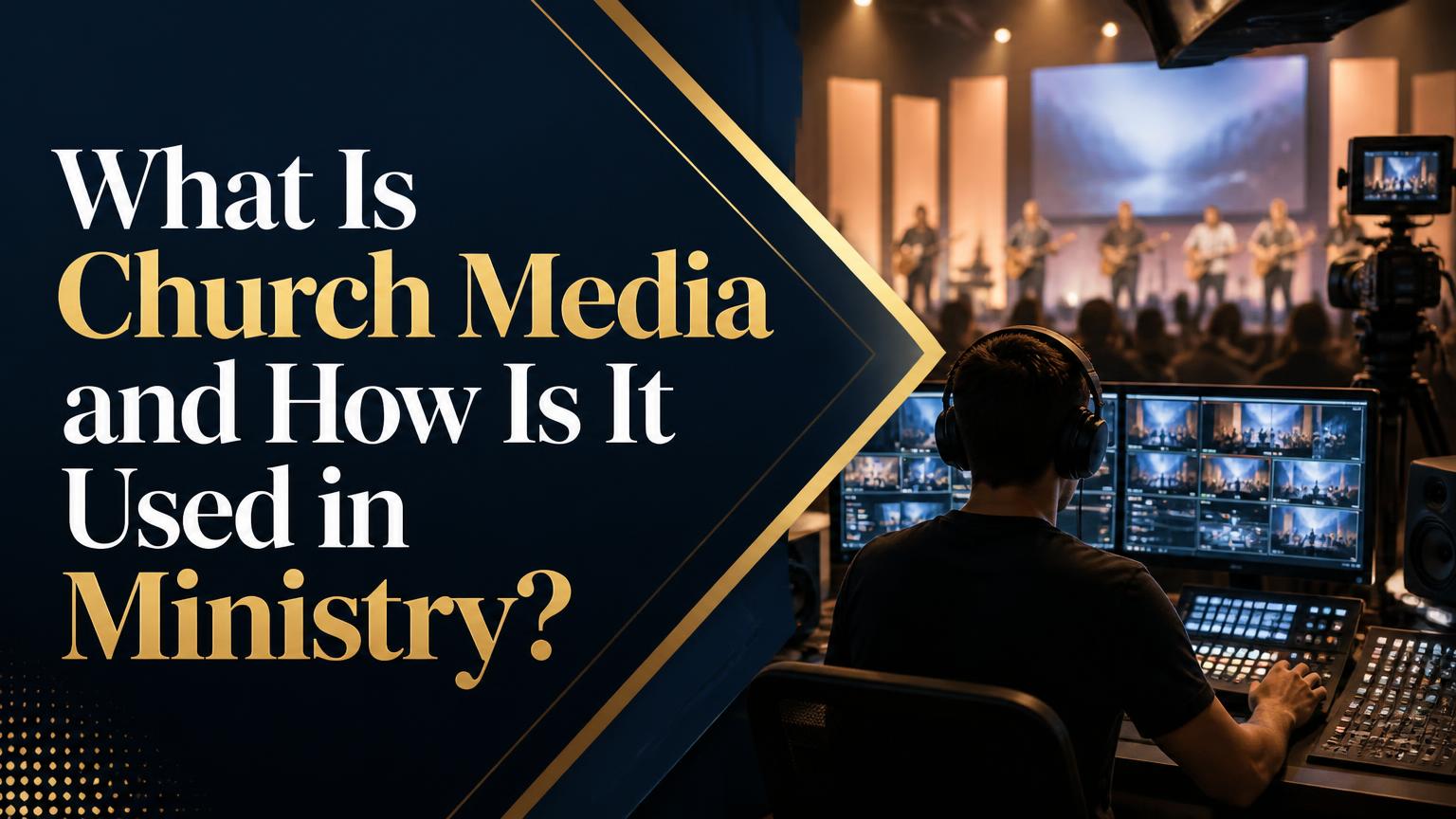
Church media is the collection of communication tools, creative practices, and ministry systems a church uses to proclaim the gospel, teach Scripture, support worship, serve its congregation, and connect with its surrounding community. It includes far more than social media or livestreaming. Church media may involve sermon slides, worship lyrics, video production, podcasts, websites, printed materials, photography, email, announcements, online classes, and visual communication throughout a church facility.
The purpose of church media is not simply to make services look polished. Effective media helps people understand truth, participate in worship, find practical information, encounter the church community, and take meaningful next steps in faith. Its value depends less on technical sophistication than on whether it serves the church’s biblical mission with clarity, wisdom, and integrity.
What Is Church Media?
Definition and Scope
Church media is the planned use of visual, audio, written, and digital communication in the life and ministry of a church. It includes the people, equipment, content, platforms, and processes used to communicate with the congregation and the wider public.
This can include cameras and livestreams, but it also includes microphones, projection systems, sermon graphics, bulletin design, website content, social posts, podcasts, printed invitations, church photography, email newsletters, and presentation software. A church’s media ministry may function during a worship service, throughout the week, or entirely online.
The term can describe both the communication itself and the ministry team responsible for creating and distributing it. In a smaller church, one person may handle several responsibilities. In a larger church, separate staff or volunteers may oversee production, design, communications, web content, social media, and technical operations.
Common Forms of Church Media
Church media usually falls into several overlapping categories:
- Worship and service media: lyrics, sermon presentations, videos, lighting, sound, livestreams, and service recordings.
- Teaching media: sermon podcasts, Bible-study videos, online courses, discussion guides, and downloadable resources.
- Outreach media: testimonies, invitation videos, event promotions, evangelistic content, and community announcements.
- Communication media: websites, email, text messaging, printed materials, calendars, and internal announcements.
- Community and storytelling media: photography, interviews, ministry updates, volunteer stories, and reports about how the church serves people.
These categories are not separate ministries in every church. A single sermon video, for example, may support people who missed a service, introduce a visitor to the church’s teaching, and help a small group discuss the message during the week.
How Church Media Differs From Church Marketing and Social Media
Church media is broader than church marketing. Marketing normally focuses on informing or persuading a defined audience to take an action, such as attending an event or registering for a program. Church media can serve that purpose, but it also supports worship, discipleship, pastoral care, internal communication, and theological instruction.
Social media is one channel within church media, not a complete definition of it. A social platform may distribute a sermon clip or announcement, while the larger media system includes the original recording, editing, captions, website publication, pastoral approval, and follow-up communication. Treating social media as the entire media ministry can lead a church to measure success by visibility rather than by understanding, participation, or spiritual care.
Why Church Media Matters for Ministry
Communication shapes what people notice, understand, remember, and act upon. Clear media can help a first-time visitor find a building, help a parent understand a children’s ministry schedule, or help a homebound member hear a sermon. Poorly planned media can create confusion, distract from worship, or cause important information to be overlooked.
Church media also extends ministry beyond a single gathering. Jesus commanded his followers to make disciples and teach them to observe his commands (Matthew 28:19–20). Media cannot fulfill that commission by itself, but it can help distribute teaching, explain the church’s invitation, connect people to relationships, and make biblical resources available beyond the room where they were first presented.
At the same time, media should not be confused with ministry itself. A compelling video does not automatically produce discipleship, and a large online audience does not necessarily represent spiritual maturity. Media is a means of communication; prayer, truth, relationships, service, and faithful leadership remain central to Christian ministry.
How Church Media Is Used in Ministry
Supporting Worship and Biblical Teaching
During gathered worship, media helps people participate rather than merely observe. Projected lyrics allow a congregation to sing together, while readable Scripture and sermon visuals help people follow the message. Audio systems make spoken teaching accessible throughout the room, and livestreams can serve people who are ill, traveling, working, or otherwise unable to attend.
The best service media is usually supportive rather than attention-seeking. It reduces avoidable distractions, presents information at the right moment, and makes the content easier to receive. Visual effects, lighting, or video elements may have a place, but they should reinforce the worship service’s purpose rather than compete with preaching, prayer, music, or congregational participation.
Extending Evangelism and Outreach
Churches use media to introduce people to the gospel and to the local Christian community. A clear website can answer basic questions about beliefs, service times, childcare, accessibility, and location. A testimony or teaching video can help someone explore Christianity before attending in person. Digital invitations can reach people who would never respond to a printed flyer or personal invitation alone.
Outreach content is most useful when it makes a genuine next step clear. That step might be attending a service, requesting prayer, joining a discussion group, speaking with a pastor, or reading a foundational resource. Media should communicate honestly rather than exaggerate results, hide difficult aspects of Christian commitment, or treat people as engagement statistics.
Strengthening Discipleship and Pastoral Care
Recorded sermons, podcasts, study materials, and online classes can reinforce learning between church gatherings. Someone may revisit a difficult explanation, share a resource with a friend, or use a discussion guide with a small group. This makes church media particularly useful when it is organized around a broader teaching plan rather than produced as disconnected content.
Media can also support pastoral care by communicating encouragement, prayer opportunities, crisis updates, and practical help. However, public content cannot replace personal attention. Sensitive needs require appropriate confidentiality and direct pastoral or professional care. A church should never assume that watching a video is equivalent to being known, shepherded, or included in Christian community.
Communicating Church Life and Community Needs
Church media helps people understand how to participate in the life of the congregation. Calendars, registration pages, ministry updates, volunteer instructions, maps, and reminders reduce practical barriers. Photos and stories can show how members serve children, support neighbors, care for one another, or participate in missions.
This kind of communication should represent the church accurately. If every publication highlights only large events, polished stages, or exceptional success, people may receive a distorted picture of Christian community. Showing ordinary service, faithful volunteers, prayer, hospitality, and care for people in difficulty often communicates the church’s life more truthfully.
What Makes Church Media Effective and Faithful?
Begin With Ministry Purpose
A church should decide what a piece of media needs to accomplish before choosing a platform or production style. The purpose may be to teach a biblical idea, invite people to an event, explain a change, encourage prayer, or help volunteers perform a task. Each purpose requires different content, length, tone, and distribution.
A useful planning question is: “What should someone understand, feel, or do after receiving this?” The answer keeps production decisions subordinate to ministry goals. It also prevents churches from creating content merely because a particular format is popular or because equipment is available.
Value Clarity, Accessibility, and Participation
Effective media is understandable to the people it serves. That means using readable text, intelligible audio, accurate captions, descriptive communication where appropriate, and language suited to the audience. Websites should be usable on mobile devices, and important information should not exist only in a video that some people cannot hear or watch.
Accessibility also includes practical and relational concerns. People may have hearing or vision limitations, limited internet access, different levels of biblical knowledge, or little familiarity with church terminology. Clear explanations and multiple communication formats allow more people to participate without lowering the depth of the message.
Pursue Excellence Without Performance
Excellence means taking responsibility for accuracy, preparation, reliability, and the quality needed for communication to work. It does not require every church to have expensive equipment or professional-level production. A simple recording with understandable sound may serve people better than an elaborate production that consumes disproportionate time and money.
Christian media can become unhealthy when appearance becomes a measure of spiritual success. Scripture emphasizes speaking truth, serving others, and doing work faithfully, while it warns against practices motivated primarily by public recognition. Technical skill is valuable, but it should remain an instrument of service rather than a substitute for spiritual depth.
Protect Truth, Dignity, and Consent
Church communication involves real people, including children, vulnerable adults, visitors, and individuals receiving pastoral care. Churches need sensible policies for photography, recording, privacy, data handling, and consent. A moving story should not be published simply because it may attract attention, especially when sharing it could expose someone to embarrassment, danger, or unwanted scrutiny.
Accuracy matters as much as permission. Dates, names, quotations, biblical references, claims about ministry results, and descriptions of community needs should be checked before publication. A church’s desire to communicate persuasively must never justify misleading images, manipulated testimonies, sensational reporting, or careless treatment of personal information.
How a Church Can Build a Practical Media Ministry
Assign Clear Responsibilities
A media ministry works more reliably when responsibilities are defined. Someone should know who approves public communication, who manages equipment, who schedules volunteers, who publishes content, and who responds when something fails. In a small church, one person may hold several roles, but the duties should still be understood by the team.
Volunteer teams also need training and pastoral support. Technical service can become invisible labor that receives attention only when something goes wrong. Clear schedules, documented procedures, backup plans, and appreciation help volunteers serve consistently without carrying unreasonable pressure.
Create a Sustainable Content Process
A sustainable process usually includes planning, preparation, production, review, publication, and evaluation. Churches may begin with a simple monthly calendar that identifies sermons, major events, seasonal opportunities, pastoral needs, and recurring announcements. This allows one idea to be adapted responsibly across several channels instead of forcing the team to invent content every day.
Evaluation should focus on ministry usefulness rather than vanity metrics alone. Attendance, registrations, views, or shares can provide limited information, but they do not explain whether people understood the message or connected with appropriate care. Feedback from pastors, ministry leaders, volunteers, and congregation members often reveals more than numbers by themselves.
Choose Tools That Match the Church’s Capacity
The right technology is the technology the church can operate, maintain, and afford responsibly. Before purchasing equipment, a church should consider staffing, training, storage, internet reliability, accessibility, replacement costs, and the time required for editing and administration. A modest system used consistently is usually more useful than an advanced system that only a few people understand.
Churches should also maintain backup plans. Internet services fail, batteries run down, files become corrupted, and volunteers become unavailable. Printed schedules, offline sermon materials, spare cables, backup recordings, and documented procedures protect ministry continuity when technology does not cooperate.
Conclusion
Church media is the organized use of communication, technology, design, and storytelling to support a church’s worship, teaching, outreach, discipleship, pastoral care, and community life. It includes livestreams and social platforms, but it also includes sound, projection, websites, print materials, podcasts, photography, email, and the people who plan and manage them.
The most faithful church media is purposeful, truthful, accessible, and proportionate to the church’s mission and capacity. It helps people understand the gospel and participate in Christian community without pretending that digital communication can replace embodied relationships, pastoral care, or congregational worship. When media remains a servant of those purposes, it becomes a practical ministry rather than merely a production department.