
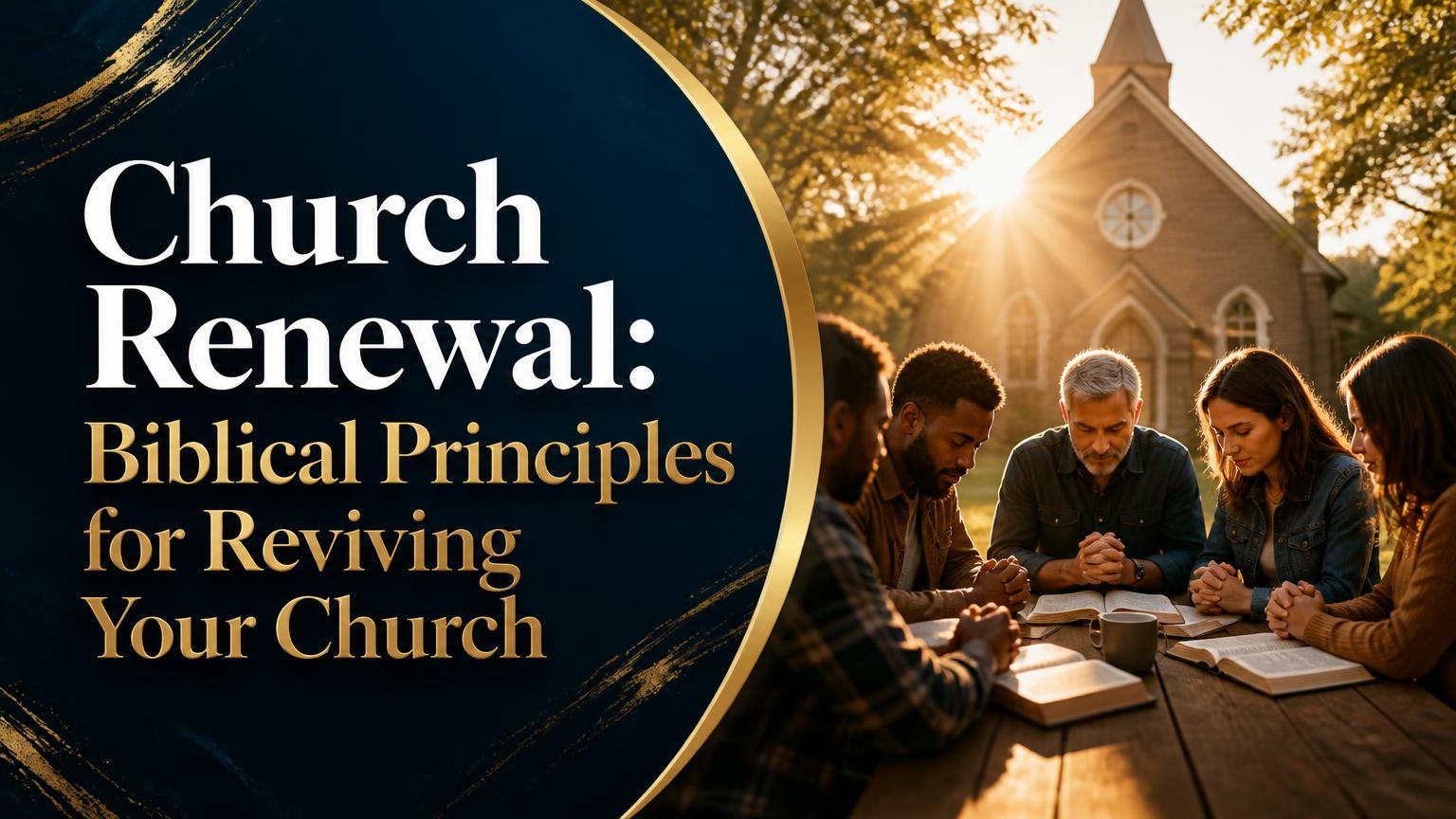
Church renewal is the work of God by which a congregation is brought back to spiritual vitality, biblical faithfulness, loving fellowship, and fruitful mission. It may involve repentance from tolerated sin, renewed dependence on the Holy Spirit, deeper commitment to Scripture and prayer, reconciliation among believers, and changes in leadership or ministry structures. Genuine renewal is more than increased attendance or a successful program. It seeks a healthier church whose worship, character, relationships, and witness increasingly reflect Jesus Christ.
Church Renewal: Biblical Principles for Reviving Your Church
Church renewal begins when a congregation recognizes that activity and spiritual health are not the same thing. A church may have services, ministries, traditions, and organizational strength while losing its first love, neglecting prayer, tolerating division, or drifting from the teaching of Scripture. Renewal addresses the inner life of the church so that its outward ministry grows from faithfulness rather than pressure to appear successful.
Renewal Begins With God’s Work, Not Human Strategy
The church belongs to Christ, and spiritual renewal ultimately depends on his work. Jesus told the church in Sardis to “wake up” and strengthen what remained (Revelation 3:1–3), while Paul described the church as God’s field and building (1 Corinthians 3:9). These passages do not make human responsibility unnecessary, but they place it in the correct order: people respond faithfully to God’s grace; they do not manufacture spiritual life through technique.
This distinction protects a congregation from treating renewal as a branding project, leadership campaign, or sequence of ministry innovations. Planning, training, outreach, and improved administration can serve renewal, but they cannot substitute for repentance, faith, obedience, and dependence on the Spirit. A renewed church asks first what God requires, not merely what will attract attention.
Return to Scripture, Prayer, and Repentance
The church in Acts devoted itself to the apostles’ teaching, fellowship, breaking of bread, and prayers (Acts 2:42). Those practices were not empty routines. They formed a community that learned the gospel, shared life, worshiped together, received correction, and depended on God. Church renewal therefore requires more than occasional inspirational preaching. It calls the congregation back to Scripture as its authority and to prayer as an expression of dependence.
Repentance is equally central. In Revelation 2, Jesus commended the church in Ephesus for doctrinal discernment and endurance but confronted it because it had abandoned its first love. The remedy was to remember, repent, and return to faithful action. Renewal may require a church to confess pride, neglect, injustice, bitterness, consumerism, or indifference. Repentance becomes fruitful when it produces changed priorities and repaired relationships rather than temporary emotional intensity.
Restore Love, Holiness, and Shared Life
A church cannot be renewed merely by becoming more doctrinally informed or more active. Christian truth must shape Christian character. Jesus identified love for God and love for neighbor as central commandments (Matthew 22:37–40), and he gave sacrificial love as the distinguishing mark of his disciples (John 13:34–35). A congregation may need to recover tenderness, patience, hospitality, forgiveness, and concern for people who have little influence.
Renewal also includes holiness. Grace does not make sin unimportant; it creates a people who increasingly turn from sin and become more like Christ. This requires honest accountability, wise pastoral care, and the courage to address destructive behavior without humiliation or favoritism. Healthy discipline aims at restoration, as reflected in Galatians 6:1, rather than punishment or control. Love without holiness becomes permissive, while holiness without love becomes harsh. Biblical renewal holds both together.
Equip the Whole Church for Service and Mission
Renewal moves believers from passive attendance toward active participation. Ephesians 4:11–16 describes leaders equipping the saints for ministry so that the whole body grows toward maturity in Christ. Similarly, Romans 12 and 1 Corinthians 12 present the church as a body with varied gifts and interdependent members. A congregation becomes healthier when people are helped to discover, develop, and use their gifts for the good of others.
Mission is part of this outward movement. Jesus commissioned his followers to make disciples, and the early church carried the gospel across cultural and geographic boundaries. Renewal does not mean focusing exclusively on internal church life. It produces greater compassion for neighbors, practical care for people in need, courageous witness, and discipleship that extends beyond Sunday gatherings. Outreach should flow from genuine love rather than become a performance metric.
Pursue Faithful Leadership and Wise Change
Leaders strongly influence whether a church can recognize its condition and respond faithfully. Biblical qualifications for overseers emphasize character, self-control, hospitality, sound doctrine, and the ability to care for people—not charisma or institutional prominence (1 Timothy 3:1–7; Titus 1:5–9). Renewal requires leaders who can receive correction, share responsibility, resist manipulation, and make decisions for the church’s spiritual good.
Wise change may be necessary, but change itself is not renewal. A congregation might revise its governance, improve pastoral care, clarify its mission, develop younger leaders, or redirect resources toward neglected needs. Such decisions should be tested by Scripture, prayer, counsel, and the church’s calling. Leaders should explain why changes are needed, listen to legitimate concerns, and distinguish biblical convictions from preferences rooted in habit. Patience matters because trust is often rebuilt gradually.
Look for Fruit Rather Than Religious Excitement
Spiritual intensity can accompany renewal, but emotion alone does not prove that renewal has occurred. Jesus taught that a tree is known by its fruit (Matthew 7:16–20), and Paul identified the fruit of the Spirit as love, joy, peace, patience, kindness, goodness, faithfulness, gentleness, and self-control (Galatians 5:22–23). These qualities provide a more reliable measure than crowded events, dramatic stories, or temporary enthusiasm.
Evidence of renewal may include increased prayer, clearer biblical teaching, confession of sin, reconciliation, generosity, responsible service, care for vulnerable people, stronger families, and more consistent witness. None of these signs earns God’s favor, and no congregation displays them perfectly. They show, however, that the gospel is shaping the church’s life. Numerical growth can accompany renewal, but growth without spiritual depth may simply magnify existing weaknesses.
A Practical Path Toward Church Renewal
Biblical principles become useful when they guide concrete congregational decisions. Renewal usually develops through a process of honest assessment, prayerful repentance, faithful teaching, relational repair, and sustained obedience. The process will differ according to a church’s history and condition, but several practices help leaders and members respond wisely.
Listen Before You Organize
A church should begin by asking truthful questions. What does the congregation celebrate? What problems are repeatedly avoided? Are members growing in discipleship? Do people feel safe enough to confess weakness and seek help? Are visitors welcomed? Are leaders exhausted or isolated? Do ministry activities serve the church’s mission, or do they continue mainly because they are familiar?
Listening may involve prayer gatherings, conversations with members, review of ministry priorities, and careful attention to people who are often overlooked. This is not permission for every preference to control the church. It is a way to distinguish real spiritual and pastoral needs from assumptions. A church cannot address what it refuses to see.
Call the Congregation to Prayer and Repentance
Prayer should not be used as a religious label placed on plans that have already been decided. It should shape the plans. Congregations can set aside regular times to pray for humility, wisdom, holiness, reconciliation, leaders, families, and the church’s witness. Corporate prayer reminds members that renewal is received through dependence on God rather than secured through organizational force.
Repentance should be specific enough to produce change. If a church has experienced racial hostility, unresolved conflict, financial secrecy, abuse of authority, or neglect of the poor, general statements about needing renewal are inadequate. The congregation must pursue truth, accountability, restitution where appropriate, and protection for those who have been harmed. Forgiveness does not eliminate the need for justice, boundaries, or responsible safeguarding.
Make Changes That Serve the Mission
After listening and praying, a church may need to change what it funds, teaches, schedules, or rewards. It may simplify an overcrowded ministry calendar so that members have time for discipleship and relationships. It may strengthen children’s ministry, establish clearer membership expectations, train small-group leaders, improve care for the grieving, or create pathways for serving the community.
The test is not whether a change is modern or traditional. The test is whether it helps the church obey Christ, make disciples, love people, and preserve the truth of the gospel. Some changes should be gradual because they involve trust and culture. Others require prompt action when safety, serious misconduct, or doctrinal integrity is at stake. Wisdom considers both urgency and endurance.
Build Structures That Sustain Renewal
Renewal fades when it depends on one gifted leader, one conference, or one season of enthusiasm. Churches need structures that support ongoing faithfulness: accountable leadership, regular preaching and teaching, meaningful membership, pastoral care, developing leaders, responsible finances, and opportunities for ordinary members to serve. These structures are not substitutes for the Spirit. They provide channels through which healthy ministry can continue.
Leaders should also establish ways to evaluate fruit without reducing discipleship to statistics. Attendance and giving can provide useful information, but they do not measure love, holiness, reconciliation, or spiritual maturity by themselves. Periodic reflection can ask whether people are becoming more faithful followers of Jesus and whether the church is serving its neighbors with truth, humility, and compassion.
Distinguishing Renewal, Revival, Reform, and Growth
These terms overlap, but they should not be treated as interchangeable. Church renewal usually refers to the restoration and deepening of a congregation’s spiritual life and faithfulness. Revival often describes an unusual season of intensified conviction, conversion, prayer, or spiritual awakening; Christians differ on how narrowly the term should be defined. Renewal may occur quietly over years without the dramatic features associated with revival.
Reform usually emphasizes correcting doctrine, practice, leadership, or institutional arrangements. Reform can be necessary for renewal, but a church may change its policies without becoming more loving or prayerful. Growth may refer to numerical increase, maturity, or both. Numerical growth is not proof of renewal, just as a smaller congregation is not necessarily spiritually unhealthy. These distinctions keep churches from pursuing visible outcomes while overlooking the character and obedience that Scripture emphasizes.
The biblical prayer in 2 Chronicles 7:14 is sometimes applied directly to every modern congregation. Its original setting is God’s covenant relationship with Israel, so it should not be treated as a universal formula guaranteeing national or congregational prosperity. Nevertheless, its themes—humility, prayer, seeking God, and turning from wickedness—accord with broader biblical teaching about repentance and restoration. Scripture should guide renewal through careful interpretation, not through isolated promises detached from their context.
Common Obstacles to Church Renewal
The greatest obstacles are often internal. Pride can prevent a congregation from admitting decline. Fear can make leaders avoid necessary decisions. Nostalgia can confuse familiar traditions with biblical commands. Conflict can consume attention that should be directed toward worship and mission. A consumer mindset can turn members into critics who evaluate services without accepting responsibility for the church’s life.
Another obstacle is confusing activity with fruit. A busy calendar may conceal weak discipleship, shallow relationships, or exhausted volunteers. Likewise, calls for unity can become a way to silence legitimate concerns, especially when leaders resist accountability. Biblical unity is not agreement that protects secrecy; it is a shared commitment to truth, love, justice, and submission to Christ. Renewal requires courage to confront sin and humility to receive correction.
Conclusion
Church renewal is a return to faithful life under the lordship of Jesus Christ. It is nourished by Scripture, prayer, repentance, the Holy Spirit, loving relationships, mature leadership, shared service, and outward mission. It may include organizational change, but it cannot be reduced to a new program or a strategy for increasing attendance. The clearest evidence of renewal is a congregation increasingly marked by love for God, holiness, truth, reconciliation, compassion, and obedience.
A church seeking renewal should therefore begin with honest self-examination and humble prayer. It should identify sin without defensiveness, strengthen what is spiritually healthy, repair what has been damaged, and make practical changes that serve its biblical mission. Renewal may be gradual and costly, but faithful churches do not need to manufacture spiritual life. They seek Christ, obey his Word, depend on his Spirit, and trust him to build up his people.