
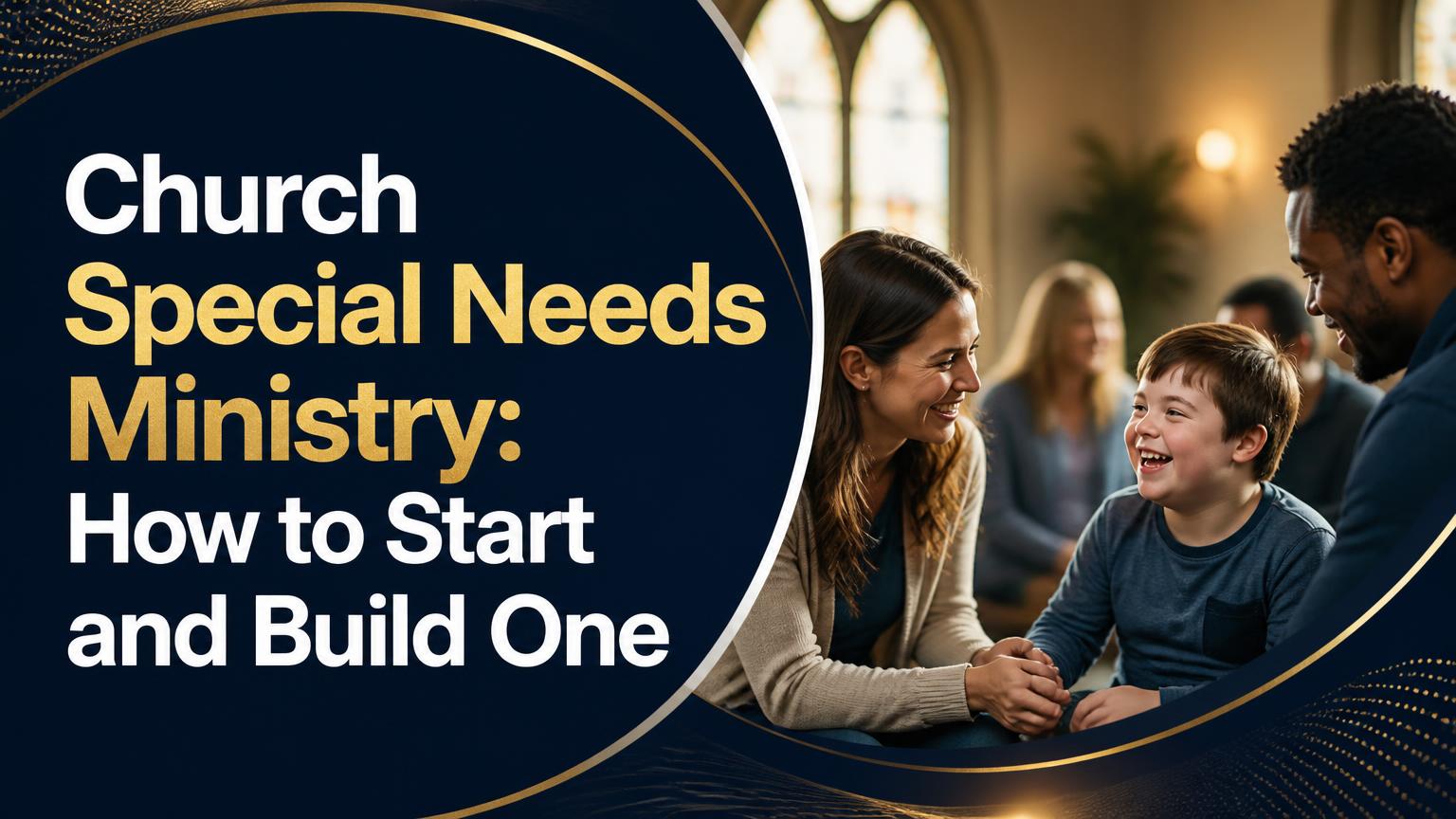
A church special needs ministry helps people with disabilities, developmental differences, medical needs, and their families participate meaningfully in worship, discipleship, fellowship, and service. Starting one does not require an elaborate program or a large budget. It requires listening, wise planning, trained people, safe practices, and a theological commitment to belonging. The strongest ministries adapt church life around real people rather than expecting every person to fit a single program.
Church Special Needs Ministry: How to Start and Build One
A sustainable ministry usually develops in stages: identify the congregation’s needs, define a clear mission, recruit and train a team, create practical accommodations, and review the ministry regularly. The goal is not simply to provide supervision during a service. It is to help people with disabilities become known, welcomed, discipled, and included as members of the church.
Define the Ministry’s Mission Before Designing Programs
Begin with a short mission statement that explains whom the ministry serves and what participation should look like. The ministry may serve children with autism, adults with intellectual disabilities, people with physical disabilities, individuals with mental-health conditions, or families managing complex medical needs. The exact scope should reflect the church’s people and capacity rather than an idealized program model.
A useful mission might state that the church will remove unnecessary barriers so people with disabilities can worship, grow in faith, build relationships, and use their gifts. This wording matters because it frames the ministry around belonging and discipleship rather than charity alone. It also prevents the church from defining people primarily by diagnoses or limitations.
Start with one or two realistic services. For example, the church might first provide supported participation in children’s Sunday school and a quiet space during worship. Later, it may add disability-inclusive small groups, respite gatherings, adult discipleship, or family support. A focused beginning is usually safer and more effective than announcing services the church cannot sustain.
Learn the Congregation’s Needs Through Listening
Before choosing a curriculum or purchasing equipment, speak with families and individuals affected by disability. Ask what makes church participation difficult, what support has helped in the past, what situations create distress, and what the person enjoys or hopes to do. Whenever possible, speak directly with the individual rather than discussing the person only through caregivers.
A confidential needs assessment can identify practical barriers such as stairs, lighting, sound levels, inaccessible restrooms, unclear signage, long transitions, crowded classrooms, or a lack of trained volunteers. It can also reveal less visible barriers, including fear of judgment, inflexible behavioral expectations, communication differences, and previous experiences of exclusion.
Do not assume that people with the same diagnosis need the same support. Two autistic children, for example, may have very different sensory, communication, and social needs. Some people may need a trained one-to-one support person; others may participate independently with a visual schedule and a predictable environment. Individual knowledge should guide decisions.
Build a Leadership and Volunteer System
A pastor or ministry leader should appoint someone to coordinate the ministry, but responsibility should not rest on one person. A small leadership team might include a church staff member, a parent or caregiver, a disability ministry volunteer, a children’s or student ministry representative, and someone familiar with safety procedures. People with disabilities should also have a meaningful voice in planning whenever possible.
Volunteers need more than goodwill. Training should cover respectful language, disability awareness, communication methods, sensory differences, personal boundaries, behavior as communication, emergency procedures, confidentiality, and mandatory reporting requirements where applicable. Volunteers should learn to support participation without taking over tasks the person can perform independently.
Use clear role descriptions and dependable schedules. A ministry becomes fragile when families must repeatedly explain their needs to a rotating group of unprepared helpers. A volunteer coordinator should maintain appropriate support notes, arrange substitutes, check in with families, and provide regular encouragement and corrective feedback.
Design Individualized and Flexible Participation
The best support plan identifies strengths, preferences, communication methods, likely triggers, calming strategies, medical considerations, and emergency contacts. It should also state what the person wants to do. A support plan is not a label or permanent verdict; it should be reviewed as the person grows and circumstances change.
Adaptations may include a visual schedule, simplified instructions, sign language, communication devices, large-print materials, a quieter seating location, extra transition time, noise-reducing headphones, movement breaks, or an alternative way to complete an activity. These accommodations should preserve the purpose of worship or discipleship rather than creating unnecessary separation.
A separate classroom can be appropriate for some people during certain activities, especially when it provides lower sensory stimulation or specialized teaching. However, separation should not become the default definition of inclusion. The church should regularly ask whether the person can participate in the main gathering, a small group, service project, or social event with reasonable support.
Make Safety, Communication, and Caregiver Trust Nonnegotiable
Safety policies should cover supervision, check-in and release procedures, allergies, medication, toileting assistance, transportation, elopement or wandering risks, emergency evacuation, and communication with caregivers. Requirements vary by location and situation, so the church should follow applicable safeguarding rules and obtain qualified advice for medical or legal questions.
Families need to know what will happen if a person becomes overwhelmed, has a seizure, communicates distress through behavior, or cannot safely remain in a particular setting. Agree on who may make decisions, how caregivers will be contacted, and what information volunteers need. Protect private information by sharing only what is necessary for safe and effective care.
Trust develops through consistency. Welcome families without making them repeatedly defend their needs, and avoid promising support that the church cannot provide. If a limitation exists, explain it honestly while working toward a safer alternative. A clear, respectful conversation is better than an enthusiastic commitment that later collapses.
Include People in the Whole Church
A special needs ministry should connect people to the wider congregation rather than becoming an isolated department. Look for meaningful participation in worship, communion, prayer, small groups, youth activities, mission projects, church meals, leadership development, and informal relationships. Inclusion means more than allowing attendance; it involves recognizing people as participants and contributors.
The church may need to modify how it communicates and organizes events. Announce sensory expectations, provide accessible registration, explain parking and restroom arrangements, offer predictable schedules, and make space for different forms of communication. Leaders should also use language that treats adults as adults and avoids speaking about people as objects of ministry.
People with disabilities possess spiritual gifts, preferences, wisdom, and capacity to serve. Depending on ability and support, they may welcome others, help prepare materials, participate in music, pray publicly, assist with service projects, or encourage peers. Mutual belonging changes the ministry from “the church helping them” to the church growing together.
Biblical and Theological Foundations for Disability Ministry
Christian disability ministry rests on more than kindness or institutional accessibility. Scripture presents every human being as created in the image of God, which gives each person inherent dignity before questions of ability, productivity, independence, or contribution arise. That conviction should shape the way a church speaks, plans, serves, and makes decisions.
See Every Person as a Bearer of God’s Image
Genesis 1:26–27 grounds human worth in God’s creative purpose rather than in intelligence, physical strength, communication style, or economic usefulness. A person does not become more valuable when accommodations make participation easier. Accommodations express the church’s recognition of a dignity that is already present.
Jesus repeatedly treated people who were socially marginalized as visible and worthy of attention. His ministry does not permit the church to regard disabled people merely as recipients of compassion or as illustrations of suffering. Their stories should not be used publicly without consent, and disability should not automatically be described as a spiritual lesson, punishment, or lack of faith.
Understand Belonging as Mutual, Not One-Directional
Paul’s description of the church as one body in 1 Corinthians 12:12–27 challenges the idea that some members are central while others are peripheral. The body needs different members, and apparent weakness does not justify treating anyone as less necessary. This supports a ministry model in which people with disabilities contribute to the church’s life rather than simply receive services from it.
Romans 12:4–8 likewise describes varied gifts within one body. The practical implication is not that every person must perform in the same way, but that the church should create genuine opportunities for participation. A ministry is strongest when it asks, “What support will help this person belong and serve?” rather than only, “What care can we provide?”
What a Church Special Needs Ministry Can Offer
A ministry may offer several kinds of support, but each should connect to the church’s mission and available capacity. Sunday participation is often the starting point: trained classroom support, accessible seating, sensory-friendly options, visual schedules, or a designated quiet room. These tools help people remain connected to worship rather than forcing families to choose between church and manageable care.
Discipleship should extend beyond childcare. Churches can develop Bible studies with accessible language, supported small groups, adapted confirmation or baptism preparation, prayer gatherings, and age-appropriate teaching for adults with intellectual disabilities. Theological depth does not require complicated presentation; it requires respect, patience, repetition when useful, and attention to the learner’s communication style.
Families may also need practical fellowship and respite. A scheduled respite event can provide temporary care while caregivers rest, attend a class, or spend time with other children. It must be adequately staffed, safely organized, and presented as one part of family support—not as a substitute for broader inclusion. Partnerships with local disability professionals or organizations may help the church understand needs without turning the ministry into a clinical service.
Common Mistakes That Weaken Disability Ministries
One common mistake is treating accessibility as a special favor rather than a congregational responsibility. A church may welcome people warmly while retaining practices that make participation predictably difficult. Reviewing buildings, schedules, teaching methods, communication, and social expectations often reveals barriers that good intentions alone do not remove.
Another mistake is launching too many programs before establishing dependable leadership. A smaller ministry with trained volunteers and clear procedures is better than a broad schedule that repeatedly cancels or provides inconsistent care. Churches should also avoid defining success only by attendance. Family trust, deeper relationships, participation in worship, spiritual growth, and increased contribution are meaningful indicators.
Finally, avoid paternalism. Do not assume caregivers always speak for the person, that unusual behavior is deliberate disobedience, or that a diagnosis explains everything. Ask, listen, and preserve agency. When a church corrects these assumptions, it becomes better equipped to respond with patience, practical wisdom, and respect.
Conclusion
Starting a church special needs ministry begins with a theological conviction and becomes effective through practical discipline. People with disabilities belong to the body of Christ, and that belonging should be visible in worship, relationships, discipleship, service, and leadership. A church can begin modestly by listening to families, identifying barriers, training a reliable team, creating individualized support plans, and establishing clear safety practices. As trust grows, the ministry can expand without losing its central purpose: helping every person participate as a valued member of the church rather than as a problem to be managed.