
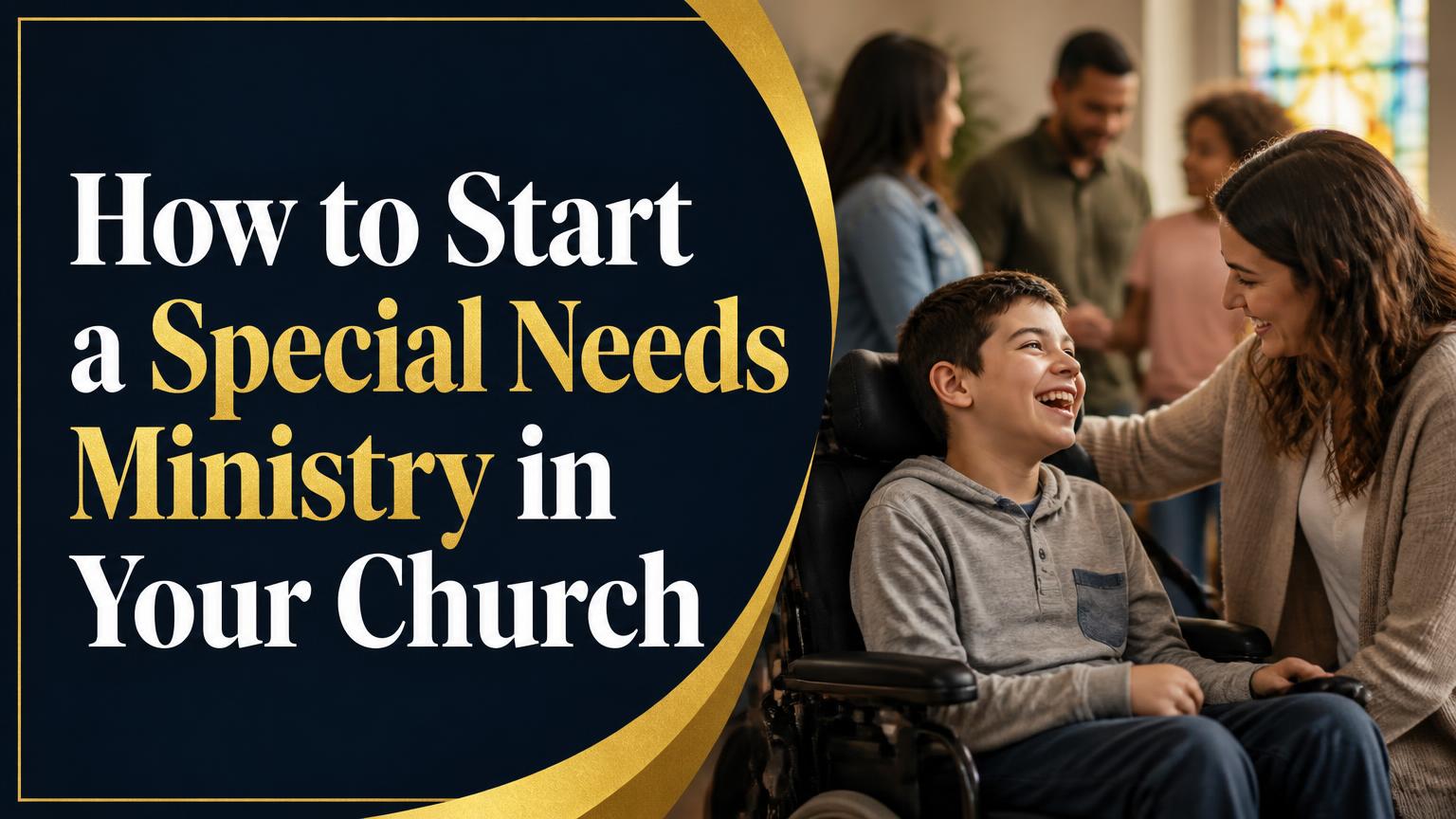
A special needs ministry helps people with disabilities participate fully in the worship, relationships, teaching, and service of the church. Starting one requires more than creating a Sunday classroom. The church must listen to disabled people and their families, remove physical and social barriers, recruit prepared volunteers, establish safeguarding procedures, and provide individualized support. The strongest ministries combine theological conviction with practical planning so that inclusion becomes part of congregational life rather than a separate activity with limited connection to the wider church.
How to Start a Special Needs Ministry
Begin with listening and assessment rather than immediately purchasing equipment or creating a program. Identify the people your church hopes to serve, understand the barriers they face, and determine what the congregation can provide safely and consistently. Then develop a modest first phase, communicate clearly with families, train volunteers, and improve the ministry through regular feedback.
Clarify the Ministry’s Mission and Scope
Write a brief mission statement that explains whom the ministry serves and what participation it seeks to support. The purpose might include helping children, teenagers, and adults with intellectual, developmental, sensory, physical, or behavioral disabilities engage in worship, discipleship, fellowship, and service.
Define the initial scope honestly. A church may begin by offering a supported Sunday school class, a quiet space, a buddy system, or accommodations within existing classes. It should not promise nursing care, specialized therapy, or one-to-one staffing unless qualified people, appropriate policies, and adequate resources exist. A clear scope protects families, volunteers, and the church from expectations it cannot responsibly meet.
Listen to People With Disabilities and Their Families
Invite disabled members, parents, caregivers, and other trusted advocates into the planning process before decisions are finalized. Ask what makes church participation difficult, what support has helped elsewhere, what communication methods work best, and what the person enjoys or hopes to contribute. The individual receiving support should have a voice whenever communication and cognitive ability make that possible.
Avoid assuming that every family wants the same arrangement. One person may need a predictable schedule and visual instructions; another may need an interpreter, mobility assistance, sensory adjustments, or help joining a small group. Listening also communicates dignity. People are not merely recipients of ministry services; they are members of Christ’s body with gifts, preferences, responsibilities, and spiritual lives.
Assess Accessibility, Safety, and Legal Responsibilities
Walk through the church with several people who have different access needs. Examine parking, entrances, ramps, doors, restrooms, seating, lighting, sound levels, classroom layout, signage, and emergency exits. Accessibility also includes communication: large-print materials, captions, interpretation, visual schedules, plain-language instructions, and reliable ways for families to contact leaders.
Create written safety procedures before opening the ministry. Depending on the setting, these may address background checks, volunteer-to-participant ratios, allergies, toileting, mobility assistance, elopement or wandering, behavioral crises, medication boundaries, allergies, emergency evacuation, sign-in and sign-out, and incident reporting. Follow applicable local safeguarding and accessibility requirements. Volunteers should never provide medical care or physical assistance beyond their training and the church’s approved policies.
Recruit and Equip the Right Team
Appoint one coordinator with sufficient authority, time, and pastoral support to organize the ministry. Then recruit a team rather than depending on a single enthusiastic volunteer. Useful roles may include classroom leaders, inclusion buddies, check-in workers, activity planners, family liaisons, accessibility advisers, and people responsible for volunteer scheduling.
Training should cover disability awareness, respectful language, confidentiality, communication differences, de-escalation, sensory needs, boundaries, emergency procedures, and the ministry’s theological purpose. Teach volunteers to support participation rather than control every action. A helper should ask, wait, offer choices, and adapt instruction instead of assuming that a person cannot learn, serve, worship, or make decisions.
Design Individualized Participation
Use a simple support profile for each participant. With the family’s permission, record communication preferences, strengths, triggers, calming strategies, dietary or medical information relevant to church care, mobility needs, emergency contacts, and the person’s goals. Keep sensitive information secure and share it only with workers who genuinely need it.
Individualization does not mean isolating everyone in a separate room. Some participants may benefit from a specialized class for part of the service and then join the congregation for worship or fellowship. Others may participate best in an existing class with a trained buddy and modest adaptations. The goal is meaningful belonging: understanding the activity, having appropriate support, building relationships, and contributing rather than merely being present.
Plan the Budget, Communication, and Review Process
Budget for more than curriculum. Possible costs include sensory tools, accessible furniture, communication devices, visual materials, interpreter services, training, background checks, transportation assistance, facility adjustments, and volunteer appreciation. Begin with essential barriers, then create a phased plan for improvements that require larger funding.
Explain the ministry through the church website, registration materials, sermons, small groups, and personal invitations. Tell families exactly what support is available, what information the church needs, and whom they should contact. After launch, review attendance, participation, incidents, volunteer capacity, and family feedback at regular intervals. A ministry that changes in response to real experience is healthier than one that protects its original plan.
Build the Ministry on a Biblical Understanding of Belonging
Christian inclusion is not simply a strategy for attracting more families. Scripture presents the church as one body in which every member matters. First Corinthians 12:12–27 rejects the idea that some parts of the body are unnecessary or less valuable. Applied to disability ministry, this means people with disabilities are not projects added to church life; they are members whose presence, faith, gifts, and relationships shape the whole congregation.
Jesus repeatedly treated people who were socially marginalized as persons worthy of attention and fellowship. In Mark 2:1–12, the friends of a paralyzed man bring him to Jesus, and the event involves both physical access and communal faith. The passage should not be used to imply that disability results from personal sin or that healing is the only meaningful outcome. It does show that barriers preventing people from reaching Jesus deserve determined, compassionate attention.
James 2:1–9 warns the church against giving honor according to status. A special needs ministry should therefore avoid segregating people because they are inconvenient, slowing, or difficult to understand. At the same time, biblical belonging does not require pretending that support needs do not exist. Loving the neighbor includes preparing carefully, protecting vulnerable people, sharing responsibility, and making room for different ways of learning and participating.
Create a Ministry That Includes the Whole Church
Connect Supported Programs With Congregational Life
A separate class can provide safety and specialized support, but it should not become a permanent substitute for relationships with the wider church. Plan shared worship, fellowship meals, service projects, age-appropriate events, and small-group opportunities. Train ushers, teachers, youth leaders, and children’s workers so inclusion is not carried by one department alone.
Integration should be thoughtful rather than forced. A person may need a quieter space during a loud service, a shortened activity, or a trusted support person nearby. The question is not whether everyone follows an identical schedule. The question is whether the church is removing unnecessary exclusion while providing the support needed for genuine participation.
Make Worship and Teaching Understandable
Predictability helps many participants engage. Provide a visual schedule, explain transitions before they happen, use clear language, and offer advance information about unusual events such as baptisms, musical performances, or changes to the building. Reduce avoidable sensory overload through seating options, sound adjustments, lighting choices, and access to a quiet area.
Teach the same biblical truth at an appropriate level rather than assuming that disability eliminates spiritual understanding. Use objects, movement, pictures, repetition, music, discussion, and hands-on activities as needed. Ask how the participant communicates knowledge; a spoken answer is not the only evidence of attention, faith, or learning.
Support Families Beyond Sunday Morning
Families may need a church community that understands respite, changing care needs, school transitions, adulthood, transportation challenges, and social isolation. A ministry can offer practical fellowship, caregiver support groups, accessible events, referral information, and opportunities for families to serve together. It should not attempt to replace professional medical, educational, or social services.
Respect confidentiality when sharing prayer requests or stories. Obtain clear permission before using photographs, diagnoses, testimonies, or personal details in newsletters and services. Families often carry years of difficult experiences with institutions; dependable communication and follow-through may build trust more effectively than a large opening event.
Avoid Common Mistakes in Special Needs Ministry
Treating Inclusion as Charity Rather Than Partnership
A charity model asks what the church can do for disabled people while overlooking what disabled people contribute. A partnership model asks how the whole church can grow through mutual relationships. Invite people with disabilities to serve according to their abilities and interests—as greeters, readers, artists, prayer participants, musicians, technology helpers, or members of planning teams.
Do not define a person entirely by a diagnosis. Use respectful language, ask before helping, speak directly to the person rather than only to a caregiver, and avoid public praise that turns ordinary participation into a spectacle. Dignity is expressed through ordinary friendship, appropriate expectations, and shared responsibility.
Launching Without Enough Staffing or Training
An attractive room cannot compensate for unreliable care. If volunteers are frequently absent, families may stop attending because each visit becomes uncertain. Start with fewer participants or fewer services if necessary, establish substitutes, and make sure leaders know what to do during emergencies or challenging situations.
Training should be ongoing. New volunteers need orientation, while experienced workers benefit from reviewing incidents, discussing changing needs, and learning from families. When a participant’s support needs exceed the team’s capacity, explain the limitation honestly and work toward a safe plan rather than improvising.
Measuring Success Only by Attendance
Attendance matters, but it does not reveal whether people feel safe, known, included, and spiritually nourished. Review whether participants are forming relationships, joining congregational activities, using their gifts, and receiving consistent support. Ask families and participants what should change, including people who quietly stopped attending.
A healthy ministry may grow slowly because it prioritizes trust and quality. It may also discover that the greatest improvement is not a new program but better training for existing teachers, an accessible restroom, a quieter worship option, or a culture in which members naturally welcome people with disabilities.
Conclusion
Starting a special needs ministry means building a church environment in which people with disabilities can belong, worship, grow, serve, and be protected. The essential process is practical and relational: listen first, define a realistic mission, assess barriers, establish safeguarding procedures, train a dependable team, provide individualized support, and connect the ministry to the wider congregation. Biblical inclusion does not erase differences or pretend every person needs the same arrangement. It recognizes equal dignity while responding wisely to particular needs.
The best first step may be a listening meeting with disabled members and families, followed by a careful building assessment and a small pilot program. A church does not need a perfect ministry before beginning, but it does need humility, consistency, accountability, and a willingness to improve. When those qualities guide the work, special needs ministry becomes part of faithful church life rather than an isolated program.