
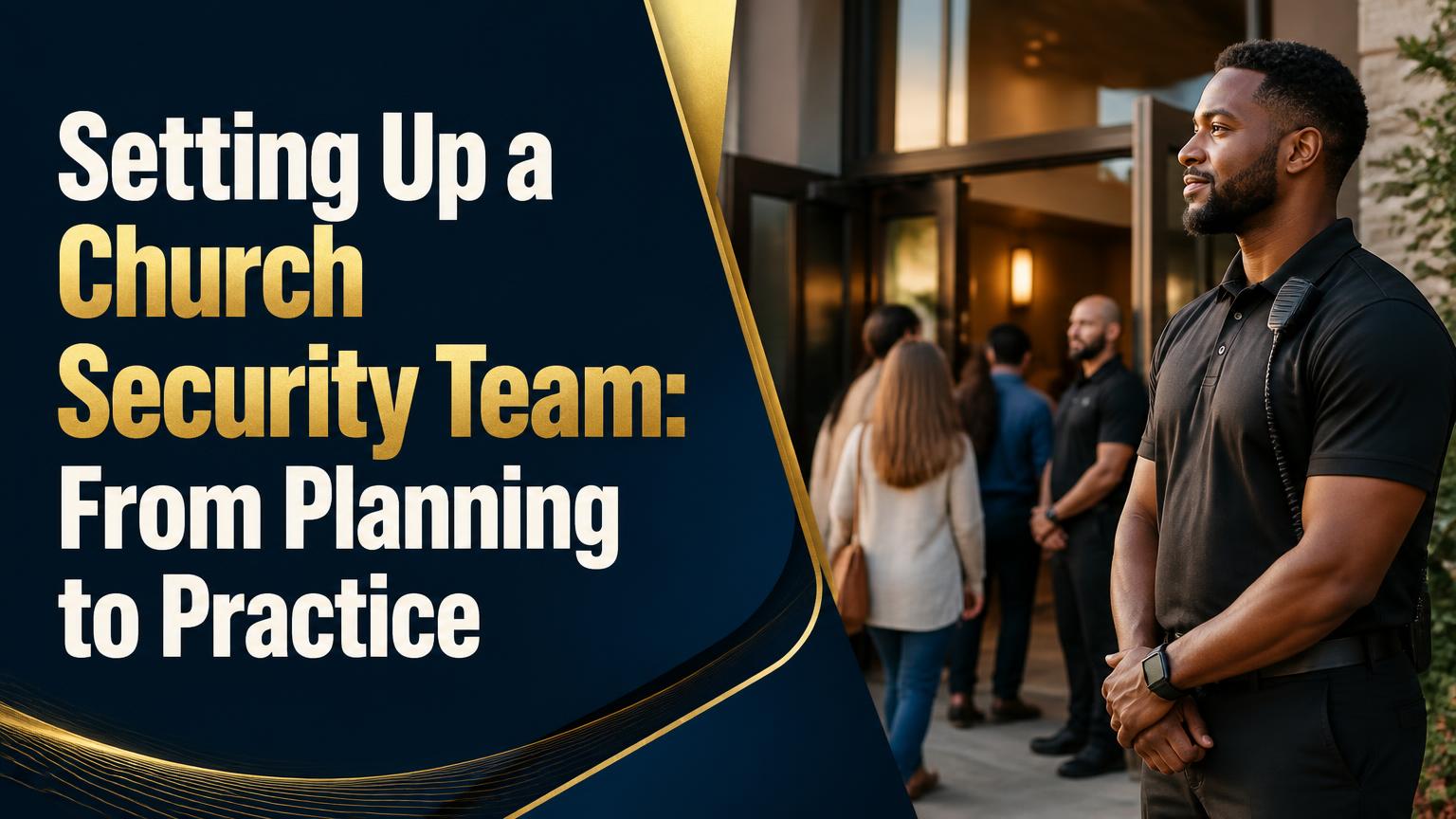
A church security team helps reduce preventable risks, protect worshipers and staff, and coordinate an organized response when something goes wrong. The strongest teams are not built around force or suspicion. They are built around risk assessment, child and vulnerable-person safeguarding, clear authority, trained volunteers, effective communication, and close coordination with emergency services. Setting up a church security team therefore requires more than assigning people to watch entrances; it requires a practical safety program that supports the church’s ministry without making the congregation feel monitored or threatened.
Setting Up a Church Security Team
A sound church security program begins by identifying realistic risks, assigning appropriate responsibilities, and creating procedures that people can follow under pressure. The team’s purpose should be prevention, preparedness, protection, and assistance—not acting as a substitute police department. Its work should complement good facility management, children’s ministry safeguards, fire safety, medical readiness, and pastoral care.
Start With a Mission and Risk Assessment
Write a short mission statement before recruiting volunteers. It might state that the team exists to protect people, support a welcoming environment, identify hazards, assist during emergencies, and coordinate with public safety agencies. This keeps the group focused on service rather than authority or confrontation.
Next, assess the church’s actual risks. Consider the building’s entrances, parking areas, classrooms, nurseries, offices, kitchens, electrical systems, and areas with limited visibility. Review likely medical emergencies, severe weather, fire, missing children, disruptive behavior, domestic disputes, unauthorized access, and threats directed at the church. The assessment should consider the congregation’s size, location, events, staffing, building design, and local emergency response times. Prioritize risks by likelihood and potential harm instead of treating every imaginable scenario as equally urgent.
Define Roles, Authority, and Accountability
A small church may need only a coordinator and several trained volunteers, while a larger congregation may require distinct responsibilities for access control, communications, medical response, children’s safety, parking, and emergency coordination. Assign a clear leader for each service or event, but define who has authority when that person is absent.
Written role descriptions should explain what team members may do and what they must not do. For example, a greeter may observe and report a concern, while a designated leader may initiate a shelter-in-place procedure. Team members should not conduct unauthorized searches, interrogate people, investigate abuse allegations, disclose confidential information, or use force except when legally justified and necessary to protect someone from immediate harm.
Accountability also matters. Establish supervision, an incident-reporting process, confidentiality expectations, and a method for removing a volunteer who disregards policy. A team that lacks boundaries can create legal, pastoral, and reputational problems even when its intentions are good.
Recruit and Screen Suitable Volunteers
Recruit for judgment, reliability, emotional maturity, and a service-oriented attitude—not merely for physical size, military experience, law-enforcement background, or enthusiasm for weapons. Effective team members notice details, communicate calmly, respect differences, and accept direction. They should be comfortable helping children, older adults, people with disabilities, and visitors who may be unfamiliar with church procedures.
Use the church’s normal volunteer-screening standards, including applications, interviews, references, and background checks where appropriate. Follow applicable laws and organizational policies, especially for people working around children or vulnerable adults. Screening is not a guarantee of safety, but it reduces avoidable risk and establishes consistent expectations.
Do not give a security role to someone who seeks control, enjoys confrontation, ignores leadership, or treats ordinary differences as threats. A volunteer who escalates conflict can be more dangerous than a security gap. Require team members to sign a code of conduct covering confidentiality, respectful treatment, prohibited discrimination, use of personal equipment, social-media behavior, and compliance with church policies.
Use Layered Security Instead of a Single Guard
Effective security uses several modest safeguards that support one another. Examples include well-lit walkways, visible entrances, controlled children’s check-in, locked staff-only areas, functioning cameras where appropriate, clear signage, maintained fire exits, first-aid supplies, and reliable methods for contacting emergency services. These measures reduce dependence on one person noticing every problem.
The team should understand the building’s normal patterns. Members need to know which doors should be open, which rooms are occupied, where utility shutoffs are located, how to guide emergency responders, and which exits are accessible to people with mobility limitations. Security should never block required fire exits or create a confusing evacuation route.
Visible presence can discourage some misconduct, but excessive surveillance can undermine trust. Cameras, visitor logs, and access controls should have a defined purpose, limited access, and appropriate retention rules. Children’s areas deserve particular attention, but safeguarding also requires two-adult practices, authorized pickup procedures, supervision standards, and prompt reporting of concerns through the church’s protection process.
Train for Prevention, De-Escalation, and Assistance
Training should begin with observation and communication. Team members should learn to recognize hazards, report concerns accurately, welcome visitors without profiling, and approach a distressed person with calm language and adequate personal space. De-escalation often depends on listening, reducing an audience, offering simple choices, and involving a pastor or trained leader when appropriate.
Basic emergency training may include first aid, CPR and automated external defibrillator use, bleeding control, fire-extinguisher awareness, evacuation assistance, severe-weather procedures, and missing-child response. The exact curriculum should reflect local risks and the team’s assigned responsibilities. Training should also cover radio or phone etiquette, documentation, confidentiality, accessibility, and interactions with children.
Physical intervention should be treated as a last resort, limited by law and church policy, and reserved for immediate threats that cannot be safely managed otherwise. If the church expects volunteers to perform specialized security work, it should use properly qualified instructors and confirm any licensing or insurance requirements. A few confident volunteers without disciplined training can increase risk rather than reduce it.
Create Simple Response Procedures
Written procedures should answer five questions: Who notices the problem? Who is notified? Who makes decisions? What should people do immediately? Who contacts emergency services and communicates with the congregation? Procedures must be short enough to use during stress and specific enough to prevent confusion.
Prepare separate guidance for common situations such as fire, medical emergencies, severe weather, a missing child, a disruptive person, suspicious behavior, a threat received by phone or email, and an active violence event. Do not rely on dramatic tactics alone. Most procedures should emphasize calling emergency services, protecting people from danger, communicating verified information, preserving access for responders, and avoiding unnecessary confrontation.
Use plain language and avoid codes that visitors or inexperienced volunteers may misunderstand. Keep emergency contact information current. Decide in advance how the church will notify leaders, parents, ushers, musicians, teachers, and the congregation. Plans should include people who cannot hear alarms, use stairs easily, speak the dominant language, or may need assistance because of age, injury, or disability.
Build the Team Around Safety, Not Force
A church security team works best when it is integrated into the church’s broader safety and safeguarding structure. The senior pastor, governing board, facilities leaders, children’s ministry, event coordinators, and communications staff should understand the plan and know their responsibilities. Security should not operate as an isolated group with undisclosed procedures.
The church should also clarify its position on weapons. Some congregations prohibit firearms on church property; others permit them only under strict legal, training, insurance, and leadership requirements. Either approach requires a written policy. A person’s claim of experience is not a substitute for current qualification, secure storage, judgment, and clear rules about carrying, handling, display, and reporting. No one should be encouraged to bring a weapon simply because the church has not planned adequately.
Legal duties vary by jurisdiction and may involve private security licensing, concealed-carry rules, mandatory reporting, privacy, employment law, accessibility, use of force, and volunteer liability. The church should review its policies with qualified local legal and insurance professionals rather than assuming that informal volunteer arrangements are automatically protected.
Turn the Plan Into a Working Program
A written plan has value only when people practice it. Conduct an orientation before volunteers serve, then hold periodic tabletop exercises in which leaders discuss realistic situations step by step. Practice should test communication, decision-making, child reunification, evacuation, sheltering, accessibility, and contact with emergency responders. Avoid exercises that frighten the congregation or simulate violence carelessly.
After every drill or real incident, conduct a review while details are fresh. Ask what worked, where communication failed, whether roles were understood, and whether any procedure created unnecessary danger or confusion. Record corrective actions, assign responsibility, and set a deadline for revision. A plan that is never updated will gradually become inaccurate as staff, buildings, technology, and schedules change.
Coordinate with local police, fire, and emergency medical services when appropriate. They may need information about entrances, floor plans, alarm systems, access points, hazardous materials, and the location of people who could require assistance. The church should not expect responders to know its building, and it should not interfere with their command once they arrive.
Conclusion
Setting up a church security team is primarily an exercise in preparation, stewardship, and responsible service. The essential elements are a realistic risk assessment, carefully screened volunteers, defined authority, layered safeguards, practical training, clear emergency procedures, and regular review. The goal is not to make worship feel militarized or to encourage volunteers to confront every unusual situation. It is to help the church recognize hazards early, protect children and vulnerable people, respond calmly, and summon professional help without delay.
The most trustworthy team is measured less by how intimidating it appears than by how consistently it prevents harm, communicates clearly, respects human dignity, and stays within its legal and organizational limits. When security is integrated with safeguarding, hospitality, facilities management, and emergency planning, it becomes a quiet support for the church’s mission rather than a separate culture of fear or control.