
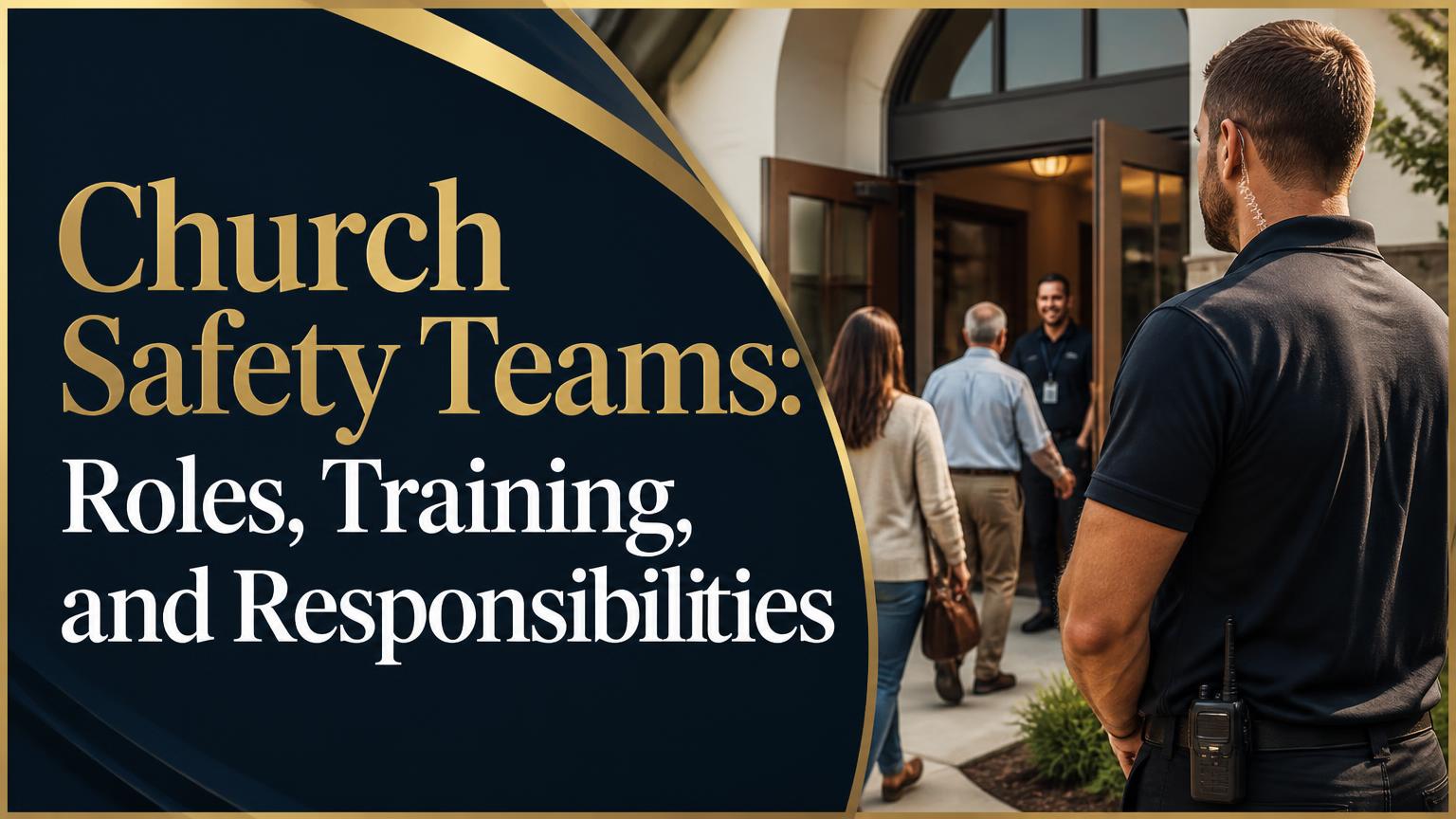
Church safety teams help congregations prepare for emergencies while preserving a welcoming, ministry-focused environment. Their work extends beyond watching entrances or responding to violent incidents. A well-designed team supports child protection, medical response, fire and weather preparedness, facility security, communication, evacuation, and compassionate care after an incident. The most effective teams are organized before a crisis occurs, operate within clear legal and ethical limits, and coordinate with church leadership and public emergency services rather than attempting to replace them.
What Are Church Safety Teams?
Church safety teams are trained groups of staff and volunteers responsible for reducing preventable risks, responding appropriately to emergencies, and helping protect people and property during church activities. Depending on the congregation, the team may include ushers, medical volunteers, facilities personnel, child-protection leaders, trained security personnel, and ministry leaders.
The team’s purpose is not to create an atmosphere of suspicion or turn ordinary worship into a security operation. Its purpose is to help people respond calmly and effectively when something goes wrong. Safety planning is most successful when it remains mostly unobtrusive during normal services but becomes immediately useful during a medical emergency, fire, severe weather event, missing-child situation, disruptive behavior, or threat of violence.
Purpose and Scope
A church safety team manages risk across the entire life of the congregation, including worship services, children’s programs, youth activities, small groups, conferences, outreach events, and use of the building by outside organizations. Its scope should be defined in writing so volunteers understand what they are expected—and not expected—to do.
Typical responsibilities include identifying hazards, monitoring conditions, reporting concerns, assisting with evacuation or sheltering, contacting emergency services, supporting first aid, protecting children and vulnerable adults, and documenting incidents. The team may also review lighting, doors, parking areas, alarms, accessibility, emergency exits, and communication systems.
Safety is broader than physical security. A locked door may address one risk, while supervision practices, safe volunteer screening, clear pickup procedures, and maintained fire exits address others. Treating safety as a whole-system responsibility prevents the church from focusing narrowly on one dramatic threat while overlooking common, preventable hazards.
Core Roles and Responsibilities
Church safety teams work best when responsibilities are distributed rather than assigned vaguely to “someone on duty.” A team may include the following roles:
- Team leader: Coordinates the team, communicates with church leadership, activates the response plan, and ensures follow-up.
- Communications coordinator: Contacts emergency services, relays verified information, and maintains communication with ministry leaders.
- Medical responders: Provide first aid within their training, locate the AED and first-aid supplies, and guide emergency personnel to the patient.
- Facility and fire-safety personnel: Monitor building conditions, manage access to relevant areas, and support evacuation or sheltering.
- Child-protection liaison: Coordinates with children’s ministry leaders during missing-child reports, reunification, injury, or allegations of abuse.
- Greeters and ushers: Notice unusual conditions, help direct people, and often provide the earliest information about an incident.
- Documentation lead: Records what happened, when actions occurred, who was notified, and what improvements should follow.
One person can hold more than one role in a small church, but the responsibilities should still be assigned in advance. The team should also identify backups because emergencies may occur when key volunteers are absent.
How Safety Teams Respond to Incidents
A sound response follows a simple sequence: recognize the problem, communicate accurate information, protect people from immediate danger, summon appropriate help, and support recovery. The exact action depends on the incident. A fainting person, a gas odor, a missing child, and a violent threat require different responses.
Team members should avoid rushing toward uncertainty without a plan. They should assess whether people need to evacuate, shelter in place, remain where they are, or move away from a danger area. They should give concise instructions, avoid spreading unverified information, and defer to police, fire, and medical professionals when those agencies arrive.
After the immediate danger passes, the response continues. Leaders may need to account for children, preserve relevant information, contact families, arrange pastoral care, report legally required matters, and conduct a structured review. The goal of that review is improvement rather than blame: What worked? What failed? Which procedure, supply, training gap, or communication problem needs attention?
What Church Safety Teams Should Not Do
Volunteers are not automatically law-enforcement officers, investigators, emergency physicians, or professional crisis negotiators. A safety team should not pursue a person merely to prove control, conduct unauthorized searches, disclose private information, or improvise tactics beyond its training. It should not obstruct emergency responders or make promises about legal outcomes.
Any use of force, defensive equipment, firearms, surveillance, or detention authority requires especially careful consideration of local law, insurance requirements, church policy, training standards, and qualified legal advice. A church should never assume that good intentions eliminate liability. In many situations, the safest contribution is to create distance, move people away from danger, call emergency services, observe from a safe location, and provide accurate information.
How to Build a Church Safety Team
A reliable team begins with governance, not equipment. Church leaders should approve the team’s mission, authority, reporting structure, and budget before recruiting volunteers. Written policies reduce confusion when several ministries, staff members, or outside agencies become involved in the same incident.
Select and Screen Team Members Carefully
Choose people who demonstrate sound judgment, emotional self-control, humility, reliability, and the ability to follow instructions. Physical fitness or a background in law enforcement may be useful, but neither automatically makes someone suitable. A person who seeks authority, escalation, or recognition may create more risk than that person prevents.
Use the same safeguarding standards applied to other roles involving children and vulnerable people. Depending on local requirements and church policy, this may include applications, interviews, references, background checks, driving-record reviews for relevant duties, and documented approval. Screening is one part of risk management, not a substitute for supervision and ongoing accountability.
Train for Realistic Emergencies
Training should match the team’s actual responsibilities. A practical program commonly includes:
- Observation, reporting, and incident documentation
- Verbal de-escalation and respectful conflict management
- Emergency communications and plain-language instructions
- CPR, first aid, and AED use for designated responders
- Fire prevention, extinguisher limitations, and evacuation
- Severe-weather sheltering and power-loss procedures
- Child protection, missing-child response, and reunification
- Accessibility considerations for children, older adults, and people with disabilities
- Recognizing behavioral or medical distress without diagnosing it
- Legal boundaries, confidentiality, and protection of personal information
- Coordination with police, fire, emergency medical services, and facility managers
Training must include practice. Walk-throughs and drills reveal problems that written plans hide, such as locked exits, poor radio coverage, unclear meeting points, inadequate lighting, or volunteers who do not know who has authority to make decisions. Drills should be announced and carefully designed so they do not traumatize congregants or resemble a real attack.
Establish a Clear Chain of Command
During an emergency, people need to know who makes operational decisions and who communicates with church leadership. The chain of command should identify the incident leader, the person responsible for contacting emergency services, ministry leaders who manage children or vulnerable adults, and the person who speaks publicly for the church.
This structure should not prevent anyone from calling for immediate medical or emergency assistance. It simply prevents conflicting instructions after the initial call. Plans should include backup leaders, contact lists, radio or phone procedures, reunification locations, and a method for communicating with people who cannot hear announcements or access digital messages.
Keep Plans Current and Accessible
An emergency plan is useful only if people can find and understand it. Maintain current floor plans, emergency contacts, utility shutoff information, first-aid and AED locations, evacuation routes, shelter areas, and procedures for accounting for children. Store sensitive information securely, but ensure authorized leaders can access it during an incident.
Review plans after building renovations, changes in children’s programming, new technology, severe incidents, or changes in local emergency guidance. At least periodically, conduct a short review with ministry leaders and volunteers. A plan that exists only in one leader’s memory is not a functioning plan.
Essential Church Safety Procedures
Church safety teams should prepare for both high-impact emergencies and ordinary hazards. Slips, falls, allergic reactions, lost children, blocked exits, aggressive disputes, and extreme weather may occur more often than a violent attack, and each can cause serious harm when a congregation is unprepared.
Protect Children and Vulnerable People
Child safety requires more than checking identification at pickup. Churches should establish consistent supervision ratios, authorized-pickup procedures, bathroom and hallway expectations, incident reporting, volunteer screening, and rules for one-on-one contact. Staff and volunteers should know how to respond when a child is missing, injured, discloses harm, or cannot be reunited with a caregiver.
The same principle applies to older adults, people with disabilities, and individuals who may need assistance during evacuation or sheltering. Plans should identify accessible routes, transportation needs, communication alternatives, and trusted people who can provide help without compromising dignity or privacy.
Prepare for Medical, Fire, and Weather Emergencies
Place first-aid supplies and AEDs where trained responders can reach them quickly, and check expiration dates and battery status. Keep emergency exits unlocked when required for occupancy, clearly marked, adequately lit, and free of storage. Staff should know when a fire extinguisher is appropriate and when immediate evacuation is safer; extinguishers are not a reason to delay calling the fire department.
Severe-weather plans should identify interior shelter areas away from windows and explain how leaders will communicate warnings. Medical plans should address crowd control, privacy, access for paramedics, and documentation. These procedures should account for children’s rooms, nurseries, kitchens, parking areas, and outdoor events rather than focusing only on the sanctuary.
Plan for Violence Without Creating Fear
Churches should acknowledge the possibility of threatening behavior without treating every unfamiliar person as dangerous. Prevention often begins with healthy relationships, visible leadership, clear reporting channels, well-maintained facilities, and staff who know how to respond to concerning behavior before it becomes an emergency.
A written plan should explain how to report a threat, contact emergency services, communicate verified instructions, and protect people through evacuation or sheltering decisions. It should avoid publishing sensitive tactical details broadly. The objective is not to make volunteers confront an attacker; it is to reduce confusion, move people away from danger when possible, summon trained responders, and preserve life.
Governance, Communication, and Accountability
Church safety work requires cooperation among pastors, ministry directors, facility managers, volunteers, parents, and emergency agencies. Leaders should explain the team’s purpose to the congregation so members understand that safety procedures support ministry rather than signal distrust. They should also provide a confidential way to report hazards, suspected abuse, threats, or concerning conduct.
Written policies should define confidentiality, media communication, documentation, incident review, volunteer conduct, and the circumstances in which emergency services must be contacted. Records should be factual and limited to relevant information; speculation, gossip, and unnecessary personal details can harm people and complicate later review.
Churches should also examine insurance requirements, employment rules, privacy obligations, child-protection laws, occupancy regulations, accessibility standards, and local emergency procedures. These requirements vary by location and by the church’s activities. When a policy involves legal authority, weapons, surveillance, mandatory reporting, or physical intervention, qualified local professionals should review it before implementation.
Common Mistakes to Avoid
The most common mistake is building a team around a dramatic scenario while ignoring routine risks. A church may purchase equipment but fail to train volunteers, maintain exits, update contact lists, or establish child-reunification procedures. Equipment cannot compensate for unclear authority and poor practice.
Another mistake is confusing visibility with effectiveness. A highly conspicuous team can reassure some people but make others feel watched or unwelcome. The right level of visibility depends on the congregation, facility, local risks, and team responsibilities. Leaders should evaluate whether a measure actually improves safety, communicates clearly, and respects the church’s mission.
Finally, churches should avoid relying on a single exceptionally committed volunteer. Sustainable safety requires shared knowledge, regular training, documented procedures, and leadership oversight. After every significant incident or exercise, the team should identify specific improvements, assign responsibility, and set a date for completion.
Conclusion
Church safety teams provide organized care before, during, and after emergencies. Their responsibilities include hazard prevention, child protection, medical and fire readiness, communication, evacuation or sheltering, incident documentation, and coordination with professional responders. The strongest teams are not defined by force or visibility; they are defined by preparation, restraint, competence, compassion, and accountability.
A church should therefore begin with a clear mission and realistic risk assessment, recruit people with sound judgment, train them for likely situations, and review its procedures regularly. Safety planning should protect people without creating unnecessary fear, preserve dignity while addressing genuine risks, and support the church’s wider responsibility to welcome and care for its congregation.