
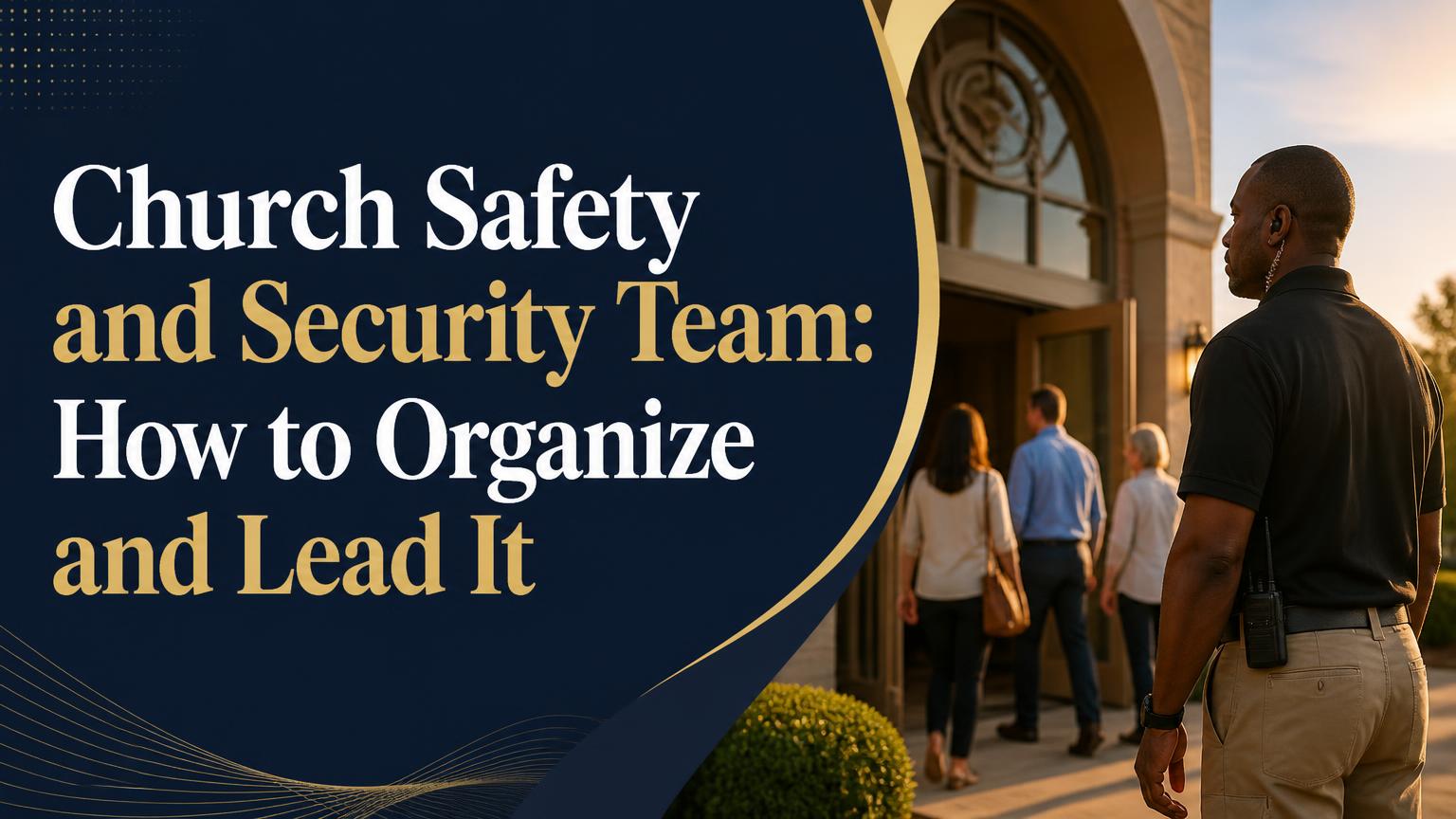
Church safety is broader than guarding doors or responding to violent threats. A well-organized church safety and security team helps prevent harm, prepares people for emergencies, protects children and vulnerable adults, supports medical and evacuation responses, and preserves a welcoming environment. The strongest teams operate through clear policies, defined authority, realistic training, and cooperation with emergency professionals rather than relying on individual instincts or heroic action.
Church Safety and Security Team: How to Organize and Lead It
A church safety and security team should be organized as a ministry of prevention, preparedness, response, and recovery. Its purpose is to reduce foreseeable risks while helping the congregation worship, learn, and gather safely. The team should complement—not replace—professional police, fire, emergency medical, mental-health, and child-protection services.
Define the Team’s Mission and Scope
Begin with a written mission statement. It might commit the team to protecting people, supporting emergency response, safeguarding children and vulnerable adults, identifying hazards, and helping the church respond calmly and compassionately to incidents.
Define what the team does and does not do. Typical responsibilities include:
- Monitoring entrances, exits, and gathering areas
- Responding to medical emergencies and contacting emergency services
- Supporting fire evacuation and severe-weather procedures
- Reporting hazards such as blocked exits, unsafe lighting, or wet floors
- Assisting with missing-child procedures
- Addressing disruptive behavior through communication and de-escalation
- Documenting incidents and recommending corrective action
The team should not improvise law-enforcement powers, conduct unauthorized investigations, or make promises about absolute security. Its authority must come from church leadership and comply with local law, insurance requirements, building codes, and denominational policies.
Select the Right People and Assign Clear Roles
Choose members for judgment, emotional maturity, reliability, confidentiality, and a service-oriented attitude—not simply for physical size, military experience, or enthusiasm for security. Volunteers should understand that the role involves patience, observation, discretion, and teamwork.
Assign responsibilities in writing. Depending on the church’s size, roles may include a team leader, service coordinator, communications lead, medical-response contact, children’s ministry liaison, facilities representative, and incident-documentation lead. One person should know who has authority to make decisions during an emergency, while every member should know how to reach that person.
Use screening appropriate to the role. Background checks may be important, particularly for people serving around children, but they are only one safeguard. References, interviews, supervision, training, and clear conduct standards are also necessary. A background check cannot guarantee future behavior or eliminate the need for good procedures.
Conduct a Risk Assessment Before Writing Procedures
A risk assessment identifies credible hazards, vulnerable locations, existing safeguards, and gaps that require attention. Examine the entire ministry environment, including worship services, classrooms, nurseries, youth events, parking areas, offices, kitchens, transportation, and off-site activities.
Consider both common emergencies and lower-frequency, high-consequence events:
- Medical emergencies and allergic reactions
- Fire, smoke, gas leaks, or utility failures
- Severe weather and power outages
- Missing or separated children
- Domestic disputes or disruptive behavior
- Unsafe people, threats, or suspicious packages
- Slips, falls, overcrowding, and blocked exits
- Data, privacy, and communication failures
Prioritize risks by likelihood and potential harm. A church may gain more safety by improving lighting, first-aid access, child-release procedures, and staff communication than by purchasing expensive equipment. The assessment should produce practical actions with assigned owners and deadlines.
Build a Written Safety and Emergency Plan
A useful plan tells people what to do, who does it, and how decisions are communicated. It should use plain language and remain accessible to pastors, staff, volunteers, and ministry leaders. Store current copies securely, while ensuring that those who need the information can reach it during an emergency.
Include procedures for:
- Calling emergency services and giving the correct address or campus location
- Alerting ministry leaders and the congregation without creating confusion
- Evacuating, sheltering, or temporarily securing an area
- Accounting for children, staff, and people needing assistance
- Directing responders to the right entrance or location
- Preserving privacy and documenting what occurred
- Supporting affected people after the immediate danger ends
Plans should account for people with disabilities, mobility limitations, hearing or vision impairments, language needs, and medical conditions. Do not assume that everyone can use stairs, hear an alarm, or move quickly without assistance.
Train for Prevention, Response, and Recovery
Training should match the team’s actual responsibilities. Core topics may include emergency calling, first aid and CPR where appropriate, fire extinguisher awareness, evacuation, severe-weather sheltering, child protection, incident reporting, radio or messaging procedures, and verbal de-escalation.
Training should also explain limits. Volunteers must know when to call 911, when to withdraw, when to avoid physical intervention, and how to follow directions from responding professionals. If a church permits armed personnel or other specialized security measures, those decisions require careful legal, insurance, pastoral, and professional review. No one should carry a weapon or assume a tactical role without explicit authorization, documented standards, and appropriate training.
Recovery is part of preparedness. After an incident, the church may need pastoral care, trauma-informed support, family communication, facility repair, insurance coordination, and a confidential review. A response is not complete merely because the immediate danger has ended.
Establish Communication and Incident Command
Confusion increases when several people give competing instructions. Establish a simple chain of communication before an emergency occurs. The team leader or designated incident coordinator should coordinate with the pastor, ministry leaders, facilities personnel, and emergency responders.
Use plain, consistent messages. Identify the location, type of problem, immediate needs, and actions already taken. Radios, phones, group messaging, or runners may all be useful, but the church should have a backup method if one system fails. Avoid broadcasting sensitive personal information over open channels.
During a serious event, the church’s internal team should support—not obstruct—professional responders. Designate someone to meet police, fire, or emergency medical personnel and guide them to the correct location. Afterward, record objective facts, preserve relevant information, and direct media or public inquiries to an authorized church representative.
Protect Children and Vulnerable People
Child safety requires more than a security presence. Churches should use controlled check-in and release procedures, authorized-pickup records, appropriate supervision ratios, bathroom and classroom policies, and clear rules for volunteers’ conduct. Two-adult or observable-ministry practices can reduce isolation and make concerns easier to identify.
The church should also establish a response for a missing child, suspected abuse, medical needs, and custody disputes. Volunteers should never promise secrecy about possible abuse; they should report concerns through the legally required process and the church’s designated safeguarding structure. Laws governing mandatory reporting differ by jurisdiction, so leaders should obtain qualified local guidance and train staff accordingly.
People who are elderly, injured, neurodivergent, unfamiliar with the building, or living with disabilities may need individualized assistance. Include them in planning without treating them as problems to be managed. A safe church preserves dignity while making practical accommodations.
Create a Welcoming Safety Culture
Visible safety should reassure people rather than make worship feel militarized. Team members should be identifiable, approachable, and trained to greet people naturally. A calm presence can improve awareness while reducing the suspicion and anxiety created by aggressive questioning or unnecessary confrontation.
Safety is also a shared responsibility. Ushers, teachers, custodians, musicians, pastors, and reception volunteers often notice problems before a dedicated team does. Teach the wider church how to report hazards, suspicious behavior, medical needs, and safeguarding concerns. Make reporting easy and explain that raising a concern is an act of care, not an accusation.
Leadership should measure success by prevention, readiness, appropriate referrals, and trust—not by the number of confrontations. A team that constantly seeks dramatic intervention may create the very fear it was formed to prevent. Good leaders reward sound judgment, early reporting, restraint, and cooperation.
Set Policies, Legal Boundaries, and Accountability
Written policies protect both the congregation and the volunteers. They should address authority, use of force, weapons, confidentiality, recording or surveillance, access to restricted areas, incident reports, child protection, medical assistance, and interaction with law enforcement. Policies must be reviewed against local law, insurance conditions, employment rules, fire regulations, and denominational requirements.
Do not assume that a volunteer’s professional background automatically authorizes conduct at church. Police officers, firefighters, nurses, security professionals, and military veterans may bring valuable experience, but their church role still needs defined boundaries. Likewise, an off-duty professional may be subject to employer policies or legal restrictions.
Create accountability through supervision, annual policy review, documented training, and a process for handling complaints. Separate facts from rumors in incident reports, restrict sensitive information to those with a legitimate need to know, and retain records according to the church’s privacy and legal practices. Leaders should address misconduct promptly, including misconduct by respected volunteers.
Train, Drill, and Improve the Program
A plan that exists only in a folder is not an operating plan. Training should be repeated often enough that volunteers can act without searching for basic information, but it should remain proportional to the church’s size and risk profile.
Use Discussion-Based and Practical Exercises
Begin with low-risk tabletop exercises. Walk leaders through scenarios such as a child who cannot be located, a medical emergency during worship, a severe-weather warning, or an evacuation blocked by a locked door. Ask who calls for help, who communicates, where people gather, and what information responders need.
Practical exercises can then test radios, emergency contacts, accessible exits, first-aid supplies, and child-accounting procedures. Avoid surprise drills that frighten children, traumatize congregants, or create a false emergency. Announce exercises appropriately and coordinate with staff and local responders when needed.
Review Every Incident and Near Miss
A near miss is useful information. A blocked exit discovered before a fire, a confused child-release attempt, or a delayed emergency call can reveal weaknesses without requiring someone to be injured. Review what happened, what worked, what failed, and what should change.
Keep the review nonpunitive when people acted in good faith, while still addressing negligence or policy violations. Convert findings into assigned actions, such as repairing a door, revising a form, changing a radio channel, or scheduling additional training.
Coordinate With Outside Professionals
Invite local emergency services, qualified medical trainers, child-protection specialists, building professionals, and insurance representatives to review relevant parts of the program. Their input can identify hazards that church volunteers may overlook and clarify how responders expect to access the facility.
Coordination should happen before a crisis. Provide accurate building information, address details, access instructions, and campus maps where appropriate. The church should also understand that professional agencies may have their own procedures and legal authority during an emergency.
Conclusion
A strong church safety and security team is organized around stewardship, preparation, and service rather than fear. Its members identify realistic risks, protect children and vulnerable people, communicate clearly, support professional responders, and know the limits of their authority. The most effective program combines a welcoming presence with written procedures, appropriate screening, practical training, accessible facilities, and regular review.
Church leaders should begin with a risk assessment and a simple written plan, then build a team whose character and judgment fit the responsibility. Safety improves when the whole congregation understands how to notice hazards, report concerns, and respond calmly. Security is therefore not a substitute for ministry; it is one way a church responsibly cares for the people entrusted to it.