
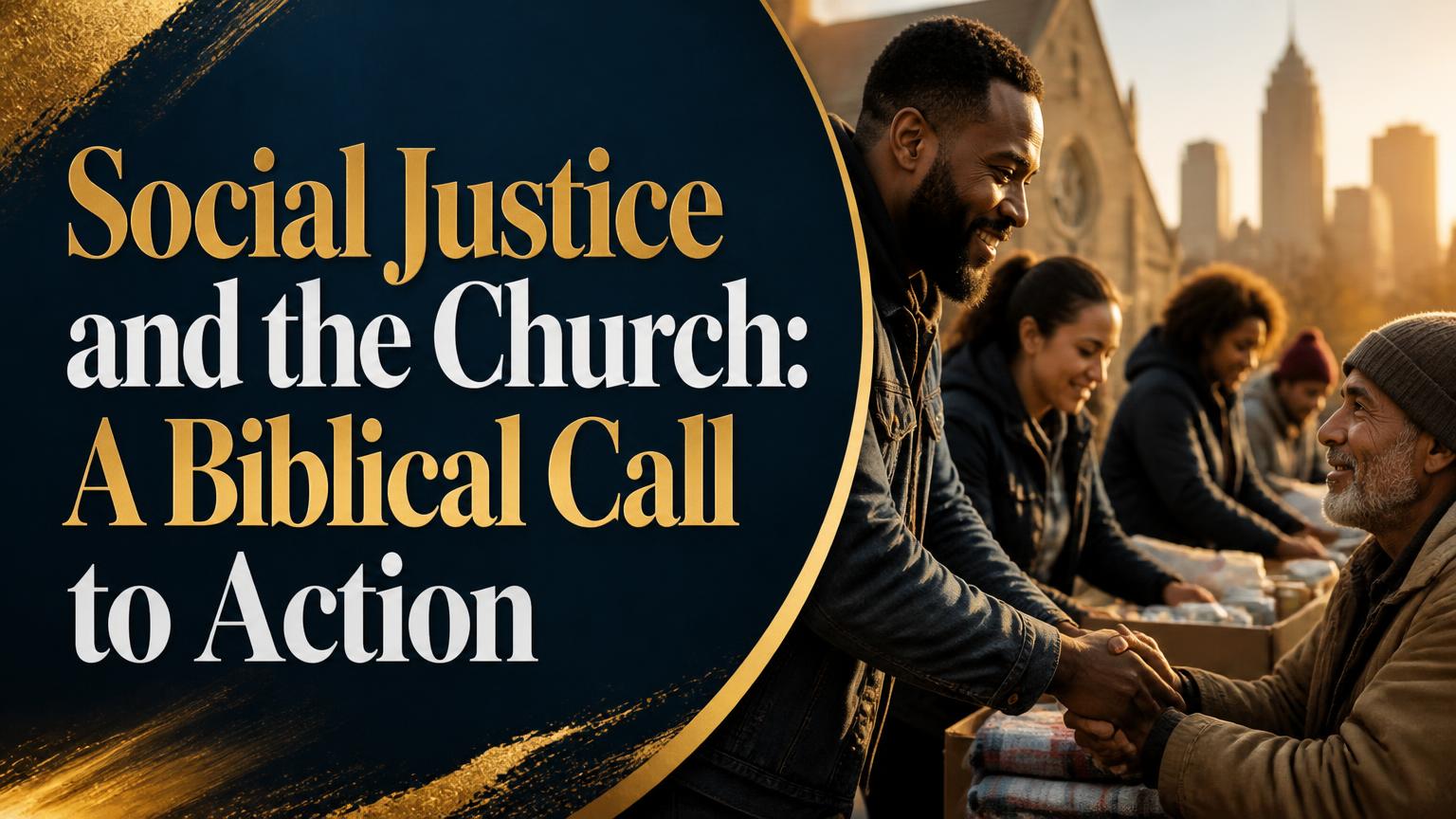
Social justice and the church are connected by the Bible’s consistent concern for human dignity, impartial judgment, mercy, and the protection of people who are vulnerable to exploitation. Scripture does not treat justice as an optional political interest or as a substitute for the gospel. It presents justice as part of faithful obedience to God, expressed through personal conduct, congregational life, compassionate service, and responsible engagement with public wrongs. The church’s task is therefore to proclaim Christ while also demonstrating what love of neighbor looks like in practice.
What Social Justice and the Church Mean in Biblical Practice
“Social justice” is a modern expression, but many of the principles associated with it are deeply biblical. In Scripture, justice includes treating people fairly, defending the oppressed, correcting dishonest systems, honoring the poor, and refusing to show partiality. The church should approach these matters through the character of God and the teachings of Jesus rather than through a party platform or ideological slogan.
Biblical Justice Includes Right Relationships
Biblical justice is broader than punishment for crime. It concerns whether people, families, communities, courts, employers, and leaders act rightly toward one another. The Old Testament repeatedly condemns dishonest scales, bribery, land exploitation, false testimony, and the abuse of legal power. Justice means giving people what is rightfully owed while refusing to use power for personal advantage.
Micah 6:8 summarizes this calling by joining justice with mercy and humble fellowship with God. The command does not reduce faith to activism, nor does it separate worship from conduct. It shows that genuine devotion to God produces integrity in relationships. A church that teaches personal morality but ignores fraud, exploitation, racism, abuse, or favoritism has separated biblical righteousness from the social consequences of human behavior.
God Gives Special Attention to the Vulnerable
Scripture repeatedly names widows, orphans, immigrants, the poor, prisoners, the sick, and the oppressed as people requiring particular care. This concern does not mean that these groups possess less dignity or that every member of another group is personally guilty of wrongdoing. It recognizes that limited resources, social exclusion, legal disadvantage, or dependence can make certain people especially vulnerable to harm.
Isaiah 1:17 calls God’s people to seek justice, correct oppression, defend the orphan, and plead the widow’s case. James 1:27 similarly describes care for orphans and widows as an expression of “pure religion.” These passages move beyond private sympathy. They require practical attention to conditions that allow vulnerable people to be neglected, manipulated, or silenced.
Justice Belongs Alongside Mercy and Evangelism
Christian justice cannot be separated from love for God, love for neighbor, and the proclamation of the gospel. Jesus announced good news to the poor, liberty to captives, and freedom for the oppressed in Luke 4:18–19. His ministry included healing, forgiveness, restoration, teaching, and confrontation with religious hypocrisy. He addressed both spiritual alienation and concrete human suffering.
This does not mean that social programs can replace repentance, faith, or reconciliation with God. Nor does evangelism excuse indifference to suffering. The New Testament holds both together: Christians announce salvation in Christ and embody sacrificial love. James 2:14–17 warns that words about faith are empty when believers encounter a person in need and refuse practical help. The church’s witness becomes more credible when its message and communal life agree.
The Church Demonstrates Justice in Community
The earliest Christian communities shared resources so that fellow believers facing serious need were not abandoned, as described in Acts 2:42–47 and Acts 4:32–35. This was not a forced political redistribution imposed on society at large; it was voluntary generosity within a worshiping community shaped by the resurrection of Jesus. The principle is significant: Christian fellowship creates material responsibilities.
A church practices justice when it treats members impartially, protects children and adults from abuse, pays workers fairly, handles finances transparently, welcomes people across ethnic and economic boundaries, and gives the marginalized a meaningful voice. These ordinary institutional choices can reveal whether a congregation’s theology has become a way of life.
How Biblical Justice Differs From Partisan Politics
Biblical justice and political activism overlap in some concerns, but they are not identical. Scripture provides enduring moral principles—truthfulness, protection of the weak, impartial judgment, care for the poor, respect for human life, and accountability for rulers. It does not endorse every policy proposed by a modern political party. Christians may agree about the biblical goal while disagreeing in good faith about taxation, criminal justice, immigration policy, economic systems, or the proper role of government.
That distinction protects the church from two opposite errors. One is political capture, in which a congregation treats a party’s program as if it were the kingdom of God. The other is political retreat, in which Christians call all public concerns “worldly” and reduce faith to private morality. Churches can teach biblical principles, equip believers to serve their communities, and speak against injustice without claiming that one political coalition represents Jesus completely.
Christian judgment also requires attention to consequences. A policy may have a worthy intention but produce harmful effects; a proposed reform may correct one injustice while creating another. Scripture supplies moral direction, but applying that direction to complex institutions requires wisdom, accurate information, humility, and respect for conscience. Faithfulness does not require pretending that every policy question has one obvious Christian answer.
How Churches Can Practice Social Justice
A church’s response should be specific enough to help real people and thoughtful enough to avoid shallow solutions. Social justice ministry is not merely making public statements. It involves examining the congregation’s own practices, listening to affected communities, serving immediate needs, and addressing preventable causes of harm where the church has legitimate influence.
Begin With Self-Examination and Impartiality
Jesus warned against condemning others while ignoring one’s own sin. Churches should therefore examine their patterns of leadership, membership, discipline, hiring, budgeting, and hospitality. James 2 condemns favoritism toward the wealthy and humiliating treatment of the poor. That principle applies wherever people receive different levels of welcome, credibility, safety, or opportunity because of status.
Self-examination should be concrete. Does the church make its facilities accessible? Are allegations of abuse handled seriously? Are leaders accountable? Are financial decisions understandable? Are racial or cultural minorities expected to assimilate without being heard? Internal integrity does not solve every social problem, but it prevents the church from demanding justice publicly while practicing inequity privately.
Meet Immediate Needs With Dignity
Biblical compassion responds to hunger, homelessness, illness, displacement, loneliness, and crisis. Churches may provide meals, emergency assistance, housing support, transportation, counseling referrals, job preparation, or help navigating public services. Effective care treats recipients as neighbors rather than projects. It listens before prescribing solutions and protects people from unnecessary exposure or humiliation.
Relief and long-term development should be distinguished without being separated. Emergency aid may keep a family safe tonight, while mentoring, education, stable employment, addiction recovery, or legal assistance may address deeper conditions. Churches should also recognize their limits and cooperate with qualified professionals when needs exceed pastoral or volunteer expertise.
Address Conditions That Produce Repeated Harm
Charity responds to suffering; justice also asks why the same suffering keeps occurring. If a congregation repeatedly encounters wage theft, predatory lending, domestic violence, racial exclusion, or barriers to housing, it can investigate patterns and support lawful, constructive solutions. This may involve helping people understand their rights, referring them to professional services, advocating for fair treatment, or partnering with organizations that possess relevant expertise.
Such work requires careful evidence. Not every unequal outcome proves discrimination, and not every social problem has a single cause. Churches should avoid slogans that replace investigation. At the same time, demands for perfect certainty must not become an excuse for ignoring credible patterns of abuse. Wisdom combines compassion with truthful assessment.
Build Partnerships Without Losing Christian Identity
Many needs are too complex for one congregation. Churches can collaborate with shelters, food programs, schools, medical providers, legal-aid groups, and other congregations. Partnerships expand capacity and reduce duplicated effort, especially when local organizations already understand the community.
Cooperation does not require surrendering Christian convictions. A church can serve alongside people who do not share its theology while remaining clear about its own motivation: love of God and neighbor. It should establish sound safeguards, define responsibilities, protect vulnerable people, and evaluate whether a partnership actually benefits those it intends to serve.
Common Distortions in Christian Justice Work
The church’s concern for justice can be weakened by both neglect and imbalance. Avoiding these distortions does not mean avoiding difficult issues; it means pursuing them in a way consistent with the gospel’s truth, humility, and love.
Political Identity Can Replace Christian Identity
A congregation may begin with a legitimate concern and gradually make political loyalty the test of faithfulness. When that happens, Christians may excuse wrongdoing by their preferred leaders, treat opponents as enemies rather than neighbors, or repeat claims without checking their truth. Scripture requires honesty and impartial judgment even when the facts are inconvenient.
The church should be willing to challenge injustice across political, economic, racial, and institutional boundaries. Its authority comes from Christ, not from access to a voting bloc. Political involvement may be appropriate for individual Christians, but the church’s public witness should not be reduced to partisan branding.
Charity Can Ignore Structural Problems
Generous relief is necessary, but giving food to hungry people does not remove the causes of hunger. If churches offer repeated assistance without asking whether people face exploitation, disability, unsafe housing, inadequate wages, or other barriers, their ministry may relieve symptoms while leaving preventable harm untouched.
The answer is not to abandon charity in favor of abstract reform. A person in immediate crisis needs help now. The wiser approach joins compassionate relief with learning, accountability, and prevention. Churches can serve an individual today while also seeking better conditions for others tomorrow.
Activism Can Neglect Spiritual Formation
Justice work can become harsh, self-righteous, or driven by anger. Biblical concern for oppression does not authorize contempt toward every person who disagrees, nor does it excuse dishonesty for a supposedly good cause. The fruit of the Spirit—love, patience, kindness, self-control, and gentleness—remains relevant in public advocacy.
Christian activism should therefore include prayer, repentance, truthful speech, forgiveness, and concern for the spiritual well-being of opponents. The goal is not merely to win a dispute or gain institutional power. It is to bear faithful witness to God’s justice and mercy while seeking tangible protection and restoration for people who are harmed.
Conclusion
Social justice and the church belong together when justice is understood biblically: honoring every person’s God-given dignity, rejecting partiality, protecting the vulnerable, confronting exploitation, and practicing mercy through concrete action. The church must proclaim salvation through Jesus Christ, but it must also show what reconciled life looks like in its own relationships and service. Faithful engagement avoids both political captivity and private indifference. It examines the church’s practices, meets immediate needs, investigates repeated harm, and acts with humility, truth, courage, and love.