
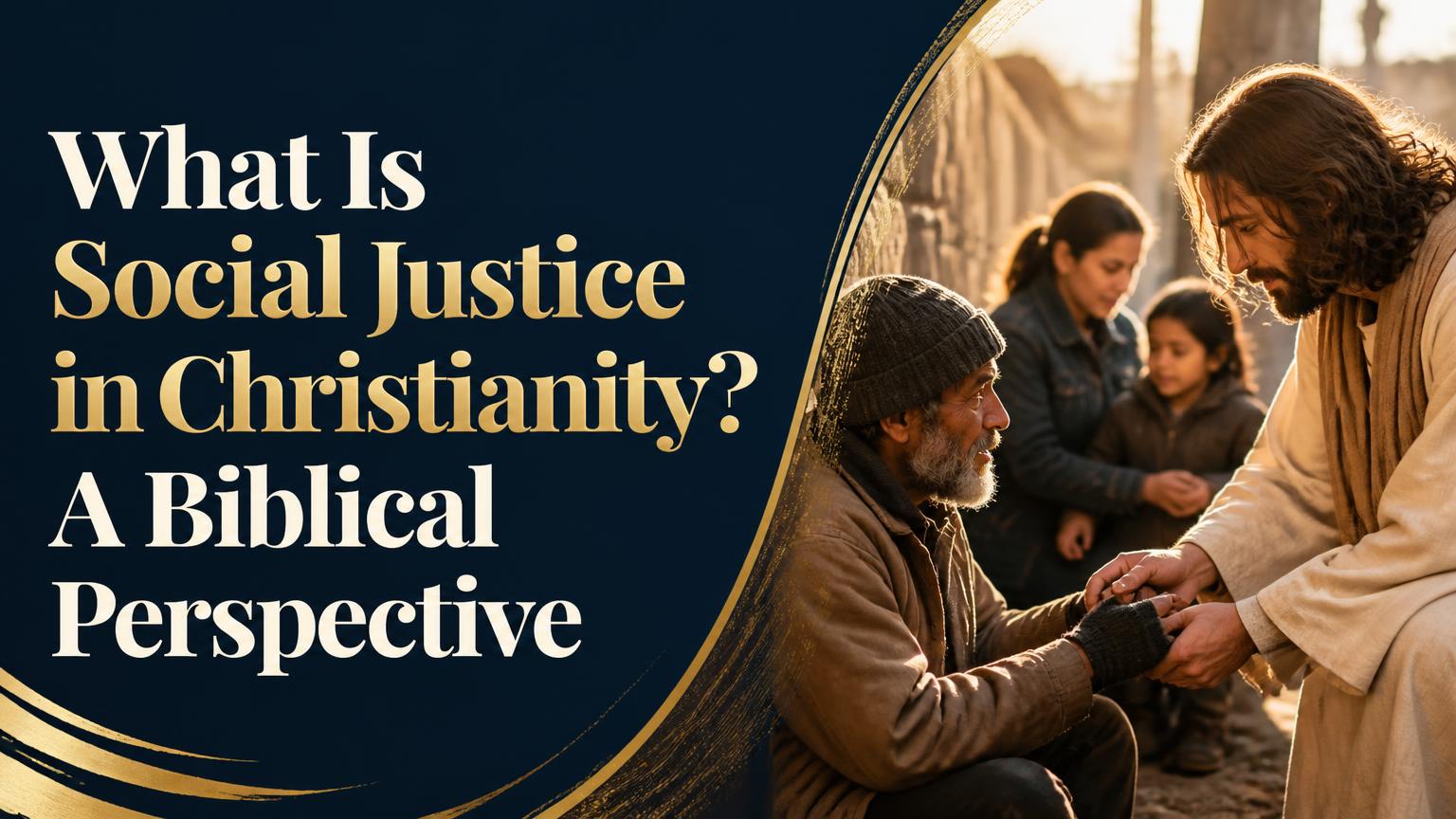
Social justice in Christianity means seeking relationships, communities, and institutions that reflect God’s justice, human dignity, mercy, and concern for the vulnerable. It includes confronting oppression, protecting the powerless, treating people impartially, meeting genuine needs, and accepting responsibility for the effects of personal and collective decisions. Christian social justice is not simply political activism or charitable giving. It is a practical expression of love for God and neighbor, grounded in Scripture and shaped by the gospel of Jesus Christ.
What Is Social Justice in Christianity?
A Biblical Definition of Social Justice
Christian social justice is the pursuit of what is right and fair in human relationships and shared life. Because every person is made in the image of God, people possess inherent dignity that does not depend on wealth, ability, ethnicity, social position, citizenship, or usefulness. Justice therefore requires more than avoiding personal cruelty. It also requires attention to laws, customs, economic practices, and institutional decisions that may protect some people while exploiting or excluding others.
The biblical vision includes impartial judgment, honest dealings, protection for the vulnerable, responsible authority, generosity toward those in need, and restoration when people have been harmed. It does not require identical outcomes in every circumstance, but it rejects favoritism and exploitation. Christian justice asks whether people are being treated according to truth and dignity, whether power is being used responsibly, and whether the community is bearing appropriate responsibility for its members.
How Social Justice Relates to the Gospel
The gospel is first the good news that sinners are reconciled to God through the life, death, and resurrection of Jesus Christ. Social justice does not replace repentance, faith, forgiveness, worship, or discipleship. At the same time, reconciliation with God produces a new way of treating other people. Jesus summarized the law through love for God and love for one’s neighbor (Matthew 22:37–40), so Christian faith cannot be reduced to private beliefs disconnected from conduct.
Ephesians 2:8–10 holds these truths together: salvation is a gift of grace, not something earned by good works, yet believers are created in Christ for good works. Justice is therefore neither a means of purchasing salvation nor an optional decoration added to Christianity. It is one way redeemed people demonstrate the character of the God they worship.
What Christian Social Justice Does Not Mean
The phrase “social justice” is used by Christians with different political and theological assumptions. Some use it to describe biblical mercy and public righteousness; others associate it with particular political movements or theories. As a result, Christians may agree that exploitation is wrong while disagreeing about which policies, institutions, or economic systems best address it.
Christian social justice does not mean that every political proposal is automatically biblical. It does not justify hatred toward opponents, dishonesty for a preferred cause, indiscriminate condemnation of social groups, or coercion that violates conscience. Nor does it mean that structural concerns excuse personal sin. Biblical justice addresses both individual conduct and the systems created, maintained, or tolerated by individuals.
Biblical Foundations of Christian Social Justice
Human Dignity and the Image of God
Genesis 1:26–27 teaches that human beings are created in the image of God. This provides the foundation for Christian concern about human dignity. People are not valuable merely because they contribute to an economy, belong to a majority, possess certain abilities, or have earned social approval. Their value is bestowed by God.
This principle challenges racism, dehumanization, abuse, trafficking, neglect, and contempt for the poor. It also gives Christian justice a broader foundation than preference or social usefulness. The same dignity applies to people who are easy to welcome and people whose beliefs, behavior, background, or circumstances make them difficult to understand. Justice must therefore be joined to truth, but truth must never become an excuse for treating people as less than human.
God’s Concern for the Vulnerable
Throughout the Old Testament, God repeatedly commands his people to protect widows, orphans, foreigners, and the poor. These groups often lacked economic security, family protection, or political power. Israel’s law included provisions such as leaving parts of a harvest for the poor and the foreigner (Leviticus 19:9–10), while the prophets condemned rulers and wealthy people who used power to exploit others.
Micah 6:8 summarizes the moral direction of this teaching: God requires people to do justice, love mercy, and walk humbly with him. The three commands belong together. Justice without mercy can become harsh and self-righteous; mercy without justice can leave exploitation unchallenged; both become distorted without humility before God.
Jesus, the Church, and Neighbor Love
Jesus treated compassion and justice as central to faithful obedience. In the parable of the Good Samaritan, he expanded the meaning of neighbor love beyond familiar social and religious boundaries (Luke 10:25–37). In Matthew 25:31–46, he connected practical care for the hungry, thirsty, stranger, sick, and imprisoned with how people respond to him. James 2:1–9 condemns favoritism toward the rich in Christian gatherings, showing that discrimination within the church is a direct spiritual failure.
The early church expressed this concern through concrete practices. Acts 2:44–45 and Acts 4:32–35 describe believers sharing resources so that needy members were not abandoned. These passages do not establish a single modern economic policy, but they clearly reject indifference to fellow believers in serious need. Christian community requires generosity, accountability, and willingness to use possessions for the good of others.
What Christian Social Justice Looks Like in Practice
Defending People From Exploitation and Partiality
A Christian approach to justice opposes practices that take advantage of people with less power. Scripture condemns dishonest business dealings, withheld wages, bribery, false testimony, and courts that favor the wealthy. James 5:4, for example, condemns employers who withhold wages from workers. These principles apply across changing economic and political settings: people should not be treated merely as tools for profit or influence.
Justice also requires impartiality. James 2 warns against giving privileged treatment to wealthy visitors while humiliating the poor. In contemporary life, this principle can inform how Christians think about hiring, housing, education, policing, immigration, disability, access to healthcare, and treatment within congregations. The relevant question is not whether every outcome is identical, but whether decisions are truthful, fair, and free from contempt or unjust advantage.
Serving the Poor With Both Mercy and Wisdom
Christian care for the poor includes generosity, hospitality, practical service, and personal presence. It may involve food, shelter, financial assistance, job support, advocacy, mentoring, or protection from abuse. Yet biblical compassion is not merely emotional sympathy. It seeks the person’s genuine good and recognizes that different situations require different responses.
Wisdom matters because assistance can sometimes create dependency, reward exploitation, or overlook the causes of hardship. Other situations involve disability, illness, persecution, unjust wages, family crisis, or barriers that individuals cannot overcome alone. A faithful response combines immediate mercy with careful discernment, accountability, and efforts to remove unjust obstacles. It refuses both blame-the-victim indifference and simplistic solutions.
Pursuing Justice Through Ordinary Responsibilities
Most Christian work for justice occurs through ordinary responsibilities rather than dramatic public campaigns. Employers can pay fairly and maintain safe conditions. Citizens can evaluate laws and leaders honestly. Churches can welcome outsiders, handle finances transparently, protect children, care for members in crisis, and refuse racial or class-based favoritism. Families can teach respect, generosity, truthfulness, and responsibility.
Public advocacy may also be appropriate when laws or institutions cause serious harm. Christians can seek reform through lawful persuasion, voting, community service, professional work, charitable organizations, and peaceful action. The method matters. Christian justice should be truthful, self-controlled, and willing to examine its own failures rather than assuming that moral purity belongs exclusively to one side of a political conflict.
Important Distinctions in Christian Social Justice
Charity and Justice Are Related but Not Identical
Charity usually refers to voluntary generosity toward people in need. Justice concerns what people are owed, what duties individuals and institutions possess, and whether power is being exercised fairly. Giving food to a hungry person is an act of mercy; ensuring that workers are not systematically denied earned wages is also a matter of justice.
The two should not be separated too sharply. A person facing immediate hunger needs charity now, even while unjust conditions may require longer-term reform. Conversely, structural reform without compassion can become abstract and impersonal. Jesus’ teaching and the early church’s example bring personal generosity and public righteousness into the same moral field.
Personal Sin and Structural Injustice
Personal sin involves choices and attitudes such as greed, prejudice, dishonesty, violence, and neglect. Structural injustice occurs when rules, institutions, traditions, or patterns of power consistently produce unfair treatment or preserve harmful advantages. Structures do not make decisions independently; people design, operate, defend, and change them. Yet a system can cause harm even when no single participant believes himself to be acting maliciously.
This distinction helps Christians avoid two errors. One error reduces every social problem to individual morality and ignores institutions. The other treats individuals as morally irrelevant and speaks as though only systems can be guilty. Biblical reasoning can address both: people are accountable for their conduct, and communities are accountable for laws and practices that harm their neighbors.
Equal Treatment and Special Concern
Biblical justice rejects partiality, but rejecting partiality does not mean ignoring relevant differences in need or vulnerability. Treating everyone identically may preserve an injustice when some people face barriers or dangers that others do not. A church that offers the same formal welcome to everyone but provides no accommodation for a disabled person may be equal in wording but unjust in practice.
Special concern for vulnerable people is not favoritism when it seeks to correct disadvantage and protect dignity. Scripture repeatedly gives attention to those with less power, not because their lives are worth more than anyone else’s, but because they are more exposed to neglect and exploitation. Christian action should therefore combine universal human dignity with particular care for people at risk.
Christian Disagreements About Social Justice
The Role of the Church and the State
Christians generally agree that the church must teach justice, practice mercy, care for its members, and proclaim the gospel. They disagree about how directly the institutional church should endorse public policies or political movements. Some emphasize the church’s prophetic responsibility to confront public wrongdoing; others stress the church’s distinct spiritual mission and caution against identifying Christianity with a political program.
Scripture affirms both concern for public righteousness and the importance of the church’s spiritual identity. These commitments require discernment. A Christian can oppose exploitation without endorsing every proposed government solution, and can emphasize evangelism without excusing social indifference. The church’s public witness is strongest when its proclamation and communal practices agree.
Different Strategies Can Share Biblical Goals
Christians may support different approaches to poverty, criminal justice, immigration, education, labor, or racial reconciliation while affirming the same biblical principles. Disagreement may concern effectiveness, unintended consequences, the proper authority of government, the balance between freedom and regulation, or the limits of coercion.
Such disagreements should not automatically be treated as evidence that one side rejects justice. Christians should distinguish clear biblical commands from prudential judgments about policy. Scripture gives firm moral direction—protect the vulnerable, tell the truth, reject partiality, keep promises, and love neighbors—but it does not provide a detailed modern policy manual for every social question.
Conclusion
Social justice in Christianity is the faithful pursuit of fairness, mercy, human dignity, and responsible relationships under God’s authority. It includes personal holiness, compassionate service, protection of vulnerable people, opposition to exploitation, and careful attention to institutions that shape shared life. Its foundation is the image of God, its model is the ministry of Jesus, and its motive is love rather than political ambition or self-righteousness.
Christian justice must remain connected to the gospel. Salvation is received by grace through faith, but genuine faith bears practical fruit in how people treat neighbors, strangers, workers, the poor, and those with little power. Christians may disagree about strategies and public policies, yet biblical social justice consistently calls them to reject partiality, practice mercy, pursue truth, and use whatever influence they possess for the good of others.