
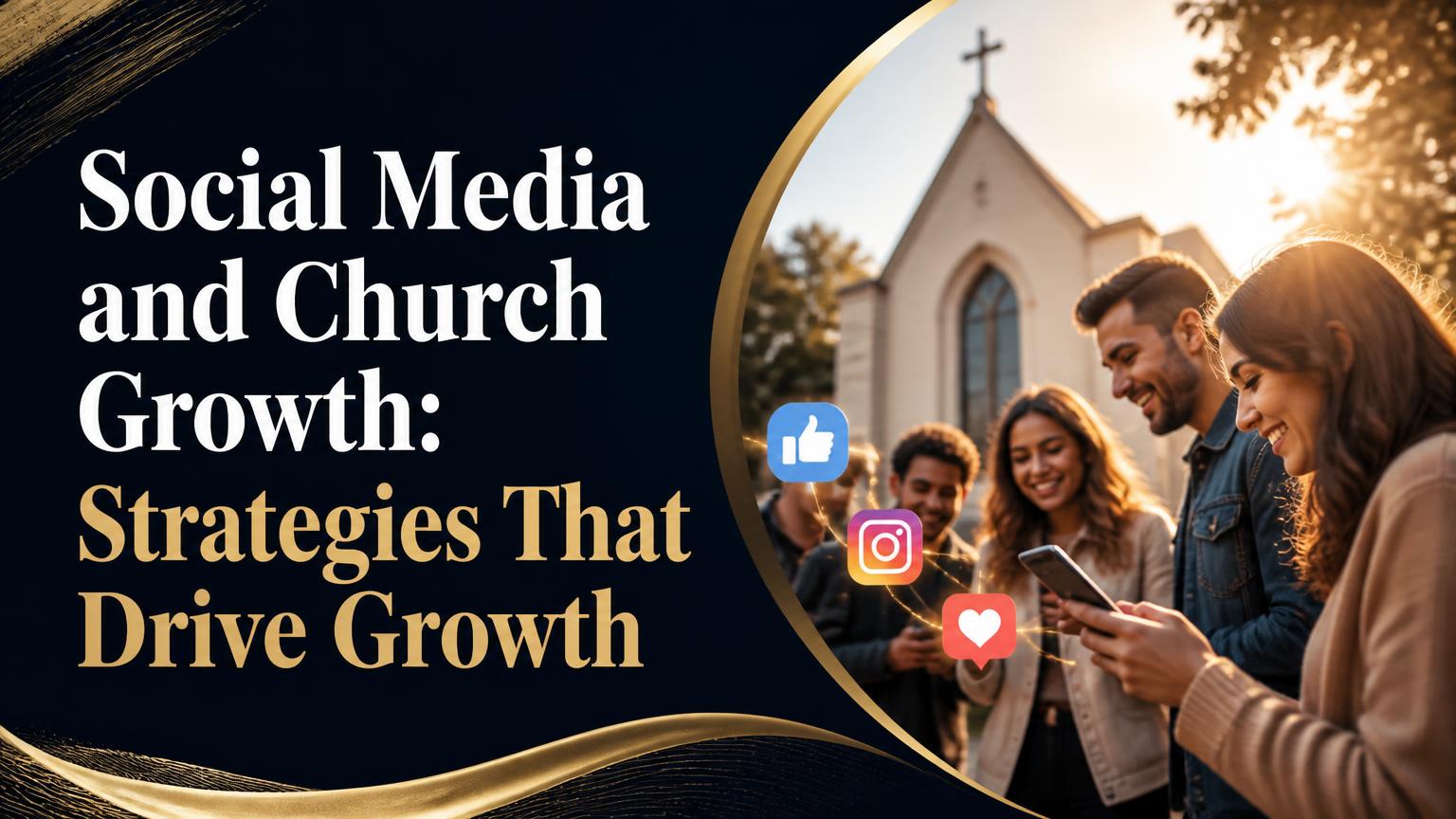
Social media can help a church reach people who may never enter a church building, but visibility alone does not constitute growth. Healthy church growth involves more than larger follower counts or fuller events. It includes meaningful connection, conversion, discipleship, worship, pastoral care, service, and participation in a faithful Christian community. The most effective strategy therefore treats social media as a pathway into relationship rather than as a substitute for the church. It uses digital communication to answer real questions, demonstrate Christian love, invite people into community, and help existing members live as disciples.
Social Media and Church Growth
Social media supports church growth when it connects a church’s mission with the needs, questions, and habits of real people. It can extend the reach of sermons, testimonies, ministries, events, and invitations, but its strongest contribution is usually relational: helping someone discover the church, understand its beliefs, recognize its culture, and take a low-pressure next step toward personal contact.
Start With a Clear Definition of Growth
Before choosing platforms or creating content, church leaders should define what growth means. Attendance and membership may matter, but they do not tell the whole story. A church may attract large online audiences without producing deeper faith, stronger relationships, generosity, service, or commitment to Christian teaching. Conversely, a small congregation may experience genuine spiritual growth that is not immediately visible in digital metrics.
A useful framework considers several dimensions together: reach, relationships, discipleship, participation, and mission. Reach asks whether new people are finding the church. Relationships ask whether digital interactions lead to conversations and belonging. Discipleship asks whether content helps people understand and practice the faith. Participation asks whether people join worship, groups, service, or pastoral care. Mission asks whether the church is becoming more effective at loving its neighbors and proclaiming the gospel.
Create Content That Serves Before It Promotes
People rarely follow a church because they want a continuous stream of advertisements. They follow when the church offers something useful, truthful, encouraging, or meaningful. Content may answer common spiritual questions, explain a biblical passage, provide prayer prompts, share a testimony, highlight practical service, or show how the congregation supports people in difficult circumstances.
Promotional posts still have a place, particularly for worship times, classes, community meals, or outreach events. However, promotion becomes more effective when it is surrounded by content that demonstrates the church’s character. A short video explaining how a ministry helps families, for example, can communicate more than a graphic announcing the ministry. The aim is not to make every post persuasive but to create a trustworthy digital presence that reflects the church’s actual life.
Turn Digital Attention Into Relational Connection
The central challenge in social media and church growth is moving people from passive attention to meaningful connection. A person may watch a sermon clip without remembering the church, while a thoughtful response to a comment may begin a pastoral conversation. Churches should make the next step clear and accessible: send a prayer request, attend a service, join an introductory gathering, download a study guide, speak with a pastor, or participate in a community project.
That pathway should be simple rather than overwhelming. A new visitor should not have to search through several platforms to discover meeting times, location, children’s policies, accessibility information, or contact details. Digital interaction should lead to a human response. If people ask questions or request prayer, a church needs a dependable process for answering them with warmth, confidentiality, and appropriate pastoral judgment.
Adapt the Message to Each Platform
A church does not need to maintain every social network. The best platform is the one where the congregation can communicate consistently and where the intended audience is reasonably present. Each platform also favors a different form of communication. Short video may introduce a pastor or explain one idea from a sermon. Images and concise text may highlight community life or a prayer. Longer posts may address a complex question or tell a testimony.
Repurposing content can save time, but copying the same post everywhere often feels impersonal. A sermon can become a short quotation, a brief explanation, a discussion question, and an invitation to listen to the full message. The underlying idea remains consistent while the presentation fits the platform. This approach increases usefulness without requiring the church to invent entirely new material for every channel.
Measure Movement Toward Discipleship
Follower counts, views, and likes can indicate distribution, but they are weak measures of spiritual fruit by themselves. A post may receive substantial attention because it is controversial, amusing, or emotionally striking. That does not necessarily mean it is helping people follow Christ or connect with the church.
More useful measures include meaningful comments, direct conversations, prayer requests, event registrations, first-time visits, group participation, volunteer involvement, and follow-up outcomes. Qualitative evidence matters as well. Ask whether people are receiving clear answers, whether members are using content in personal ministry, and whether online communication reflects the church’s theological and pastoral commitments. Metrics should guide learning, not become a substitute for discernment.
A Biblical and Pastoral Framework for Digital Outreach
The Bible does not prescribe social media platforms, but it provides principles for communicating the gospel and caring for people. Jesus’ command to make disciples of all nations in Matthew 28:19–20 gives the church a missionary purpose. Digital communication can support that purpose by helping people hear Christian teaching, encounter an invitation to follow Christ, and find a community where discipleship can continue. The platform is a tool; the mission remains the formation of faithful disciples.
Paul’s willingness to adapt his approach for different audiences in 1 Corinthians 9:19–23 also offers a relevant principle. Adaptation does not mean changing the gospel to gain approval. It means communicating faithfully in forms people can understand. A church may use accessible language, brief videos, visual explanations, or responses to contemporary questions while preserving the substance of Christian belief. Relevance should serve clarity, not replace conviction.
Digital outreach must also be understood alongside the embodied nature of Christian community. Acts 2:42–47 describes believers learning, sharing fellowship, breaking bread, praying, and caring for one another. Social media can invite people toward those practices, but it cannot fully replace them. Online worship may be important for people who are ill, isolated, traveling, or unable to attend, yet digital interaction has limits in pastoral presence, accountability, sacramental practice where applicable, and mutual service. A wise church uses technology to widen access while continuing to cultivate face-to-face community.
Pastoral ethics are equally important. Churches should avoid exploiting personal stories, publishing identifiable prayer requests without permission, targeting vulnerable people with manipulative messages, or presenting polished online content that misrepresents congregational life. Truthfulness, humility, confidentiality, and respect for human dignity should govern both content and follow-up. A church’s digital presence should make its real community more visible, not create a brand that the real community cannot sustain.
Common Mistakes That Undermine Church Growth on Social Media
Treating Social Media as a Digital Bulletin Board
A bulletin board communicates dates and announcements, but social media is built around conversation, attention, and relationship. If every post is merely an event notice, people have little reason to follow or share it. Announcements should be clear, but they should be balanced with teaching, testimony, service stories, pastoral encouragement, and opportunities for discussion. This broader content helps people understand why an event matters rather than simply when it occurs.
Chasing Virality Instead of Trust
A dramatic clip or provocative statement may produce rapid reach while weakening credibility. Content designed primarily to trigger outrage, mock opponents, or imitate online trends can attract attention that does not lead to Christian commitment. It may also confuse the church’s witness and harm people who expect pastoral wisdom. Sustainable growth usually depends on repeated, trustworthy communication that accurately reflects the congregation’s theology, character, and care.
Neglecting Follow-Up After Online Contact
A church can produce excellent content and still lose potential connections if nobody responds after a person comments, sends a message, or attends an event. Follow-up should have clear ownership. Leaders need to determine who answers questions, how prayer requests are handled, when a visitor is contacted, and how sensitive matters are referred to qualified pastoral staff. Promptness matters, but so do boundaries: online volunteers should know what they may answer and when a conversation requires private or professional care.
How to Build a Sustainable Church Social Media Plan
Begin with the church’s mission and audience rather than with a platform. Identify the people the church hopes to serve, the questions they commonly ask, and the barriers that keep them from connecting. Then choose a manageable number of channels and assign responsibility for planning, approval, publishing, comment moderation, and follow-up. A small team with defined roles will usually serve the church better than an ambitious plan that depends on one exhausted volunteer.
Create several recurring content categories, such as biblical teaching, personal testimony, congregational life, community service, pastoral encouragement, and invitations to participate. A simple calendar can ensure that promotional material does not crowd out more useful communication. Content should be planned far enough ahead to maintain consistency, while leaving room for timely pastoral responses and local needs.
Review the plan regularly using both numbers and stories. Look for patterns in questions, direct messages, event participation, and first-time visitors. If a particular format attracts attention but produces no meaningful connection, adjust it. If a modest post consistently leads to conversations or ministry involvement, give it greater value than its raw reach suggests. The goal is a sustainable rhythm that serves people and supports the church’s mission without turning ministry into a performance.
Conclusion
Social media and church growth are connected most fruitfully when digital communication leads people toward truth, relationship, discipleship, and participation in the life of the church. Social platforms can expand a congregation’s reach, clarify its beliefs, answer spiritual questions, and provide an accessible first step for people who are uncertain about church. They cannot, however, replace pastoral presence or the shared practices of Christian community.
The strongest strategy is therefore not to pursue maximum visibility at any cost. It is to communicate consistently, serve before promoting, respond personally, protect people’s dignity, measure meaningful movement, and connect online attention with embodied fellowship. When social media reflects the church’s real mission rather than a manufactured image, it becomes a useful instrument for welcoming people and helping them take faithful next steps.