
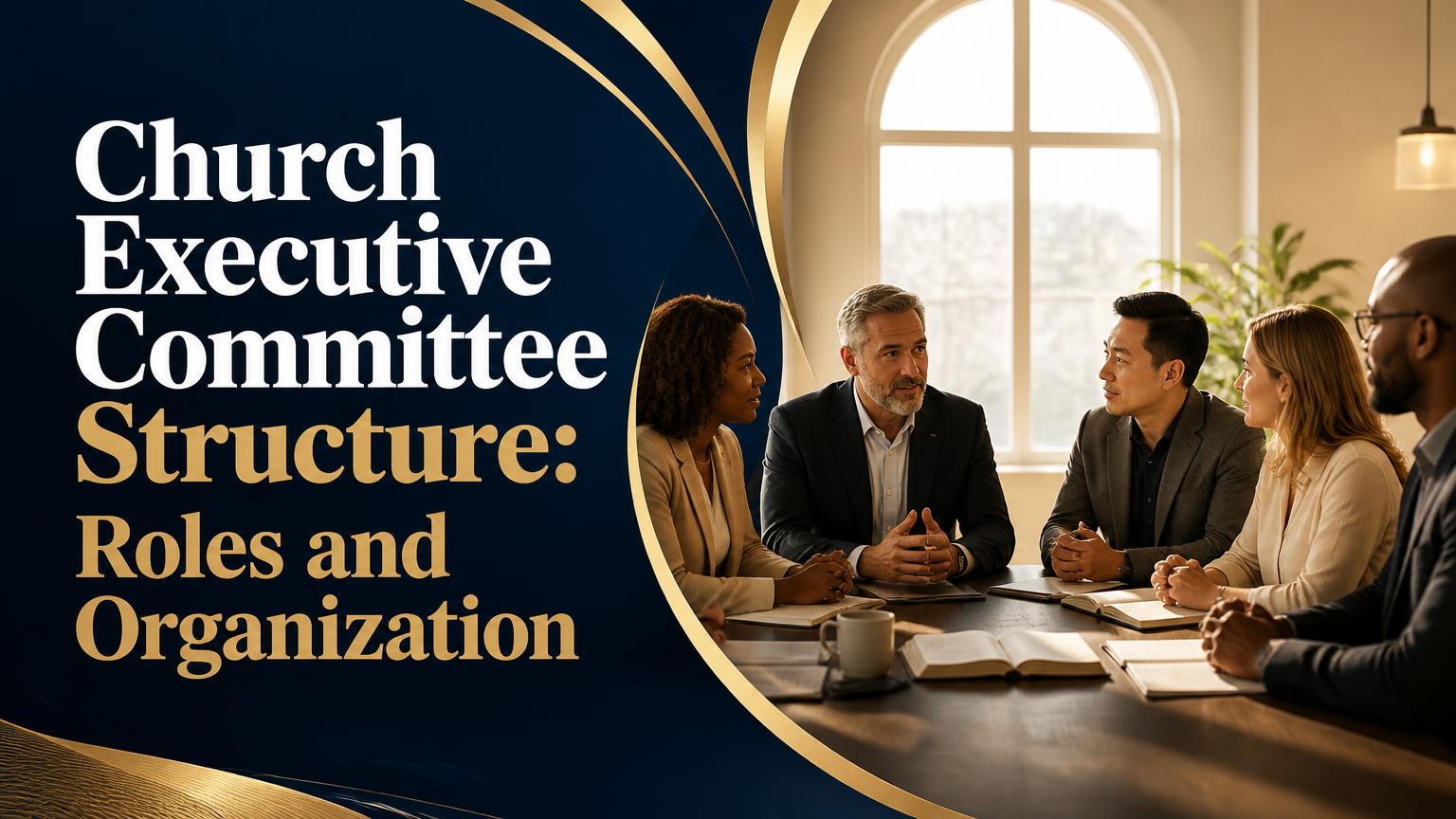
A church executive committee is usually a smaller leadership group authorized to coordinate administration, implement approved plans, and handle matters between meetings of the church’s larger governing body. Its exact membership and authority depend on the church’s denomination, bylaws, size, and governing tradition. A healthy structure makes responsibilities clear, preserves accountability, supports pastoral leadership, and prevents a small group from gaining authority it was never meant to possess.
Church Executive Committee Structure
The most effective church executive committee structure separates spiritual leadership, administrative coordination, financial oversight, and congregational accountability without treating them as unrelated functions. The committee should have enough authority to act efficiently, but its authority should come from the church’s constitution, bylaws, congregation, elders, or governing board—not from informal influence.
What an Executive Committee Is
An executive committee is a delegated leadership body that acts on behalf of a larger church authority within defined limits. Depending on the church, that larger authority may be the congregation, board of elders, deacons, trustees, session, bishop, denominational supervisor, or another governing body.
The committee commonly handles matters such as preparing agendas, coordinating ministry leaders, implementing approved decisions, monitoring urgent administrative issues, and making recommendations. It should not automatically become a substitute for the congregation, the full board, or the pastor. Delegation is legitimate only when the committee knows what it may decide, what it must recommend, and what it must report.
A written charter or bylaws provision should answer four questions:
- Who appoints or elects the committee?
- What decisions may it make independently?
- Which matters require approval from the congregation or full governing body?
- To whom is the committee accountable?
Typical Roles and Reporting Lines
A common committee includes the senior pastor or lead pastor, a chairperson, vice chairperson, secretary or clerk, treasurer, and one or more representatives of the elders, deacons, trustees, or ministry teams. Some churches also include an executive pastor, church administrator, board chair, or denominational representative.
The chairperson normally leads meetings, keeps discussion focused, and ensures that authorized decisions are followed through. The pastor brings ministry priorities, theological perspective, and awareness of pastoral realities, but the pastor should not necessarily control every administrative decision. The secretary maintains minutes, motions, and official records. The treasurer or finance representative explains financial information and confirms that decisions fit approved policies and budgets.
Reporting lines should be explicit. Ministry staff may report operationally to a pastor or executive pastor, while the pastor may be accountable to elders, a personnel committee, the full board, or the congregation. The executive committee should coordinate these relationships rather than create competing chains of command.
Core Responsibilities of the Committee
The executive committee’s responsibilities should focus on coordination, oversight, and delegated action. Typical duties include:
- Preparing recommendations: The committee studies issues and presents informed proposals to the full governing body or congregation.
- Implementing approved plans: It converts broad decisions—such as a building project, staffing plan, or annual ministry goal—into assigned actions and timelines.
- Monitoring church administration: It reviews policies, personnel processes, facilities, risk management, legal compliance, and operational needs.
- Coordinating leaders: It helps pastors, staff, elders, ministry directors, and committees work from a shared direction.
- Responding to urgent matters: It may act between regular meetings when delay would harm the church, provided the bylaws permit such action.
- Maintaining accountability: It reports decisions, finances, progress, and unresolved concerns to the body that granted its authority.
The committee should not make every routine ministry decision. Excessive centralization slows ministry, discourages qualified leaders, and causes the committee to become a bottleneck. Policies should identify which decisions belong to staff, ministry teams, pastors, elders, or the executive committee.
How Decisions Should Move Through the Committee
A sound decision process usually follows a sequence:
- A need, proposal, or problem is identified.
- The responsible leader gathers relevant information.
- The executive committee determines whether the matter falls within its authority.
- Members discuss the ministry, financial, ethical, and practical consequences.
- The committee either decides, recommends action to another body, or sends the matter to the appropriate ministry team.
- The secretary records the decision, responsible persons, deadlines, and reporting requirements.
- Progress is reviewed at a later meeting.
This process prevents two common failures: making major decisions without adequate accountability and sending every minor issue through a large governing body. Acts 6 illustrates a related principle: leaders recognized a practical need, clarified responsibilities, and assigned qualified people so that ministry could continue without neglecting either spiritual or administrative duties.
Sample Structures for Different Church Sizes
A small church may use a simple structure consisting of the pastor, board chair, secretary, treasurer, and one or two ministry representatives. Because the same people may hold several responsibilities, conflict-of-interest safeguards and clear voting rules become especially important.
A midsize church may include the senior pastor, executive pastor or administrator, board chair, treasurer, secretary, elder representative, deacon representative, and personnel or missions representative. Staff may manage daily operations, while the executive committee coordinates priorities and reports to the full board or congregation.
A larger or multisite church may require a central executive committee alongside campus pastors, a central finance function, human resources or personnel leadership, legal or risk oversight, and delegated site-level boards. The central committee should establish consistent policies while allowing local leaders enough authority to address local ministry conditions.
The best structure is not the one with the most positions. It is the one that matches the church’s size, legal setting, ministry complexity, and governing tradition.
How Church Polity Changes the Structure
Churches do not share one universal model of authority. In congregational churches, the congregation may retain final authority over budgets, property, pastoral calls, major borrowing, and constitutional changes. The executive committee then prepares recommendations and manages delegated matters between congregational meetings.
In elder-led or presbyterian structures, the executive committee may function under a session, board of elders, or presbytery. Its role may be more administrative than doctrinal, with elders retaining responsibility for spiritual oversight. The committee must understand whether it is acting as a governing body, an administrative subcommittee, or an implementation team.
In episcopal or hierarchical traditions, authority may flow through bishops, diocesan structures, or denominational offices. A local executive committee may advise the pastor or rector and oversee local administration, but it may have less independent authority over clergy, doctrine, property, or discipline. Independent churches often have the greatest variation, making written bylaws especially important.
These distinctions matter because a structure that works in one church can create confusion in another. Titles such as “elder,” “trustee,” “director,” and “executive committee” do not have identical meanings across denominations. The church should define each role rather than assuming that a familiar title automatically establishes authority.
Building a Clear Committee Charter
A committee charter translates general governance principles into practical rules. It should be consistent with the church’s bylaws, applicable law, denominational requirements, and theological commitments. The charter should be accessible to committee members and reviewed when the church changes its staffing, size, or governing arrangements.
Define Authority and Limits
The charter should state the committee’s purpose, membership, terms, appointment process, voting rights, quorum, meeting schedule, and reporting obligations. It should also list reserved matters that the committee cannot decide independently. These may include calling or dismissing a pastor, approving the annual budget, purchasing or selling property, taking on significant debt, changing doctrine, amending bylaws, or disciplining leaders.
Authority should be specific enough to guide action. “Oversee the church” is too vague. A clearer provision might authorize the committee to implement the approved budget, supervise designated administrative functions, and respond to urgent operational matters subject to later review.
Establish Meetings, Quorum, and Records
Regular meetings should have a published schedule, defined agenda process, and reasonable notice requirements. A quorum ensures that a small number of members cannot make decisions for the entire committee. Minutes should record attendance, motions, decisions, recusals, and assigned follow-up without turning the record into a transcript of every conversation.
Financial and personnel discussions may require confidentiality, but confidentiality should not become secrecy. Sensitive matters can be handled in closed session while final actions, financial effects, and accountability requirements are reported appropriately to the governing body.
Include Accountability and Conflict Safeguards
Members should disclose conflicts of interest and abstain from decisions involving their own compensation, contracts, relatives, or personal financial interests. Churches also benefit from separating approval, payment, recordkeeping, and review functions rather than giving one person complete control over money.
Accountability includes regular reports, annual evaluation of the committee, leadership succession planning, and a process for raising concerns. The biblical principle that leaders should exercise oversight without domineering over those entrusted to them, reflected in 1 Peter 5:2–3, supports a model of authority expressed through service and example rather than control.
Common Problems in Executive Committee Design
Many governance problems arise not from bad intentions but from unclear boundaries. A committee may begin as a small coordinating group and gradually become the real decision-making center of the church. Members who attend regularly may gain informal power over absent or less assertive leaders, even when the bylaws assign authority elsewhere.
Another problem is the confusion of pastoral and corporate roles. Pastors require meaningful spiritual leadership, but they should not be expected to manage every financial, personnel, legal, and facilities decision alone. Conversely, an executive committee should not use administrative oversight to direct sermons, manipulate pastoral care, or replace recognized spiritual leadership without proper authority.
A third problem is the absence of documented decisions. Verbal agreements can produce conflicting memories, unclear responsibilities, and recurring debates. Brief but accurate minutes, written policies, and scheduled reporting create institutional memory and make leadership transitions safer.
Healthy committees address these risks by reviewing their mandate, inviting dissent before decisions are finalized, distinguishing recommendations from binding actions, and communicating decisions to the people affected by them. Order exists to serve the church’s mission; it should not become a mechanism for concentrating power.
Practical Principles for a Healthy Structure
An effective executive committee normally follows several principles:
- Mission before procedure: Administrative decisions should support worship, discipleship, pastoral care, witness, and service rather than exist for their own sake.
- Delegation with accountability: Leaders need real authority to act, paired with clear reporting and review.
- Appropriate representation: The committee should understand the church’s major ministry and operational realities without becoming too large to function.
- Transparency with discretion: Members should communicate decisions openly while protecting legitimate pastoral, personnel, and personal information.
- Shared responsibility: No single pastor, chairperson, donor, or long-serving member should become indispensable to governance.
- Regular review: The structure should be reassessed as the church grows, adds staff, changes locations, or encounters new legal and ministry responsibilities.
First Corinthians 14:40 connects order with the proper conduct of church life. In organizational terms, order does not mean rigid bureaucracy. It means that responsibilities, decisions, and relationships are clear enough for the church to pursue its calling without unnecessary confusion.
Conclusion
A church executive committee structure should provide coordinated leadership without bypassing the authority of the congregation, elders, board, denomination, or other governing body. Its central functions are to implement approved plans, coordinate leaders, oversee delegated administration, address urgent matters within defined limits, and report faithfully. The strongest structure is not necessarily the most elaborate; it is the one whose authority is written clearly, matched to the church’s polity and size, protected by accountability, and exercised as service. Clear roles allow pastors and ministry leaders to focus on their responsibilities while helping the entire church make decisions with wisdom, order, and trust.