
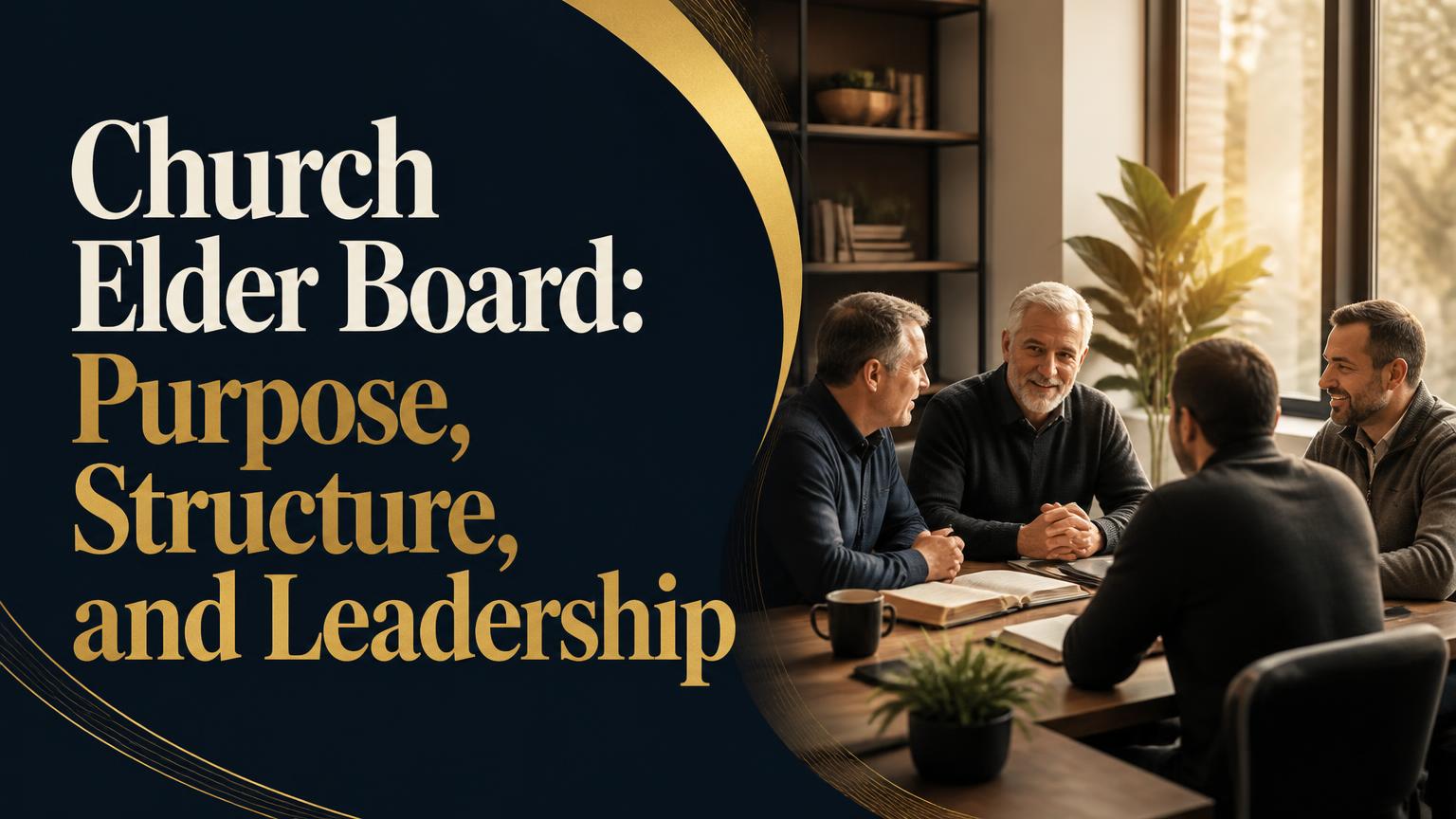
A church elder board is a group of qualified spiritual leaders who help shepherd, teach, protect, and govern a local congregation. In many churches, the board includes pastors and lay elders who share responsibility rather than placing all authority in one leader. Its precise structure varies by denomination and church polity, but a healthy elder board combines biblical character, spiritual oversight, wise decision-making, accountability, and care for the congregation.
What Is a Church Elder Board?
Definition and Biblical Foundation
A church elder board is a recognized group of elders responsible for providing spiritual leadership and oversight to a local church. The New Testament uses several related terms, including elder, overseer, and shepherd. These terms emphasize maturity, supervision, and pastoral care rather than mere administrative authority.
The New Testament regularly presents local churches as having multiple elders. Acts 14:23 describes elders being appointed in each church, while Acts 20:17 and 20:28 connects the elders of Ephesus with the responsibility to oversee and shepherd God’s people. First Peter 5:1–4 likewise instructs elders to care for the flock willingly and by example, not by domineering over those entrusted to them.
“Elder board” is a modern organizational term, not a required biblical phrase. The essential question is whether the church’s leaders fulfill the responsibilities and qualifications Scripture gives to elders. A church may use terms such as leadership team, session, presbytery, or council while operating according to a similar model.
Why Churches Use a Plurality of Elders
A plurality of elders means that leadership is shared among several qualified people rather than concentrated in one individual. This arrangement provides counsel, mutual correction, broader perspective, and protection against the dangers of unchecked personal authority. It also allows different elders to contribute different gifts, such as teaching, pastoral care, administration, evangelism, or financial wisdom.
Plural leadership does not guarantee health. A group can still become controlling, passive, divided, or dominated by one personality. However, shared oversight creates a structure in which leaders can examine one another’s decisions and bear responsibility together. Proverbs 11:14 expresses the general wisdom that safety increases through wise counsel, while 1 Timothy 5:19–20 shows that elders are not beyond accountability.
The board should therefore function as a body of shepherds, not simply as a committee that votes on institutional matters. Its authority exists to serve Christ and build up the church, not to provide personal status or preserve the preferences of a small inner circle.
Elder Board, Session, and Governing Board
Different churches use different names for similar or partially similar leadership bodies. In Presbyterian traditions, a session commonly serves as the local church’s governing body and is composed of teaching and ruling elders. In other churches, an elder board may include the senior pastor, other pastors, and non-staff elders. Some congregations also have a separate legal or corporate board for matters such as property, employment, or compliance.
These structures should not be assumed to be identical. A legal board may have responsibilities required by civil law, while an elder board has spiritual and pastoral responsibilities. One body may serve both functions, or the church may distinguish them carefully. The governing documents, denomination, local laws, and church history all matter.
Regardless of terminology, churches should clearly define who has authority, how leaders are appointed, how members participate, and how disputes are handled. Ambiguous authority often produces conflict because people do not know whether a decision belongs to the elders, the congregation, staff leaders, or a denominational body.
Biblical Qualifications and Responsibilities of Elders
Character Matters More Than Status
The primary biblical qualifications for elders concern character, spiritual maturity, relationships, and self-control. First Timothy 3:1–7 describes an overseer as respectable, self-controlled, faithful, hospitable, able to teach, and capable of managing his household well. Titus 1:5–9 emphasizes integrity, devotion to what is good, discipline, and the ability to encourage believers and refute error.
These qualifications do not describe a flawless person. An elder must still repent, grow, and receive correction. They do, however, describe a recognizable pattern of mature Christian life. Technical expertise, wealth, popularity, professional success, or long attendance cannot substitute for spiritual character.
Churches often make serious mistakes when they select elders primarily because someone is influential, generous, articulate, or available. Skill can be useful, but biblical leadership begins with trustworthiness. A person who can manage a budget but cannot receive correction may be poorly suited to spiritual oversight.
Teaching, Shepherding, and Protecting
Elders normally carry responsibility for the church’s spiritual direction. This includes teaching sound doctrine, guarding the congregation from destructive error, praying for members, caring for people in distress, and helping the church remain faithful to its mission. Elders may preach regularly, though not every elder must be a paid pastor or occupy the pulpit every week.
Shepherding involves more than making policies. Leaders should know the congregation well enough to recognize spiritual needs, encourage growth, address harmful behavior, and help people pursue reconciliation. First Thessalonians 5:12–13 calls believers to respect those who labor among them and provide spiritual direction, while Hebrews 13:17 describes leaders as people who keep watch over souls and must give an account.
Protection also requires courage. Elders may need to confront false teaching, abuse, serious misconduct, financial dishonesty, or patterns that damage vulnerable people. Such action should follow truthful investigation, fair procedures, appropriate confidentiality, and lawful reporting. Protecting the church never means concealing wrongdoing to preserve its reputation.
Elders, Pastors, and Deacons
In the New Testament, “pastor” describes a shepherding function, “elder” describes a mature leader or office, and “overseer” emphasizes supervision. Many churches therefore understand pastors as elders who devote significant time to teaching and shepherding, often as paid staff. Other churches use the terms differently. The exact relationship depends partly on denominational tradition.
Deacons serve in a distinct but complementary role. Acts 6:1–6 connects the appointment of servants with the practical distribution of aid, allowing the apostles to remain devoted to prayer and the ministry of the word. First Timothy 3 gives qualifications for deacons separately from those for overseers. Deacons may oversee benevolence, facilities, finance, hospitality, or other ministries, but their service should not be treated as spiritually inferior.
A healthy church avoids making elders responsible for every operational task. Elders provide spiritual oversight and accountability; pastors, staff, deacons, ministry leaders, and volunteers may carry out many practical responsibilities. Clear delegation allows leaders to shepherd effectively without turning the board into a bottleneck for every decision.
How a Church Elder Board Is Structured and Operates
Selecting and Recognizing Elders
A church should select elders through a process that tests character, doctrine, relational maturity, and willingness to serve. Depending on the church’s polity, candidates may be nominated by existing elders, recommended by members, examined publicly, or approved by a congregational vote. The process should make qualifications visible rather than treating appointment as an insider decision.
Potential elders need time for observation and conversation. Churches may ask about marriage and family life, doctrinal convictions, conflict history, financial integrity, personal habits, and responses to correction. The goal is not intrusive perfectionism but responsible discernment. First Timothy 5:22 warns against appointing leaders hastily.
Terms of service vary. Some churches use indefinite service with periodic affirmation; others use rotating terms and scheduled sabbaticals. Either approach can work if the church provides regular evaluation and a respectful process for resignation or removal. Rotation can widen participation, while continuity preserves institutional memory. The governing documents should explain these procedures before a crisis occurs.
Meetings, Decisions, and Delegation
An elder board typically meets regularly for prayer, spiritual assessment, pastoral concerns, strategic direction, and significant decisions. A useful meeting does not spend all its time on property repairs, calendars, or minor operational questions. Those matters may be necessary, but they should not crowd out prayer, Scripture, shepherding, and examination of the church’s spiritual health.
Decision-making methods differ. Some boards seek consensus; others use formal votes after discussion. Consensus should not mean suppressing disagreement, and voting should not reduce spiritual discernment to political competition. In either model, leaders should identify the decision, gather relevant facts, hear affected perspectives, discuss biblical and practical considerations, record the outcome, and communicate what the congregation needs to know.
Delegation is essential. The board should establish boundaries for staff, ministry teams, deacons, and committees, then hold them accountable without micromanaging them. A written decision-making framework can clarify which matters require elder approval, which belong to staff leaders, and which should be brought to the congregation.
Accountability, Transparency, and Confidentiality
Elders need accountability because spiritual authority can be misused. Healthy safeguards may include multiple elders involved in serious pastoral matters, financial controls, conflict-of-interest policies, background checks where appropriate, outside counsel, documented complaints, and a clear process for investigating accusations. Leaders should not be permitted to investigate themselves when allegations concern their own conduct.
Confidentiality requires wisdom rather than absolute secrecy. Personal prayer requests and sensitive pastoral information should be protected, but confidentiality must not become a way to conceal abuse, criminal conduct, financial fraud, or threats to others. Legal reporting requirements and the safety of vulnerable people take priority over institutional reputation.
Transparency also matters. Members do not need every private detail, but they should understand the church’s basic structure, decision-making authority, financial accountability, elder qualifications, and process for raising concerns. Trust grows when leaders explain decisions honestly, acknowledge mistakes, and avoid presenting personal preferences as divine commands.
What Makes an Elder Board Healthy or Unhealthy?
A healthy elder board is spiritually serious without becoming self-important. Its members pray together, handle Scripture responsibly, welcome disagreement, listen to members, and make decisions for the good of the whole congregation. They distinguish biblical requirements from personal preferences and distinguish essential doctrine from matters on which faithful Christians may disagree.
Healthy boards also balance shepherding with governance. They care for individuals while preserving the church’s wider mission. They address problems rather than postponing every difficult conversation, but they do so with fairness and patience. They evaluate pastors and programs without reducing ministry to attendance figures, revenue, or public approval.
Unhealthy patterns often include one-person control, secrecy, chronic indecision, factionalism, inadequate financial oversight, resistance to correction, or the use of spiritual language to end legitimate discussion. Another warning sign is a board that treats members as customers to satisfy or as subjects to control. Biblical authority is accountable authority: elders lead under Christ, within Scripture, and for the benefit of the people they serve.
How Members Can Relate to an Elder Board
Church members can support elders through prayer, respectful communication, honest feedback, and a willingness to follow legitimate leadership. Hebrews 13:17 calls believers to respond appropriately to those who watch over them, but that instruction does not require blind obedience. Elders remain accountable to Scripture and can make mistakes.
Members who have concerns should use the church’s stated process rather than spreading unverified accusations. They should distinguish between disagreement over preference and evidence of disqualification, misconduct, doctrinal error, or serious governance failure. At the same time, churches should make it possible for concerns to be heard without retaliation.
Elders, for their part, should welcome questions without interpreting every concern as rebellion. Listening is part of shepherding. A congregation that can raise difficult issues honestly, and leaders who can respond without defensiveness, is more likely to preserve unity without confusing unity with silence.
Conclusion
A church elder board is best understood as a shared ministry of spiritual oversight, not merely an administrative committee. Its members are called to demonstrate mature character, teach and protect the faith, shepherd people, make wise decisions, and remain accountable. The New Testament supports plural and qualified leadership, but it does not require every church to use one identical organizational model. Whatever the terminology, a healthy board combines clear authority with humility, careful governance with pastoral care, and leadership with genuine accountability.