
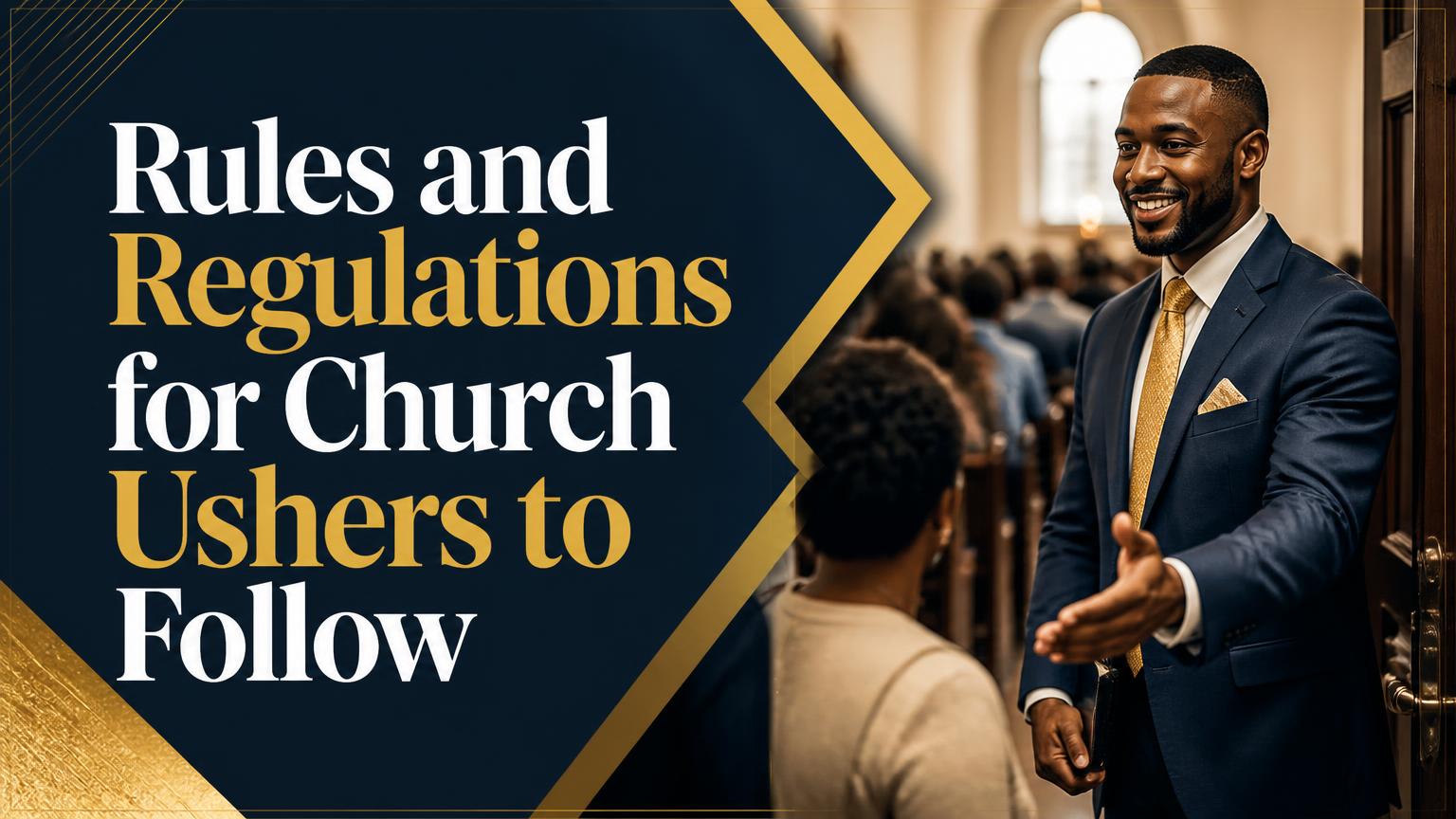
Church ushers are responsible for more than greeting people at the door. They help create an orderly, welcoming, safe, and worshipful environment while representing the church’s values. Effective rules and regulations for church ushers should address conduct, preparation, seating, accessibility, offering procedures, child safety, emergencies, confidentiality, and cooperation with church leadership. Because churches differ in size, denomination, facilities, and local legal requirements, these rules should be adapted into a written policy approved by the pastor, governing board, or designated ministry leader.
Rules and Regulations for Church Ushers
The following standards provide a practical foundation for an usher ministry. They should guide behavior during worship services, special events, funerals, weddings, conferences, and other gatherings held on church property.
Represent the Church With Respect and Humility
Ushers should arrive with a servant’s attitude, dress appropriately for the congregation and occasion, and speak to worshipers with patience and courtesy. They should avoid arguments, favoritism, gossip, unnecessary joking, or behavior that distracts from worship. Their role is to serve rather than control.
A biblical foundation for this attitude appears in Philippians 2:3–4, which directs believers to act with humility and consider the interests of others. Ushers should therefore correct problems discreetly, avoid embarrassing guests, and remember that a person’s appearance, background, income, disability, or familiarity with church customs does not determine how warmly that person should be treated.
Arrive Prepared and Know the Service Plan
Ushers should arrive early enough to attend the team briefing, inspect their assigned areas, and learn about that day’s service. Preparation may include checking entrances, seating areas, restrooms, lighting, collection supplies, accessibility routes, children’s check-in procedures, and emergency exits.
The head usher or service coordinator should communicate expected attendance, reserved seating, special guests, baptisms, communion, altar ministry, weddings, funerals, or other unusual arrangements. Ushers should also know whom to contact if a medical, security, pastoral, or building problem occurs. A prepared team responds calmly because it has already established responsibilities rather than improvising during a crisis.
Welcome Every Person Without Discrimination
Ushers should greet attendees impartially and offer reasonable assistance without making assumptions about their beliefs, family situation, nationality, race, age, disability, economic status, or personal history. A visitor should not be pressured to identify as a Christian, give money, disclose private information, or sit in a particular location without a legitimate reason.
Welcoming service includes clear directions, a helpful explanation of basic procedures, and sensitivity toward people who may be unfamiliar with the church. If translation, mobility assistance, hearing support, or another accommodation is requested, the usher should provide it when able or promptly involve the appropriate ministry leader. Local accessibility and nondiscrimination requirements may also apply, so church policies should be reviewed for the jurisdiction and facility.
Seat and Assist Worshipers With Discretion
Ushers may help people find seats, manage reserved areas, distribute bulletins, and reduce congestion near entrances. They should avoid forcing people to move unless there is a genuine safety, accessibility, or service-related reason. When late arrivals enter during prayer, Scripture reading, preaching, or another quiet moment, ushers should use judgment and minimize disruption.
Reserved seating should be marked clearly and applied consistently. A person with a disability, an older adult, a pregnant worshiper, or someone managing a small child may need a more accessible location. Ushers should ask before offering physical assistance and should never pull, lift, or guide someone without consent unless an immediate emergency requires action and the usher is trained to respond.
Protect Children, Older Adults, and Vulnerable People
Usher rules should work alongside the church’s child-protection and safeguarding policy. An usher should not take a child to a private room, transport a child alone, or release a child to an unauthorized person. Concerns about suspected abuse, neglect, exploitation, or immediate danger should be reported through the church’s designated process and, where required, to the appropriate authorities.
The same principle applies to older adults and other vulnerable people. Ushers should not handle personal finances, medication, confidential records, or transportation arrangements casually. They should request help from authorized leaders when a situation exceeds their role. Good intentions do not replace screening, training, supervision, or documented safeguarding procedures.
Handle Offerings and Church Property Securely
Money collected during worship should be handled according to a written financial-control procedure. Ushers should use designated offering containers, avoid counting funds alone, and transfer collections promptly to the authorized treasurer, finance team, or secure location. At least two authorized people should ordinarily verify or transport offerings when the church’s policy requires dual control.
Ushers should not borrow, exchange, or privately hold church funds. They should also protect keys, radios, equipment, communion supplies, records, and lost property. If money is missing or an irregularity occurs, the usher should report it immediately and factually rather than attempting a private investigation. Clear procedures protect both the church and the volunteers who serve it.
Respond to Disruptions and Emergencies Safely
Ushers should know the location of emergency exits, first-aid supplies, fire extinguishers, telephones, and evacuation assembly areas. In a medical emergency, they should contact emergency services when necessary, notify the designated leader, keep the area clear, and provide only the assistance for which they are trained. They should not diagnose conditions or administer medication without proper authorization.
During a fire, violent threat, severe weather event, or other emergency, ushers should follow the church’s emergency plan and directions from emergency personnel. They should not pursue a suspected offender, physically remove someone, or place themselves in unnecessary danger. De-escalation, communication, evacuation, and timely reporting are generally safer than confrontation. Any incident should be documented according to church policy after immediate danger has passed.
Protect Privacy and Maintain Appropriate Boundaries
Ushers often learn sensitive information: a visitor’s personal circumstances, a family conflict, a medical problem, or a security concern. Such information should be shared only with people who need it to respond appropriately. Ushers should never turn private observations into conversation, prayer requests, social media posts, or informal reports.
Boundaries also apply to communication and physical contact. Ushers should not pressure visitors for personal details, use their position to solicit business, or pursue inappropriate relationships with people they meet through ministry. Questions involving pastoral care, abuse, marital conflict, mental health, or financial hardship should be referred to trained and authorized leaders rather than handled as casual conversations.
Follow the Direction of Authorized Leaders
Ushers should follow the service plan and reasonable instructions from the head usher, pastor, event coordinator, or emergency personnel. If an instruction appears unsafe, discriminatory, unlawful, or inconsistent with church policy, the usher should raise the concern through the proper leadership channel instead of creating a public confrontation.
The head usher should assign posts, coordinate breaks, settle routine questions, and communicate with pastors and staff. Ushers should not independently change security procedures, promise special treatment, make public announcements, or discipline attendees unless their assigned role specifically permits it. Clear authority prevents conflicting instructions and helps the team respond consistently.
What Church Usher Policies Should Clarify
A written policy should define the usher’s authority and limits rather than relying on tradition or personal preference. It should identify who supervises the team, how volunteers are selected, what training is required, and how concerns are reported. It should also explain expectations for attendance, dress, mobile-phone use, punctuality, confidentiality, social media, and respectful communication.
The policy should cover routine service procedures as well as unusual events. Useful details include opening and closing responsibilities, seating plans, accessibility arrangements, lost-and-found procedures, offering controls, child release rules, emergency contacts, incident reports, and evacuation instructions. These details are especially important when several ushers serve together or when volunteers rotate frequently.
Church leaders should review the policy periodically, particularly after an incident, building renovation, change in ministry structure, or change in local requirements. Rules should be specific enough to guide action but flexible enough to account for differences between a normal Sunday service, a crowded holiday gathering, and a private event such as a funeral.
Usher, Greeter, and Security Roles Are Not Identical
A greeter primarily welcomes people, answers basic questions, and helps create a friendly first impression. An usher usually has additional responsibilities involving seating, service logistics, collections, crowd movement, accessibility, and emergency coordination. Some churches combine both roles, but volunteers should still understand which duties they are expected to perform.
Security personnel, safeguarding officers, pastoral counselors, and medical professionals have different training and authority. An usher may observe a concern and summon the appropriate person, but observation does not automatically authorize investigation, counseling, restraint, medical treatment, or law-enforcement action. Distinguishing these roles reduces risk and prevents volunteers from attempting tasks for which they are not prepared.
Training and Accountability Make Rules Effective
Rules are useful only when ushers understand them and can apply them under pressure. Initial training should cover welcoming practices, accessibility, child protection, emergency response, conflict de-escalation, offering security, confidentiality, and incident reporting. Practical walkthroughs can help volunteers locate exits, practice evacuation routes, and learn how to summon assistance.
Churches should provide a clear way to report misconduct, safety hazards, injuries, missing funds, or policy violations without fear of retaliation. Leaders should address concerns consistently and document significant incidents. Corrective action may involve coaching, additional training, temporary reassignment, or removal from the usher ministry, depending on the seriousness of the conduct. Accountability protects the congregation and preserves trust in the ministry.
Common Mistakes Church Ushers Should Avoid
An usher should not treat hospitality as a popularity contest, assume that every unfamiliar person is dangerous, or enforce personal preferences as though they were church policy. They should not embarrass late arrivals, criticize someone’s clothing, block a person with a disability from an accessible seat, or pressure anyone to give an offering.
They should also avoid promising confidentiality when a safeguarding concern may require reporting, handling church money outside established controls, posting photographs of attendees without permission where privacy concerns exist, or physically intervening in a confrontation without training. A calm referral to the right leader is often more responsible than an improvised response.
Conclusion
Rules and regulations for church ushers should combine Christian hospitality with practical responsibility. Ushers are expected to welcome people, support orderly worship, protect children and vulnerable adults, handle church property carefully, respect privacy, assist with accessibility, and respond to emergencies within the limits of their training. These duties should be written into a church-approved policy that reflects local law and the congregation’s actual facilities and ministries. The best usher serves warmly without becoming intrusive, exercises authority without seeking control, and knows when to call a pastor, safeguarding leader, medical professional, emergency service, or other authorized person.