
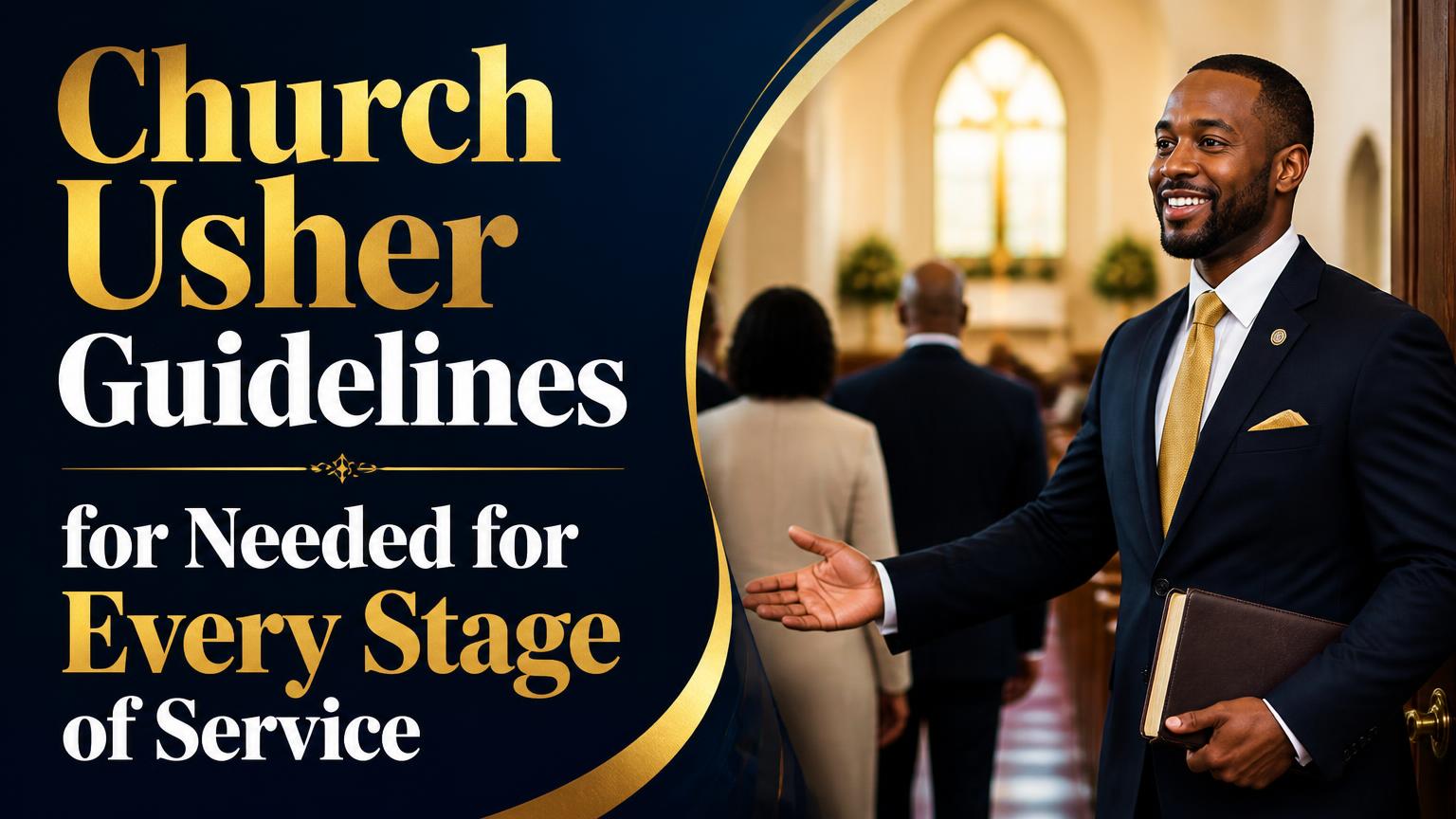
Church ushers help create a welcoming, orderly, and safe environment in which people can participate in worship. Their work begins before the first person enters and continues after the final prayer. Effective church usher guidelines therefore cover preparation, hospitality, seating, worship support, emergencies, confidentiality, and follow-up. An usher is not merely someone who hands out bulletins or directs traffic; the role combines practical organization with humble Christian service.
Church Usher Guidelines for Every Stage of Service
Prepare the Building and Team Before Service
Ushering begins before the congregation arrives. Ushers should report early enough to pray together, review assignments, inspect entrances and seating areas, and identify any special instructions for the service. Check that walkways are clear, doors are accessible, lighting is adequate, restrooms are easy to locate, and printed materials are available.
The team should know who is assigned to each entrance, section, offering duty, parking area, children’s ministry connection, and emergency responsibility. If the service includes baptisms, communion, a guest speaker, a wedding, a funeral, or a large visitor group, the ushering plan may need to change. Preparation prevents confusion and helps ushers serve calmly rather than react hurriedly.
Welcome People Without Showing Partiality
A warm greeting should be respectful, genuine, and appropriate to the person’s situation. Ushers can make eye contact, offer a simple welcome, answer basic questions, and help visitors find seating or ministry areas. They should avoid overwhelming newcomers with excessive attention, intrusive questions, or assumptions about their background.
Christian hospitality must extend to everyone. James 2:1–4 warns against showing favoritism based on appearance or social status. In practice, this means offering the same courtesy to families with young children, elderly people, people with disabilities, people experiencing homelessness, regular attendees, and first-time visitors. A church usher’s welcome should communicate dignity rather than evaluation.
Help People Find Suitable Seating
Ushers should guide people to available seats without making them feel pressured or embarrassed. When possible, leave appropriate space for late arrivals, families, older adults, people with mobility needs, and guests who may need quick access to an exit or restroom. Do not ask people to move unnecessarily after they have settled unless there is a genuine logistical reason.
During a crowded service, ushers may need to fill front rows, open additional seating, or explain that a section is reserved. These decisions should be communicated politely. Avoid loudly calling attention to latecomers or treating an occupied seat as permanently reserved without a clear policy. Good seating coordination preserves both order and personal dignity.
Support Worship Without Distracting From It
The usher’s task during worship is attentive availability, not constant movement. Ushers should remain in their assigned areas, observe the congregation discreetly, and respond when help is needed. They may assist with late seating, distribute materials, guide children or visitors, coordinate congregational movement, and communicate quietly with ministry leaders.
The principle in 1 Corinthians 14:40—doing things “decently and in order”—does not mean creating a rigid or lifeless atmosphere. Order should serve worship rather than compete with it. Ushers should avoid unnecessary conversations, visible disagreement, phone use, dramatic gestures, or repeated movement during prayer, Scripture reading, sermons, or musical transitions.
Handle Offerings and Communion Carefully
When ushers assist with offerings or communion, they should understand the church’s procedure before the service begins. They need to know where people should move, who receives the elements, how collected funds are secured, and what to do if an item is dropped or a person declines participation.
Participation should never be forced. Visitors may not understand the church’s practice, and some people may choose not to receive communion or contribute financially. Ushers can provide clear directions without pressuring anyone. Money and confidential materials should be handled according to established church procedures, with more than one authorized person involved where appropriate.
Respond to Needs, Disturbances, and Emergencies
Ushers should watch for practical needs such as illness, distress, conflict, unsafe conditions, blocked exits, or a lost child. The correct response is calm and discreet. An usher should notify the appropriate pastor, ministry leader, medical responder, child-protection coordinator, or emergency service rather than attempting a task beyond personal training.
Church ushers should know basic emergency procedures, including evacuation routes, severe-weather plans, first-aid locations, and how to contact emergency services. They should never physically confront an aggressive person unless immediate protection is unavoidable and they are trained to respond. The priority is to reduce danger, protect vulnerable people, and summon qualified help quickly.
Character Standards for Church Ushers
Serve From Love, Not From Status
Jesus connected leadership with service rather than prominence. In Mark 10:43–45, he taught that greatness among his followers is expressed through serving others. That principle shapes the usher’s attitude: the role is not a platform for authority, personal recognition, or control.
An usher may sometimes need to give directions, enforce a safety rule, or correct a procedural problem. Those responsibilities should be carried out with firmness and kindness. The goal is to protect worship and people, not to demonstrate power. A servant-minded usher asks, “What will help this person participate safely and respectfully?” rather than “How can I make everyone follow my preferences?”
Practice Confidentiality and Discretion
Ushers may notice personal information that others do not: a family conflict, a medical concern, financial difficulty, emotional distress, or a visitor’s uncertain circumstances. Such information should not become hallway conversation or a subject for informal prayer requests. Share details only with the people who need them to provide appropriate care or protection.
Discretion also applies to correcting behavior. Whenever possible, speak quietly and privately. Do not publicly identify a person who needs assistance, announce sensitive information over a microphone, or discuss a difficult incident where others can hear. Confidentiality is not secrecy about genuine safety threats; serious risks must be reported through the church’s safeguarding and leadership procedures.
Treat Safety as Part of Hospitality
Hospitality includes more than friendliness. People are more likely to feel welcome when entrances are accessible, children are accounted for, walkways are clear, and emergencies can be handled competently. Ushers should take concerns seriously rather than dismissing them as inconveniences.
Safety policies should be consistent and applied without discrimination. At the same time, ushers should use judgment and compassion. A parent soothing a crying child, a person with a disability needing extra time, or an older adult requiring assistance may need support rather than correction. Good judgment combines clear standards with attention to individual circumstances.
Practical Training and Team Procedures
Give Every Usher a Clear Assignment
Vague responsibility produces gaps. A written schedule should identify arrival time, assigned location, relief arrangements, offering responsibilities, emergency contacts, and the leader to whom questions should be directed. Ushers should know who is covering their position if they need to assist someone or leave the area.
A short pre-service briefing can address attendance expectations, special events, expected crowd size, accessibility needs, and unusual circumstances. Afterward, a brief review can identify what worked and what needs improvement. This process turns experience into better practice without blaming individuals for every problem.
Establish Communication Methods
Ushers need a discreet way to communicate with one another and with church leaders. Depending on the congregation, this may involve agreed hand signals, radios, text messages, or a designated contact person. The method should be simple enough to use during worship and clear enough to prevent misunderstandings.
Communication plans should also distinguish ordinary needs from emergencies. A request for extra seating does not require the same response as a medical crisis or missing child. Everyone should know how to summon help, who has decision-making authority, and when to contact emergency services directly.
Make Accessibility and Inclusion Routine
Accessibility should be planned rather than improvised. Ushers should know which entrances are step-free, where wheelchair spaces are located, how hearing-assistance systems work, and how to provide seating for people who need an unobstructed view or quick access to an exit. They should ask before physically assisting someone and follow the person’s instructions.
Inclusion also involves language, age, culture, and family circumstances. Clear signage, patient explanations, and a willingness to locate an interpreter or ministry representative can make a major difference. The objective is not to draw attention to a person’s difference but to remove avoidable barriers to participation.
Common Mistakes Church Ushers Should Avoid
A frequent mistake is confusing order with control. Ushers are responsible for helping the service function well, but they do not own the building, the congregation, or the worship experience. Excessive enforcement, sharp correction, and unnecessary restrictions can make visitors feel unwelcome and can undermine the church’s message of grace.
Another mistake is treating ushering as a passive position. Standing at a door without observing needs means missed opportunities to help. Ushers should remain alert while avoiding suspicion or surveillance. They should also avoid favoritism, gossip, arguing with guests, giving medical or pastoral advice beyond their competence, and leaving an assigned area without arranging coverage.
The opposite mistake is trying to handle everything personally. An usher is not automatically a counselor, security officer, medic, conflict mediator, or child-protection investigator. Knowing when to refer a matter is a sign of maturity, not failure. Clear boundaries protect the congregation and the usher.
A Simple Standard for Evaluating Ushering
A church can evaluate its ushering ministry by asking whether people are welcomed, informed, safe, and treated with dignity. Are first-time visitors able to find the entrance, seating, restrooms, and children’s areas without confusion? Can people with disabilities participate without unnecessary barriers? Do ushers know what to do during illness, conflict, evacuation, or a missing-child situation?
The church should also ask whether its procedures support worship rather than interrupt it. Good ushering is visible when needed and nearly invisible when everything is functioning well. Regular feedback from ushers, pastors, visitors, families, and people with accessibility needs can reveal problems that leaders may not notice from the platform.
Conclusion
Church usher guidelines should cover every stage of service: preparation before people arrive, welcoming and seating, quiet support during worship, careful handling of offerings and communion, response to emergencies, and follow-up afterward. The best ushers combine practical readiness with Christian character. They serve without favoritism, protect confidentiality, respect personal dignity, and know when to involve qualified leaders or emergency professionals. When these standards are practiced consistently, ushering becomes more than crowd management; it becomes a ministry of hospitality, order, safety, and humble care.