
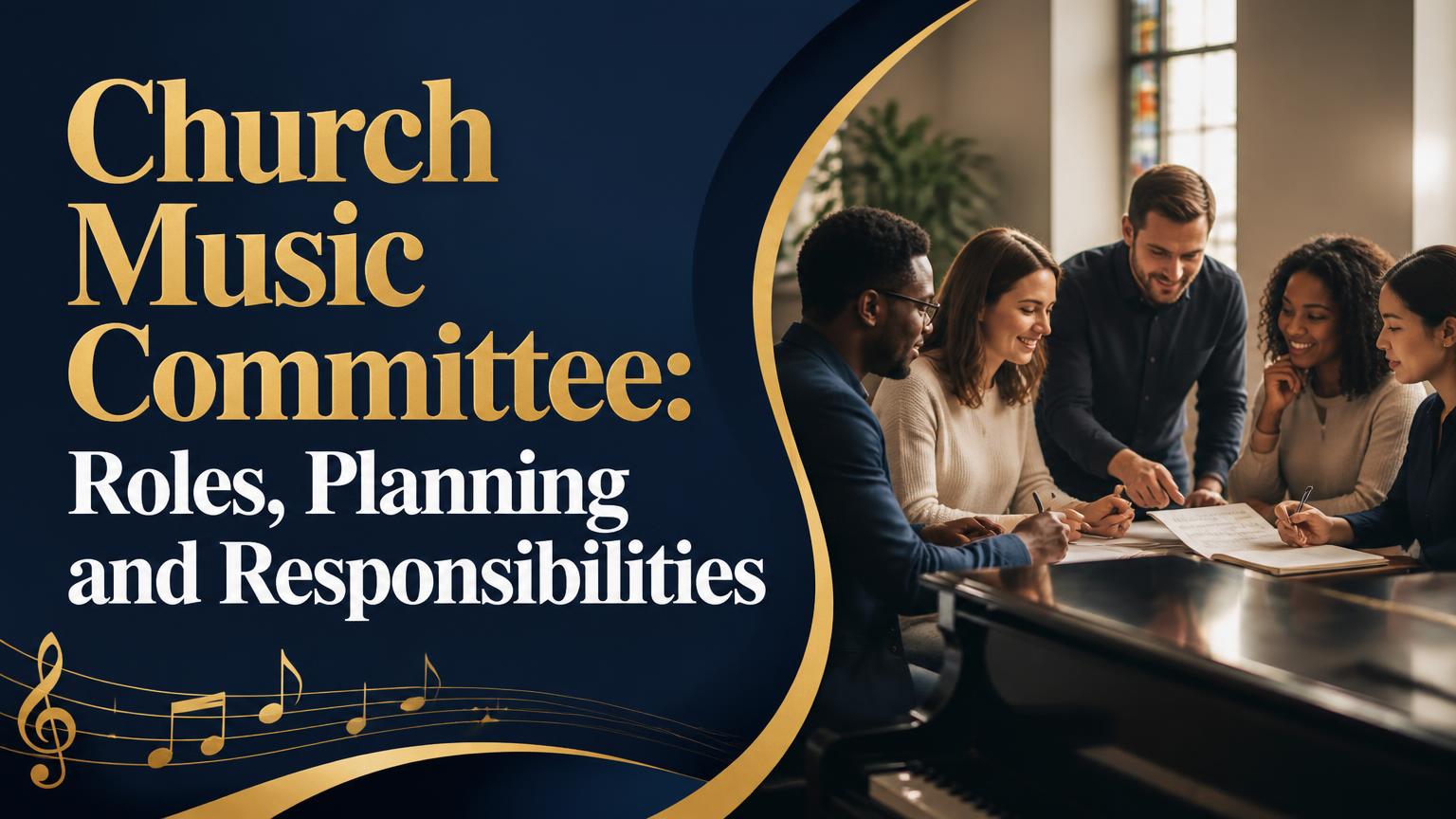
A Church Music Committee helps a congregation use music faithfully, skillfully, and responsibly in worship. Its work may include selecting songs, coordinating musicians, supporting choir and worship teams, preparing budgets, organizing rehearsals, and communicating with pastors and church leaders. The committee is not simply a group that chooses songs according to personal taste. It connects the church’s theology, worship practices, musical resources, congregational needs, and practical schedules so that music serves the gathered church rather than competing with it.
What Is a Church Music Committee?
A Church Music Committee is a group appointed or elected to oversee the musical life of a congregation. Its exact authority differs among churches: some committees advise a pastor or music director, while others manage most music-related decisions. In either case, its central responsibility is to help the church offer worship that is biblically grounded, pastorally appropriate, musically prepared, and accessible to the congregation.
The committee should establish clear boundaries with the pastor, worship leader, choir director, musicians, and governing board. A healthy committee does not treat music as an isolated performance department. It considers how music supports preaching, prayer, Scripture reading, Communion, seasonal observances, evangelism, congregational participation, and the wider mission of the church.
Clarify the Committee’s Mission and Authority
The committee should begin with a written purpose statement. This statement might explain that the committee supports congregational worship by coordinating music, developing musicians, maintaining resources, and encouraging participation across generations. Clear language prevents confusion about whether the committee makes final decisions or provides recommendations to the pastor, worship leader, or church council.
Authority should also be defined. A committee may approve an annual music budget but not hire staff, or it may recommend repertoire while the pastor confirms its theological and liturgical fit. Written responsibilities reduce duplicated work and prevent disagreements from becoming personal. They also give volunteers a stable framework when leadership changes.
Plan Repertoire and Worship Support
Song selection requires more than asking whether a piece is familiar or musically attractive. The committee should consider biblical and theological content, clarity of language, congregational singability, cultural sensitivity, service theme, season of the church year, and the abilities of available musicians. A technically impressive arrangement may be unsuitable if the congregation cannot sing it or if its message conflicts with the service.
Variety can be valuable, but variety should serve worship rather than become an end in itself. A balanced repertoire may include hymns, psalms, contemporary songs, spiritual songs, instrumental music, choral anthems, and music from different cultural traditions, depending on the congregation’s identity and theological convictions. The committee should explain significant repertoire decisions instead of allowing them to appear arbitrary.
Develop Musicians and Volunteers
A music committee should help people serve according to their gifts, maturity, availability, and training. This includes recruiting choir members, instrumentalists, singers, accompanists, sound volunteers, children, teenagers, and occasional participants. Recruitment works best when the church communicates expectations clearly: rehearsal times, preparation standards, dress requirements, spiritual conduct, and the type of service involved.
Development includes more than improving musical technique. Musicians need dependable schedules, constructive feedback, mentoring, and opportunities to grow in teamwork and worship leadership. Younger members may need age-appropriate roles rather than immediate responsibility for every service. A committee that invests in people builds continuity and reduces dependence on one highly skilled volunteer.
Manage Resources, Policies, and Communication
Administrative work often determines whether a music ministry remains healthy. The committee may oversee music purchases, instrument maintenance, sheet-music organization, microphones, robes, rehearsal space, digital files, and music-related portions of the church budget. It should also understand applicable copyright and licensing requirements rather than assuming that every song may be copied, projected, recorded, or distributed freely.
Communication should be centralized and timely. Musicians need to know the service theme, selected pieces, rehearsal schedule, keys, arrangements, substitutions, and performance expectations. The committee should maintain an updated contact list and calendar, document decisions, and communicate changes through agreed channels. Good administration protects relationships because volunteers are less likely to feel ignored, surprised, or overburdened.
How a Church Music Committee Plans Worship
Planning should begin well before the weekly rehearsal. The committee does not need to control every musical detail, but it should create a process that connects the service’s purpose with realistic preparation. A useful plan accounts for the order of worship, available personnel, seasonal events, the congregation’s abilities, and the time required to learn unfamiliar music.
Begin With the Service’s Purpose and Theme
The first planning question is not, “Which songs do we like?” It is, “What is this service helping the congregation hear, confess, celebrate, remember, or practice?” The answer may relate to a Scripture passage, sermon theme, baptism, Communion, Advent, Easter, lament, mission, or a community concern.
Once the purpose is clear, the committee can choose music that reinforces rather than distracts from it. For example, a service focused on confession may require songs that acknowledge sin and grace, while a service centered on mission may emphasize God’s sending and the church’s response. Music should complement the service without merely repeating every spoken idea.
Match Music to the Congregation and the Moment
A suitable song must fit both the congregation and its place in the service. A processional, prayer response, offertory, hymn of praise, choral meditation, and closing song serve different functions. The committee should consider vocal range, tempo, text density, accompaniment, language, accessibility, and whether people can participate while standing, responding, praying, or receiving Communion.
This is also where inclusion matters. Large-print materials, readable projections, accessible keys, translated texts, and opportunities for people with different abilities can broaden participation. Introducing every new song at once may frustrate the congregation, while never introducing new music can prevent growth. A gradual approach usually works better: teach unfamiliar pieces clearly, repeat them enough for recognition, and retain trusted music as an anchor.
Prepare, Review, and Improve
Preparation includes distributing music early, scheduling adequate rehearsals, confirming instrumental parts, checking technology, and identifying difficult transitions. The committee should distinguish between problems caused by insufficient preparation and problems caused by an unsuitable arrangement or unrealistic schedule. Adding more rehearsals will not solve every structural problem.
After a service or season, the committee can conduct a brief review. What helped the congregation participate? Did musicians have enough time? Were the songs appropriate to the service? Did the sound system or printed materials create barriers? Review should seek improvement rather than assign blame. Specific observations produce better results than general comments such as “the music felt wrong.”
Biblical and Ministry Principles for Music Committees
Scripture presents singing and music as ways God’s people praise, remember truth, express lament, teach one another, and respond to God’s work. Colossians 3:16 connects psalms, hymns, and spiritual songs with teaching and mutual encouragement. That principle means church music has a formative role: texts help shape what people believe, feel, remember, and say together. A committee should therefore evaluate lyrics with care, especially when a song makes claims about God, salvation, suffering, the church, or Christian discipleship.
The New Testament also emphasizes order, mutual service, and the use of gifts for the good of the body. First Corinthians 14:40 calls for worship to be conducted decently and in order, while Romans 12:4–8 describes different gifts functioning together. These passages do not prescribe one musical style or one committee structure. They do support a ministry approach in which musical ability serves the congregation, leadership remains accountable, and excellence is joined to humility, care, and intelligibility.
How to Organize Meetings and Decisions
An effective committee meeting needs a defined agenda and the right participants. A typical agenda might include upcoming services, repertoire decisions, rehearsal needs, volunteer coverage, equipment or budget issues, pastoral coordination, and follow-up from previous meetings. The committee should circulate necessary information beforehand so meeting time is used for decisions rather than avoidable explanation.
Decision-making should reflect the committee’s authority and the church’s governance structure. Personal preference should not be the only standard. Useful criteria include theological suitability, congregational participation, pastoral fit, musical feasibility, cost, accessibility, and consistency with the church’s stated worship identity. Recording decisions and assigning a responsible person with a deadline turns discussion into action.
Membership should include the perspectives needed for the ministry, not simply the people most interested in music. Depending on the church, that may include a pastor, music director, choir representative, instrumentalist, youth or children’s representative, worship leader, and church administrator. Rotating terms can introduce new ideas while preserving enough continuity to maintain long-term planning.
Common Problems and Better Practices
Committees often struggle when their responsibilities are unclear or when musical disagreements become symbolic of larger church tensions. The following problems are common, but each can be addressed through disciplined processes and a ministry-centered purpose.
Treating Musical Preference as the Main Standard
People naturally have different preferences about hymns, instruments, volume, languages, arrangements, and musical styles. Preference matters, but it cannot by itself determine church policy. A committee should ask whether a proposed choice communicates faithfully, enables participation, fits the service, and can be prepared well.
This approach does not require pretending that every style suits every congregation. Churches may have legitimate theological, cultural, or historical convictions about worship. The key distinction is between a reasoned congregational standard and an individual demand that personal taste become the standard for everyone.
Overloading a Small Group of Volunteers
A committee may unintentionally depend on the same musicians for every service, rehearsal, emergency substitution, and special event. That pattern creates fatigue and makes the ministry vulnerable when one person moves, becomes ill, or needs rest. A schedule should distribute responsibilities realistically and identify backup options before emergencies occur.
The committee can also distinguish essential services from optional additions. Not every special program needs a choir anthem, instrumental ensemble, or elaborate arrangement. Sustainable ministry often requires saying no to good ideas when the available people, time, or budget cannot support them without harming volunteers.
Confusing Excellence With Performance
Preparation and musical excellence can honor the congregation, but a worship service is not successful merely because it sounds polished. Excessive complexity, volume, or stage focus can reduce congregational participation. Conversely, the idea that sincerity excuses careless preparation can burden singers and distract worshipers.
The better goal is faithful excellence: prepare carefully, use gifts responsibly, correct avoidable errors, and keep the congregation’s participation and attention central. The committee should evaluate music by both musical quality and ministry effect. A simpler piece may serve better than a difficult one if it communicates clearly and allows the church to sing together.
Conclusion
A Church Music Committee provides direction, accountability, and continuity for a congregation’s musical ministry. Its work includes repertoire planning, volunteer development, rehearsal coordination, budgeting, equipment oversight, communication, and evaluation. The committee’s deepest responsibility is to keep these practical tasks connected to worship’s purpose: helping the church praise God, receive and remember the gospel, respond in faith, and encourage one another.
The strongest committees establish clear authority, make decisions through shared criteria, respect the pastor and musicians, welcome appropriate variety, and protect volunteers from unsustainable expectations. They pursue musical preparation without turning worship into performance and encourage participation without treating quality as irrelevant. When music, theology, people, and planning work together, the committee becomes a servant of the whole congregation rather than a gatekeeper for musical preferences.