
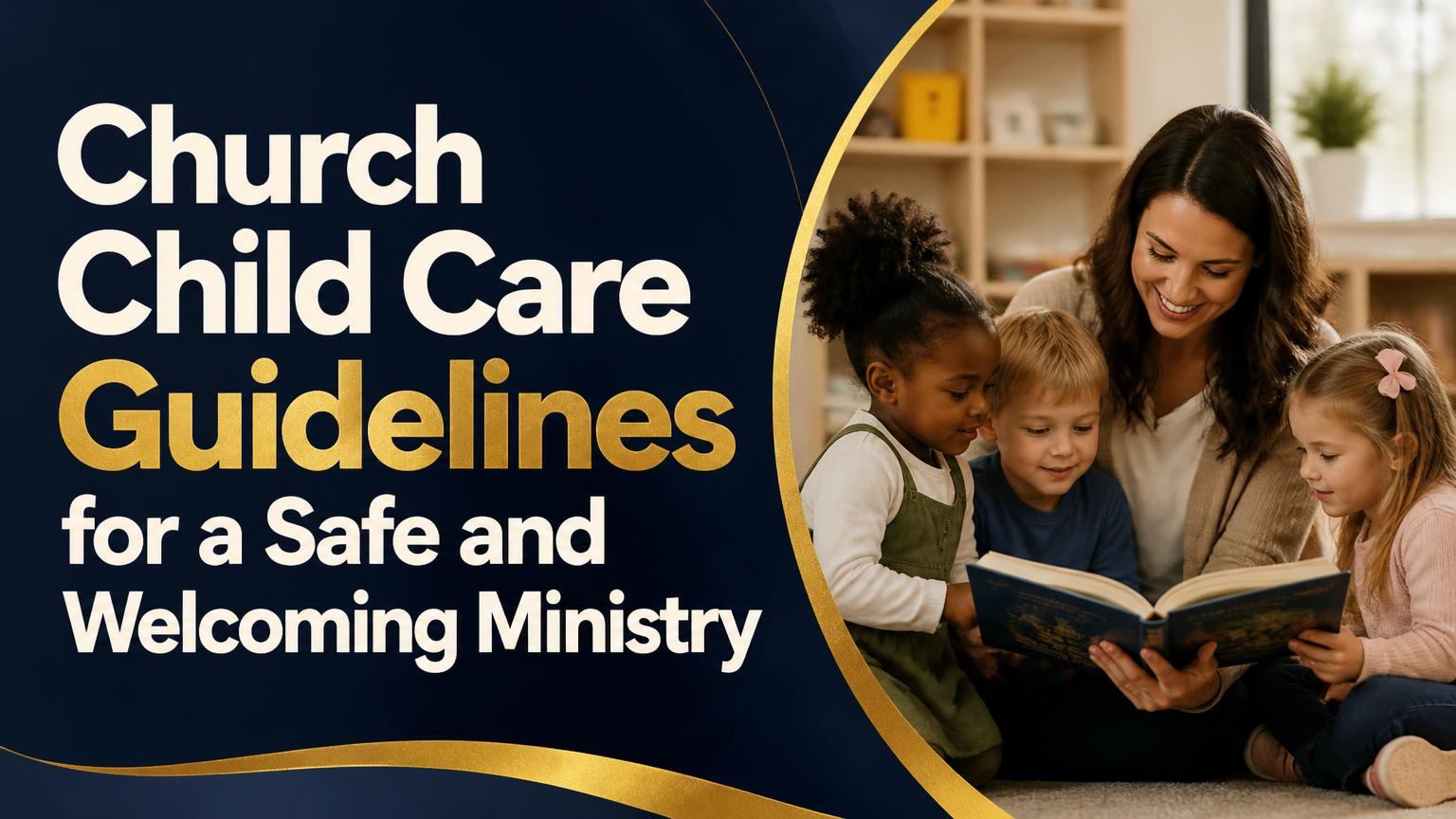
Church child care guidelines should protect children physically, emotionally, and spiritually while helping families feel confident entrusting their children to the church. A sound ministry plan goes beyond keeping doors open and assigning volunteers. It addresses screening, supervision, secure check-in and release, health needs, emergency response, abuse prevention, age-appropriate care, inclusion, documentation, and ongoing training. The goal is a ministry environment where children are safe, caregivers are prepared, parents are informed, and every child is treated with dignity and compassion.
Church Child Care Guidelines
Define the Ministry’s Scope and Responsibilities
Begin by deciding exactly what the church provides. A nursery during worship, a children’s Sunday school class, a midweek program, and extended child care during an adult meeting may have different staffing, supervision, and legal requirements. State the ages served, hours of operation, activities included, who may pick up a child, and what happens when a parent is late.
The church should designate a ministry leader with authority to train workers, maintain records, respond to concerns, and suspend a program when safety standards cannot be met. Written procedures should be available to employees, volunteers, parents, and church leadership. If the program meets the legal definition of child care in the local jurisdiction, the church must follow applicable licensing, health, building, employment, and reporting requirements.
Screen and Train Every Worker
Every paid worker and volunteer who regularly serves with children should complete an application, interview, reference process, and background screening appropriate to the role and local law. Screening reduces risk, but it cannot guarantee that a person is safe; it must be combined with supervision, clear boundaries, and a culture in which concerns are taken seriously.
Training should cover child protection, recognizing signs of abuse or neglect, appropriate physical contact, toileting and diapering, emergency procedures, allergies, medication policies, behavior guidance, confidentiality, and incident reporting. Workers should know exactly whom to contact when they suspect abuse or observe unsafe conduct. Training should occur before service begins and be refreshed periodically rather than treated as a one-time administrative requirement.
Use Two-Adult and Visibility Practices
Whenever practical, children should be supervised by at least two approved adults, or care should take place where another authorized adult can readily see and hear what is happening. Avoid isolated rooms, blocked windows, closed doors without a documented reason, and situations in which one adult has unchecked access to a child. The appropriate policy may vary by age and setting, but the principle is consistent: reduce secrecy and make ordinary supervision observable.
Workers should not use private messaging, personal social media accounts, or undisclosed transportation arrangements to communicate with children. Physical affection should be brief, appropriate, and responsive to the child’s comfort. Caregivers should redirect behavior calmly, never use corporal punishment, threats, humiliation, or frightening discipline, and should summon a parent or ministry leader when a situation exceeds their training.
Maintain Safe Staffing and Active Supervision
Staffing levels should reflect the children’s ages, needs, room size, activity, and local regulations. Infants and toddlers generally require closer supervision than older children because they have limited communication, mobility, and hazard awareness. The church should follow the strictest applicable standard among law, insurance requirements, denominational policy, and its own written safety policy.
Active supervision means workers position themselves to see the whole space, count children regularly, anticipate hazards, and avoid distractions such as personal phones. A head count should occur during transitions, outdoor activities, evacuations, and whenever a group enters or leaves a room. A volunteer who is responsible for supervision should not simultaneously be expected to prepare food, manage registration, or leave the group unattended.
Secure Check-In, Identification, and Release
Use a consistent check-in process that records the child’s name, age, parent or guardian contact information, authorized pickup names, allergies or medical alerts, and any special instructions. Give the parent a matching identification method, such as a numbered label or secure digital record. Release a child only to an authorized adult whose identity can be verified according to the church’s policy.
Do not rely on familiarity alone, even in a small congregation. If a parent sends someone else, the church should require prior authorization or confirm the change directly with the parent. Establish procedures for custody restrictions, late pickup, lost identification labels, and an unclaimed child. Records should be stored securely, accessed only by appropriate personnel, and retained according to legal and organizational requirements.
Prepare for Health Needs and Emergencies
Collect emergency contacts, allergy information, relevant medical conditions, and consent forms before care begins. Workers should know how the church handles food allergies, illness, fever, injury, medication, and emergency medical treatment. Medication should be accepted and administered only under a written process that addresses authorization, storage, labeling, dosage, and documentation.
Rooms should have accessible first-aid supplies, working communication devices, emergency exits, posted evacuation instructions, and an updated attendance list. Plans should address fire, severe weather, earthquake where relevant, lockdown or security threats, missing children, and medical emergencies. Practice age-appropriate drills without creating unnecessary fear. For infants, use safe sleep procedures: place babies on their backs in an approved sleep space with a firm surface and no loose blankets, pillows, toys, or other soft items.
Protect Children From Abuse and Neglect
A child protection policy should explain how workers prevent, recognize, document, and report suspected abuse. Workers should understand that they are not responsible for proving abuse or conducting an investigation. When a concern reaches the threshold established by local law, the designated worker must make the required report to the appropriate authority, even if the suspected person is a respected church member or ministry leader.
The church should prohibit retaliation against anyone who raises a good-faith concern. Reports should be handled promptly and shared only with people who need the information to protect the child and fulfill legal responsibilities. Internal reputation, pastoral relationships, or a desire to avoid embarrassment must never take priority over a child’s safety.
Build a Consistent Child Care System
Good guidelines work because they are implemented consistently. A church may have excellent policies on paper but still create risk if volunteers improvise check-in, overlook missing forms, or assume that familiar people do not need to follow the rules. The system should be simple enough for a new volunteer to understand and firm enough to prevent exceptions from becoming routine.
Create Written Policies and Forms
A practical child care handbook should include the purpose of the ministry, eligibility and screening standards, supervision rules, check-in and release procedures, health exclusions, medication requirements, emergency plans, discipline expectations, abuse reporting instructions, transportation rules, and procedures for documenting incidents. Forms should include registration, emergency contacts, authorized pickup information, medical permissions, photo permissions, and incident reports where appropriate.
Policies should use direct language. “Never leave children unsupervised” is clearer than “provide adequate supervision.” Assign responsibility for updating documents, checking supplies, reviewing attendance records, and communicating changes to families. Policies should be reviewed after an incident, a near miss, a facility change, or a change in law or insurance requirements.
Design Rooms for Safety and Belonging
Arrange rooms so adults can see children easily and exits remain accessible. Secure furniture, cover or remove hazards, separate age groups when needed, store cleaning supplies and sharp objects out of reach, and inspect toys for broken parts or choking hazards. Keep diaper-changing and toileting areas clean, supplied, and designed to preserve privacy while maintaining appropriate visibility.
A welcoming room also supports children with disabilities, sensory differences, language differences, and varying family circumstances. Provide reasonable accommodations when possible, ask parents what helps their child participate, and avoid treating disability-related behavior as deliberate disobedience. Inclusion is a safety issue as well as a hospitality issue because children are more secure when caregivers understand their communication and support needs.
Communicate Clearly With Families
Parents should receive the church’s basic procedures before leaving a child in care. Explain where to check in, how workers will contact them, what symptoms require a child to stay home, who may pick up the child, and how incidents or injuries will be communicated. Do not promise absolute confidentiality; explain that safety concerns may need to be shared with leaders or authorities.
Communication should be respectful and factual. If a child is injured, becomes ill, has a serious behavioral incident, or reports something concerning, document what was observed and tell the parent or guardian through the designated process. Avoid speculation, accusations, or casual discussion with other families. Consistent communication builds trust because parents can see that the church has a process rather than relying on individual judgment.
Common Weaknesses to Avoid
Several practices create preventable risk even when a church has caring volunteers. Treating background checks as complete protection ignores the importance of daily supervision. Allowing “just this once” exceptions to pickup or room-access rules weakens the entire system. Using teenagers as the only caregivers for infants, leaving a classroom during transitions, or permitting adults to work alone with children can create unacceptable gaps in oversight.
Another weakness is confusing a warm ministry with an unstructured ministry. Children need welcome, affection, play, and spiritual care, but they also need predictable routines and boundaries. A church can be compassionate while requiring registration, enforcing illness policies, documenting injuries, and addressing unsafe conduct immediately. These safeguards serve families; they do not communicate distrust of every volunteer.
How Churches Should Review Their Guidelines
Review child care procedures at least annually and whenever circumstances change. Invite the ministry leader, trained workers, church leadership, facilities personnel, and, where appropriate, parent representatives to identify hazards and test whether the written policy matches actual practice. Walk through a typical arrival, classroom transition, bathroom visit, emergency evacuation, and pickup period rather than reviewing paperwork in isolation.
The review should examine near misses as well as actual incidents. A child who nearly left an unsecured area, an unlabeled medication, or a recurring difficulty reaching parents may reveal a system weakness before serious harm occurs. Corrective actions should have an assigned person and deadline. Churches should also confirm that insurance, legal, licensing, and denominational requirements remain current instead of assuming that an old policy still provides adequate protection.
Conclusion
Effective church child care guidelines combine hospitality with disciplined protection. They require screened and trained workers, observable supervision, secure check-in and release, careful health procedures, abuse-prevention practices, emergency readiness, inclusive facilities, and clear communication with families. No single safeguard is sufficient by itself: background checks do not replace supervision, written policies do not replace training, and good intentions do not replace consistent procedures.
The strongest child care ministry makes safety part of ordinary church culture. Leaders model accountability, volunteers follow the same rules, parents know what to expect, and concerns receive prompt attention. By treating children as people entrusted to the church’s care rather than as a logistical responsibility, a congregation creates an environment that is safer, more welcoming, and more faithful to its responsibility to serve families well.