
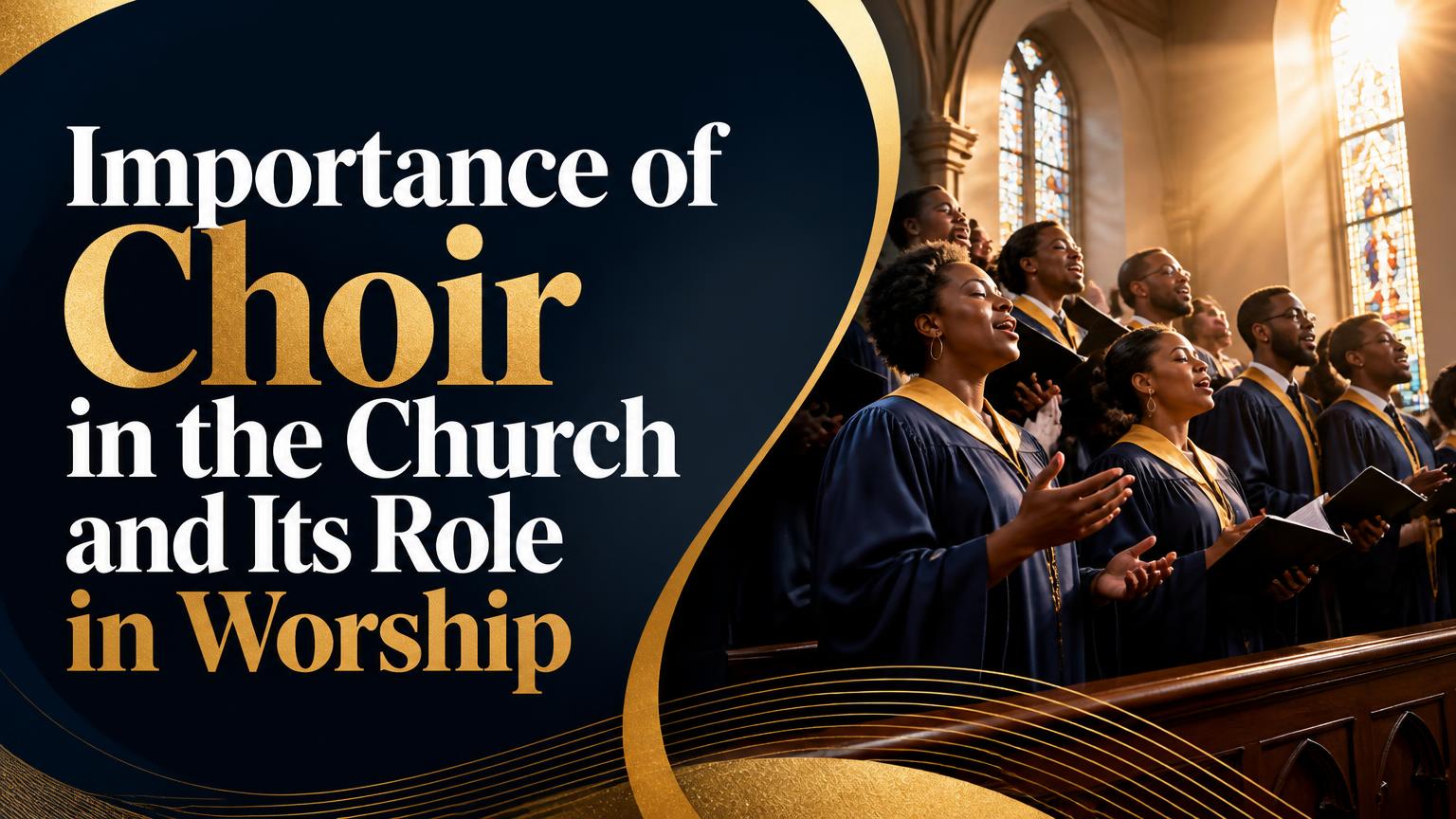
A church choir is more than a group that performs songs during a service. When its ministry is shaped by biblical worship, musical preparation, spiritual maturity, and pastoral sensitivity, the choir helps the congregation praise God, understand Christian truth, express unity, and participate more fully in worship. Its importance does not come from volume, technical complexity, or public visibility. The choir serves best when it supports congregational worship rather than replacing it, directing attention toward God rather than toward the singers themselves.
What Is the Importance of Choir in the Church?
The Choir Leads Praise While Serving the Congregation
The choir helps lead the church in expressing praise, thanksgiving, repentance, lament, and hope. A trained group can provide musical stability, introduce a new hymn or arrangement, support difficult harmonies, and help the congregation begin singing with confidence. Its role is therefore participatory rather than merely performative.
The choir should sing on behalf of the congregation only in the limited sense that it gives voice to truths the whole church is learning to confess. It does not worship instead of the congregation. Its leadership is successful when people in the pews, seats, or gathered community are encouraged to sing, pray, listen, and respond to God.
The Choir Teaches Biblical Truth Through Song
Songs often remain in the memory longer than spoken explanations. A choir can help the church learn biblical language about God’s character, Christ’s saving work, the Holy Spirit, sin, grace, suffering, mission, and eternal hope. Colossians 3:16 connects singing with teaching and admonishing one another, showing that Christian music can communicate doctrine as well as emotion.
This makes song selection a theological responsibility. A beautiful arrangement cannot compensate for shallow, confusing, or inaccurate words. Choir leaders should examine whether lyrics agree with Scripture, whether they present the gospel faithfully, and whether they speak appropriately to the congregation’s season of worship. The choir becomes a teaching ministry when musical beauty carries sound Christian truth.
The Choir Expresses Unity in the Body of Christ
A choir brings people with different voices, ages, abilities, personalities, and backgrounds into one coordinated act of service. Each singer must listen to others, follow a shared rhythm, accept correction, and contribute without overpowering the group. That process offers a practical picture of Christian unity: people retain their differences while serving a common purpose.
The image is especially meaningful in churches divided by preference, culture, or generation. A carefully chosen repertoire can make room for different musical traditions without treating one style as the measure of spiritual maturity. Unity does not require musical uniformity. It requires a shared commitment to worship God and build up the church.
The Choir Develops Spiritual Gifts and Faithful Service
Singing, conducting, arranging, accompanying, organizing, and teaching are all forms of service when offered to God and the church. A choir gives members a structured way to use musical abilities for the common good. It also develops habits that Christian ministry requires: preparation, reliability, humility, patience, cooperation, and willingness to serve when the task is unseen.
Musical ability alone, however, does not make someone ready for visible ministry. Character, teachability, respect for church leadership, and concern for the congregation matter as well. First Corinthians 12 emphasizes that gifts are given for the benefit of the whole body. The choir should therefore value spiritual maturity and dependability alongside vocal skill.
The Choir Offers Pastoral Support Through Music
Music can help a congregation express emotions that are difficult to articulate in ordinary speech. A choir may sing during a funeral, a service of confession, a season of grief, a baptism, a celebration, or a time of corporate prayer. In these settings, the choir does not manipulate emotion; it helps the church place emotion before God.
The Psalms provide examples of worship that includes joy, fear, sorrow, anger, waiting, and confidence. A faithful choir leaves room for this full range of biblical experience. Its ministry may comfort people who are hurting, strengthen those who are discouraged, and help the church remember God’s promises when circumstances are difficult.
Biblical Foundations for Choir Ministry
Temple Singers Show the Value of Organized Musical Service
The Old Testament describes organized singers and musicians serving in Israel’s worship, particularly in connection with the temple. First Chronicles 25 refers to singers appointed and trained for ministry, while other passages describe Levites leading musical praise. These accounts show that preparation, leadership, and musical organization can have a legitimate place in corporate worship.
The temple system should not be transferred mechanically into the modern church. Christians worship under the new covenant and are not required to reproduce Israel’s priestly structure. Nevertheless, the principle remains useful: music offered in public worship deserves care, discipline, and intentional service rather than being treated as an afterthought.
New Testament Singing Emphasizes Mutual Edification
The New Testament gives the church a broad calling to sing. Ephesians 5:19 speaks of psalms, hymns, and spiritual songs, and Colossians 3:16 connects singing with teaching one another. These passages emphasize the congregation’s shared participation and mutual encouragement.
The New Testament does not require every church to maintain a formal choir. A church may worship faithfully with congregational singing led by a small group, a worship leader, an instrumentalist, or no specialized musical ensemble. The biblical priority is not the existence of a choir as an institution but the church’s truthful, reverent, and mutual worship.
The Choir Should Point Beyond Itself
Jesus warned against religious practices performed to gain human approval, including public acts shaped by the desire for recognition (Matthew 6:1). That principle applies to choirs as well as to other ministries. A choir can unintentionally become a platform for status, competition, or artistic display if attention shifts from God and the congregation to individual performers.
This does not mean excellence is wrong. Psalm 33:3 encourages skillful musical praise, and careful preparation can express love for God and respect for the church. The necessary distinction is between excellence as stewardship and excellence as self-promotion. Skill should make worship clearer and more compelling, not make the choir the main object of attention.
The Choir and the Congregation: A Necessary Distinction
A choir and a congregation have related but different functions. The choir often provides leadership, musical support, special parts, or a fuller sound. The congregation represents the gathered body of believers, offering collective praise and confession. A healthy service makes space for both rather than allowing the choir to sing every significant moment while the congregation listens passively.
This distinction affects arrangement, volume, repertoire, and service planning. If songs are too difficult, unfamiliar, or dominated by the choir, participation may decline. If the choir supports melodies, introduces accessible material, and leaves room for congregational voices, it strengthens rather than displaces the church’s worship.
The distinction also protects the choir from unrealistic expectations. Choir members are not entertainers, spiritual celebrities, or substitutes for preaching and pastoral care. Their ministry is one part of the church’s larger worship, alongside Scripture reading, prayer, proclamation, the sacraments or ordinances practiced by that tradition, fellowship, and acts of mercy.
How Churches Can Strengthen Their Choir Ministry
Choose Repertoire for Theology and Congregational Use
A useful repertoire combines biblical faithfulness, musical quality, cultural awareness, and suitability for the congregation. Leaders should consider whether the words are understandable, whether the range is singable, and whether the song fits the service’s theme without forcing every passage into a celebratory mood.
Variety can serve the church when it is purposeful. Psalms, historic hymns, contemporary songs, spirituals, and music from different Christian traditions may each contribute something valuable. Variety should not become novelty for its own sake; every selection should help the congregation worship and understand the gospel.
Build Preparation Around More Than Rehearsal
Rehearsal is necessary, but choir formation should include prayer, biblical reflection, and discussion of the ministry’s purpose. Singers who understand why they are serving are better prepared to handle correction, missed notes, schedule changes, and moments when their contribution receives little public recognition.
Leaders should also establish practical expectations concerning attendance, punctuality, dress, communication, auditions where appropriate, and care for vocal health. Clear expectations reduce conflict and help the choir serve consistently. Training should be demanding enough to improve quality while remaining patient with developing musicians.
Practice Inclusion Without Abandoning Standards
A church choir should welcome people who can contribute meaningfully, while recognizing that public musical leadership requires some level of preparation and competence. Inclusion does not mean ignoring pitch, rhythm, conduct, or the needs of other singers. It means treating people with dignity, offering pathways for growth, and avoiding the assumption that only highly trained musicians can serve God.
Some members may sing in a large choir, a small ensemble, a children’s group, or an occasional seasonal presentation. Others may support the ministry through accompaniment, administration, hospitality, or prayer. Broad participation helps prevent the choir from becoming an exclusive social or artistic club.
Measure Success by Faithfulness, Not Applause
A choir’s visible response from the audience is an unreliable measure of spiritual value. A quiet anthem may serve a grieving congregation better than an impressive production. A simple hymn may teach more effectively than a technically demanding arrangement. Faithfulness includes preparation, theological integrity, humility, and attention to the church’s actual needs.
Leaders can ask practical questions: Did the music support the service? Could people understand and participate? Did the selection fit the congregation’s context? Were singers treated well? Did the ministry encourage worship, or did it create unnecessary distraction? These questions help preserve the choir’s purpose.
Common Challenges in Choir Ministry
Choirs can face tension over musical style, leadership, scheduling, visibility, and standards. Older and younger members may prefer different traditions. A conductor may emphasize artistic quality while a pastor prioritizes congregational accessibility. Some singers may want frequent public opportunities, while others prefer occasional service. These disagreements are not automatically signs of spiritual failure, but they require honest communication and shared submission to the church’s mission.
Another danger is treating the choir as either indispensable or irrelevant. It is neither. A church can worship faithfully without a formal choir, and a choir can make a valuable contribution when its ministry fits the church’s theology, resources, and culture. The appropriate question is not whether every church must have one, but whether this congregation can use organized singing to serve God and strengthen its people.
Financial and logistical limitations also matter. Robes, music, instruments, rehearsal space, and trained leadership require resources. Churches should pursue excellence responsibly rather than creating burdens that undermine other ministries. A modest choir that serves consistently may be healthier than a large program sustained by pressure, competition, or excessive expense.
Conclusion
The importance of choir in the church lies in its capacity to help the whole congregation worship with truth, unity, beauty, and spiritual understanding. A choir teaches through Scripture-shaped song, develops gifts for service, supports the emotional life of the church, and gives visible expression to shared faith. Yet the choir is not the center of Christian worship, and the Bible does not require every congregation to maintain one. Its proper role is supportive and formative: prepared without pride, excellent without performance-driven vanity, and always directed toward God and the edification of the church.