
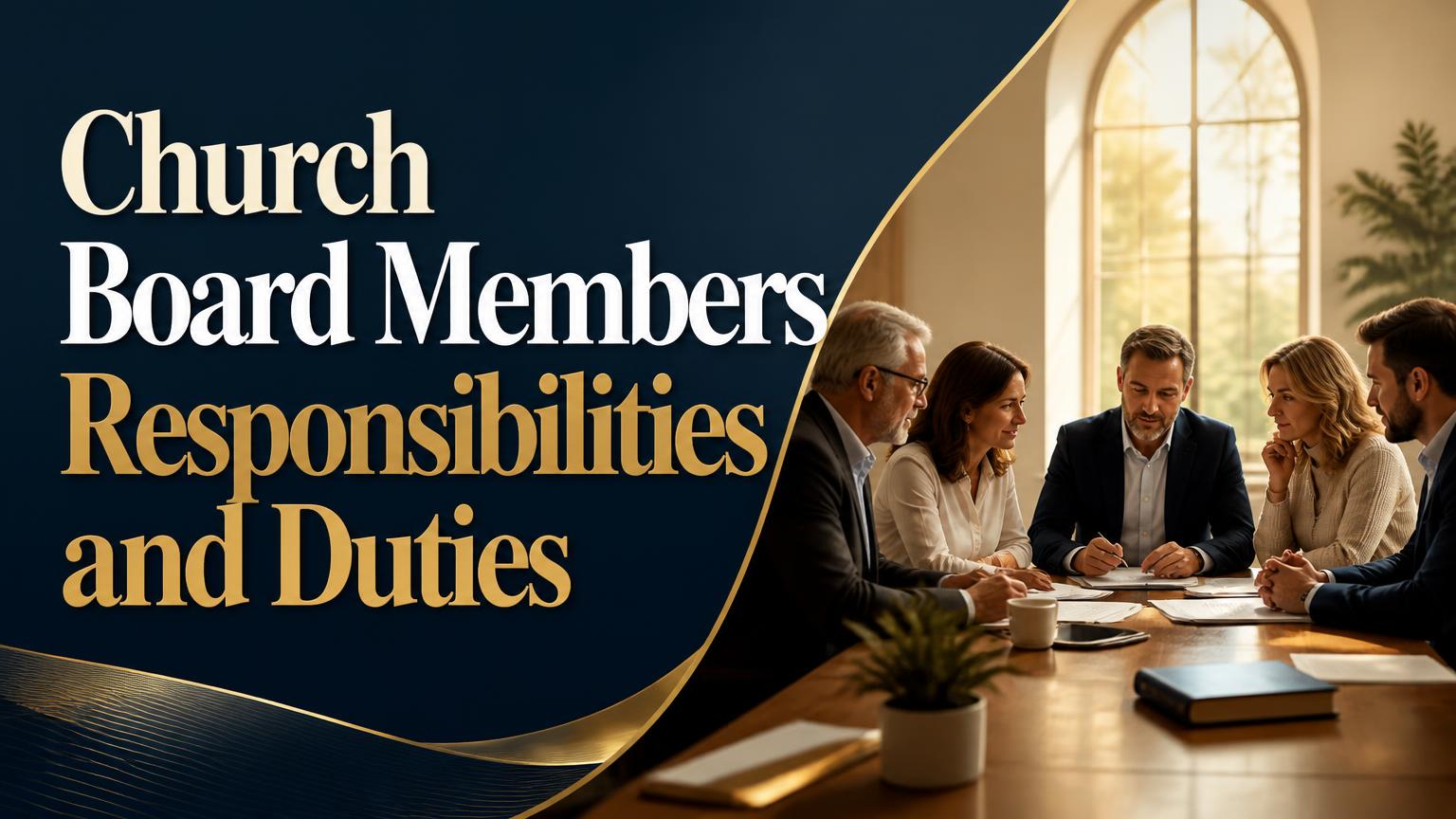
Church board members provide spiritual and organizational oversight so a church can pursue its mission faithfully, responsibly, and sustainably. Their work commonly includes safeguarding doctrine and mission, overseeing finances, supporting pastoral leadership, protecting people, complying with governing documents and law, and making significant decisions through prayerful, accountable governance. Exact duties vary by denomination, church polity, bylaws, and local legal requirements.
Church Board Members’ Responsibilities and Duties
A church board is responsible for stewardship rather than personal control. Board members act on behalf of the congregation and the church’s mission, not as owners of church property or as managers of every ministry detail.
Provide Spiritual Oversight and Direction
Church board members help ensure that the church’s decisions reflect its Christian mission and stated beliefs. This may include:
- Clarifying or protecting the church’s mission and vision
- Evaluating whether major plans support that mission
- Encouraging faithful worship, discipleship, evangelism, service, and care
- Praying for the church, its leaders, and its ministry
- Addressing serious spiritual or ethical concerns
- Helping the congregation remain focused on its calling rather than internal preferences
Spiritual oversight does not mean that every board member becomes a preacher or directs individual members’ personal lives. It means that the board treats the church as a ministry entrusted to it, not merely as an organization requiring administration.
Scripture describes overseers as responsible for watching over God’s people (Acts 20:28) and instructs shepherds to lead willingly and by example rather than domineering over others (1 Peter 5:2–3). These principles shape the board’s posture: service, humility, accountability, and care.
Guard the Church’s Mission and Doctrine
Boards often have a responsibility to preserve the church’s doctrinal identity and ensure that teaching and public ministry remain consistent with its confession, statement of faith, or denominational commitments.
This can involve:
- Approving or reviewing major ministry initiatives
- Establishing policies for teaching, membership, baptism, communion, and discipline where applicable
- Responding to serious doctrinal disputes
- Ensuring that church leaders understand the organization’s beliefs and policies
- Revising the mission or governing documents when the congregation’s circumstances change
The board should not use doctrinal oversight as a pretext for suppressing every disagreement. Healthy governance distinguishes between a central doctrinal issue, a legitimate difference of interpretation, and a personal preference. The board’s task is to protect the church’s identity while encouraging truthfulness, patience, and unity.
Exercise Fiduciary and Financial Stewardship
Financial oversight is one of the most concrete church board duties. In legal and practical terms, board members commonly have fiduciary responsibilities, including:
- Duty of care: making informed, reasonable decisions
- Duty of loyalty: acting for the church’s benefit rather than personal gain
- Duty of obedience: following the church’s mission, bylaws, policies, and applicable law
Financial responsibilities may include approving the budget, monitoring income and expenses, reviewing financial reports, overseeing audits or financial reviews, approving significant contracts, and ensuring that church funds are used for authorized purposes.
Good boards also establish safeguards such as:
- Separation of financial duties
- More than one person involved in counting and depositing offerings
- Appropriate approval procedures for payments and reimbursements
- Regular reporting to the board and, where appropriate, the congregation
- Clear rules for restricted gifts
- Documented policies for purchasing, expenses, and use of church property
Financial stewardship is more than balancing a budget. It protects the church’s witness and reduces opportunities for error, misuse, or suspicion. The principle in 2 Corinthians 8:20–21—taking care to handle gifts honorably before God and people—supports transparent and accountable financial practices.
Support and Hold Pastoral Leadership Accountable
A board normally works with the pastor or senior ministry leader rather than functioning as a competing leadership center. Its responsibilities may include:
- Participating in the pastor’s call, appointment, or dismissal according to church polity
- Clarifying the pastor’s authority and responsibilities
- Agreeing on goals and expectations
- Conducting periodic evaluations
- Providing encouragement, prayer, and appropriate care
- Addressing performance, ethical, or relational concerns
- Helping create healthy boundaries around workload, compensation, leave, and family privacy
Accountability should be clear before a crisis occurs. A board should not wait until a serious failure to decide who evaluates the pastor, how complaints are handled, or what process applies to misconduct.
At the same time, board members should avoid treating the pastor as an employee who must obtain permission for every ministry decision. The pastor may lead preaching, pastoral care, staff supervision, and ordinary ministry operations while the board retains oversight of mission, policy, finances, personnel accountability, and major organizational decisions.
Protect People and Manage Risk
Church boards have a serious duty to protect children, vulnerable adults, volunteers, employees, and the congregation as a whole. Depending on the church’s activities and jurisdiction, this includes overseeing:
- Child and vulnerable-adult protection policies
- Background-check and screening procedures
- Appropriate supervision and transportation practices
- Safe facility and emergency procedures
- Workplace and volunteer conduct standards
- Response procedures for allegations of abuse or misconduct
- Insurance and property protection
- Privacy and records management
A board must never treat safeguarding as a reputational problem to conceal. Allegations of abuse or serious criminal conduct require prompt action consistent with applicable reporting laws, professional advice, and the safety of potential victims. Internal forgiveness or reconciliation does not replace legal reporting, investigation, or appropriate restrictions on access to people at risk.
Practice Good Governance and Shared Discernment
Board members make decisions collectively. A responsible board prepares for meetings, reads reports, asks substantive questions, keeps appropriate minutes, follows its bylaws, and records important decisions.
Good governance also includes:
- Defining which matters require board approval
- Delegating authority clearly
- Managing conflicts of interest
- Maintaining confidentiality where appropriate
- Disclosing relevant personal, family, financial, or business interests
- Recusing members when impartiality is compromised
- Communicating decisions accurately to the congregation
- Reviewing policies and board performance periodically
Prayer and spiritual discernment do not eliminate the need for evidence, budgets, risk analysis, or orderly procedures. They shape how those tools are used. A board can seek God’s direction while still asking difficult questions and documenting responsible decisions.
How Church Board Responsibilities Are Structured
Church boards do not all operate under the same model. A congregational church may give the congregation final authority over major decisions. An elder-led church may place spiritual and organizational oversight primarily in a plurality of elders. A Presbyterian, Anglican, Methodist, Baptist, or independent church may use different titles and decision-making structures.
The word board may refer to:
- A legally incorporated board of directors
- A group of elders with spiritual oversight
- A church council
- Trustees responsible mainly for property and legal matters
- A governing body that combines several of these functions
The church’s bylaws, denominational rules, articles of incorporation, policies, and local law determine the formal responsibilities. A board should therefore clarify its authority rather than assume that practices from another church automatically apply.
Distinguish Governance From Daily Ministry
The board generally governs; pastors and ministry leaders generally carry out approved ministry. The exact boundary depends on the church, but boards commonly focus on:
- Mission and direction
- Policy
- Budget and major expenditures
- Senior leadership
- Legal and ethical compliance
- Risk and safeguarding
- Significant property or personnel decisions
Pastors and staff commonly oversee:
- Preaching and teaching
- Pastoral care
- Worship planning
- Volunteer coordination
- Routine ministry operations
- Staff supervision within delegated authority
Micromanagement occurs when board members make routine operational decisions that should belong to ministry leaders. Abdication occurs when the board avoids necessary oversight. Healthy governance requires both delegation and accountability.
Understand the Difference Between Elders, Deacons, Trustees, and Directors
These titles overlap in some churches but not in others. Elders are often associated with spiritual oversight and shepherding. Deacons commonly serve practical needs and support the church’s ministry. Trustees may manage property, legal matters, or finances. Directors may be the formal legal officers of an incorporated church.
No title automatically determines legal authority or spiritual qualifications. The governing documents and church tradition must be examined together. In some churches, one person may serve in more than one role; in others, the roles are deliberately separated to provide checks and balances.
Qualifications and Conduct of Effective Board Members
Church board service requires more than business experience or availability. The New Testament connects leadership with character, spiritual maturity, self-control, faithfulness, and a good reputation (1 Timothy 3:1–13; Titus 1:5–9). Churches apply these passages differently, but the underlying principle is consistent: competence cannot compensate for dishonesty, arrogance, uncontrolled conflict, or moral unfitness.
Effective board members should be able to:
- Put the church’s mission above personal preference
- Listen carefully and disagree without hostility
- Keep appropriate confidences
- Make decisions using facts rather than rumor
- Accept collective decisions after participating honestly
- Recognize their own limitations
- Welcome correction and accountability
- Protect unity without hiding serious problems
- Give adequate time to preparation and follow-through
A board member is not required to agree with every decision. However, once a lawful and properly made decision is reached, members should not undermine it privately or publicly unless they raise a legitimate governance, legal, ethical, or doctrinal concern through the appropriate process.
Common Problems Church Boards Should Avoid
Several patterns weaken church governance:
- Micromanaging the pastor or staff: This confuses oversight with control and often prevents leaders from carrying out their responsibilities.
- Making decisions without documentation: Informal agreements can create confusion, disputes, and accountability gaps.
- Allowing one person to control finances: Concentrated authority increases the risk of error and misuse.
- Ignoring conflicts of interest: Even a well-intended decision can appear improper when personal interests are undisclosed.
- Avoiding hard conversations: Delayed action can worsen financial, ethical, personnel, or safeguarding problems.
- Treating confidentiality as secrecy: Private information should be protected, but confidentiality must not be used to conceal abuse or evade legitimate accountability.
- Confusing unity with unanimity: Christian unity does not require identical opinions; it requires truthful, charitable, and responsible decision-making.
- Failing to plan for succession: Churches are more resilient when they prepare for leadership transitions, emergencies, and changing ministry needs.
A Practical Standard for Church Board Service
A useful test is whether the board’s decisions are faithful to the church’s mission, consistent with its governing documents, legally and ethically responsible, financially sound, and made with appropriate accountability. Boards should review their own work periodically by asking:
- Are we focusing on strategic and spiritual oversight rather than routine control?
- Do we understand our legal and organizational duties?
- Are finances transparent and properly safeguarded?
- Are pastors and staff both supported and held accountable?
- Are vulnerable people protected?
- Do our meetings produce clear decisions and follow-through?
- Does our conduct reflect humility, wisdom, and service?
Church board members’ responsibilities and duties are therefore both spiritual and practical. They steward doctrine, mission, people, finances, property, leadership, and public trust. The strongest boards do not seek power for its own sake; they create the clarity, accountability, and protection that enable the whole church to serve faithfully.