
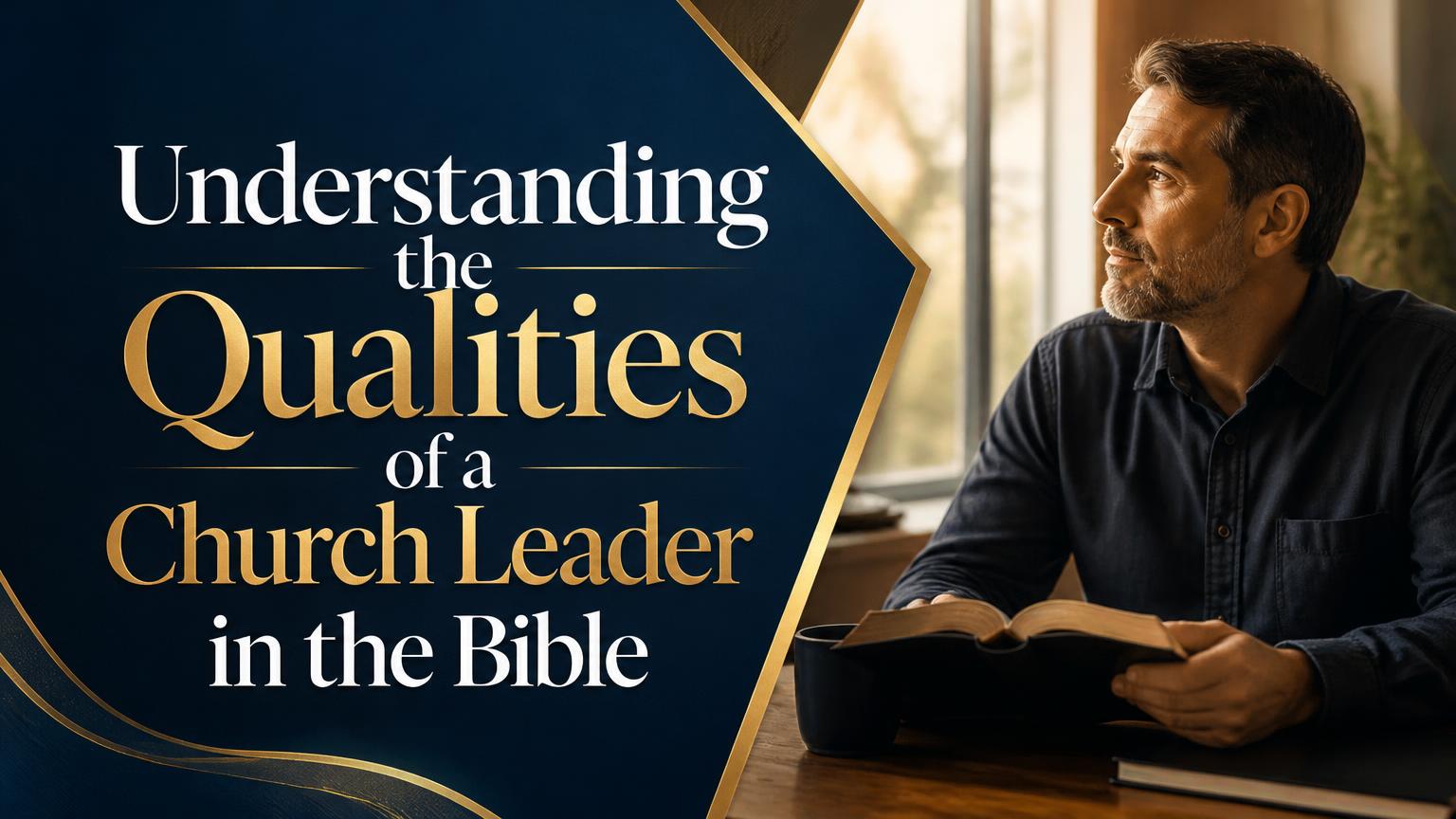
A church leader in the Bible is measured primarily by character, spiritual maturity, faithfulness to God’s Word, and the ability to care for people—not by charisma, status, wealth, or public influence. The New Testament’s main passages on leadership, especially 1 Timothy 3:1–13, Titus 1:5–9, and 1 Peter 5:1–4, describe leaders who are trustworthy at home, sound in doctrine, self-controlled, humble, hospitable, and willing to serve rather than dominate.
Qualities of a Church Leader in the Bible
The biblical qualifications for church leadership are most directly given for elders or overseers, with a related list for deacons. Together, these passages show that leadership begins with who a person is before focusing on what the person can do.
A Blameless and Credible Character
Paul says that an overseer must be “above reproach” (1 Timothy 3:2), and Titus 1:6–7 repeats the idea. This does not mean a leader must be sinless. Scripture recognizes that every Christian depends on God’s grace and must continue growing in holiness.
Being above reproach means that a leader’s life should not provide a credible, unresolved reason for serious accusation. His public conduct, private choices, relationships, and use of authority should be consistent with his Christian profession. A leader may have weaknesses, but he must not be characterized by hypocrisy, scandal, dishonesty, or patterns of unrepentant sin.
This quality protects the church from placing spiritual authority in the hands of someone whose conduct undermines the message he teaches.
Spiritual Maturity and Self-Control
A church leader should be sober-minded, self-controlled, respectable, disciplined, and emotionally steady (1 Timothy 3:2; Titus 1:8). These qualities describe a person who is not controlled by impulses, anger, appetite, pride, or the desire for approval.
Paul specifically warns against appointing a recent convert, because spiritual immaturity can produce pride and make a person vulnerable to condemnation (1 Timothy 3:6). Time alone does not guarantee maturity, but responsible leadership normally requires tested faith, growing wisdom, and demonstrated stability.
Self-control also affects how leaders respond under pressure. A person who teaches well but regularly reacts with rage, manipulation, or recklessness is not displaying the kind of maturity required for shepherding God’s people.
Faithfulness to Sound Doctrine
Titus 1:9 requires an elder to hold firmly to the trustworthy message so that he can encourage others with sound teaching and refute those who oppose it. Biblical leadership therefore includes a firm commitment to the truth of the gospel.
A leader does not merely need personal sincerity. He must know what the church believes, understand Scripture accurately, and resist teaching that distorts the character of God or the message of salvation. Sound doctrine matters because teaching shapes how people worship, make moral decisions, understand suffering, and relate to one another.
This does not require a leader to answer every theological question or possess academic credentials. It does require faithfulness, teachability, discernment, and the ability to distinguish biblical truth from error.
The Ability to Teach and Correct
An overseer must be “able to teach” and must correct opponents with gentleness (1 Timothy 3:2; 2 Timothy 2:24–25). Teaching ability involves more than public speaking. It includes explaining Scripture clearly, applying it wisely, answering questions, and helping people grow in faith.
Correction is also part of the responsibility. A leader sometimes must address false teaching, harmful behavior, or conflict. Yet the manner of correction matters. Biblical leadership does not use truth as a weapon for humiliation. The goal is restoration, protection, and faithfulness to Christ.
This is why a gifted communicator is not automatically a qualified spiritual leader. Communication skills can attract attention, but biblical teaching must be accurate, responsible, and directed toward the good of the church.
Faithful Leadership at Home
Paul says that a leader should manage his own household well and have faithful children who are not open to charges of rebelliousness (1 Timothy 3:4–5; Titus 1:6). He explains that someone who cannot manage his own household will have difficulty caring for God’s church.
The point is not that a leader’s family must display artificial perfection or that parents control every decision their children make. Rather, the home provides an important setting in which a person’s patience, responsibility, integrity, and relational leadership can be observed.
Church leadership should not become an excuse for neglecting a spouse or children. A person who appears devoted in public but is consistently harsh, absent, irresponsible, or abusive at home is not demonstrating the shepherding character described in Scripture.
Humility, Hospitality, and Service
Biblical leaders must not be arrogant, violent, quarrelsome, or domineering. Instead, they should be gentle, peaceable, hospitable, and willing to serve (1 Timothy 3:2–3; Titus 1:7–8; 1 Peter 5:2–3).
Jesus defined leadership through service. In Mark 10:42–45, He contrasted worldly authority, which often seeks control, with the servant posture expected among His followers. He then presented His own life as the model: He came “not to be served but to serve.”
Peter applies this principle directly to elders. They are to shepherd God’s flock willingly, eagerly, and by example—not by lording it over people (1 Peter 5:2–3). Authority in the church is therefore accountable authority. Leaders serve under Christ and must care for people rather than use people to build personal influence.
Hospitality reflects the same orientation. It means making room for others, welcoming people with practical care, and treating relationships as part of ministry rather than as interruptions to it.
Financial Integrity and Freedom From Greed
A church leader must not be a lover of money, dishonest for financial gain, or controlled by material ambition (1 Timothy 3:3; Titus 1:7; 1 Peter 5:2). Deacons likewise must not pursue dishonest gain (1 Timothy 3:8).
The Bible does not teach that poverty is a requirement for leadership, nor does it condemn responsible ownership or compensation for legitimate ministry. The concern is whether money governs the leader’s decisions and desires.
Financial integrity includes honesty, transparency, contentment, and appropriate handling of church resources. Greed is especially dangerous in spiritual leadership because it can turn ministry into a means of personal gain and make vulnerable people easier to exploit.
A Good Reputation Inside and Outside the Church
An overseer should have a good reputation with outsiders so that he does not fall into disgrace (1 Timothy 3:7). Christian leaders represent the message they proclaim, and their conduct in workplaces, neighborhoods, civic life, and ordinary relationships affects the credibility of their witness.
This does not mean every outsider must approve of a faithful Christian leader. Jesus warned that His followers could be opposed because of their allegiance to Him. A good reputation means that opposition should not arise from dishonesty, abusive behavior, broken promises, arrogance, or disregard for others.
The qualification also shows that the church should not evaluate leadership in isolation from everyday life. Private integrity and public credibility belong together.
What Biblical Leadership Is Designed to Do
The qualities in these passages are not random personality preferences. They equip leaders to perform specific responsibilities: teaching truth, protecting the church from error, caring for people, resolving conflict, modeling holiness, and directing the congregation toward Christ.
The image of a shepherd helps explain this responsibility. Jesus called Himself the Good Shepherd who knows His sheep and lays down His life for them (John 10:11–15). Peter calls Jesus the “Chief Shepherd” and presents church leaders as accountable under Him (1 Peter 5:4). A pastor or elder is therefore not the owner of the church. The congregation belongs to Christ.
This changes how authority should be understood. Biblical leadership is neither passive neglect nor personal control. It requires courage to confront harmful teaching and tenderness toward people who are weak, confused, grieving, or spiritually immature.
Elders, Overseers, Pastors, and Deacons
The New Testament uses several related terms for church leadership, and churches differ in how they organize these roles.
Elders and overseers: In Titus 1:5–9, Paul begins by discussing the appointment of elders and then describes the overseer using closely connected language. This is one reason many interpreters understand elder and overseer as referring to the same pastoral office from different perspectives: “elder” emphasizes recognized spiritual maturity, while “overseer” emphasizes responsibility for care and supervision.
Pastors or shepherds: The word pastor describes a shepherd. Ephesians 4:11 lists pastors and teachers among those given to equip the church, and 1 Peter 5 describes elders as shepherds of God’s flock. The emphasis is on spiritual care, guidance, protection, and nourishment through God’s Word.
Deacons: First Timothy 3:8–13 gives qualifications for deacons, including dignity, honesty, faithfulness, a clear conscience, and tested character. Deacons serve the practical and organizational needs of the church, but their ministry is still spiritual and requires integrity. Acts 6 is often viewed as an important pattern for this kind of service, although the passage does not explicitly identify the seven men appointed there as deacons.
These roles may be arranged differently among Christian traditions, but the common principle is clear: church responsibility should be entrusted to people whose character and faith have been tested.
How Churches Should Apply These Qualifications
Biblical qualifications should be assessed as patterns of life, not as a superficial checklist. A church should look for observable evidence of faith, humility, doctrinal reliability, relational wisdom, and responsible service over time.
Several principles follow:
- Character comes before platform. A person should not be promoted into leadership simply because he is talented, popular, wealthy, or effective at attracting attention.
- Testing should precede appointment. First Timothy 3:10 explicitly says deacons should be tested first. The same wisdom applies broadly to spiritual leadership.
- The whole life matters. A public ministry cannot compensate for serious private dishonesty or relational irresponsibility.
- Qualifications are communal, not merely self-declared. Other mature believers should be able to recognize these qualities in a candidate’s life.
- Leaders remain accountable. Even qualified leaders are still disciples under Christ and need correction, encouragement, and oversight.
- Grace and standards belong together. The church should not demand sinless perfection, but neither should it excuse persistent, unrepentant conduct that contradicts biblical leadership.
A church also needs to distinguish between spiritual gifts and leadership qualifications. Teaching ability, administration, evangelism, or strong communication may be valuable gifts, but gifts do not remove the need for humility, holiness, and proven trustworthiness.
Common Misunderstandings About Church Leadership
One misconception is that biblical leadership is mainly about having a powerful personality. The New Testament emphasizes the opposite: leaders must be gentle, self-controlled, humble, and examples to the flock.
Another misunderstanding is that a leader’s success can be measured by size, visibility, or influence. Scripture measures leadership by faithfulness. A leader may serve a small congregation and still carry out a deeply significant ministry.
It is also mistaken to treat the qualifications as optional ideals rather than serious standards. They describe the kind of life that makes spiritual authority safe and credible. At the same time, they should not be used to demand perfection from leaders while ignoring the gospel’s call to repentance and restoration.
Finally, biblical leadership is not domination. Jesus condemned the pattern in which rulers use authority to exalt themselves. Christian leaders are called to exercise responsibility for the benefit of others, under the authority of Christ, and with awareness that they will give an account to Him.
Conclusion
The qualities of a church leader in the Bible center on faithful character: spiritual maturity, self-control, sound doctrine, teaching ability, family faithfulness, humility, hospitality, financial integrity, and a credible reputation. These qualifications show that Christian leadership is fundamentally shepherding rather than self-promotion. Skills and gifts matter, but they must be governed by holiness, service, truth, and accountable care for God’s people.