
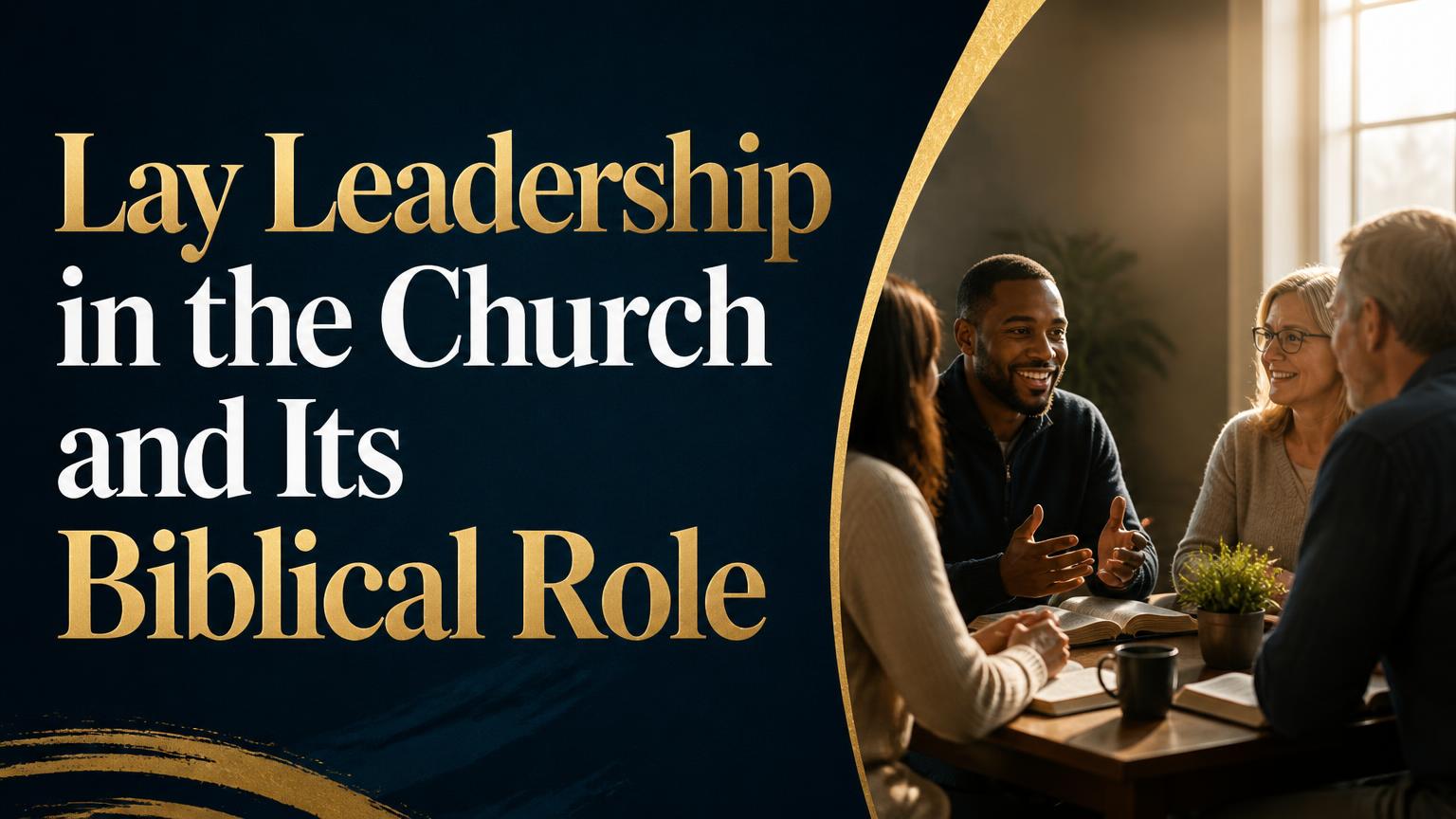
Lay leadership in the church refers to the service and oversight carried out by church members who are not serving as ordained or paid clergy. Although the New Testament does not use the modern term lay leader, it presents Christian ministry as the responsibility of the whole body of Christ while recognizing distinct leaders, elders, overseers, and deacons. Healthy lay leadership therefore combines spiritual maturity, practical service, shared responsibility, and accountability to Scripture and the church community.
Lay Leadership in the Church
Lay leadership is not simply filling organizational gaps or giving volunteers authority. It is the faithful use of God-given gifts to strengthen the church, care for people, support its mission, and help the congregation live under the lordship of Christ.
A Biblical Foundation for Shared Ministry
The New Testament teaches that every Christian is part of Christ’s body and has a meaningful role within it. Paul describes the church as one body with many members, each having different functions (Romans 12:3–8; 1 Corinthians 12:12–27). These passages reject the idea that ministry belongs only to a professional religious class.
Ephesians 4:11–16 describes leaders as equipping believers for “the work of ministry.” The implication is important: pastors and other recognized leaders do not perform all ministry themselves. They help the entire congregation mature and serve effectively.
The early church also provides examples of members taking responsibility for important needs. In Acts 6:1–6, the apostles supported the selection of spiritually qualified men to help administer the distribution of food to widows. This arrangement addressed a practical problem while protecting the apostles’ primary calling to prayer and the ministry of the word. The passage illustrates a lasting principle: churches need both spiritual oversight and trustworthy people who take responsibility for practical ministry.
Lay leadership may therefore include teaching, discipleship, pastoral care, administration, mission, hospitality, mercy ministry, youth ministry, financial stewardship, and participation in congregational decision-making. The specific responsibilities vary by denomination and local church structure.
What Lay Leaders Actually Do
The responsibilities of a lay leader depend on the church’s theology, polity, and needs, but effective lay leaders generally serve in several connected ways.
They care for people. Lay leaders may visit the sick, welcome newcomers, encourage struggling members, lead small groups, mentor younger believers, and notice needs that might otherwise be overlooked. This ministry is not a substitute for pastoral care in every situation, but it extends the church’s capacity to provide attentive and personal support.
They teach and disciple. Qualified members may lead Bible studies, facilitate prayer groups, teach children or adults, train ministry volunteers, and help new Christians develop habits of faith. Teaching should be faithful to Scripture and appropriate to the leader’s level of preparation. James 3:1 warns that teachers are subject to stricter judgment, so enthusiasm alone is not sufficient qualification.
They organize ministry. Churches require people who can coordinate volunteers, plan events, manage communication, oversee facilities, administer benevolence, or handle financial processes. These tasks are spiritual responsibilities when they are performed for the church’s mission rather than personal recognition.
They protect unity. Lay leaders often stand close to the congregation and can either strengthen or damage trust. They help resolve misunderstandings, communicate decisions accurately, discourage gossip, and direct serious concerns through appropriate channels. Their influence should be used to build up the body, not to create factions.
They represent the church in the community. Through hospitality, service to neighbors, evangelism, mercy ministries, and vocational relationships, lay leaders demonstrate that the church’s mission extends beyond worship gatherings. Their ordinary work and relationships become settings for Christian witness.
Lay Leaders and Ordained Ministers
The distinction between lay leaders and ordained ministers varies considerably among Christian traditions. In some churches, “lay” means any member who is not ordained. In others, lay elders or lay preachers may receive formal authorization, training, or commissioning. Some traditions use the word lay mainly to distinguish the congregation from clergy, while others avoid the term because it can imply that ordinary Christians are less involved in ministry.
The Bible does recognize different forms of leadership. Elders and overseers are entrusted with spiritual oversight, teaching, and shepherding (1 Timothy 3:1–7; Titus 1:5–9; 1 Peter 5:1–4). Deacons serve the church through responsibilities requiring trustworthiness, maturity, and practical wisdom (1 Timothy 3:8–13). These offices should not be collapsed into every form of Christian service.
At the same time, a distinction in responsibility does not mean a difference in spiritual value. Jesus taught his disciples that Christian leadership is expressed through service rather than domination: “Whoever would be great among you must be your servant” (Mark 10:43–45). Ordained leaders and lay leaders serve the same Lord, belong to the same body, and remain accountable to the same gospel.
A healthy relationship usually involves cooperation rather than competition. Pastors and elders provide theological direction and recognized oversight; lay leaders bring proximity to the congregation, practical knowledge, specialized abilities, and sustained participation in daily ministry. Neither group should attempt to control every decision or operate independently of the other.
Why Lay Leadership Matters
Lay leadership matters because a church cannot mature when ministry is concentrated in a few individuals. Shared ministry allows more people to exercise their gifts, gives members meaningful responsibility, and creates closer pastoral care.
It also improves resilience. A congregation that depends entirely on one pastor may struggle during illness, transition, conflict, or growth. A congregation with trained and accountable lay leaders can continue caring for people and serving its community under changing circumstances.
Lay leadership can also reveal gifts that formal positions might overlook. A member may have exceptional ability in counseling, hospitality, administration, teaching, cross-cultural ministry, or conflict mediation without holding a conventional church title. Recognizing such gifts helps the church become more faithful to the New Testament picture of a functioning body.
However, lay leadership is not valuable merely because it distributes workload. Its purpose is spiritual formation and faithful mission. Delegating tasks without offering training, authority, support, and accountability can produce frustration rather than healthy ministry.
Biblical Qualifications for Lay Leaders
The central qualification for Christian leadership is character. Skill and availability matter, but neither can compensate for dishonesty, uncontrolled ambition, persistent divisiveness, or an unwillingness to submit to correction.
Character Before Position
The qualifications for elders and deacons in 1 Timothy 3 and Titus 1 emphasize integrity, self-control, faithfulness, hospitality, sound judgment, and a good reputation. Although these passages address recognized offices, the principles apply broadly to anyone entrusted with influence.
A lay leader should be dependable in ordinary responsibilities, truthful in communication, respectful toward others, and willing to serve without constant recognition. Spiritual maturity is demonstrated over time. A person may be gifted, energetic, or popular without being ready to lead.
Spiritual Maturity and Biblical Understanding
Leaders need enough knowledge of Scripture to teach responsibly, recognize error, and apply biblical principles wisely. This does not require every lay leader to possess formal theological education. It does require a teachable spirit, regular engagement with Scripture, and willingness to seek guidance when a question exceeds the leader’s competence.
The goal is not to win arguments or display knowledge. Christian teaching should help people know God, follow Christ, resist destructive beliefs, and practice faithful obedience.
Humility and Servant-Minded Authority
Christian authority is meant to protect and equip people, not elevate the leader. Peter instructs elders to shepherd willingly and not domineer over those entrusted to them, but to be examples to the flock (1 Peter 5:2–3). This principle applies to lay leadership as well.
A lay leader who treats a ministry role as personal territory may become controlling, resistant to oversight, or threatened by other gifted people. A servant leader welcomes cooperation, shares credit, receives correction, and steps back when another person is better equipped for a task.
Accountability and Trustworthiness
No leader should function as an unaccountable individual. Churches should establish clear reporting relationships, especially for finances, counseling, children’s ministry, transportation, and access to vulnerable people. Appropriate safeguards may include background checks, two-adult policies, financial controls, confidentiality guidelines, and documented procedures for reporting abuse or misconduct.
Accountability is not a sign of suspicion; it is a means of protecting both the congregation and the leader. Spiritual language must never be used to bypass responsible governance.
Common Misunderstandings About Lay Leadership
One misconception is that lay leadership is merely “helping the pastor.” Members certainly may support pastors, but their calling is broader. They are participants in the church’s ministry, not only assistants to professional leaders.
Another misconception is that every influential member should hold a leadership position. Influence and readiness are not identical. Some people exercise faithful influence through prayer, hospitality, generosity, mentoring, or quiet service without holding public office. Churches should recognize different forms of contribution rather than measuring significance by visibility.
A third misconception is that lay leaders may act independently because they are volunteers. Voluntary service still requires faithfulness to the church’s doctrine, policies, safeguarding practices, and legitimate leadership. Freedom to serve does not mean freedom from accountability.
A final misconception concerns authority. Lay leaders should neither claim authority that the church has not entrusted to them nor avoid responsibility when leadership is needed. Healthy leadership uses clearly defined authority for the good of others and remains willing to explain decisions.
How Churches Can Develop Healthy Lay Leaders
Churches develop effective lay leadership by identifying character and gifts before assigning titles. Leaders can observe how members serve, respond to difficulty, handle disagreement, and treat people who cannot benefit them.
Training should address both ministry skills and spiritual formation. Depending on the role, this may include Bible interpretation, prayer, communication, pastoral boundaries, child protection, conflict resolution, financial procedures, evangelism, or referral of serious mental-health and safeguarding concerns to qualified professionals.
New leaders also need a clear description of their responsibilities. Ambiguous authority creates conflict: one person may assume a role includes decisions that another believes belong to the pastor, elders, or congregation. Written expectations, regular meetings, mentoring, and periodic evaluation make cooperation easier.
Finally, churches should create a culture in which leadership is reproducible. Mature lay leaders should train others rather than making themselves indispensable. Paul instructed Timothy to entrust teaching to faithful people who would be able to teach others also (2 Timothy 2:2). This pattern turns leadership into multiplication rather than dependence on a single gifted individual.
The Role of Women in Lay Leadership
Christian traditions interpret passages about church offices and teaching authority differently. Some churches restrict certain governing or teaching offices to qualified men, while others understand Scripture to permit women to serve in those roles. The debate commonly engages passages such as 1 Timothy 2:11–15, 1 Timothy 3, 1 Corinthians 11:5, Romans 16, and Acts 18:24–26.
Despite these differences, Christian traditions broadly recognize that women serve the church through prayer, evangelism, discipleship, hospitality, mercy, teaching children, mission, administration, and many other forms of ministry. Churches should state their convictions clearly, apply them consistently, and treat every person with dignity rather than reducing the question to a struggle for status.
The larger biblical principle remains that service must be governed by faithfulness to Scripture, the church’s stated convictions, spiritual maturity, and the good of the congregation.
Conclusion
Lay leadership in the church is the ministry of spiritually mature members who use their gifts to serve, teach, care for people, organize mission, and strengthen the whole body of Christ. It does not erase the distinction between pastors, elders, deacons, and other members, but it does reject the idea that ministry belongs only to clergy. Biblical lay leadership is shared, accountable, character-based, and directed toward service rather than control. When churches equip ordinary believers to lead faithfully, more people are cared for and the congregation more fully reflects the New Testament vision of a living, mutually serving body.