
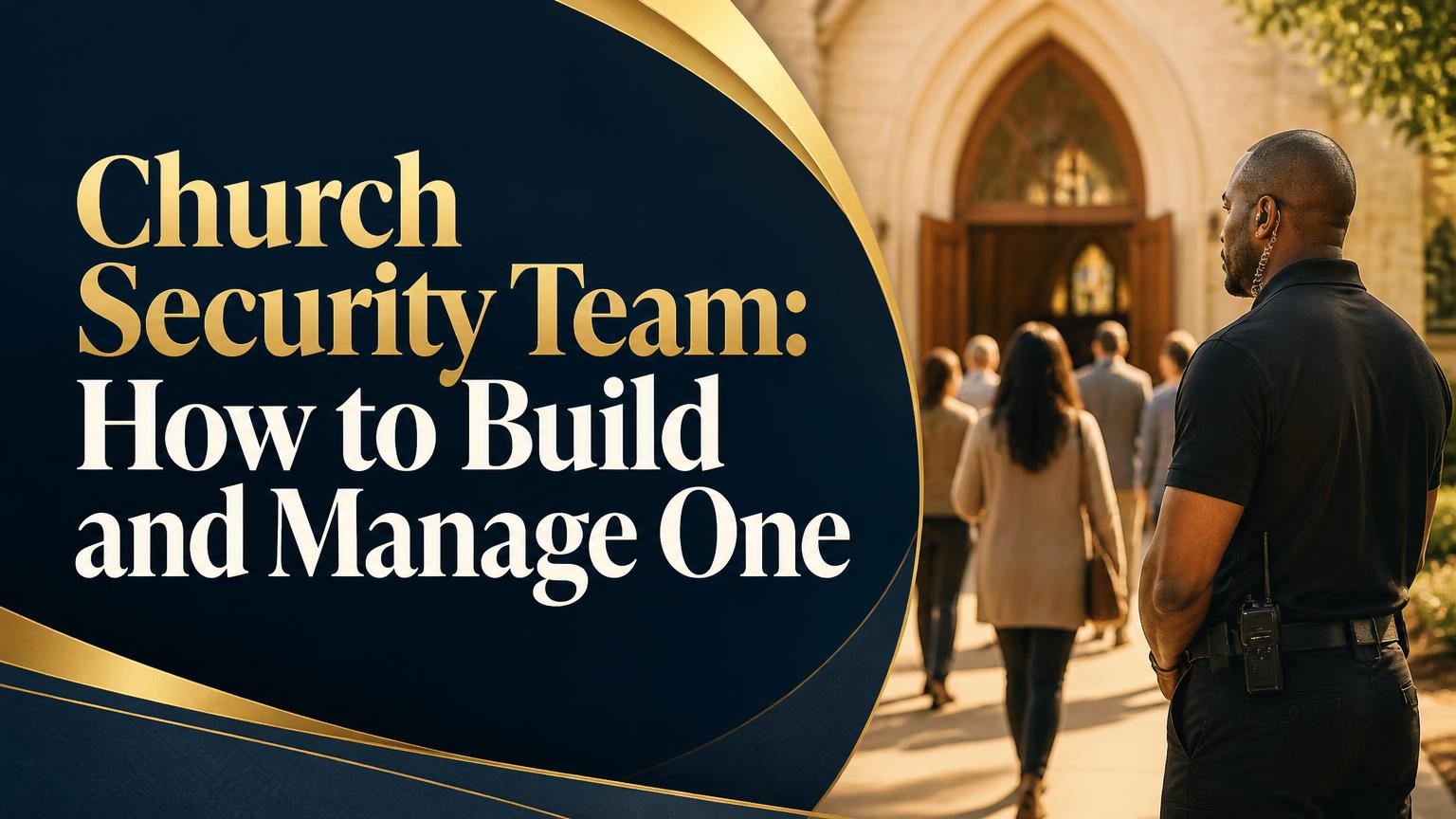
A church security team helps protect people, preserve a welcoming environment, and coordinate an orderly response when something goes wrong. It is not simply a group of people watching doors, and it does not have to be armed. An effective team combines risk assessment, trained volunteers or staff, clear authority, emergency procedures, child-safety practices, communication, and pastoral sensitivity. The goal is prevention and protection—not intimidation, unnecessary surveillance, or replacing trained law enforcement and emergency responders.
Church Security Team: How to Build and Manage One
Define the Team’s Mission and Boundaries
Begin with a written mission statement. A church security team may be responsible for recognizing hazards, assisting with medical or fire emergencies, protecting children and vulnerable adults, managing disruptive behavior, securing facilities, and contacting emergency services. Its responsibilities should be specific enough to guide decisions but limited enough to prevent overreach.
The team should not function as a private police force. Members generally should not investigate crimes, conduct unauthorized searches, detain people without lawful justification, or use force merely because someone appears unusual. Security exists within the church’s legal, ethical, and pastoral framework. A clear scope protects both the congregation and the volunteers serving it.
The mission should also emphasize hospitality. People should experience the team as calm, approachable, and helpful. Visible security can reassure a congregation when members understand its purpose; it can create fear when personnel appear aggressive, secretive, or eager to exercise authority.
Conduct a Congregational Risk Assessment
A risk assessment identifies realistic threats and vulnerabilities rather than copying procedures from another church. Review the building, grounds, parking areas, entrances, classrooms, nursery, offices, worship spaces, kitchens, and rooms used by outside groups. Consider how people enter and leave, where crowds gather, which doors remain unlocked, and how emergency responders would reach the building.
Assess both deliberate and accidental hazards. These may include medical emergencies, severe weather, fire, missing children, domestic disputes, suspicious behavior, active violence, unauthorized access, and overcrowding. The assessment should consider the congregation’s circumstances, location, building design, ministry activities, and available resources.
A useful assessment asks three questions: What could happen? How vulnerable are we to it? What practical measure would reduce the likelihood or impact? The answer may be better lighting, improved door control, first-aid training, clearer supervision, or a revised evacuation plan—not necessarily more personnel or weapons.
Establish Leadership, Roles, and Accountability
A security team needs one clearly identified leader and a defined reporting relationship to church leadership. The leader may coordinate with the pastor, executive staff, facilities director, or governing board, but operational authority should not be divided among several people during an emergency.
Create roles that match the church’s size and activities. Possible assignments include team leader, service coordinator, communications lead, medical-response liaison, children’s-area contact, facilities coordinator, and parking or entrance observers. In a small congregation, one person may perform several functions. The important issue is that responsibilities are understood before an incident occurs.
Accountability also requires written policies, attendance records for training, background-screening procedures where appropriate, incident reports, and regular review by church leadership. Volunteers should know who can remove them from service, who handles complaints, and how the church responds if a team member violates policy.
Recruit for Judgment, Character, and Reliability
The strongest candidates are not necessarily the people with the most forceful personalities or tactical experience. Look for emotional maturity, sound judgment, self-control, dependability, confidentiality, physical and mental readiness, and the ability to treat people respectfully under stress.
Recruitment should follow the church’s broader volunteer-screening standards. Depending on the role and local requirements, this may include an application, references, background screening, an interview, and a defined probationary period. Screening is especially important for anyone working around children, handling sensitive information, or exercising responsibility during crises.
Avoid creating a team composed entirely of one demographic or professional background. Former military or law-enforcement experience may be useful, but it does not automatically qualify someone to lead a church ministry. Teachers, nurses, facilities workers, counselors, administrators, ushers, and people experienced in conflict resolution may contribute essential skills.
Train for Prevention, Response, and De-Escalation
Training should reflect the team’s actual mission. Core topics commonly include recognizing hazards, emergency communication, evacuation and shelter procedures, fire response, basic first aid, cardiopulmonary resuscitation where available, bleeding control, missing-child procedures, severe-weather response, and documentation.
De-escalation deserves particular attention. Team members should learn to maintain a calm voice, give clear directions, preserve personal space, avoid argumentative language, identify when a conversation is worsening, and request assistance early. They should understand that mental illness, intoxication, grief, developmental disabilities, or medical conditions can affect behavior. The objective is to reduce danger while preserving dignity.
If the church permits armed personnel, additional training and written controls are essential. The church must examine applicable laws, licensing requirements, insurance, storage, access, qualification standards, identification, and coordination with responding officers. Armed service should never be treated as a substitute for planning, medical preparation, access control, or de-escalation.
Create Service-Day Procedures
A team becomes effective when its plan works during an ordinary worship service, not only during a classroom exercise. Before services, designated members should check communication devices, emergency exits, key areas, lighting, door conditions, and any unusual changes to the building. They should know who is present, which leaders are on site, and how to reach emergency services.
During services, personnel should remain attentive without making congregants feel watched. A simple communication system is usually better than complicated codes that volunteers may forget. Messages should identify the location, nature of the problem, immediate need, and whether emergency responders have been contacted.
Plans should address evacuation, sheltering in place, medical response, fire alarms, disruptive conduct, and reunification after an emergency. Children’s areas require special coordination because caregivers must be able to account for children, control release procedures, and communicate with parents without creating additional confusion.
Review Incidents and Improve the Plan
Every significant incident, near miss, or exercise should produce a short after-action review. Ask what happened, what worked, what failed, whether communication was clear, and whether the response created unintended risks. The purpose is improvement, not automatic blame.
Record objective facts rather than speculation. Include the date, time, location, people involved, actions taken, notifications made, injuries or property damage, and follow-up required. Sensitive information should be stored securely and shared only with people who have a legitimate need to know.
Church leadership should review the plan at least annually and after major changes such as a building renovation, new campus, expanded children’s ministry, school partnership, or change in local threats. A plan that is not practiced and updated is unlikely to work under pressure.
Policies and Equipment That Support Church Safety
Control Access Without Making the Church Feel Closed
Access control should match the activity. During worship, the church may keep some entrances open while securing restricted areas. During children’s programming, access should be limited to authorized adults through a defined check-in and release process. Staff and volunteers need to know which doors are emergency exits and which doors should not be propped open.
Security should not depend on one person recognizing every visitor. Clear signage, visitor procedures, door hardware, lighting, cameras where appropriate, and responsible supervision can reduce confusion. Cameras may support investigations, but they do not replace people, communication, or sound policy.
Build an Emergency Communication Plan
Decide how team members will communicate with one another, church leaders, emergency dispatchers, and the congregation. The method may involve radios, phones, a mass-notification system, or a combination. Establish backup options in case power, cellular service, or internet access fails.
The plan should identify who calls emergency services, who meets responders, who gives instructions to the congregation, and who accounts for children or vulnerable adults. Messages should be concise and factual. Afterward, a designated spokesperson should manage communication with families and the wider community so that privacy and accuracy are protected.
Equip the Team for Likely Needs
Equipment should follow the risk assessment rather than personal preference. Depending on the church, useful resources may include first-aid kits, automated external defibrillators, flashlights, high-visibility identification, radios, emergency contact lists, floor plans, door keys or access cards, fire extinguishers, and supplies for severe weather.
Equipment must be accessible, maintained, and understood. An automated external defibrillator that volunteers cannot locate or operate is not a meaningful safety resource. Check batteries, expiration dates, radio function, signage, and emergency lighting on a defined schedule. Avoid collecting specialized equipment without training, policy, and a clear reason for its use.
Pastoral and Legal Guardrails
Use De-Escalation Before Confrontation
Most difficult encounters should begin with observation, distance, calm communication, and a request for assistance—not immediate physical intervention. A team member can often reduce risk by moving bystanders away, offering a quiet conversation, involving a trusted pastor or family member, or contacting professional help.
Physical force carries legal, physical, and pastoral consequences. Policies should explain when team members should disengage, when emergency services should be called, how injuries are handled, and what reporting is required. The church should obtain qualified legal and insurance guidance because rules concerning self-defense, detention, weapons, privacy, and volunteer liability differ by jurisdiction.
Protect Privacy and Human Dignity
Security work exposes volunteers to sensitive information about medical conditions, family conflict, alleged misconduct, and personal crises. Team members should receive confidentiality training and understand that information is shared only for safety, legal, or ministry reasons. Gossip can harm people and undermine trust even when no formal rule has been broken.
Avoid profiling based on race, clothing, age, disability, homelessness, emotional expression, or religious background. Behavior and credible safety concerns should guide attention. A welcoming church can maintain boundaries without treating unfamiliar people as threats.
Coordinate With Professional Responders
A church security team should support, not replace, police, fire, emergency medical services, mental-health professionals, and child-protection authorities. Invite appropriate local professionals to review access points, emergency routes, evacuation procedures, and building information when feasible.
Team members should know how to describe the building accurately, where responders will enter, who will meet them, and how to avoid interfering with their work. If a situation involves suspected abuse, a weapon, serious injury, or an immediate threat, the church’s internal process must not delay required emergency or safeguarding action.
Common Mistakes to Avoid
A common mistake is building a team around equipment before defining its purpose. Radios, cameras, uniforms, or weapons cannot compensate for unclear authority and poor judgment. Another mistake is relying on a single highly experienced volunteer whose absence leaves the church without a functioning plan.
Churches also weaken their programs by failing to train ushers, children’s workers, musicians, facilities staff, and pastors. Security is a shared responsibility, although not everyone needs the same role or level of training. Finally, avoid treating every disruption as a security emergency. A lost child, a medical crisis, a grieving visitor, and a violent threat require different responses.
Conclusion
A church security team is most effective when it combines prevention, preparedness, hospitality, and disciplined response. Building one begins with a realistic risk assessment and a narrowly defined mission, followed by careful recruitment, practical training, clear communication, child-safety procedures, appropriate equipment, and regular review. The team should remain accountable to church leadership and operate within local law, insurance requirements, and professional emergency systems. Its success is measured less by visible force than by whether people are protected, treated with dignity, and helped quickly when genuine danger or crisis occurs.