
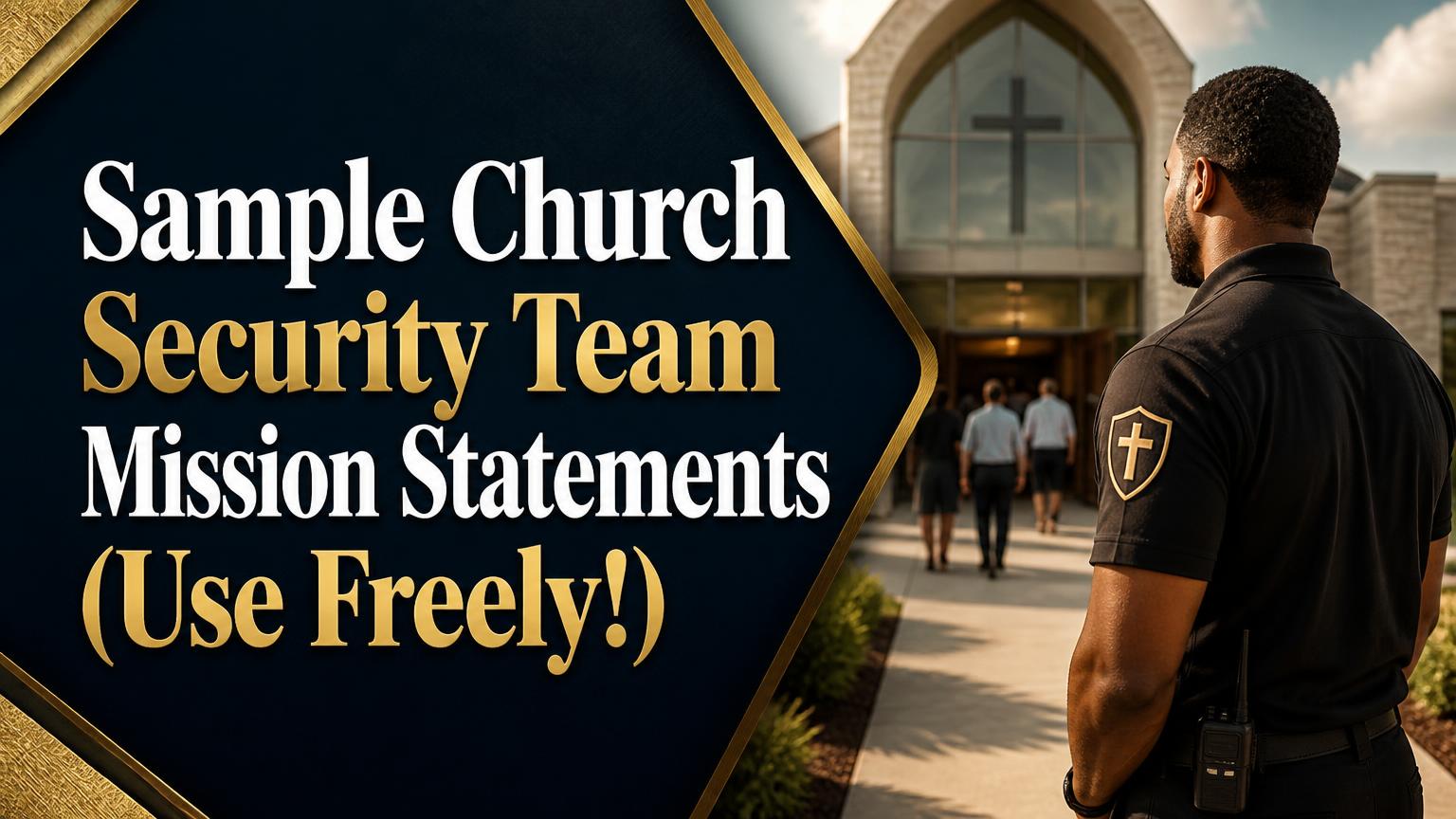
A church security team mission statement explains why the team exists, whom it serves, and how it should carry out its responsibilities. The strongest statements connect physical safety with the church’s ministry: welcoming people, protecting vulnerable individuals, responding calmly to emergencies, and supporting worship without creating an atmosphere of fear. The examples below are original and may be adapted freely. They are starting points, not substitutes for detailed policies, training, background checks, emergency plans, or compliance with applicable laws.
Church Security Team Mission Statement
The best statement depends on your congregation’s size, facilities, risks, theology, and relationship with local emergency services. Each example below can be used as written or combined with language from another version.
A Balanced Mission Statement
Our mission is to help provide a safe, secure, and welcoming environment where people can worship, learn, serve, and gather without unnecessary fear or disruption. We protect people and property, prepare for emergencies, respond with wisdom and compassion, and work alongside church leaders and public safety professionals.
This version works well for many churches because it balances security with hospitality. It does not portray the team as a private police force or suggest that force is the primary solution. Instead, it identifies the team’s broad responsibilities while emphasizing calm response, cooperation, and the church’s ministry purpose.
A Faith-Focused Mission Statement
Our mission is to serve Christ and His church by stewarding the safety of every person entrusted to our care. Through prayerful preparation, humble service, careful observation, and compassionate action, we help create an environment where people can worship, fellowship, and encounter God in peace.
A faith-focused statement can help volunteers understand security as a ministry of service rather than a position of authority. The reference to stewardship reflects the responsibility to care for people and facilities, while “humble service” guards against pride, unnecessary confrontation, or a desire for control. Churches may connect this approach with biblical principles such as seeking peace and serving others.
A Hospitality and De-Escalation Mission Statement
Our mission is to protect the church community while preserving a welcoming atmosphere. We seek to prevent harm through awareness, communication, and preparation; address concerns with patience and dignity; and use the least intrusive effective response when intervention becomes necessary.
This statement is useful for churches that want to make hospitality central to their security culture. Many situations are resolved through a greeting, a respectful conversation, or an early request for assistance. The language does not imply that every incident can be handled informally; it establishes de-escalation as a preferred approach when doing so is safe and appropriate.
An Emergency Preparedness Mission Statement
Our mission is to prepare the church to respond effectively to medical emergencies, fires, severe weather, hazardous conditions, missing persons, disturbances, and other threats. We coordinate with church leadership and emergency responders to protect life, communicate clearly, support orderly evacuation or sheltering, and help the congregation recover after an incident.
This version emphasizes readiness rather than only visible security. A church security team may have responsibilities during events that are not criminal in nature, including a child becoming separated from a parent, a cardiac emergency, a storm, or a building evacuation. The statement should therefore reflect the full range of foreseeable emergencies without attempting to function as a detailed response plan.
A Concise Mission Statement
Our mission is to protect people, support a welcoming church environment, prepare for emergencies, and respond to safety concerns with wisdom, compassion, and professionalism.
A concise statement is easier for volunteers to remember and repeat. It works well on an orientation document, volunteer handbook, identification card, or church website. Its brevity also makes it flexible, but the church should define the individual responsibilities behind each phrase in separate policies and training materials.
A Community Partnership Mission Statement
Our mission is to support the safety and wellbeing of the church by identifying concerns early, assisting people during emergencies, and maintaining effective communication with church leaders, ministry teams, families, and public safety agencies. We serve with discretion, respect, and a commitment to protecting human dignity.
This option suits churches that coordinate closely with police, fire, emergency medical services, schools, or neighboring organizations. It makes clear that security is a shared responsibility. The team contributes observation, preparation, and assistance but does not replace trained emergency responders or assume authority it has not been given.
What Should a Church Security Team Mission Statement Include?
A mission statement does not need to mention every task performed by the team. It should establish the principles that guide those tasks and provide a standard for evaluating decisions.
State the Team’s Purpose
The statement should explain the team’s central purpose in direct language. Common purposes include protecting people, supporting a safe worship environment, preparing for emergencies, assisting vulnerable individuals, and helping the church respond to safety concerns.
Purpose language should be broad enough to remain useful as the church changes. A statement focused only on “stopping criminals,” for example, may overlook medical emergencies, severe weather, lost children, fire safety, and preventive planning. A broader purpose gives the team a more accurate understanding of its role.
Identify the People and Environment Served
A church security team serves more than regular adult attendees. Its responsibilities may include children, older adults, people with disabilities, visitors, staff members, volunteers, vendors, and people attending weddings, funerals, classes, or community events.
The statement should also describe the desired environment. Words such as “safe,” “welcoming,” “orderly,” “peaceful,” and “accessible” communicate that security should support ministry rather than undermine it. A guarded environment that discourages visitors or treats ordinary behavior as suspicious may fail the church’s larger mission.
Define Values and Standards of Conduct
Useful values include humility, vigilance, confidentiality, compassion, fairness, restraint, preparedness, accountability, and respect for human dignity. These values influence how volunteers speak to people, handle sensitive information, respond to confusion, and make decisions under pressure.
A mission statement should avoid vague promises of absolute safety. No team can eliminate every risk. Language such as “help provide,” “work to protect,” or “prepare to respond” is more accurate than claiming that the team will guarantee security or prevent every incident.
Set Boundaries and Relationships
A mission statement should make clear that the team works under church leadership and within applicable law. It should recognize the role of pastors, ministry leaders, parents and guardians, facility managers, and public safety professionals.
This boundary is especially important when volunteers carry out observations, access restricted areas, manage an emergency, or contact law enforcement. The mission statement should support responsible action without implying powers that volunteers do not possess. Detailed authority, reporting requirements, equipment use, and escalation procedures belong in policies and training.
Mission Statement vs. Security Policy
A mission statement describes why the team exists and the principles that guide its work. A security policy describes what the church requires in specific circumstances. For example, a mission statement may say that the team protects children with compassion and vigilance, while a child-safety policy explains check-in procedures, identification requirements, authorized pickup, missing-child response, and reporting obligations.
Procedures answer the question of how a task is performed. They may cover radio communication, evacuation routes, medical response, severe-weather sheltering, incident documentation, access control, and coordination with emergency services. Keeping these levels separate makes the mission statement readable while ensuring that volunteers still have precise instructions.
How to Customize a Church Security Team Mission Statement
Begin by asking church leaders and team members what the security ministry must accomplish, what kind of environment the church wants to create, and which responsibilities belong to other ministries or emergency responders. Review the church’s facilities, service schedule, children’s programs, special events, and known operational concerns before selecting language.
Then choose three or four central ideas rather than trying to include every task. A practical process is to identify the team’s purpose, name its primary values, describe the people it serves, and state how it should respond. Read the draft aloud to volunteers and ministry leaders. If it sounds aggressive, overly vague, or disconnected from the church’s identity, revise it.
The final statement should be approved by the appropriate church authority and introduced during orientation. Revisit it after a major incident, facility change, change in leadership, or significant adjustment to the team’s responsibilities. A mission statement should remain stable enough to guide decisions but not so fixed that it becomes inaccurate.
Common Mistakes to Avoid
One common mistake is writing a statement that focuses almost entirely on threats, suspects, weapons, or enforcement. That language may cause volunteers to view normal ministry activity through a confrontational lens. Security is necessary, but the mission should show that protection exists to serve people and preserve the church’s ability to gather.
Another mistake is using inspirational language without operational meaning. Words such as “excellence,” “vision,” and “commitment” have limited value unless they are connected to conduct. A stronger statement explains that the team prepares, communicates, protects, de-escalates when possible, respects confidentiality, and cooperates with emergency responders.
Avoid promising outcomes the team cannot control. “We will guarantee everyone’s safety” is unrealistic and may create confusion about responsibility. Avoid placing tactical instructions in the mission statement as well. Specific response methods, equipment rules, defensive-force decisions, and reporting processes require careful policy development, training, and legal review.
A Mission Statement That Protects and Welcomes
An effective church security team mission statement holds two responsibilities together: protecting people from preventable harm and preserving a welcoming environment for worship, fellowship, and service. It should present security as disciplined, accountable service rather than dominance or suspicion. The most useful wording recognizes preparation, early communication, compassionate treatment, emergency response, and cooperation with church leadership and public safety professionals.
Choose the sample that best reflects your congregation, then adapt its language to your actual structure and responsibilities. Keep the final version clear enough for every volunteer to remember and specific enough to guide conduct. The mission statement becomes meaningful when training, policies, supervision, and daily interactions consistently put its values into practice.