
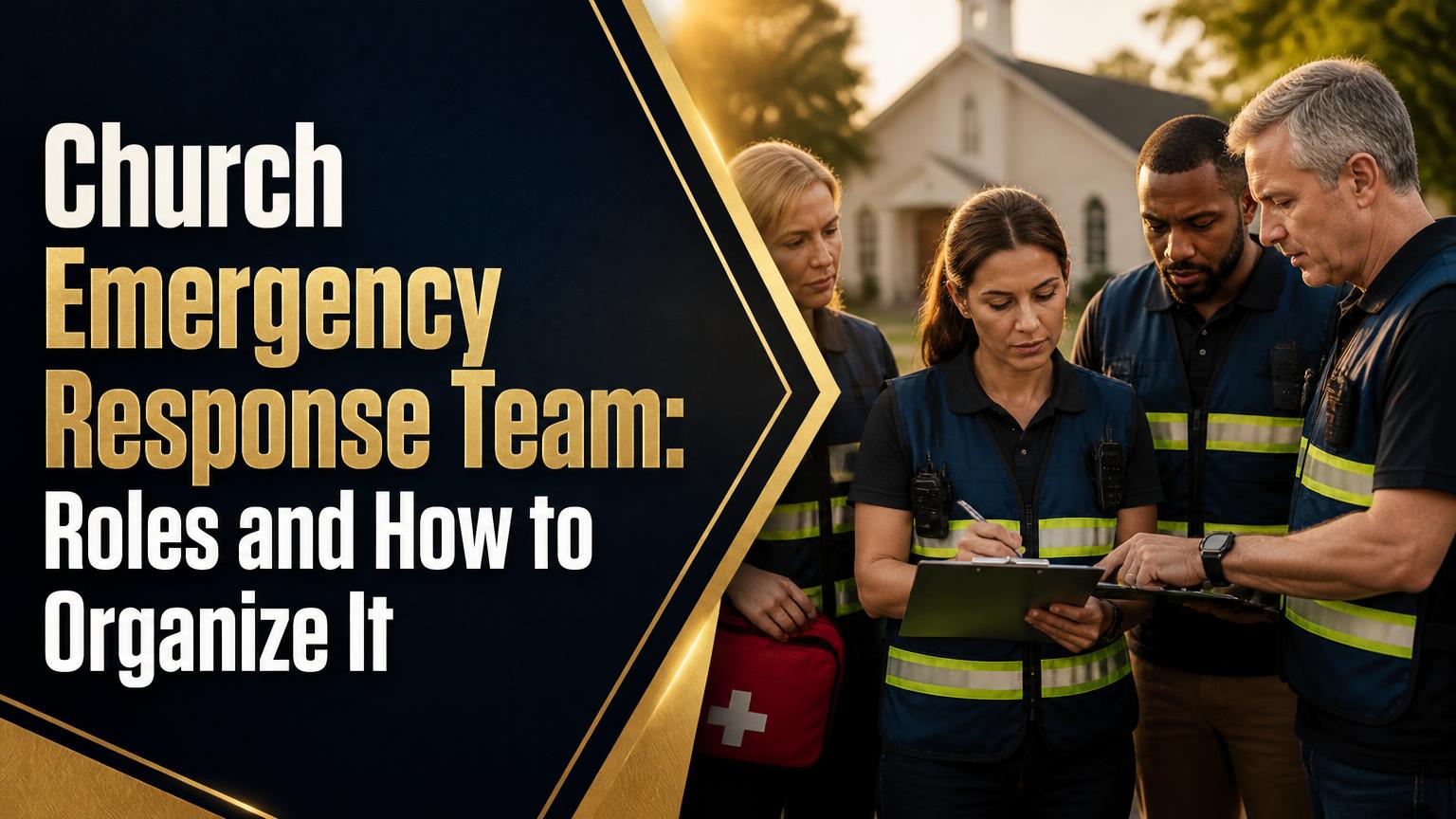
A church emergency response team is a trained group of members and staff who help protect people before, during, and after emergencies on church property or at church-sponsored activities. Its purpose is not to replace police, fire, emergency medical services, or professional security. Instead, the team provides organized first actions: identifying hazards, calling for help, guiding people to safety, giving basic assistance, communicating accurate information, and supporting accountability afterward. A well-designed team is calm, clearly authorized, appropriately trained, and prepared for the specific risks faced by its congregation.
What Is a Church Emergency Response Team?
A church emergency response team is a coordinated ministry or operational function responsible for emergency preparedness and immediate incident support. Depending on the congregation’s size and setting, it may include staff members, ushers, medical professionals, facilities personnel, children’s ministry workers, security volunteers, and trained congregants.
The team should operate from a simple principle: preserve life, communicate clearly, reduce confusion, and transfer responsibility to public emergency responders as quickly as possible. Its work includes prevention and preparation, not just reaction. Team members may inspect exits, maintain emergency supplies, conduct drills, establish severe-weather procedures, respond to injuries, and help leaders account for children and vulnerable adults.
The name itself is not a universally standardized designation. Some churches use terms such as safety team, emergency preparedness team, medical response team, or security and safety ministry. The title matters less than the team’s written responsibilities, training, limitations, and relationship with local emergency services.
The Team’s Primary Purpose
The team’s primary purpose is to give the church a reliable structure for responding to foreseeable emergencies. Without an assigned structure, several people may assume someone else has called emergency services, while others give conflicting instructions or enter an unsafe area to help.
A response team reduces those failures by assigning responsibilities in advance. Members know who contacts 911 or the local emergency number, who meets arriving responders, who directs evacuation, who retrieves emergency equipment, and who communicates with church leadership. The team should focus on practical actions within its competence rather than attempting to perform duties reserved for licensed professionals.
Core Roles on a Church Emergency Response Team
A small church may assign several roles to the same person, while a larger congregation should distribute them among multiple trained members. Typical roles include:
- Incident coordinator: Assesses the situation, activates the church plan, assigns tasks, and communicates with emergency responders. This person should coordinate rather than personally attempt every intervention.
- Emergency caller or communications lead: Contacts emergency services, provides the exact location and nature of the emergency, and keeps a reliable record of important updates.
- First-aid or medical support members: Provide care within their training, retrieve first-aid supplies or an automated external defibrillator, and guide paramedics to the patient.
- Evacuation and accountability leads: Direct people toward safe exits, check designated areas when it is safe, and help leaders account for children, visitors, and participants with mobility or communication needs.
- Facilities or utility lead: Knows the location of electrical panels, gas shutoffs, fire extinguishers, alarm systems, and building access points. This person should only operate equipment when doing so is safe and authorized.
- Family reunification and pastoral support leads: Help establish a controlled location for parents, guardians, or relatives after an incident while protecting confidential information and avoiding unnecessary disclosure.
- Responder liaison: Meets police, fire, or medical personnel, provides building maps and keys, identifies hazards, and explains who is still unaccounted for.
A team does not need a large hierarchy. It does need clear authority, backups for each critical role, and a method for handing control to professional responders when they arrive.
Emergencies the Team Should Anticipate
The plan should address realistic hazards rather than attempting to predict every imaginable event. Common scenarios include medical emergencies, fires, severe weather, hazardous-material exposure, utility failures, missing children, transportation incidents, and situations involving violence or a threatening person.
Each scenario may require a different protective action. A fire generally requires evacuation if routes are safe. A tornado or other severe storm may require moving people away from windows into designated interior areas. A gas leak or chemical exposure may require avoiding the affected area and following instructions from emergency authorities. A violent threat may require people to follow the safest available direction—such as evacuating away from danger or sheltering where they are—rather than gathering in a predetermined location that could itself be unsafe.
The team should not publish sensitive security details widely. General instructions should be available to staff, volunteers, and ministry leaders, while access to building maps, alarm controls, keys, and other operational information should be limited to people who need it.
Boundaries, Authority, and Safety
Church volunteers should never be expected to act beyond their training. A person with first-aid training may provide basic care, but should not diagnose complex conditions or perform advanced medical procedures without the appropriate qualifications. Similarly, a safety volunteer should not pursue a dangerous person, investigate a suspected explosive device, enter a smoke-filled structure, or interfere with law enforcement.
The team also needs defined authority. Members should know who can suspend an event, order an evacuation, close a room, contact emergency services, or communicate with parents. In an urgent situation, anyone should be empowered to call emergency services when immediate danger exists; internal approval should never delay a life-safety response.
Church leaders should review volunteer screening, insurance, privacy, child-protection rules, accessibility obligations, and applicable local requirements with qualified professionals. Good intentions do not remove legal or ethical responsibilities, particularly when the church supervises children, youth, older adults, or people who need assistance during evacuation.
How to Organize a Church Emergency Response Team
Organization should begin with a risk assessment and a written plan, not with the purchase of equipment. The church should identify its people, facilities, activities, and likely hazards, then build a response structure that matches its actual capacity. A small congregation may need a compact plan with cross-trained volunteers; a large campus may require zone leaders, radio procedures, and separate teams for medical care, facilities, children, and communications.
Conduct a Practical Risk Assessment
Walk through the building and grounds during normal activities. Identify blocked or confusing exits, locked doors, poor lighting, slippery surfaces, inaccessible routes, crowded rooms, kitchen hazards, fire risks, and locations where people may be difficult to hear or see. Review risks created by worship services, classrooms, nurseries, overnight events, parking areas, food preparation, and off-site activities.
Consider who may need assistance. Infants, people using wheelchairs, individuals with hearing or vision limitations, older adults, visitors unfamiliar with the building, and people experiencing medical or cognitive difficulties may not respond to an alarm in the same way as other occupants. Planning for them should preserve dignity and avoid assigning one person as the permanent “owner” of another person’s safety without consent and appropriate safeguards.
Select and Train the Right People
Choose volunteers who are dependable, calm under pressure, physically capable of their assigned duties, and willing to follow procedures. Selection should include appropriate background screening where the role involves children or vulnerable adults. A person’s professional background can be valuable, but a medical license, military experience, or security background does not automatically qualify someone to lead every type of emergency response.
Training should match assigned responsibilities. Useful subjects include CPR and first aid, automated external defibrillator use, fire extinguisher limitations, evacuation assistance, severe-weather sheltering, radio or phone communication, child and vulnerable-adult accountability, basic incident command, and psychological first aid. Training should emphasize when to withdraw, call for help, and wait for professionals.
Write a Simple Emergency Action Plan
The written plan should be short enough to use under stress and specific enough to guide action. It should include:
- Emergency phone numbers and the church’s exact address, including building or entrance details
- Evacuation routes and exterior assembly areas
- Severe-weather shelter locations
- First-aid kits, AEDs, fire extinguishers, utility controls, and emergency keys
- Responsibilities for calling, directing, accounting, and communicating
- Procedures for children’s ministry check-in, release, and family reunification
- Accessible evacuation arrangements
- A process for documenting incidents and reviewing the response
- Contact information for church leaders, property managers, and designated backups
Post general evacuation and emergency instructions where people can see them, but protect sensitive information such as access codes, detailed camera coverage, or individualized security procedures. Keep printed copies available in case power, internet, or mobile service fails.
Establish Communication and Accountability
Use plain language and predetermined terms. During an emergency, people need to know what is happening, what action to take, and where to go. Avoid rumors, speculation, graphic descriptions, or unnecessary details. One designated person should communicate official updates to staff and ministry leaders, while the incident coordinator maintains contact with emergency responders.
Accountability systems should be realistic. A church may use classroom rosters, sign-in records, ministry attendance lists, or a designated check-in process. Leaders should report missing or extra people to the responder liaison rather than independently searching unsafe areas. Parents and guardians should receive children through a controlled reunification process, not by entering an active emergency scene.
Equip the Team Without Creating False Confidence
Basic equipment may include first-aid supplies, AEDs, flashlights, high-visibility vests, gloves, emergency blankets, battery-powered radios, spare batteries, printed maps, megaphones, and weather-appropriate supplies. Equipment should be accessible, clearly labeled, inspected, and assigned to people who know how to use it.
Equipment cannot compensate for an unclear plan or inadequate training. An AED that is locked away, an expired first-aid kit, or a radio system nobody tests offers little practical protection. Assign responsibility for inspections and record the dates of checks, battery replacement, training renewal, and equipment servicing.
How the Team Should Respond During an Emergency
A useful response sequence is to assess, alert, protect, assist, account, and transfer. First, identify what is known without creating additional danger. Next, call emergency services and provide the exact location, type of incident, hazards, injuries, and safest access point. Then protect people by directing them away from danger, toward safe exits, or into appropriate shelter.
After immediate movement or sheltering, trained members provide basic assistance while others account for occupants. The team should preserve access routes for professional responders and avoid crowding the injured person or incident area. When police, fire, or medical personnel arrive, the church team should clearly identify itself, provide maps and updates, and follow the responders’ instructions.
Afterward, preserve records, document what occurred, notify appropriate leaders and families, and offer pastoral and emotional support. A post-incident review should ask what worked, what failed, whether communication was clear, and what changes are needed. The purpose is improvement, not blame.
Drills, Review, and Ongoing Improvement
A church emergency response plan is only useful if people can apply it under pressure. Conduct drills that fit the congregation’s maturity and risk profile, and announce or design them carefully so participants are not unnecessarily frightened. A fire evacuation, severe-weather shelter exercise, first-aid scenario, communication test, or children’s reunification exercise may reveal different weaknesses.
Do not simulate violence with realistic weapons, fake injuries, surprise confrontations, or tactics that could traumatize children and adults. Exercises should have clear objectives, trained facilitators, a way to stop the drill, and a debrief afterward. Record problems such as locked exits, unclear announcements, missing attendance lists, slow notification, or inaccessible routes.
Review the plan at least annually and whenever the building, staff, ministries, technology, or local hazards change. New volunteers need orientation, returning members need refresher training, and every critical role needs a backup. Coordination with local fire, police, emergency medical, and public-safety officials can also help the church identify practical improvements without expecting those agencies to manage the church’s internal responsibilities.
Conclusion
A church emergency response team provides structure when confusion could endanger people. Its essential work is to prepare for likely hazards, assign clear roles, communicate accurately, provide assistance within training, protect children and vulnerable individuals, and cooperate promptly with professional responders. The strongest teams are not defined by aggressive security tactics or elaborate equipment. They are defined by realistic plans, responsible volunteers, regular practice, accessible procedures, and the discipline to recognize the limits of their authority. Properly organized, the team supports both physical safety and compassionate care before, during, and after an emergency.