
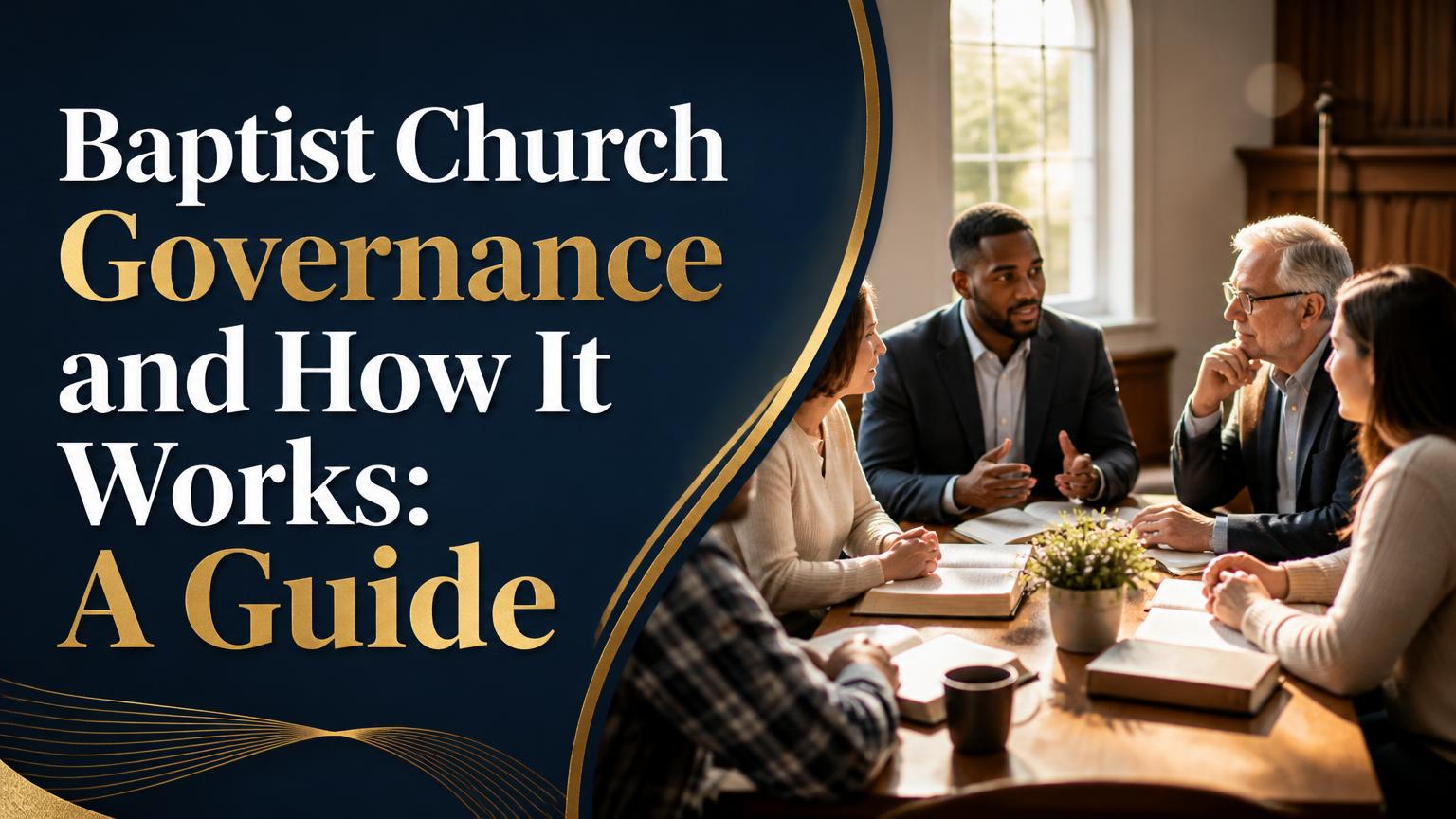
Baptist church governance generally combines local church autonomy, congregational decision-making, biblical accountability, and voluntary cooperation with other churches. The local congregation is not ordinarily governed by a bishop, regional presbytery, or denominational headquarters. Instead, members recognize Christ as the church’s supreme authority, seek to follow Scripture, and entrust day-to-day leadership to pastors, elders, deacons, and other ministry leaders.
There is no single Baptist governance blueprint. Churches differ in how much authority they assign to pastors, elders, deacons, committees, and the membership. Still, several principles appear widely across Baptist life.
Baptist Church Governance: How It Works
Local Church Autonomy Under Christ
A Baptist church is normally understood to be a self-governing local congregation. It calls its own pastor, receives and disciplines its own members, approves its budget, determines its ministries, and decides whether to cooperate with other Baptist organizations.
This autonomy does not mean that a church is independent of all accountability or free to disregard Scripture. Rather, it means that no external Baptist body ordinarily possesses routine governing authority over the congregation. A denomination, convention, or association may advise, train, support, or cooperate with a local church, but it usually cannot appoint its pastor or reverse the church’s decisions.
Baptists also distinguish between autonomy and isolation. A congregation may voluntarily cooperate with other churches for missions, theological education, disaster relief, church planting, or shared ministry. Cooperation is usually based on agreement and mutual support rather than institutional control.
Congregational Authority and Member Responsibility
Baptist churches generally practice a form of congregational polity, meaning that the gathered membership has final responsibility for major decisions. Members may vote on matters such as:
- Calling or dismissing a pastor
- Receiving new members
- Approving a budget
- Purchasing or selling property
- Adopting or amending governing documents
- Electing officers or ministry leaders
- Exercising church discipline
- Merging with or leaving an association or denomination
Congregationalism does not require members to vote on every operational detail. A church may authorize its pastor, elders, staff, or committees to make ordinary ministry decisions within defined limits. The congregation’s authority is often exercised through approval of leaders, policies, budgets, and major actions rather than through constant direct management.
This arrangement also gives church membership a serious meaning. Membership is not merely a way to receive services; it carries responsibility for the church’s doctrine, unity, witness, discipline, and mission. Jesus’ teaching about addressing a fellow believer’s sin and the church’s responsibility in serious cases is reflected in Matthew 18:15–20 and 1 Corinthians 5.
Pastors, Elders, and Deacons
The pastor commonly serves as the primary preaching, teaching, shepherding, and vision-casting leader. In many Baptist churches, the pastor also moderates business meetings or works with other leaders to guide the congregation through significant decisions. The pastor does not automatically possess unilateral authority, however. The extent of pastoral authority depends on the church’s constitution, bylaws, traditions, and membership expectations.
Some Baptist churches use elders as a formal governing body. Elders may share responsibility for doctrine, spiritual oversight, pastoral care, discipline, and strategic direction. A lead pastor may serve as one elder among several, or as the primary elder with other elders serving alongside him.
Deacons traditionally focus on service and practical care. The pattern in Acts 6—delegating the distribution of food so that the apostles could concentrate on prayer and the ministry of the word—is often associated with this distinction. In practice, deacons may oversee benevolence, facilities, member care, finances, or other ministries. Some churches, however, have historically given deacons broader governing authority than this service-oriented model suggests.
The titles alone do not settle the question of authority. Two churches may both have pastors, elders, and deacons but assign them substantially different responsibilities.
How Major Decisions Are Made
The usual process begins with prayer, biblical reflection, discussion among leaders, and communication with the congregation. A proposal may then be presented at a members’ meeting for approval.
Healthy congregational decision-making aims at more than winning a majority vote. Acts 15 shows an early Christian council reasoning from Scripture, testimony, experience, and the work of the Holy Spirit before reaching a shared conclusion. Although Baptist churches do not all interpret this passage in the same way, it illustrates why many congregations value patient deliberation and spiritual unity.
A church’s voting rules may specify:
- Who may vote
- Whether a person must be a member for a certain period
- The quorum required for a meeting
- The majority needed for ordinary or extraordinary decisions
- Whether votes are open, written, or electronic
- How conflicts of interest are handled
- What process applies to pastoral transition or discipline
These procedural details matter because they turn broad theological convictions into predictable practices.
Biblical Foundations for Baptist Governance
Baptist polity is based on a particular reading of several New Testament themes rather than on one verse that provides a complete organizational chart.
The New Testament presents local churches as real communities with recognized responsibilities. Churches receive members, appoint or recognize leaders, administer discipline, gather for worship, care for the needy, and guard the teaching they have received. These activities require both leadership and congregational participation.
Baptists commonly emphasize the direct responsibility of every believer before Christ. First Peter 2:9 describes Christians as a “royal priesthood,” which Baptists have historically connected with the spiritual dignity and responsibility of all believers. This teaching does not mean that every member has identical gifts or authority. It means that access to God and participation in Christian service do not depend on a separate priestly class.
The New Testament also identifies qualified leaders. Elders are instructed to shepherd willingly and by example rather than domineering over the congregation (1 Peter 5:1–4). First Timothy 3 and Titus 1 describe moral and spiritual qualifications for overseers, while 1 Timothy 3 also addresses deacons. Baptist churches therefore typically understand congregational governance as shared responsibility under qualified spiritual leadership, not as unrestricted rule by popular opinion.
The tension between leadership and congregational authority is intentional. Leaders teach, shepherd, equip, and protect; members listen, test teaching, participate, affirm leaders, and take responsibility for the church’s faithfulness.
Common Models of Baptist Church Governance
Pastor-Led Congregational Government
In a pastor-led church, the pastor provides substantial spiritual and administrative leadership, while the congregation retains final authority over major matters. Deacons, staff members, and committees may assist with implementation.
This model can produce clear direction and quick coordination. Its danger is excessive dependence on one personality. Strong safeguards include transparent finances, defined job responsibilities, regular evaluation, congregational access to information, and meaningful involvement by other qualified leaders.
Elder-Led Congregational Government
An elder-led church gives a group of elders responsibility for spiritual oversight and often for many operational decisions. The congregation may reserve approval of the pastor, budget, major property decisions, constitutional changes, and church discipline.
This model can provide shared wisdom and reduce dependence on a single leader. It still requires clarity. If the elders make every decision without meaningful accountability to members, the church may function as an elder-governed church in practice even if its documents describe it as congregational.
Deacon-Led or Traditional Committee Government
Some Baptist churches assign substantial leadership to deacons or committees. This model often developed through long-standing local custom and may work effectively when leaders communicate well and understand their responsibilities.
It can become difficult when committees exercise authority simply because they have done so historically, rather than because the church has clearly defined their role. Confusion commonly arises when pastors, elders, deacons, trustees, and committees possess overlapping or competing authority.
Hybrid Governance
Many contemporary Baptist churches use a hybrid arrangement. Elders provide spiritual oversight, deacons lead service ministries, staff members manage daily operations, and the congregation approves major decisions. Bylaws may also delegate specific authority to finance, personnel, missions, or property teams.
Hybrid systems can match leadership structures to actual ministry needs, but they must be documented clearly. Without defined boundaries, authority may shift informally to the most influential individuals or groups.
How Church Documents Shape Governance
A Baptist church’s practical government is usually defined by several documents and established practices:
- Statement of faith: explains the church’s doctrinal commitments.
- Church covenant: describes the commitments members make to God and one another.
- Constitution or articles of incorporation: establishes the legal and organizational identity of the church.
- Bylaws: specify membership, officers, meetings, voting, finances, discipline, and amendment procedures.
- Policies: address areas such as child protection, employment, benevolence, conflicts of interest, and financial controls.
These documents should agree with one another. A church may claim that members hold final authority while its bylaws give an unelected board control over all significant decisions. Conversely, documents may give the congregation authority while practical custom leaves members uninformed. The written structure and lived structure should correspond.
Good governance also includes financial transparency and responsible stewardship. Churches commonly use budgets, financial reports, designated approval levels, multiple-person counting procedures, and independent review. These practices are not signs of distrust; they protect the church, its leaders, and its ministry.
The Role of Baptist Associations and Denominations
Baptist associations and conventions generally support local churches rather than govern them as a centralized hierarchy. A local church may contribute funds, send messengers or representatives, cooperate in missions, and participate in shared educational or relief efforts.
Because participation is voluntary, a church can ordinarily withdraw from an association or denomination. An association may define its own membership requirements and may decide that a church no longer fits its doctrinal or ethical standards. That action affects the church’s relationship with the association but does not usually give the association direct control over the congregation’s property, officers, or internal decisions.
This relationship illustrates a central Baptist distinction: churches can cooperate extensively without surrendering local responsibility.
Strengths and Challenges of Baptist Governance
Baptist governance can encourage member participation, protect the independence of the local church, and keep authority close to the people who know the congregation’s context. It can also create strong accountability because major decisions are not permanently concentrated in a distant institution.
The same structure has weaknesses when it is poorly practiced. Congregational authority can become consumer preference, factional politics, or resistance to necessary change. Church meetings may reward the loudest voices rather than the wisest judgment. Conversely, leaders may use spiritual language to avoid accountability or treat congregational approval as a formality.
Three safeguards are especially important:
- Clear authority: Members, pastors, elders, deacons, and committees should know who decides what.
- Spiritual maturity: Decisions should be shaped by Scripture, prayer, truthfulness, and concern for the whole body rather than personal preference.
- Transparent accountability: Leaders should communicate openly, handle finances responsibly, and submit to appropriate review.
Congregational government is therefore not automatically healthy simply because members vote. Its quality depends on whether the church practices shared responsibility with integrity, humility, and theological seriousness.
How to Evaluate a Baptist Church’s Governance
Someone considering membership can ask practical questions:
- Who has final authority in major decisions?
- What decisions require a congregational vote?
- How are pastors, elders, and deacons selected and evaluated?
- What role do members have between business meetings?
- How are finances reported and reviewed?
- What process governs discipline, grievances, or leadership misconduct?
- Can members inspect the constitution and bylaws?
- What authority does an outside denomination or association possess?
- How are disagreements handled?
The answers reveal more than labels such as “elder-led” or “congregational.” A healthy structure should make authority understandable, accountability real, and member participation meaningful.
Baptist church governance is best understood as local congregational responsibility exercised under the authority of Christ and Scripture, through qualified leaders, with voluntary cooperation among churches. The precise arrangement varies, but the central issue is consistent: authority should be clearly assigned, spiritually accountable, and directed toward the church’s worship, unity, holiness, care, and mission.