
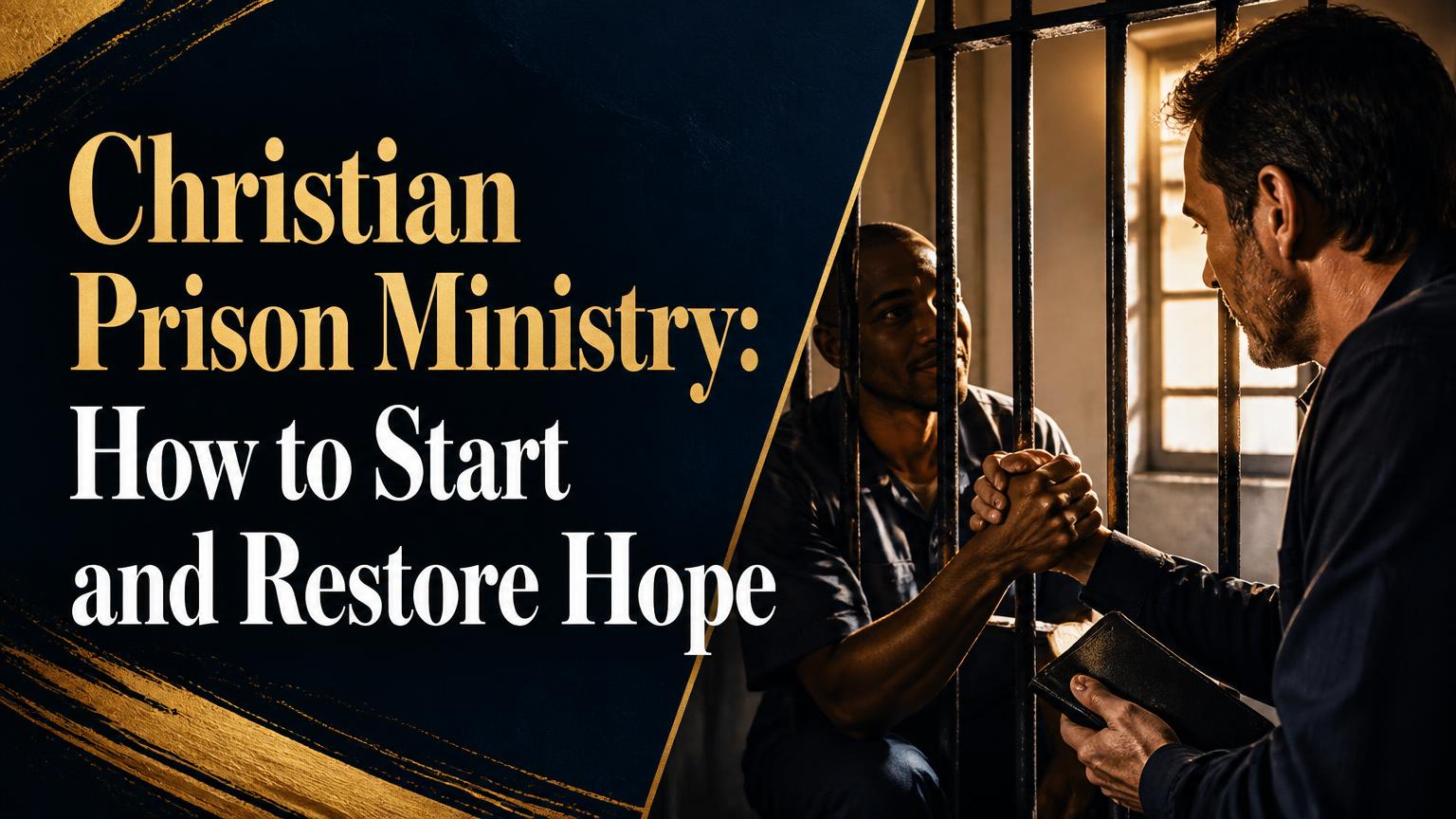
Christian prison ministry is the organized work of serving incarcerated people with the gospel, compassionate relationships, practical support, and a credible message of redemption. It includes Bible studies, worship services, one-to-one mentoring, correspondence, family support, reentry preparation, and cooperation with correctional institutions and local churches. Effective ministry does not treat prisoners as projects or reduce hope to a promise of immediate release. It recognizes their dignity, takes sin and responsibility seriously, and points to the possibility of forgiveness, transformation, reconciliation, and faithful living through Jesus Christ.
Christian Prison Ministry: What It Is, How It Works, and Why It Matters
Christian prison ministry brings the church into relationship with people who are often isolated from healthy community and spiritual care. Its purpose is not simply to conduct religious meetings inside a facility. It seeks to communicate the gospel, form trustworthy relationships, encourage moral and spiritual growth, and help people pursue constructive lives during incarceration and after release.
The strongest ministries hold several commitments together: truth without condemnation, compassion without excusing wrongdoing, evangelism without coercion, and practical assistance without creating unhealthy dependence. Correctional facilities also have strict rules, security concerns, diverse religious populations, and complex institutional systems. Ministry must therefore be spiritually sincere and operationally disciplined.
The Biblical Foundation for Prison Ministry
Scripture presents care for prisoners as a meaningful expression of Christian faith. Jesus identifies himself with people who are hungry, sick, excluded, or imprisoned in Matthew 25:31–46. Hebrews 13:3 calls believers to remember those in prison as though they were suffering alongside them. These passages do not erase criminal responsibility or require Christians to approve of every action a prisoner has taken. They require believers to see incarcerated people as human beings who remain accountable before God and worthy of compassionate attention.
The gospel also provides the ministry’s central message. Jesus offers forgiveness and reconciliation, but Christian hope is more than emotional encouragement. It involves repentance, faith, a changed relationship with God, and a new pattern of life. The apostle Paul’s conversion demonstrates that a person’s past does not place them beyond God’s power to redeem, while the Bible’s teaching on repentance makes clear that grace is not permission to continue harming others.
What Christian Prison Ministry Includes
Prison ministry may involve formal worship services, small-group Bible studies, discipleship courses, prayer meetings, Christian correspondence, mentoring, and distribution of approved religious materials. Some ministries specialize in trauma recovery, addiction recovery, literacy, parenting, marriage support, or preparation for release. Others focus on connecting prisoners with churches and mentors in the community.
The ministry can also extend beyond prison walls. Families of incarcerated people may need practical assistance, emotional support, transportation help, or a church community that will not define them by a relative’s offense. After release, former prisoners often need help finding stable housing, employment, transportation, counseling, substance-use treatment, and a trustworthy congregation. These needs do not replace gospel ministry; they often create the practical setting in which discipleship can become credible and sustainable.
How Prison Ministry Restores Hope
Christian hope does not depend on pretending that incarceration is easy or that every consequence will disappear. It begins by affirming that a prisoner’s identity is not exhausted by an offense, a sentence, or an institutional number. In Christ, a person can receive forgiveness and begin learning a new way to live, even when legal consequences remain.
Hope grows through repeated experiences of truth and faithful presence. A volunteer who listens carefully, keeps appropriate commitments, teaches Scripture patiently, and refuses manipulation demonstrates that trust can be rebuilt. A Bible study that connects God’s grace with responsibility, self-control, restitution, and reconciliation gives hope moral substance. The result may not be dramatic or immediate, but consistent relationships can help people imagine a future shaped by obedience rather than by past patterns.
How to Start Christian Prison Ministry
Starting a Christian prison ministry requires more than enthusiasm. A church or ministry team must understand the facility’s procedures, clarify its theological purpose, develop dependable leaders, and earn the confidence of correctional staff. The first step is usually not planning a large event; it is learning what the institution permits and what incarcerated people genuinely need.
Define the Calling and Scope
Begin by deciding what the ministry is prepared to do well. A small church might start with a weekly Bible study, a letter-writing ministry, or a partnership with an established prison organization rather than attempting to provide every service. Clarify the ministry’s doctrinal commitments, intended population, leadership structure, volunteer expectations, and boundaries.
The team should also identify what it cannot provide. Volunteers are not substitutes for attorneys, licensed therapists, probation officers, medical professionals, or social-service agencies. Clear limits protect prisoners, volunteers, and the ministry itself. A written purpose statement can keep the program focused: for example, proclaiming the gospel, offering biblical discipleship, treating incarcerated people with dignity, and supporting responsible reentry through appropriate partnerships.
Build Relationships With the Facility and Church
Contact the correctional facility through its official chaplaincy, volunteer-services office, or designated administrator. Requirements vary by jurisdiction and institution, but commonly include applications, background checks, orientation, security training, identification procedures, approved materials, and restrictions on communication or personal property. The facility’s rules are not obstacles to work around; they are conditions for safe and lasting access.
A local church should also understand and support the ministry. Church leaders can provide accountability, volunteers, prayer, financial oversight, and a place of welcome for people returning to the community. Partnerships with chaplains, reentry organizations, recovery programs, and congregations near release locations can prevent the ministry from becoming isolated or promising assistance it cannot deliver.
Recruit and Train the Right Volunteers
Effective volunteers need more than compassion and Bible knowledge. They must be dependable, emotionally mature, teachable, able to follow instructions, and willing to treat prisoners as adults rather than objects of rescue. Training should address correctional procedures, confidentiality, trauma, addiction, manipulation, cultural differences, mental-health concerns, religious liberty, and appropriate communication.
Volunteers also need to understand power dynamics. Incarcerated people may view a volunteer as a connection to money, legal assistance, outside relationships, or future opportunities. That does not mean every request is manipulative, but it does mean boundaries must be clear. Volunteers should not lend money, exchange personal contact details outside approved systems, make private promises, transport people without authorization, or begin romantic or emotionally dependent relationships.
Design a Program Around Discipleship
A sustainable program has a clear rhythm and learning purpose. Bible studies should do more than discuss isolated inspirational verses. They can explore themes such as repentance, forgiveness, identity in Christ, anger, honesty, suffering, reconciliation, stewardship, family responsibility, and perseverance. Each session should allow careful reading of Scripture, honest discussion, prayer, and practical application.
Discipleship also requires patience. Participants may have limited biblical literacy, painful religious experiences, unresolved trauma, or skepticism toward institutions. Teachers should welcome serious questions without weakening Christian convictions. The aim is not to force quick public decisions but to encourage understanding, genuine faith, accountable conduct, and continued growth.
Follow Security and Safeguarding Standards
Safety is part of Christian stewardship. Volunteers should never bypass searches, bring prohibited materials, ignore staff instructions, or assume that spiritual motives justify rule-breaking. Meetings should take place through approved channels, and records should be handled according to institutional requirements and privacy laws.
Safeguarding policies should address contact with minors, vulnerable adults, personal disclosures, allegations of abuse, gifts, transportation, digital communication, and one-to-one meetings. Two-adult practices or other oversight arrangements may be appropriate. If someone discloses imminent danger, abuse, or a serious threat, volunteers should follow the facility’s reporting procedures rather than promising absolute secrecy. Confidentiality must never be used to conceal harm.
Practices That Make Christian Prison Ministry Credible
A ministry’s credibility depends less on its public visibility than on whether its conduct matches its message. Incarcerated people quickly recognize performative concern, inconsistent attendance, and promises that disappear after a conversion story or release date. Trust grows when volunteers show up, listen well, tell the truth, respect boundaries, and remain committed when progress is slow.
Listen Before Speaking
Listening does not mean abandoning evangelism. It means learning a person’s circumstances before assuming what they need. A volunteer may hear grief over separation from children, fear about violence, shame about an offense, anger toward God, or anxiety about release. These experiences require attention rather than an immediate collection of religious phrases.
Careful listening also improves biblical application. A person struggling with guilt may need to understand both forgiveness and restitution. Someone controlled by anger may need teaching about self-control, accountability, and practical conflict reduction. Someone facing manipulation or abuse may need safety guidance from qualified professionals. Christian volunteers should pray, ask thoughtful questions, and avoid presenting themselves as experts in matters beyond their competence.
Combine Gospel Proclamation With Practical Care
Christian prison ministry should clearly communicate the person and work of Jesus Christ. It should explain sin, grace, repentance, faith, forgiveness, and the call to follow Christ. Yet proclamation becomes difficult to trust when volunteers ignore obvious human needs or use assistance to pressure people into religious participation.
Practical care can include approved books, educational support, family encouragement, reentry referrals, or help connecting with a church. Assistance should be offered fairly and without requiring a person to pretend to believe. This protects freedom of conscience and demonstrates that Christian service is rooted in love rather than recruitment or control.
Support Families and Reentry
Incarceration affects spouses, children, parents, and other relatives. A church can support families without minimizing the offense or placing them under pressure to reconcile before they are ready. Helpful care may include prayer, transportation coordination, childcare support, mentoring, and a safe community that avoids gossip.
Reentry planning should begin before release whenever possible. A realistic plan considers housing, identification documents, employment, transportation, medical care, treatment, supervision requirements, relationships, and church involvement. Churches should make specific commitments rather than vague assurances. A named mentor, scheduled meeting, transportation plan, and referral to qualified services are more useful than simply saying, “Let us know if you need anything.”
Measure Faithfulness Rather Than Dramatic Results
Visible decisions, emotional testimonies, and large attendance numbers can encourage a ministry, but they are incomplete measures. A person may make a public profession without developing durable faith, while another may grow quietly through years of study and responsible conduct. Ministries should evaluate consistency, biblical understanding, healthy relationships, volunteer reliability, appropriate referrals, and participant safety.
This perspective protects the work from manipulation. Volunteers do not need to produce impressive stories to prove that God is working. Their responsibility is to teach faithfully, serve wisely, maintain integrity, and leave ultimate spiritual transformation to God. First Corinthians 3:6–7 uses agricultural imagery to distinguish faithful labor from the power that produces growth.
Common Challenges and Wise Responses
Prison ministry involves tensions that cannot be solved by simple slogans. Some participants may want material help more than spiritual instruction. Others may distrust churches because of past abuse or hypocrisy. Volunteers may encounter people who exaggerate stories, test boundaries, or resist accountability. These realities call for discernment rather than cynicism.
A wise ministry avoids two opposite errors. The first is naïveté: assuming that every request is harmless and every spiritual claim is mature. The second is suspicion: treating every prisoner as dishonest or spiritually unreachable. Consistent policies, team oversight, careful documentation, and patient relationships allow volunteers to show compassion without surrendering judgment.
Ministry may also face theological disagreements, denominational differences, and questions about whether evangelism is appropriate in a government-controlled setting. Participation should remain voluntary, religious liberty should be respected, and the ministry should cooperate with institutional authorities without becoming an instrument of coercion. Christian conviction is strongest when it is offered openly, taught responsibly, and embodied through service.
Conclusion
Christian prison ministry restores hope by bringing the truth of the gospel into places marked by isolation, guilt, loss, and uncertainty. It sees incarcerated people as responsible for their actions yet still capable of repentance, faith, growth, and service. Starting well requires a defined mission, institutional cooperation, trained volunteers, strong safeguards, biblical teaching, and practical partnerships that continue beyond the prison gate.
The ministry’s most persuasive message is expressed through both words and conduct: Jesus Christ offers forgiveness, and his followers can be trusted to act with humility, wisdom, patience, and integrity. When churches serve without manipulation, keep appropriate boundaries, support families, and prepare people for responsible reentry, they help make Christian hope concrete rather than merely promised.