
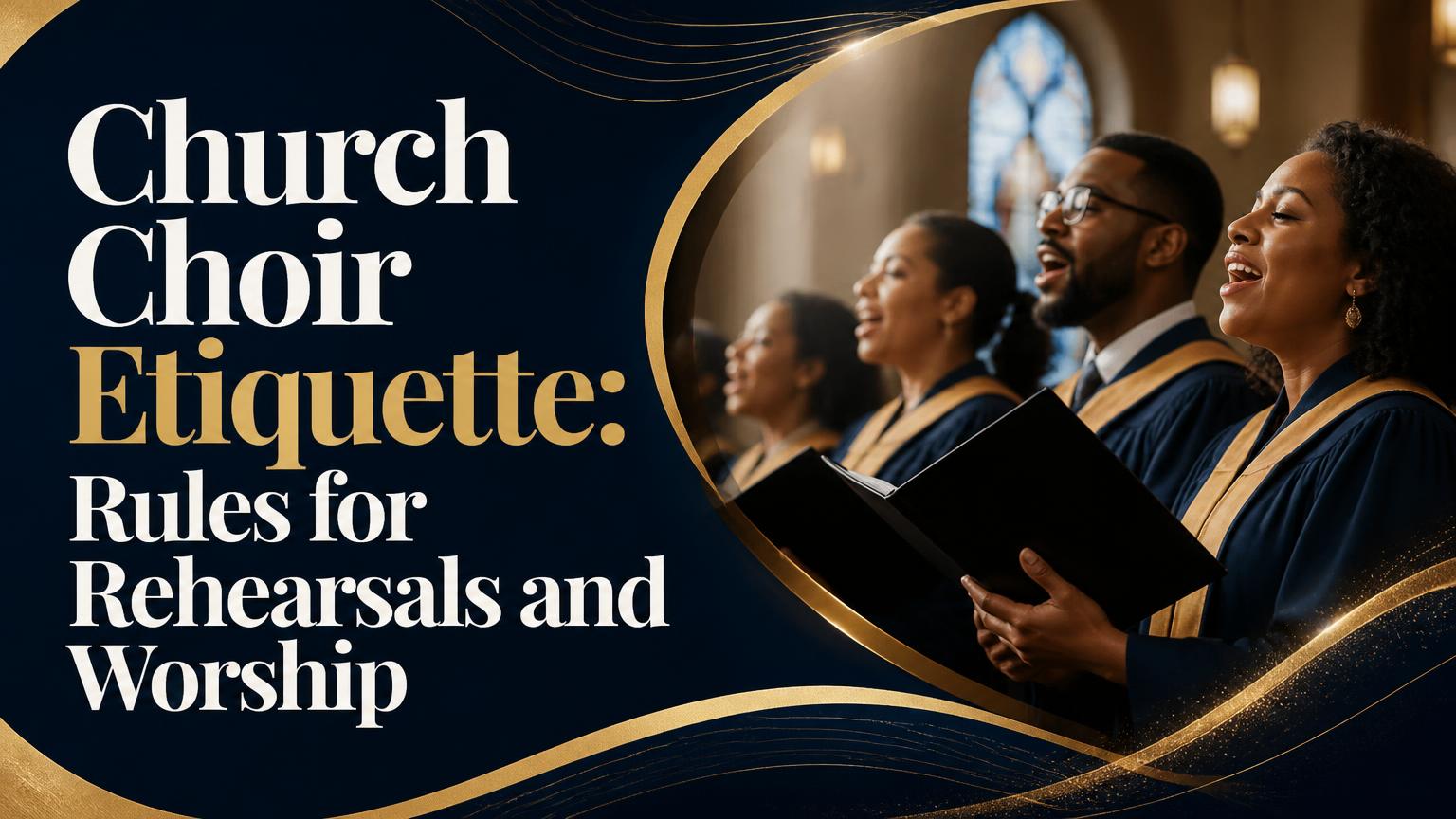
Church choir etiquette is the set of attitudes and practices that help singers serve together with preparation, humility, respect, and musical discipline. It applies before rehearsal, during practice, in the worship service, and in communication with the choir director, musicians, pastor, and congregation. Good etiquette does not mean treating worship like a performance or suppressing every individual style. It means using personal abilities in a way that supports the church’s worship, protects unity, and helps the congregation participate rather than compete for attention.
Church Choir Etiquette: Rules for Rehearsals and Worship
A church choir functions best when members understand that musical excellence and spiritual service belong together. The specific expectations will vary among congregations, denominations, and worship traditions, but the central principles are widely applicable: prepare faithfully, follow appropriate leadership, respect fellow singers, and keep the purpose of worship in view.
Prepare Music and Arrive Ready
Learn assigned music before rehearsal whenever possible. Review the score, listen to approved practice recordings, mark difficult passages, and bring the required music or folder. A choir member who arrives unprepared often causes the director to spend rehearsal time teaching notes that others have already learned.
Punctuality is part of preparation. Arrive early enough to find your seat, collect music, warm up quietly, and resolve practical matters before rehearsal begins. If illness, work, transportation problems, or a family emergency will prevent attendance, notify the director as soon as possible rather than leaving the choir uncertain about your participation.
Preparation also includes caring for your voice. Adequate rest, hydration, sensible warmups, and avoiding unnecessary shouting can improve both individual singing and ensemble balance. Members should not attempt to sing through significant illness merely to appear committed; communicating honestly allows the director to adjust responsibly.
Respect Rehearsal Time and Leadership
During rehearsal, listen while the director or section leader is speaking. Side conversations, unnecessary phone use, private joking, and singing unrelated material make it harder for others to concentrate. If a question affects the entire choir, ask it clearly; if it concerns only your part, wait for an appropriate moment or speak privately.
The choir director normally has responsibility for musical interpretation, entrances, tempos, dynamics, diction, and rehearsal priorities. Members may have valuable suggestions, but correcting the director publicly, arguing over every instruction, or repeatedly insisting on personal preferences undermines the group. Respectful questions are appropriate; persistent resistance is not.
Leadership does not eliminate accountability. A director should give clear instructions, treat members fairly, and make reasonable accommodations when possible. Choir members should follow the established chain of communication, usually beginning with the director and involving the worship leader or pastor when the concern affects broader worship planning.
Sing as an Ensemble, Not as Soloists
A choir is an ensemble, so the goal is a unified sound rather than maximum individual volume. Sing the marked dynamics, blend vowel sounds, observe phrasing, and listen to the sections around you. A strong singer can still harm the choir by overpowering nearby voices, adding unplanned ornamentation, or changing the melody without permission.
This does not mean every voice should sound identical. Healthy choirs include different vocal colors, ranges, ages, and levels of experience. The issue is whether those differences are coordinated. A confident singer can support less experienced members by modeling accurate notes and clear diction without turning every phrase into a personal showcase.
Unless a solo is assigned, avoid improvising, adding harmonies, clapping, or changing lyrics spontaneously. Even stylistic traditions that encourage freedom require shared musical judgment. The director may invite expressive variation at particular moments, but individual creativity should serve the arrangement rather than distract from it.
Handle Worship Space, Attire, and Movement Carefully
Follow the church’s expectations for clothing, seating, microphones, folders, robes, and movement. Appropriate attire is usually modest, clean, comfortable enough for singing, and consistent with the congregation’s worship culture. A choir does not need identical clothing in every church, but members should avoid outfits or accessories that draw disproportionate attention or create avoidable distraction.
Keep the choir area orderly. Store personal belongings where instructed, silence phones, handle music quietly, and avoid unnecessary movement during prayers, Scripture readings, sermons, or musical offerings. If you must leave because of illness or an urgent need, do so discreetly and at a suitable moment when possible.
Microphones and risers also require care. Do not adjust shared equipment without permission, crowd a microphone, or place music where it blocks the congregation’s view. Small practical habits communicate consideration for the musicians, worship leaders, ushers, and people who maintain the worship space.
Practice Reverence and Participation During Worship
A choir is still part of the worshiping congregation when it is not singing. Members should participate appropriately in prayer, Scripture reading, congregational songs, and other elements of the service rather than appearing disengaged while waiting for their next entrance. Expressions of worship may differ, but visible boredom, whispered conversations, or distracted phone use can affect the congregation.
The choir should also avoid treating its musical offering as a concert inserted into the service. Colossians 3:16 connects singing with teaching, encouragement, and gratitude, which points beyond technical performance. A well-rehearsed anthem can support worship, but the choir’s purpose is to direct attention toward God and help the church respond faithfully—not to obtain applause or personal recognition.
After singing, remain attentive. Do not immediately relax into private conversation, make exaggerated reactions to mistakes, or leave the platform simply because your portion is finished. A calm, prayerful presence helps maintain the continuity of the service and reassures the congregation that the choir is serving rather than displaying itself.
Communicate Problems Directly and Charitably
Disagreements about music, scheduling, volume, solos, seating, or worship style should be handled privately and respectfully. Speak to the person with authority to address the issue instead of building a campaign through gossip or group messages. Describe the specific concern, explain its practical effect, and be willing to hear information you may not have known.
Matthew 18:15 presents direct conversation as a constructive first step when conflict arises, although serious matters may require pastoral or safeguarding procedures. Direct communication does not mean confronting someone aggressively or demanding an immediate result. It means replacing speculation and resentment with honest, appropriate discussion.
Avoid criticizing another singer’s voice, age, musical ability, appearance, or level of commitment. If correction is necessary, it should normally come from the director or designated leader. A choir becomes safer and more effective when members can improve without being embarrassed and when experienced singers help beginners rather than ranking themselves above them.
Protect Health, Boundaries, and Inclusion
Respect physical and personal boundaries in rehearsals, retreats, transportation, and social activities. Churches should use appropriate safeguarding practices for children and vulnerable adults, including clear supervision rules and responsible communication. Choir members should never assume that informal ministry settings remove the need for ordinary safety and professional conduct.
Vocal strain, hearing concerns, mobility limitations, pregnancy, disability, anxiety, and cultural or language differences may affect participation. Members should communicate relevant needs, and leaders should seek reasonable adjustments where practical. Inclusion does not require ignoring musical or safety requirements; it requires distinguishing genuine necessities from avoidable barriers.
Never shame someone for missing a note, needing an easier part, or declining a solo. Choir service is not a measure of spiritual worth. Romans 12:10 emphasizes honoring others, and that principle applies to how experienced singers treat newcomers, how leaders give feedback, and how the group responds when someone cannot participate fully.
Why Church Choir Etiquette Matters
Choir etiquette has a musical purpose because coordinated behavior directly affects rehearsal efficiency, accuracy, blend, timing, and confidence. When members arrive prepared and listen carefully, the director can spend more time refining interpretation instead of correcting preventable problems. When singers control their volume and follow shared phrasing, the congregation hears a unified offering rather than several competing performances.
It also has a relational and spiritual purpose. Churches bring together people with different personalities, musical backgrounds, ages, and expectations. A choir can easily become a place of comparison, status, or resentment if recognition is treated as the main reward. Practices such as punctuality, charitable correction, shared responsibility, and willingness to follow direction turn those differences into cooperation.
The biblical principle that “all things should be done decently and in order” in 1 Corinthians 14:40 is not a command for cold formality. In context, order protects the congregation’s ability to be built up. Applied to a choir, organization and restraint create space for worship, teaching, encouragement, and participation rather than allowing confusion or individual ambition to dominate.
Common Situations in Church Choir Etiquette
What Should a Choir Member Do If They Disagree With the Director?
Raise the concern privately and respectfully, preferably after rehearsal or through an agreed communication channel. Ask for the reasoning behind the decision before assuming it is careless or unfair. Some choices involve the pastor’s worship plan, the capabilities of the instrumentalists, the liturgical calendar, or time limitations that individual members cannot see.
If the issue concerns safety, discrimination, inappropriate conduct, or a serious breach of church policy, do not treat it as an ordinary musical disagreement. Follow the congregation’s established reporting process and involve appropriate pastoral or safeguarding leadership. Otherwise, once a decision has been made, members should support it in good faith unless they are asked to provide further input.
Is It Acceptable to Miss Rehearsal but Sing on Sunday?
That depends on the choir’s policy and the difficulty of the music. For familiar congregational material, occasional absence may not prevent participation. For a new, complex, or highly coordinated piece, missing rehearsal can create problems for entrances, harmonies, movement, and confidence. A member should ask the director rather than assume that Sunday attendance alone is sufficient.
Notify the director as early as possible and ask whether practice materials, a recording, or an alternate assignment is available. Avoid joining a piece unprepared merely because a place is available. In some situations, responsible service means sitting out one selection so that the ensemble remains secure.
Should Choir Members Applaud After Their Special Music?
Follow the worship leader’s and congregation’s established practice. Applause may be appropriate in some churches as an expression of gratitude, while other traditions move directly into prayer, Scripture, or the next part of worship. Choir members should not initiate exaggerated applause, cheering, or self-congratulation when doing so would shift attention toward the performers.
The same principle applies to compliments afterward. Receive encouragement graciously, but direct credit toward the shared work of the choir, musicians, director, and the purpose of the service. A simple “thank you” is usually better than either false humility or an extended discussion of personal performance.
Conclusion
Church choir etiquette is best understood as disciplined service shaped by preparation, humility, attentiveness, and love for the congregation. The essential rules are straightforward: arrive ready, respect rehearsal leadership, sing for the ensemble, follow worship and attire expectations, remain engaged throughout the service, communicate conflict appropriately, and protect the dignity and well-being of fellow members. These practices do more than prevent disruption. They allow musical skill to support shared worship instead of competing with it, making the choir a dependable ministry rather than merely a group of performers.