
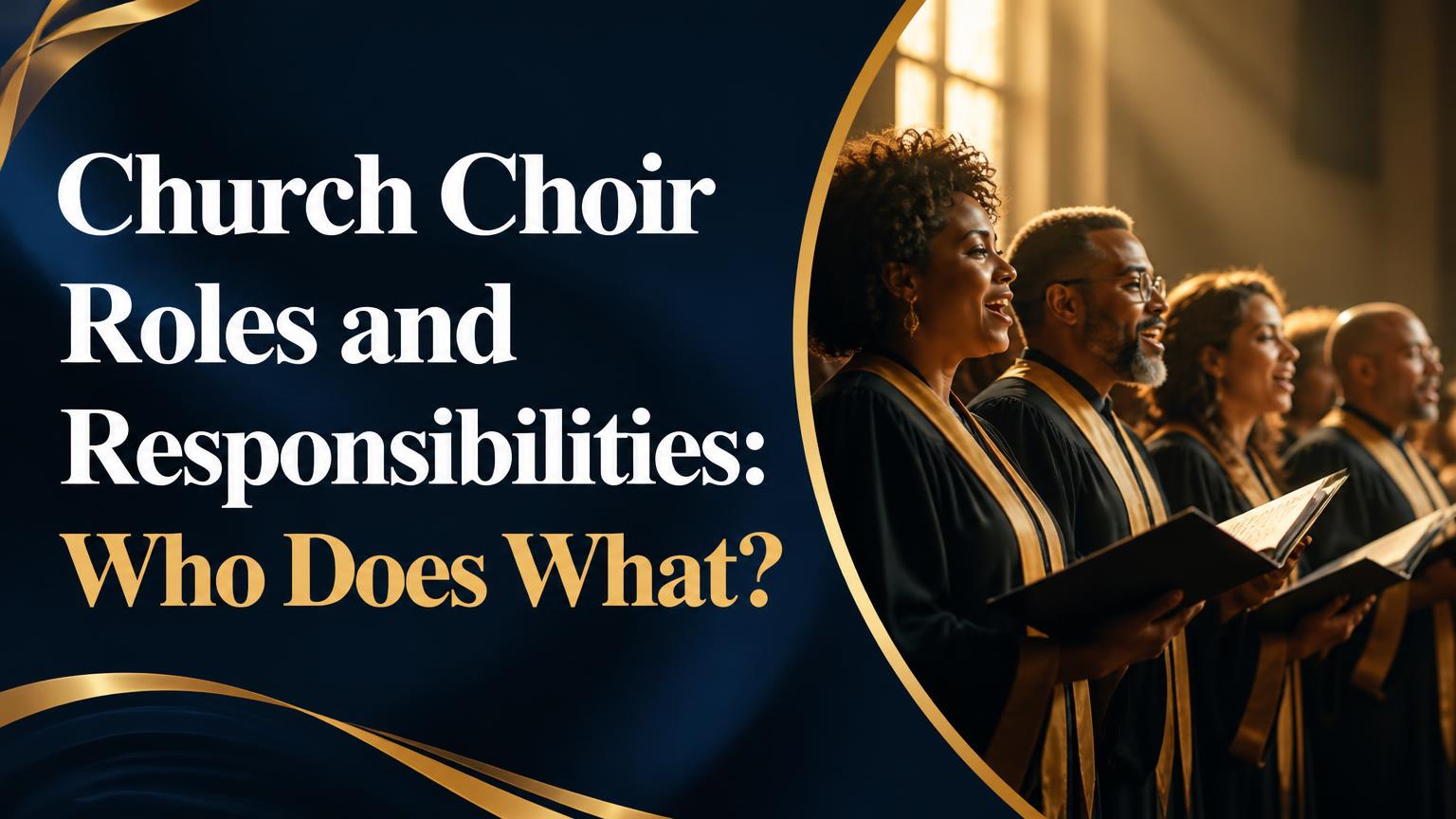
A church choir is more than a group of singers standing together during a service. It is a ministry organized around musical preparation, spiritual formation, congregational participation, and orderly worship. Because churches vary in size and tradition, one person may carry several responsibilities, while larger churches may assign each function to a different leader. Understanding church choir roles and responsibilities helps prevent confusion, supports healthy teamwork, and ensures that music serves the church’s mission rather than becoming a performance detached from worship.
Church Choir Roles and Responsibilities
The central responsibility of a church choir is to help the congregation worship through prepared, biblically appropriate, and musically responsible singing. That work includes rehearsing, learning music, supporting the service’s theme, cooperating with church leadership, and encouraging participation rather than seeking attention.
Choir Director or Minister of Music
The choir director plans rehearsals, selects or approves musical arrangements, teaches vocal parts, establishes musical expectations, and conducts the choir during services. In some churches this person is called a minister of music, music director, or choral director. The title may differ, but the essential function is the same: coordinating the choir’s musical and ministerial work.
A director normally prepares a seasonal or service-based repertoire, communicates schedules, evaluates the choir’s readiness, and works with accompanists and worship leaders. The director should correct musical problems clearly but respectfully, recognizing that choir members are serving voluntarily in many congregations. Good leadership combines musical competence with patience, organization, spiritual maturity, and the ability to develop people rather than merely produce polished performances.
Pastor and Worship Leader
The pastor provides theological and pastoral oversight for the worship ministry. This may include clarifying the service’s theme, approving major changes in worship practice, addressing pastoral concerns, and ensuring that the choir’s ministry fits the church’s doctrine and mission. The pastor does not necessarily conduct rehearsals or choose every anthem, but the choir should not operate as an independent organization disconnected from church leadership.
A worship leader, where the position exists, coordinates the musical flow of a service. That person may lead the congregation, singers, musicians, and transitions between musical elements. The worship leader and choir director may be the same person, but they have different emphases: the choir director focuses primarily on choral preparation, while the worship leader coordinates the broader worship experience. Clear communication prevents competing instructions or uncertainty about who makes final decisions.
Accompanist and Instrumentalists
The accompanist supports the choir during rehearsals and services by establishing pitch, maintaining tempo, reinforcing vocal parts, and helping singers recover when they lose their place. An accompanist must do more than play the notes accurately. The musician needs to follow the director, adjust volume to the singers, understand breathing and phrasing, and adapt when a service changes unexpectedly.
Other instrumentalists may provide piano, organ, guitar, orchestral, or rhythm-section support. Their responsibility is to serve the arrangement and the singers rather than overpower them. Instrumentalists should attend enough rehearsals to understand entrances, endings, dynamics, tempo changes, and transitions. When several musicians are involved, someone should clarify who leads musical cues so the choir receives consistent direction.
Section Leaders and Choir Officers
Section leaders guide the soprano, alto, tenor, bass, or other vocal sections. They may help members learn difficult passages, communicate rehearsal information, identify recurring problems, and encourage attendance. Section leaders do not replace the choir director; their role is to provide practical support and improve communication within the group.
Larger choirs may also have a president, vice president, secretary, treasurer, librarian, or rehearsal coordinator. These officers often manage attendance, announcements, social activities, budgets, uniforms, transportation, or special events. Their responsibilities should be defined in writing, especially when money, official communication, or access to church resources is involved. Administrative roles are ministry roles when they help the choir function reliably and serve people well.
Choir Members
Choir members are responsible for attending rehearsals, learning assigned music, bringing necessary materials, arriving prepared, and participating with a cooperative attitude. Preparation includes more than knowing the melody. Members need to learn their vocal parts, observe dynamics and diction, follow the director’s instructions, and understand when to sing, remain silent, stand, sit, or move.
Members also contribute to the choir’s spiritual and relational health. They should treat fellow singers with respect, avoid gossip and unnecessary conflict, and recognize differences in age, musical experience, culture, and personality. A choir member does not need to be a professional singer, but should accept correction, protect the group’s unity, and take reasonable responsibility for personal improvement. Consistent participation matters because one absent or unprepared section can affect the entire ensemble.
Music Librarian and Administrative Volunteers
A music librarian organizes scores, folders, hymnals, digital files, copyright information, and performance copies. This work is easy to overlook, yet misplaced or incomplete music can waste rehearsal time and create confusion during worship. The librarian may label parts, distribute music, collect it after use, track borrowed materials, and maintain an orderly archive.
Administrative volunteers may schedule rehearsals, send reminders, coordinate substitutes, prepare attendance records, arrange robes, or communicate with the church office. These tasks should follow the church’s privacy and safeguarding policies. Personal contact information, health details, transportation arrangements, and children’s participation require careful handling rather than informal sharing.
Sound and Technical Team
The sound team manages microphones, monitors, amplification, recording, livestreaming, and the balance between choir, instruments, and congregation. Its work affects whether the choir can hear itself, whether the congregation can understand the words, and whether the service remains free from distracting technical problems.
Choir members should follow microphone instructions, maintain appropriate spacing, and avoid making independent equipment changes. The director and sound operator need rehearsal time to test entrances, volume, soloists, spoken introductions, and unusual arrangements. A technically strong choir can still sound unclear if diction, microphone placement, room acoustics, and amplification are not considered together.
How Choir Responsibilities Work Together
A healthy choir functions through shared responsibility rather than one person carrying every task. The director may lead musical preparation, but the pastor provides church oversight, the worship leader coordinates the service, musicians support the arrangement, section leaders strengthen communication, and members bring the preparation that makes the ministry possible.
Preparation Before the Service
Before worship, the team should confirm the music, order of service, keys, tempos, instrumentation, solo assignments, transitions, dress expectations, arrival times, and any congregational participation. The director should identify difficult passages early instead of discovering them during the service. The sound team should test microphones and monitor levels, while the pastor or worship leader should communicate any theological or pastoral emphasis that affects the music.
A written schedule is especially valuable for Christmas, Easter, funerals, weddings, concerts, and services involving children or multiple choirs. It reduces assumptions and allows volunteers to understand their specific assignments.
Conduct During Worship
During the service, the choir’s visible behavior communicates as much as its singing. Members should remain attentive, respond to the director, handle music discreetly, and avoid conversations or unnecessary movement. If a mistake occurs, the best response is usually to continue calmly rather than draw attention to it.
The choir should also understand its relationship to the congregation. Its purpose is not simply to perform for an audience. Through an anthem, hymn, response, or sung Scripture, the choir may teach, encourage, lead, or support congregational worship. That purpose affects repertoire, volume, presentation, and the amount of musical complexity that is appropriate.
Follow-Up After the Service
After worship, the team can briefly evaluate what worked, what caused confusion, and what should change next time. Evaluation should address observable issues—such as unclear cues, insufficient rehearsal, poor balance, or missing music—rather than becoming personal criticism.
The director or coordinator should return music, record useful notes, communicate future assignments, and recognize the contributions of volunteers. When concerns involve conflict, repeated unreliability, inappropriate conduct, or pastoral care, they should be handled privately through the church’s established leadership process.
Biblical Principles That Shape Choir Service
The New Testament presents singing as a ministry of mutual edification, praise, teaching, and gratitude. Ephesians 5:19 and Colossians 3:16 connect singing with addressing one another, giving thanks, and allowing the word of Christ to dwell richly among believers. This means a choir’s ministry includes the spiritual effect of its words and attitude, not only its musical accuracy. A beautiful arrangement cannot compensate for lyrics that are unclear, theologically unsuitable, or disconnected from the congregation’s worship.
First Corinthians 14:40 instructs the church to conduct its gatherings decently and in order. Applied to choir ministry, this principle supports preparation, clear leadership, dependable schedules, appropriate authority, and respectful cooperation. Order does not mean rigid uniformity or emotional coldness; it creates conditions in which people can participate without confusion. The choir’s excellence should therefore serve understanding, worship, and love rather than personal status.
Common Confusions About Church Choir Responsibilities
The choir director is not automatically the pastor, worship leader, or head of every musical decision in the church. Authority depends on the church’s structure and the responsibilities formally assigned to each position. Likewise, being a strong singer does not by itself qualify someone to lead people, manage conflict, choose theology, or oversee a ministry.
The choir also does not carry sole responsibility for the quality of worship. Congregational singing depends on the pastor’s direction, the worship leader’s coordination, the musicians’ preparation, the sound team’s work, the congregation’s participation, and the choir’s readiness. When problems arise, blaming one group often hides the real issue: unclear expectations, inadequate rehearsal, poor communication, or an unsuitable arrangement.
Creating a Clear Choir Role Structure
Churches can reduce confusion by writing a simple ministry description for every position. Each description should state the role’s purpose, regular duties, decision-making authority, reporting relationship, expected preparation, and process for handling concerns. A small church may combine several positions, but it should still distinguish the responsibilities even when one person performs them all.
A practical structure might assign the pastor or worship committee overall oversight, the choir director musical leadership, the accompanist instrumental support, section leaders member support, a librarian music management, and the sound team technical coordination. The choir handbook can also explain attendance expectations, rehearsal etiquette, dress, child and youth safeguarding, substitute procedures, and how new members are welcomed and trained.
Clear roles should support ministry rather than create bureaucracy. They give volunteers a realistic understanding of what they have agreed to do, make accountability fairer, and help the choir respond to changes in membership or leadership without losing continuity.
Conclusion
Church choir roles and responsibilities extend beyond singing during a worship service. The choir director prepares and leads the music, the pastor and worship leader provide appropriate oversight, instrumentalists and technicians support the sound, officers and volunteers organize the ministry, and every choir member contributes through preparation, cooperation, and responsible conduct. These roles may be combined or arranged differently from one church to another, but the underlying principles remain consistent: clear authority, careful preparation, mutual respect, theological faithfulness, and service to the congregation. When those elements work together, the choir becomes a dependable ministry that strengthens worship rather than merely adding musical decoration.