
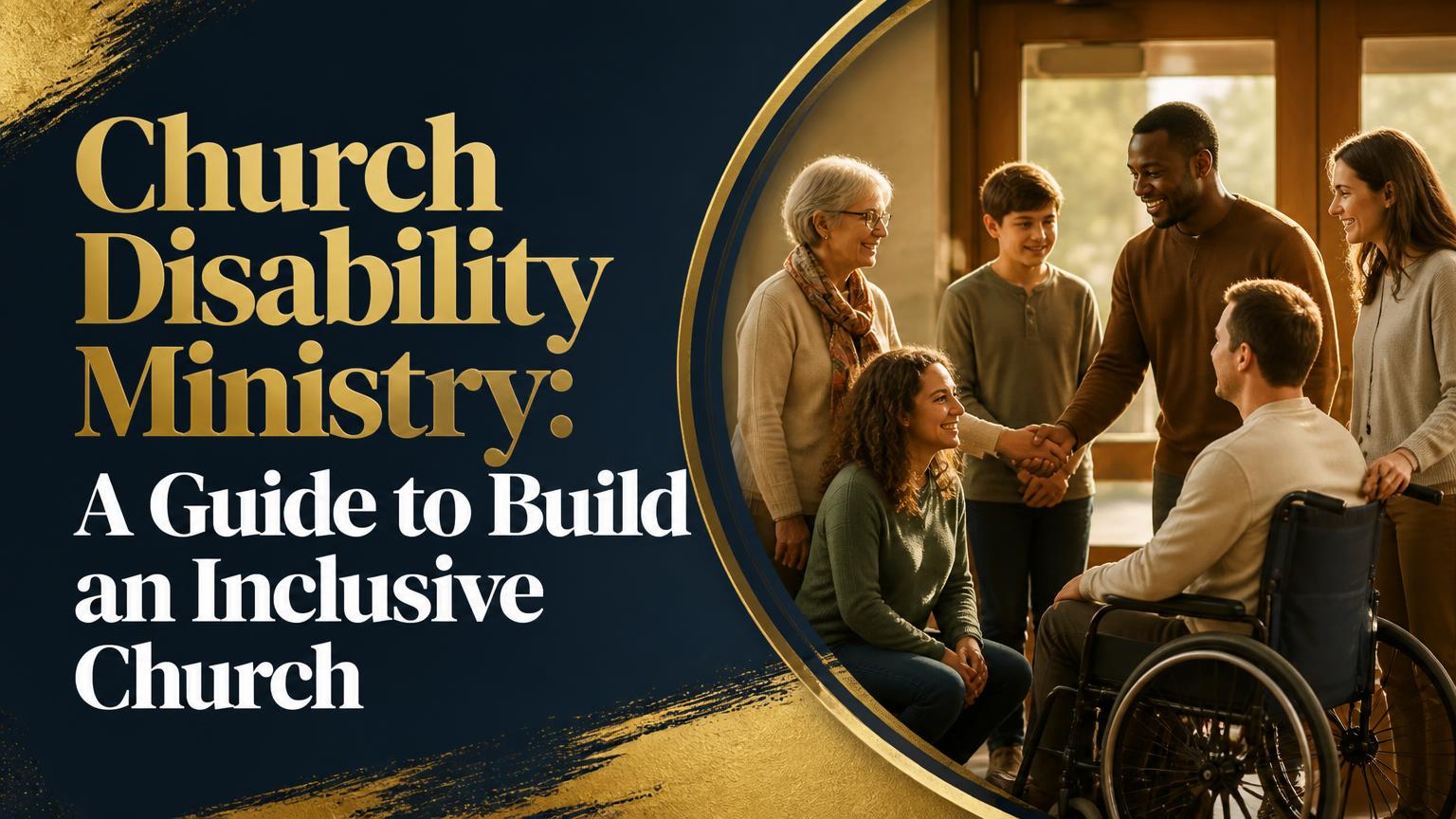
Church disability ministry helps a congregation remove barriers so people with disabilities can worship, serve, learn, form relationships, and exercise spiritual gifts as full members of the church. Effective ministry is more than providing a separate class or accommodating occasional visitors. It combines biblical conviction with practical planning: listening to disabled people and their families, improving physical and communication access, training volunteers, protecting vulnerable people, and creating meaningful opportunities for belonging and leadership.
Church Disability Ministry: What It Is and What It Should Do
Church disability ministry is the organized effort to include people with physical, sensory, intellectual, developmental, neurological, and mental-health-related disabilities in the ordinary life of a congregation. Some churches offer specialized support, but the goal should not be to create a parallel church for disabled people. The goal is participation, belonging, spiritual growth, and mutual service throughout the church community.
Ministry Means Belonging, Not Mere Attendance
A person may be physically present in a worship service and still be excluded. Belonging involves being known by name, welcomed without embarrassment, included in relationships, taught in an understandable way, and invited to contribute. A child who receives support in Sunday school, an adult who serves on a greeting team, and a deaf worshiper who can follow the sermon are all experiencing more than access to a building; they are participating in the body of Christ.
This distinction changes how a church evaluates success. Counting disabled attendees is useful, but it does not reveal whether people have friends, understand the teaching, make choices about their support, or have opportunities to serve. Inclusion asks whether disabled people are treated as members and neighbors rather than as projects, guests, or recipients of charity.
Build Accessibility Into Ordinary Church Life
Accessibility should be part of normal church planning rather than an emergency response to individual requests. Physical access may involve ramps, accessible restrooms, clear pathways, seating options, lighting, acoustics, and safe evacuation procedures. Sensory and communication access may include captions, large-print materials, visual schedules, sign-language interpretation, hearing assistance, plain-language instructions, and a quiet space for people who become overwhelmed.
Cognitive accessibility also matters. Churches can explain routines before events, use predictable transitions, reduce unnecessary noise, and offer multiple ways to participate. These changes often help older adults, young children, people with temporary injuries, people learning the local language, and families experiencing stress. Designing for a wider range of needs usually strengthens ministry for the whole congregation.
Distinguish Accommodation, Inclusion, and Integration
Accommodation means adjusting an environment or practice so a person can participate. For example, a church may provide an interpreter, modify a classroom activity, or allow a worshiper to move during the service. Integration places a person in a shared setting, but it does not guarantee meaningful participation. Inclusion goes further by examining whether the setting, relationships, expectations, and leadership structures genuinely welcome that person.
A separate program can be helpful when it provides specialized teaching or support that a person needs. It becomes harmful when it assumes disabled people cannot belong in the main congregation or should never make decisions about their own participation. The wisest approach is usually flexible: provide specialized support where necessary while maintaining connection to the wider church and respecting the individual’s preferences.
Let Disabled People Shape the Ministry
A church should not design disability ministry entirely from the perspective of nondisabled leaders. Disabled people and family members can identify barriers that others overlook, evaluate proposed solutions, and explain what respectful support looks like. Their involvement should not be limited to sharing personal stories or approving plans; they should have real influence in ministry decisions.
Leadership participation may include serving on an accessibility team, teaching, advising staff, helping develop policies, or holding formal ministry roles. Not every disabled person will want public leadership, and no one should be pressured to represent an entire disability community. The principle is shared authority: people affected by ministry decisions should have a meaningful voice in forming them.
Biblical and Theological Foundations for Disability Ministry
Christian inclusion begins with more than institutional kindness. Scripture presents human beings as made in the image of God and describes the church as one body with different members and gifts. These convictions challenge both neglect and paternalism. Disabled people are not valuable because they can contribute to a program; they possess inherent dignity and belong to God before they perform any role.
Every Member Belongs to the Body
In 1 Corinthians 12, Paul describes the church as a body in which apparently weaker members are indispensable. The passage does not create a hierarchy in which some people serve and others merely receive. It teaches mutual dependence: the church needs gifts, perspectives, patience, wisdom, and forms of service that may be overlooked by conventional standards of productivity.
Romans 12:4–8 likewise presents different gifts as part of one body. A congregation should therefore ask not only, “How can we help disabled people?” but also, “What has God given these members to share with us?” The answer may involve teaching, prayer, hospitality, encouragement, administration, artistic expression, practical service, or forms of presence that strengthen relationships in ways formal programs cannot measure.
Reject Shame-Based Explanations of Disability
Jesus’ encounter with a man born blind in John 9 challenges the assumption that disability is evidence of personal sin or a family’s guilt. Jesus does not treat the man as a theological problem to be explained before he can be loved. This does not answer every question about suffering, but it clearly warns churches against blaming disabled people or promising that faith will remove disability.
A faithful ministry avoids language that portrays disability as a spiritual defect, a punishment, or a condition that prayer must inevitably cure. Prayer, healing, and hope have a legitimate place in Christian life, but they should never communicate that a person is incomplete until a cure occurs. Disabled Christians should be welcomed as whole persons in the present, not valued only for a future change.
Practice Hospitality and Mutual Service
Biblical hospitality involves receiving people with dignity, attention, and practical care. In Luke 14, Jesus confronts social patterns that treat hospitality as an exchange of favors. Christian welcome should not depend on whether a person can repay the church through money, status, convenience, or visible service.
This principle also protects families from being treated as ministry burdens. A church may provide respite, transportation, classroom support, or practical assistance, but it should do so relationally and respectfully. Mutual service means that disabled people, caregivers, volunteers, pastors, and other members all participate in giving and receiving care. The relationships should not be defined only by need.
How to Build a Church Disability Ministry
A sustainable ministry develops through listening, assessment, training, and gradual improvement. Churches do not need to solve every accessibility issue before beginning. They do need to communicate honestly, avoid making promises they cannot keep, and create a process for responding to needs consistently rather than relying on one unusually committed volunteer.
Assess Barriers Before Choosing Programs
Begin by examining the church’s buildings, worship services, classes, events, communication, transportation, and emergency procedures. Invite disabled people and caregivers to walk through the experience from arrival to departure. Ask where confusion, noise, inaccessible materials, social isolation, or physical risk may occur.
The assessment should include less visible barriers. A person with an intellectual disability may need clear instructions and predictable routines. A person with autism may need a quiet space or advance information about sensory conditions. A person with a mental health condition may need privacy and nonjudgmental support. Avoid assuming that one accommodation represents every disabled person.
Form a Team With Clear Responsibility
A disability ministry needs a defined coordinator or team, even when the church is small. The team can maintain an accommodation request process, communicate with families, recruit and train volunteers, advise leaders, and track improvements. Its work should connect with children’s ministry, worship, facilities, pastoral care, safety, and small groups rather than operating as an isolated department.
The team should establish boundaries around confidentiality and consent. Personal information should be shared only with people who need it to provide support. Families should know what assistance the church can provide, what volunteers are expected to do, and when professional or medical support lies beyond the church’s role.
Train Volunteers for Respect and Safety
Volunteers need more than goodwill. Training should cover disability awareness, person-centered support, communication, behavior as communication, de-escalation, appropriate physical assistance, inclusion in group activities, and when to seek help. Volunteers should learn to speak directly to disabled people rather than automatically addressing a companion or caregiver.
Safeguarding is essential, particularly when ministry involves children or adults who may be vulnerable to abuse. Churches should use appropriate screening, supervision, reporting procedures, transportation rules, medication policies, and emergency plans consistent with local requirements. Support should preserve dignity and choice while never allowing a desire to help to override consent or safety.
Include Worship, Discipleship, and Service
Inclusion should extend beyond childcare. Consider how disabled people can participate in communion, baptism preparation, small groups, Bible study, retreats, membership classes, leadership development, and service teams. Teaching may require visual aids, simplified language, repetition, sensory adjustments, or alternative communication, but adapted teaching should remain spiritually serious rather than merely entertaining.
Ask each person what meaningful participation looks like. One person may want a support person in a typical class; another may prefer a specialized group; a third may need a combination. Avoid making disability ministry synonymous with entertainment or supervision. People need friendship, theological formation, prayer, responsibility, and opportunities to contribute, just as other members do.
Common Mistakes That Weaken Disability Ministry
Good intentions can still produce exclusion when a church acts without listening. One common mistake is treating every disabled person as though the same diagnosis produces the same needs. Disability affects people differently, and support preferences vary. Use respectful language, ask before helping, and allow people to describe their own needs whenever possible.
Another mistake is making the family responsible for all inclusion. Parents and caregivers may provide vital information, but they should not have to train every volunteer, remain beside a loved one during every service, or advocate repeatedly for basic access. A coordinated church process reduces that burden.
Churches also sometimes focus on visible renovations while neglecting social barriers. A ramp does not create friendship, and a captioned sermon does not automatically create discipleship. Review both measurable access features and lived experience: Can people find information? Are they invited into relationships? Do leaders respond when an accommodation fails? Are disabled members represented in decisions?
How to Know Whether the Ministry Is Working
Evaluation should consider participation, belonging, safety, and spiritual growth rather than attendance alone. Useful questions include: Are disabled people returning because they feel welcomed? Can they participate in worship and teaching? Do they have relationships outside their immediate family? Are accommodations delivered consistently? Do volunteers understand their responsibilities? Can people raise concerns without fear of being labeled difficult?
Gather feedback privately and in more than one format, since a public meeting may not work for everyone. Review both successes and failures, then make specific changes with an assigned person and deadline. A church that acknowledges limitations and improves steadily will usually build more trust than one that advertises complete inclusion but cannot respond reliably to ordinary needs.
Conclusion
Church disability ministry is successful when disabled people are recognized as full members of the body of Christ, not merely as visitors who receive assistance. Building that kind of church requires accessible spaces, adaptable teaching, trained volunteers, strong safeguarding, family support, and genuine participation in leadership and service. Biblical inclusion also requires rejecting shame-based explanations of disability and recognizing mutual dependence within the church. The most reliable starting point is to listen to disabled people, identify concrete barriers, make realistic changes, and measure belonging by participation and relationships as well as attendance.