
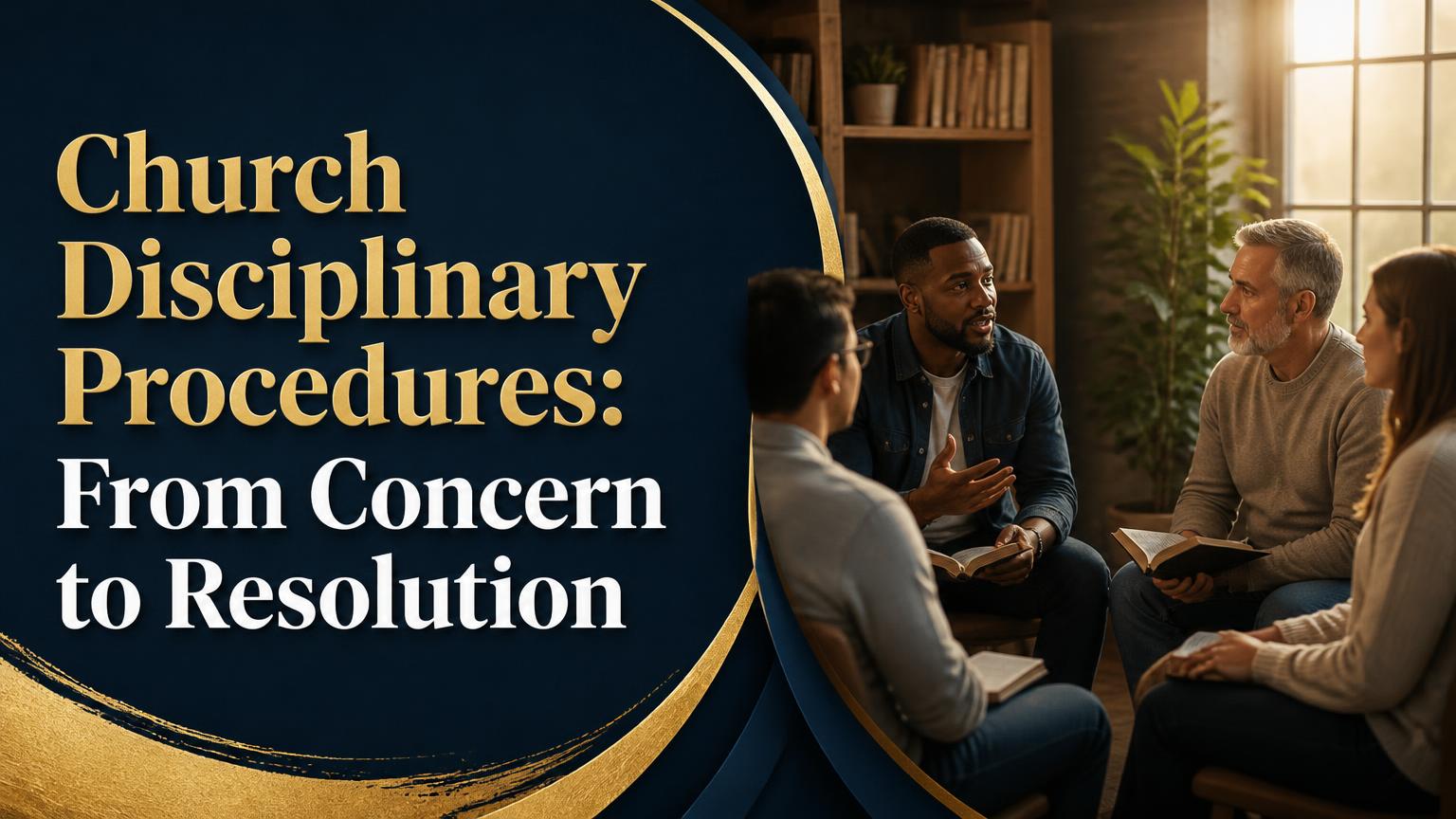
Church disciplinary procedures are a church’s organized response to serious, persistent, or publicly harmful conduct that conflicts with its teachings, membership commitments, or leadership standards. Proper discipline is intended to protect people, establish truth, call for repentance, preserve the integrity of the congregation, and pursue restoration where possible. It is not supposed to function as retaliation, public humiliation, or a substitute for criminal or civil justice.
Because churches differ in structure, their procedures may be governed by congregational bylaws, denominational rules, elder policies, or a bishop’s authority. Even so, sound processes generally move from careful fact-finding and private correction toward formal action only when the concern is credible, serious, and unresolved.
Church Disciplinary Procedures
What Church Discipline Is and Is Not
Church discipline is the deliberate correction of conduct that contradicts Christian teaching or the commitments a person made when joining or serving the church. It may address persistent unrepentant behavior, serious moral misconduct, abuse of authority, public doctrinal error, destructive division, or conduct that places others at risk. The response should be proportionate to the seriousness and certainty of the matter.
Discipline is not the same as disagreement, personal preference, or ordinary interpersonal conflict. A member should not be disciplined simply because another person dislikes a decision, disputes a minor mistake, or interprets a nonessential doctrine differently. Nor should church discipline replace law enforcement when conduct may involve assault, sexual abuse, exploitation, threats, or other crimes.
The New Testament presents correction as purposeful rather than punitive. Galatians 6:1 instructs spiritually mature believers to restore someone gently, while Matthew 18:15–17 describes increasingly formal action when a person refuses to acknowledge serious wrongdoing. These passages hold accountability and restoration together.
Biblical Purposes of Church Discipline
The biblical purpose of discipline includes confronting sin, protecting the vulnerable, preserving truthful Christian witness, and seeking repentance. Jesus’ teaching in Matthew 18 begins with a private conversation rather than immediate public exposure. That sequence reflects a concern for truth and correction while limiting unnecessary shame and rumor.
The process becomes more formal when the person will not listen, but escalation is not automatic punishment. It is a way to establish facts, involve appropriate witnesses, and clarify the seriousness of continued refusal. In 1 Corinthians 5, Paul addresses public and serious misconduct that was damaging the congregation; his response shows that a church may need to separate someone from its fellowship when persistent conduct threatens the community and the person remains unrepentant.
Restoration remains an important aim. Second Thessalonians 3:14–15 describes warning a disorderly person while still treating that person as a brother or sister rather than an enemy. Discipline therefore seeks a change in conduct and relationship, not merely an institutional decision.
The Typical Procedure From Concern to Resolution
No single procedure governs every church, but a responsible process commonly includes these stages:
-
A concern is raised. The complaint should identify specific conduct, dates, people affected, relevant documents, or other information. Vague accusations and anonymous rumors should not ordinarily trigger severe action without further verification.
-
The church determines the appropriate pathway. A pastoral conversation may be suitable for a minor or personal matter. A safeguarding concern, allegation against a pastor, financial misconduct claim, or possible crime requires a more formal and independent response.
-
The facts are examined. Responsible leaders speak with the complainant, the person whose conduct is questioned, and relevant witnesses. They should distinguish firsthand knowledge from speculation, preserve records, and avoid assuming guilt merely because an allegation sounds plausible.
-
The person receives a fair opportunity to respond. The accused should ordinarily know the substance of the concern, understand the possible consequences, and have a meaningful chance to provide context, evidence, or correction. Some details may need to be limited temporarily to protect victims or an active investigation.
-
Leaders or the appropriate church body make a decision. Possible outcomes include no formal action, pastoral guidance, mediation, a written warning, removal from a ministry role, a period of accountability, suspension from membership privileges, or removal from membership. The decision should follow the church’s governing documents and be proportionate to the established conduct.
-
The church communicates the result appropriately. Information should be shared only with people who need it for safety, governance, pastoral care, or implementation. Confidentiality does not mean concealing abuse or misleading the congregation.
-
Review or appeal may follow. A fair policy identifies whether the person can appeal, the grounds for appeal, the deadline, and who will hear it. An appeal is generally meant to address procedural error, overlooked evidence, conflicts of interest, or disproportionate action—not to provide endless reconsideration of the same dispute.
-
The matter moves toward resolution. Resolution may involve repentance, restitution, counseling, changed boundaries, restored service, continued restrictions, or permanent removal from a role. Restoration should be assessed by observable conduct over time rather than by a quick verbal apology alone.
Different Levels of Church Discipline
Churches often distinguish between informal correction and formal discipline. Informal correction may involve a private conversation, pastoral counseling, conflict mediation, or a request to stop conduct that is harmful but not severe. This level is appropriate when facts are reasonably clear, the issue is limited, and the person is willing to respond.
Formal discipline is more appropriate when misconduct is serious, repeated, publicly damaging, connected to leadership, or accompanied by refusal to repent. It may involve a written decision, removal from a ministry position, suspension, or termination of membership. Leadership discipline can be especially strict because pastors, elders, teachers, and ministry workers hold authority and may influence others.
The most serious cases may require permanent restrictions even when a person is forgiven or welcomed into worship. Forgiveness and restoration to fellowship do not automatically mean restoration to leadership, access to children, financial responsibility, counseling authority, or unsupervised contact with a person who was harmed.
Safeguards That Make the Process Fair
A credible disciplinary procedure should protect both the complainant and the person accused. It should define who has authority, prevent conflicted leaders from deciding their own cases, preserve evidence, prohibit retaliation, and provide a reasonable timetable. Leaders should not promise outcomes before the facts are examined.
Fairness also requires proportionality. A church should distinguish proven facts from disputed claims, consider the seriousness and pattern of conduct, and avoid treating every violation as equally severe. The process should not be manipulated to silence criticism, settle personal disputes, protect influential members, or avoid embarrassment.
Biblical principles support careful testimony. Deuteronomy 19:15 establishes the need for more than one witness in certain accusations, and 1 Timothy 5:19 warns against accepting an accusation against an elder without adequate evidence. These principles do not mean that victims must produce a perfect eyewitness account—many forms of abuse occur privately—but they do require careful investigation rather than impulsive judgment.
How Churches Should Handle Serious Allegations
Safeguarding Comes Before Internal Reputation
Allegations involving child abuse, sexual assault, domestic violence, credible threats, stalking, exploitation, or serious financial crimes should not be treated as ordinary membership disputes. The church should take immediate steps to protect potential victims, preserve evidence, and comply with applicable reporting obligations. Depending on the circumstances, that may require contacting emergency services, child-protection authorities, law enforcement, insurers, or specialized safeguarding professionals.
A church should not conduct a private internal process in a way that compromises a criminal investigation or pressures a victim into reconciliation. Prayer, pastoral care, and church discipline may be appropriate, but they do not replace public authorities or professional investigation. Removing someone from a ministry role can be necessary for safety even before every fact has been finally adjudicated.
Confidentiality Is Different From Secrecy
Confidentiality limits information to people who have a legitimate reason to receive it. Secrecy hides misconduct, discourages reporting, or protects an institution’s reputation at the expense of those who may be harmed. A responsible church explains these limits at the start of a complaint process rather than promising absolute confidentiality that it cannot ethically or legally maintain.
Communication should be accurate and restrained. Leaders should not publish unnecessary details, identify victims without permission, or circulate unverified allegations. At the same time, a congregation may need enough information to understand a leadership change, a safety restriction, or a formal membership decision. The level of disclosure should serve truth, protection, and accountability—not curiosity.
Restoration After Church Discipline
What Genuine Repentance Involves
Repentance is more than regret over consequences or a promise to improve. It normally includes acknowledging the conduct honestly, ending the harmful behavior, accepting appropriate accountability, making restitution where possible, and respecting boundaries imposed for safety. In some cases, repentance also requires treatment, financial repair, surrender of authority, or cooperation with legal and safeguarding processes.
A church should avoid demanding a dramatic public confession when a private process better protects victims or prevents unnecessary humiliation. Conversely, it should not accept a vague apology as proof that serious patterns have changed. Observable behavior over time is more reliable than emotional presentation in a single meeting.
Restoration Is Not Always Restoration to Office
A person may be restored to Christian fellowship without being restored to a former position. The distinction matters because leadership requires trust, judgment, self-control, and the ability to protect others. Biblical qualifications for overseers in 1 Timothy 3 and Titus 1 describe character and reputation, not merely technical ability or public talent.
For that reason, a church may welcome someone to worship and pastoral care while maintaining permanent limits on teaching, handling money, counseling, supervising minors, or exercising authority over the person harmed. Such boundaries are not necessarily evidence that forgiveness has been withheld; they may reflect wisdom, protection, and the consequences of broken trust.
When Reconciliation Is Appropriate
Reconciliation should not be forced in every case. It may be appropriate when the harm has been acknowledged, safety has been established, the injured person freely agrees, and the process can be supported by competent pastoral or professional guidance. Reconciliation is different from requiring the victim to resume contact, offer private access, or declare the relationship fully restored.
In cases involving abuse or coercive control, direct mediation may increase danger or pressure. Restoration may instead mean that the offender accepts accountability and the church provides care without demanding renewed relationship. Christian forgiveness does not eliminate the need for boundaries, justice, truthful memory, or protection.
What Members Should Look for in a Fair Process
Members can evaluate a church’s disciplinary procedures by asking practical questions. Does the church have written bylaws or policies? Is the decision-maker identified? Are conflicts of interest addressed? Can a person respond to an allegation? Is there an appeal process? Does the policy distinguish pastoral correction from safeguarding emergencies? Does it explain how information will be handled?
A fair process should also protect complainants from retaliation and avoid placing the burden of investigation on the person who reports harm. Leaders should document significant decisions, apply standards consistently, and explain enough of the reasoning for affected people to understand what happened. A church that demands unquestioning loyalty, discourages outside advice, threatens anyone who raises concerns, or treats leaders as beyond accountability is not demonstrating healthy spiritual authority.
Members should remember that church membership does not remove ordinary legal rights or duties. People may seek independent pastoral counsel, professional therapy, legal advice, or help from public authorities. A church’s internal decision may determine membership or ministry eligibility, but it does not determine criminal guilt, civil liability, or the complete truth of a disputed event.
Conclusion
Church disciplinary procedures should move carefully from concern to fact-finding, from correction to proportionate action, and from accountability toward restoration when restoration is safe and warranted. The process must distinguish ordinary disagreement from serious misconduct, protect complainants and the accused from unjust treatment, and recognize that safeguarding and civil law may require action beyond internal church structures.
Healthy discipline is neither permissiveness nor control. It combines truthful investigation, defined authority, fair opportunity to respond, appropriate consequences, and practical protection for vulnerable people. Forgiveness can coexist with boundaries, and restoration to fellowship does not automatically restore leadership. When churches hold those distinctions together, discipline can serve integrity, safety, repentance, and the long-term health of the congregation.