
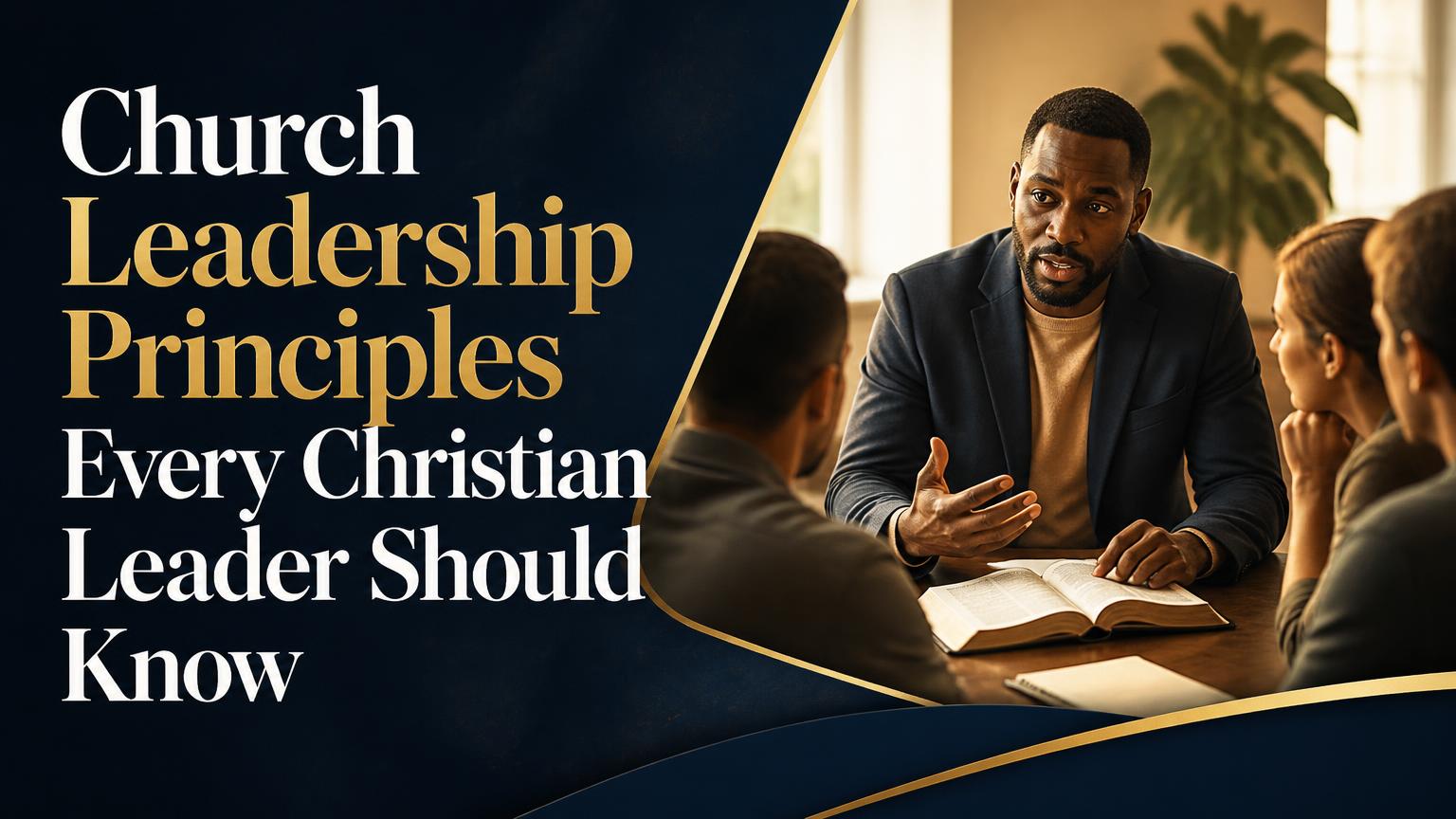
Church leadership principles are biblical convictions that shape how leaders serve God’s people, exercise authority, make decisions, develop others, and remain accountable. Christian leadership is not primarily about influence, position, or organizational success. It is stewardship: guiding people toward faithfulness to Christ while protecting, teaching, equipping, and caring for them.
The New Testament places character at the center of leadership. Skill matters, but a leader’s integrity, humility, spiritual maturity, and treatment of people determine whether that skill becomes a blessing or a source of harm.
Church Leadership Principles
Lead as a Servant, Not a Ruler
Jesus directly rejected leadership modeled on domination and status. When His disciples argued about greatness, He contrasted worldly authority with Christian leadership:
“Whoever would be great among you must be your servant” (Matthew 20:26–28).
Jesus did not teach that leaders have no authority. He taught that authority must be used for the good of others rather than for personal importance. Christian leaders do not ask, “How can people serve my ambitions?” They ask, “How can I faithfully serve Christ and help these people grow?”
This principle affects everyday leadership:
- Decisions should consider the spiritual and practical welfare of the congregation.
- Leaders should accept difficult responsibilities rather than seek only public recognition.
- Authority should protect people, clarify direction, and promote order—not intimidate or control.
- Leaders should be willing to perform unnoticed work.
Jesus demonstrated this pattern by washing His disciples’ feet (John 13:1–17). Servant leadership is therefore more than a leadership style. It reflects the character of Christ.
Put Character Before Competence
The qualifications for overseers in 1 Timothy 3:1–7 and Titus 1:5–9 focus heavily on character, relationships, self-control, reputation, and spiritual maturity. They mention the ability to teach, but teaching ability appears within a larger pattern of faithful living.
A gifted communicator may attract a crowd, but gifting does not compensate for dishonesty, arrogance, sexual misconduct, uncontrolled anger, or habitual irresponsibility. Public ability can conceal private weakness for a time; it cannot produce lasting spiritual health.
Important qualities include:
- Integrity and a trustworthy reputation
- Self-control and emotional steadiness
- Faithfulness in marriage and family responsibilities
- Hospitality and generosity
- The ability to teach sound doctrine
- Humility and willingness to receive correction
- Freedom from greed and the improper use of power
This does not mean leaders must be flawless. Christian leaders remain sinners who need repentance and grace. It does mean that persistent, unaddressed patterns of serious misconduct should not be excused because someone is talented or successful.
Shepherd People With Care and Truth
Church leaders are called to shepherd, not merely manage. Paul told the elders of Ephesus to care for the church of God (Acts 20:28), and Peter instructed elders to shepherd God’s flock willingly and eagerly, “not domineering over those in your charge, but being examples to the flock” (1 Peter 5:1–4).
Shepherding includes both protection and nourishment. Leaders guard the church from destructive teaching and behavior, while also feeding people through Scripture, prayer, wise counsel, worship, and community. Care requires knowing people as individuals rather than treating the congregation as a crowd or set of attendance figures.
Biblical shepherding also holds compassion and truth together. A leader who avoids every difficult conversation may appear gentle while allowing people to remain trapped in sin, confusion, or destructive conflict. Conversely, a leader who emphasizes correction without patience can use truth as a weapon. Faithful shepherding speaks truth for restoration, protects the vulnerable, and seeks repentance rather than humiliation.
Equip Others Instead of Centralizing Ministry
Ephesians 4:11–12 describes leaders as people who equip the saints for the work of ministry. The goal is not for one pastor or a small leadership team to perform every ministry task. The goal is to help the whole body serve according to the gifts God gives.
Centralized leadership often begins with good intentions. A capable leader sees a need and handles it personally. Over time, however, this can create exhaustion, dependency, and a congregation that watches ministry instead of participating in it.
Equipping leadership does the following:
- Identifies gifts, maturity, and potential in other believers.
- Gives people meaningful responsibility rather than merely assigning tasks.
- Provides training, expectations, encouragement, and supervision.
- Allows others to make decisions appropriate to their responsibility.
- Corrects mistakes without removing every opportunity to grow.
Moses learned this lesson when Jethro warned him that trying to judge every matter alone would wear him and the people out (Exodus 18:13–26). Delegation is not abandonment. Healthy delegation combines trust with appropriate support and accountability.
Exercise Authority Through Accountability
Authority in the church is real, but it is never absolute. Every Christian leader remains under the authority of Jesus Christ and Scripture. Leaders are stewards, not owners, of the people and ministry entrusted to them.
Accountability should therefore be built into church life through appropriate structures such as:
- Shared leadership rather than unchecked individual control
- Clear financial procedures and transparent reporting
- Policies for handling complaints and allegations
- Regular evaluation and spiritual reflection
- Trusted relationships in which leaders can receive honest correction
- Safeguards for children, vulnerable adults, and people receiving pastoral care
The New Testament presents leadership in a plural and relational context in many local churches, including elders who shared responsibility. It does not prescribe one universal organizational chart for every denomination or congregation, so traditions may differ in how pastors, elders, deacons, and boards function. The underlying principle remains consistent: no leader should be beyond examination, correction, or removal when serious wrongdoing is established.
Accountability protects both the congregation and the leader. It also distinguishes legitimate spiritual authority from coercive control.
Practice Humility, Wisdom, and Teachability
Christian leaders must make decisions, but confidence is not the same as infallibility. Proverbs repeatedly connects wisdom with listening to counsel, and James 3:1 warns that teachers will be judged more strictly. Leaders therefore need the humility to admit uncertainty, reconsider a decision, apologize, and learn.
Teachability is especially important during conflict. A leader should ask:
- What facts might I be missing?
- Have I listened carefully to the people affected?
- Am I defending a biblical conviction or merely protecting my preference?
- Could my communication have caused unnecessary harm?
- What would faithfulness, rather than pride, require here?
Humility does not mean indecision or surrendering every conviction to popular opinion. It means recognizing that leaders see partially and can misuse certainty. Wise leaders seek prayer, Scripture, counsel, and relevant information before acting, particularly when decisions affect people’s livelihoods, reputations, families, or spiritual well-being.
How Church Leadership Principles Work Together
These principles are strongest when held together rather than isolated.
Servanthood without truth can become people-pleasing. A leader may avoid necessary correction because conflict feels unloving.
Truth without love can become harshness. Doctrinal accuracy does not excuse contempt, impatience, or public humiliation.
Authority without accountability can become abuse. Even a leader with sound theology may damage people when no one can question decisions or challenge conduct.
Delegation without oversight can create confusion. Equipping others requires clear responsibility, communication, and follow-up.
Humility without courage can become passivity. Leaders sometimes must confront injustice, reject harmful teaching, or make an unpopular decision.
A faithful leader therefore combines conviction with gentleness, courage with listening, responsibility with delegation, and confidence with dependence on God. These are not competing ideals when properly understood. They describe different aspects of leadership shaped by Christ.
The Purpose of Christian Leadership
The purpose of church leadership is not to build a leader’s personal platform. It is to help the church become mature, unified, holy, and equipped for mission.
Paul explains in Ephesians 4:13–16 that mature ministry produces a body growing into Christ, speaking truth in love, and functioning as each member contributes. This gives leadership a broader measure of success than attendance, revenue, visibility, or reputation.
A healthy leader asks whether people are:
- Growing in knowledge and obedience to Christ
- Becoming more capable of serving others
- Practicing repentance, forgiveness, and reconciliation
- Caring for the vulnerable and the wider community
- Developing spiritual maturity rather than dependence on one personality
- Remaining rooted in Scripture while responding wisely to real needs
Numerical growth may accompany faithful ministry, but numbers alone cannot prove spiritual health. A church can become larger while becoming less honest, less compassionate, or more dependent on celebrity leadership. Biblical leadership measures fruit by faithfulness and transformation, not by scale alone.
Applying These Principles in Practice
Church leadership principles become credible through repeated habits, not occasional speeches. Leaders can begin by establishing a pattern of prayerful self-examination, honest relationships, and clear responsibility.
A practical approach includes:
- Clarify the church’s biblical mission. Decisions should serve the congregation’s calling rather than the leader’s changing preferences.
- Examine character regularly. Invite trusted people to identify blind spots in conduct, communication, and use of authority.
- Create healthy leadership structures. Define who decides, who advises, who handles finances, and how concerns are addressed.
- Develop emerging leaders. Give qualified people supervised opportunities to teach, serve, organize, and care for others.
- Communicate decisions clearly. Explain the purpose, relevant principles, expected effects, and limits of a decision.
- Address conflict early. Unresolved tension often grows through assumptions, avoidance, and private conversations that never reach resolution.
- Protect rest and family responsibilities. Exhaustion can impair judgment and make leaders more controlling or emotionally reactive.
- Respond to failure with repentance and repair. Apologies should be specific, and serious harm may require external investigation, boundaries, or removal from leadership.
These practices do not eliminate difficult decisions. They make the process more trustworthy and reduce the risk that one person’s preferences will dominate the church.
Common Misconceptions About Church Leadership
“Servant leadership means leaders have no authority.”
No. Jesus exercised authority, taught with conviction, confronted hypocrisy, and commissioned His disciples. Servanthood describes the purpose and manner of authority, not its absence.
“A gifted leader must be a qualified leader.”
No. Gifts may reveal ability, but biblical qualifications also require character, maturity, and a trustworthy life.
“Submission means tolerating abuse.”
No. Biblical submission to legitimate leadership does not require silence about exploitation, coercion, criminal conduct, or doctrinal manipulation. Protecting people and seeking truthful accountability are consistent with Christian faithfulness.
“Successful churches always have successful leaders.”
No. Visible results can be produced by personality, resources, cultural conditions, or organizational skill. Faithful leadership must be assessed by truth, character, love, justice, and spiritual fruit.
Conclusion
Church leadership principles begin with Christlike service and are sustained by character, sound teaching, shepherding care, accountability, humility, and the development of others. Christian leaders are not owners of the church or performers seeking admiration; they are stewards entrusted with people and responsibility. The central question is not how much control a leader can gain, but whether that leadership helps people become more faithful, mature, loving, and equipped followers of Jesus.