
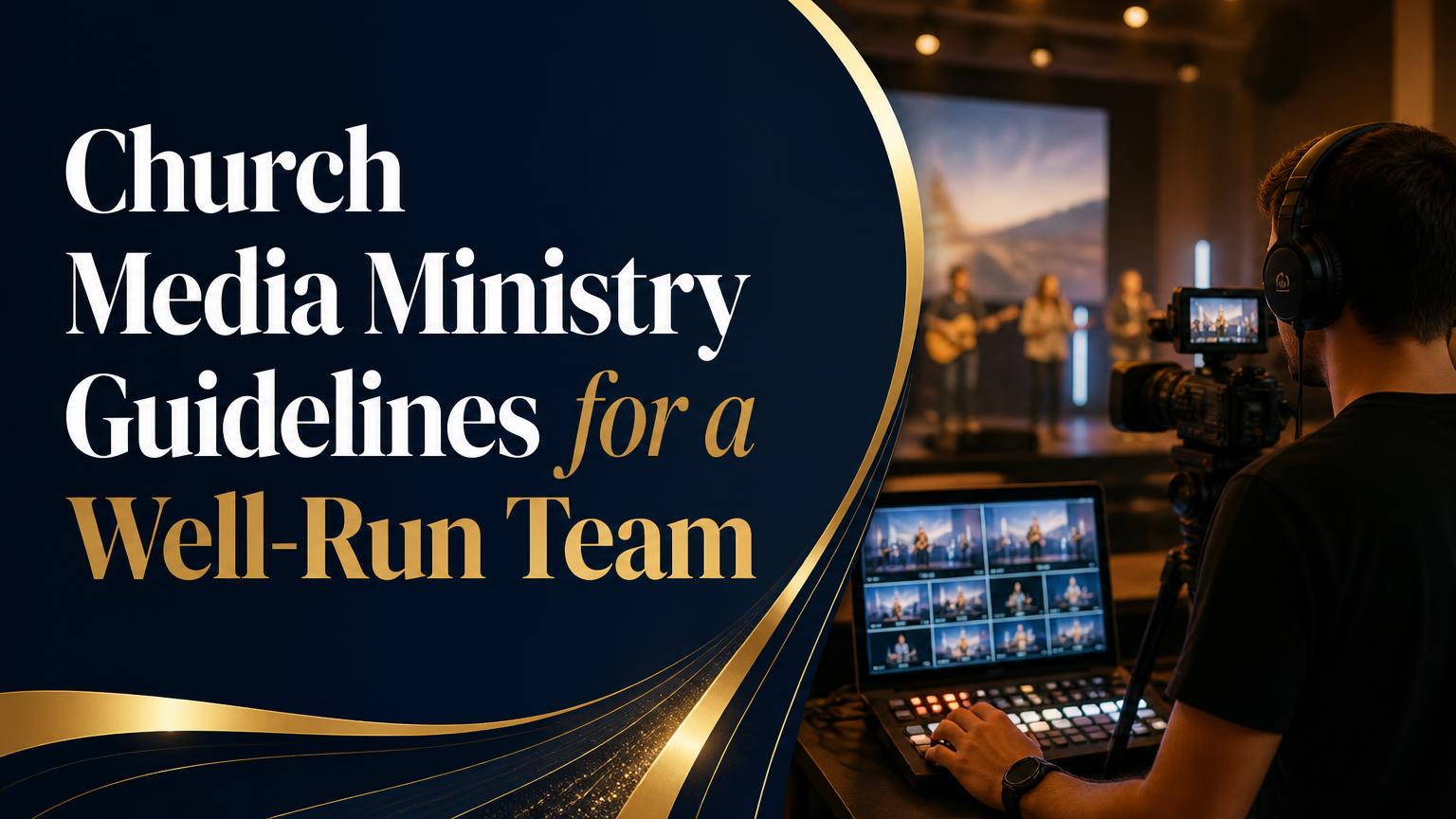
Church media ministry is more than operating cameras, microphones, presentation software, or livestream platforms. It is a service that helps people hear, see, understand, and participate in the church’s worship and teaching. Effective Church Media Ministry Guidelines must therefore address both spiritual purpose and technical practice. A healthy team needs clear responsibilities, reliable preparation, wise communication, consistent standards, respect for people, and a willingness to improve without turning ministry into a performance.
Church Media Ministry Guidelines
A well-run media ministry connects the church’s message with the congregation’s actual experience. Technology should support worship rather than compete with it. The following guidelines provide a practical framework for building a dependable, servant-hearted team.
Define the Ministry’s Purpose Before Choosing Equipment
The purpose of church media ministry is to remove unnecessary barriers to participation. Audio should help people hear Scripture, prayer, music, and preaching clearly. Visuals should help them follow the service without distracting from it. Online ministry should give remote participants a meaningful way to engage rather than merely offering a low-quality recording.
This purpose should guide every equipment purchase and production decision. A church does not necessarily need the most expensive camera, the largest display, or the most elaborate lighting system. It needs tools that serve its congregation, building, worship style, and communication goals. First Peter 4:10 describes spiritual gifts as resources to be used in serving others, which gives media work a ministry direction: technical ability is valuable because of the people it helps.
Establish Clear Roles and Ownership
Media teams function more reliably when each person knows what they are responsible for before the service begins. Depending on the church’s size, roles may include audio engineer, presentation operator, camera operator, livestream director, lighting operator, photographer, graphics creator, and team leader. One person may fill several roles, but the responsibilities should still be defined.
The team leader should know who makes final decisions during a service and who handles common problems. A volunteer should not have to guess whether the audio operator, worship leader, pastor, or livestream director controls a particular decision. Written role descriptions also make training easier and prevent the ministry from depending on one person who knows everything.
Design a Workflow for Preparation and Handoffs
Most service problems begin before the service. A dependable workflow might include receiving the order of service early, collecting sermon slides and videos, confirming song arrangements, checking guest speakers’ needs, preparing lyrics, testing media files, and reviewing special transitions. The team should also know when rehearsal begins and when each operator must arrive.
Use a shared planning system rather than relying on scattered text messages. A service plan can identify the speaker, songs, Scripture passages, videos, cues, slide operators, microphones, camera positions, and livestream elements. During the service, concise communication matters. Headsets, hand signals, or agreed cue words can help the team respond without distracting the congregation or interrupting worship.
Set Technical Standards for Consistency
Consistency is more valuable than complexity. Establish practical standards for microphone volume, music balance, slide design, camera framing, lighting, video quality, and livestream settings. Audio deserves special attention because poor sound often makes an otherwise strong service difficult to follow. The congregation should be able to understand speech without strain, while music remains full without overpowering voices.
Visual standards should also serve comprehension. Use readable fonts, sufficient contrast, restrained animation, and lyrics that remain on screen long enough to follow. Test videos with their actual audio, not merely their visual appearance. Create a basic pre-service checklist that includes batteries, cables, microphones, presentation files, network connections, recording storage, and emergency backups.
Serve People in the Room and Online
A livestream is not simply a camera pointed at the platform. Online viewers need intelligible audio, stable video, appropriate camera choices, and enough context to follow what is happening. At the same time, production decisions should not make people in the room feel as though the service exists primarily for the broadcast.
Plan for both audiences. Keep important spoken content audible online, provide captions when feasible, and avoid displaying private conversations or sensitive information. Use camera shots that communicate what is happening without excessive movement. If the livestream fails, the in-person gathering should continue with a simple fallback plan. Technology should extend the church’s welcome, not determine whether ministry can happen.
Protect People, Privacy, and Content
Media ministry involves real people, including children, guests, volunteers, and individuals who may not expect to appear publicly. Follow the church’s policies for photography, video recording, livestreaming, and the use of minors’ images. Do not casually publish prayer requests, counseling situations, personal testimonies, or identifying information without appropriate permission.
The team should also respect copyright and licensing requirements for worship songs, recorded music, photographs, video clips, fonts, and other materials. Permission to use something in a room does not automatically mean permission to broadcast or post it online. Keep records of approved assets and use original or properly licensed material whenever possible. These practices protect the church and demonstrate respect for creators and congregants.
Train Volunteers With Patience and Documentation
A volunteer may be willing to serve but unfamiliar with signal flow, presentation software, camera operation, or livestream systems. Training should begin with the ministry’s purpose and then move into specific tasks. Let new volunteers observe, practice in a low-pressure setting, serve alongside an experienced operator, and gradually assume responsibility.
Document the recurring procedures. A short operations guide can explain how to start and shut down equipment, route microphones, load a service presentation, troubleshoot common failures, contact the right leader, and respond when a device stops working. Documentation reduces anxiety and makes the ministry less vulnerable when a key volunteer is absent.
Review the Ministry Without Blaming People
After a service, review what helped and what created difficulty. Ask specific questions: Was the pastor easy to hear? Did slides advance at the right time? Was the online audio balanced? Did the team receive materials early enough? Did a technical failure reveal a missing backup or unclear responsibility?
The purpose of review is learning, not public criticism. First Corinthians 14:40 connects orderly gatherings with thoughtful practice, but order does not require perfection. A healthy team can acknowledge mistakes, correct systems, and encourage volunteers. If the same problem occurs repeatedly, examine the workflow, training, equipment, or communication rather than simply blaming the person who happened to be operating it.
Build a Ministry Structure That Can Last
A sustainable media ministry needs more than talented volunteers. It needs realistic scheduling, adequate preparation time, and leadership support. Avoid assigning the same person to every service, every technical role, and every emergency. Rotations give volunteers rest and create opportunities for others to develop competence. A small team may need to simplify production until its available people can serve consistently.
Church leadership should also clarify the ministry’s authority and budget. The media team needs to know who approves purchases, who sets communication standards, who handles sensitive content, and how major production changes are evaluated. Equipment should be purchased according to actual ministry needs, maintenance capacity, and long-term usefulness rather than excitement about new technology.
A simple structure may include a ministry leader, service coordinators, trained operators, and an equipment or systems contact. These titles matter less than clear ownership. When responsibility is visible, problems are addressed earlier and volunteers are less likely to feel that they are carrying an undefined burden alone.
Balance Excellence With Servanthood
Excellence in church media does not mean producing the most polished service possible. It means taking reasonable care with work that affects people’s ability to participate. A clean mix, readable slide, accurate Scripture reference, and dependable livestream can reflect preparation and love for the congregation. Yet technical quality becomes counterproductive when it draws attention to the operator or turns worship into a showcase.
Jesus’ teaching about serving rather than seeking status provides a useful corrective to media culture. Volunteers may receive little public recognition even when their work succeeds. Much of the best media ministry is invisible: the microphone is ready, the lyric appears at the right moment, the camera avoids a distraction, and the online viewer hears the sermon clearly. The team should measure success by faithful service, not by applause or personal control.
Create a Practical Pre-Service Checklist
A checklist should be short enough to use and specific enough to prevent predictable failures. Before each service, confirm that the room is arranged correctly, microphones are labeled and tested, batteries are available, presentation files open properly, videos include usable audio, slides contain the correct lyrics and Scripture, cameras have suitable framing, and the livestream connection is stable.
The team should also identify unusual elements in the service, such as baptisms, communion, testimonies, guest speakers, children’s presentations, dramatic readings, or changes in stage layout. These events often require different microphones, camera positions, lighting, or cues. After the service, shut down equipment safely, save recordings correctly, return the room to order, and record any issue that needs attention before the next gathering.
Avoid Common Church Media Ministry Mistakes
One frequent mistake is preparing only on Sunday morning. Last-minute preparation leaves no time to discover missing files, incompatible formats, dead batteries, or unclear cues. Another is buying equipment before defining the problem it should solve. A larger system can increase complexity, training demands, and maintenance costs without improving the congregation’s experience.
Other problems include allowing one person to become indispensable, treating volunteers as replaceable labor, changing procedures without communicating them, and correcting mistakes harshly in front of others. These practices reduce trust and eventually shrink the team. Clear expectations, advance planning, backup procedures, and respectful feedback usually produce more improvement than constant pressure for dramatic technical results.
Conclusion
Effective Church Media Ministry Guidelines bring spiritual purpose and operational discipline together. The team should serve participation, communicate clearly, prepare before the service, protect people and content, maintain reasonable technical standards, and train others to share responsibility. Good media ministry is not measured by how much technology appears on screen, but by whether people can hear the gospel, follow the service, and engage without unnecessary distraction.
The strongest teams pursue excellence without vanity and organization without rigidity. They use equipment as a tool, treat volunteers as people, learn from failures, and keep the church’s mission ahead of production style. When media serves rather than dominates, it becomes a quiet but meaningful expression of hospitality, stewardship, and care.