
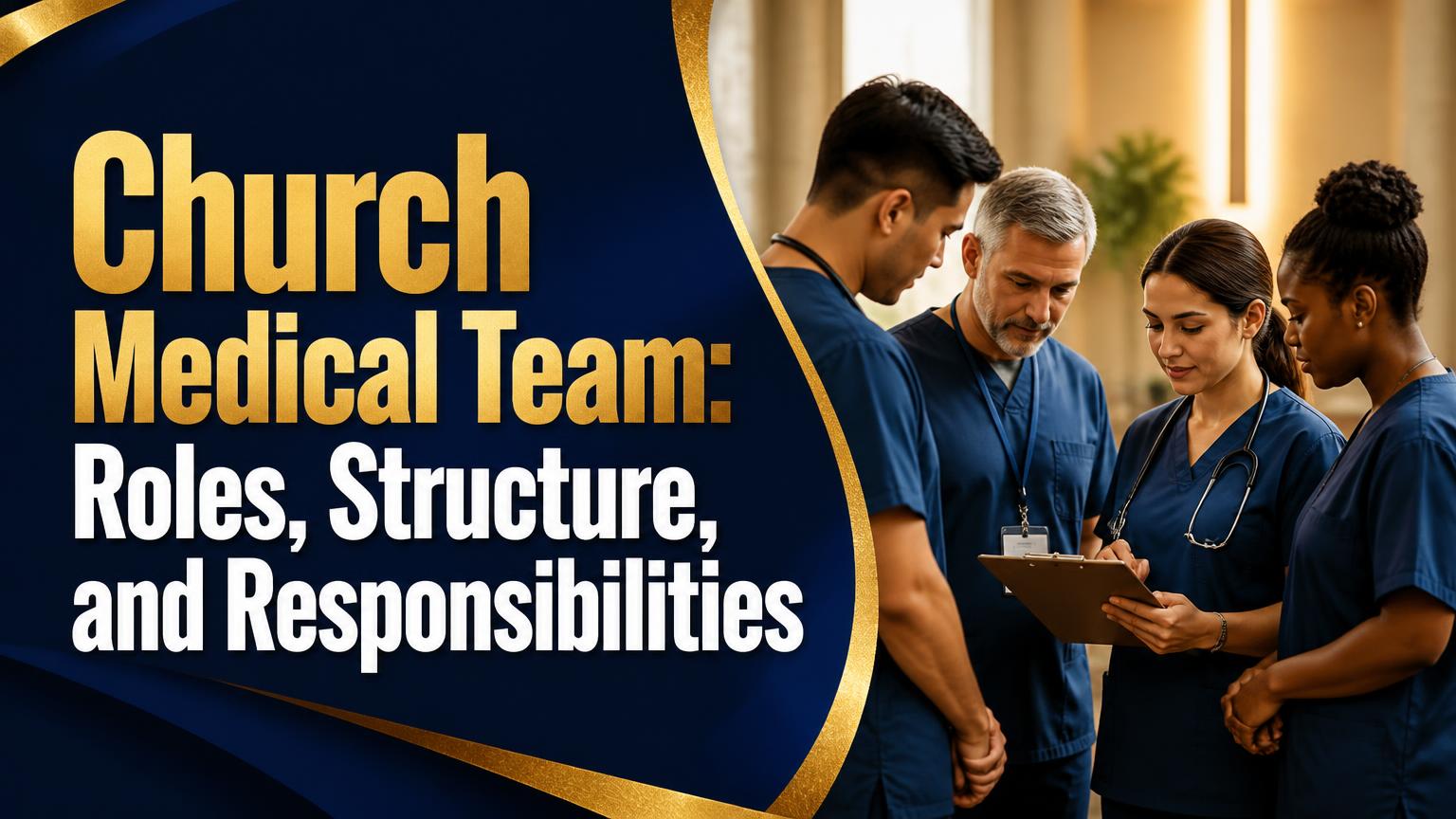
A church medical team is a volunteer or staff ministry that helps protect the health and safety of people attending worship services, classes, conferences, camps, and other church activities. Its work may include first aid, emergency assessment, CPR and AED response, injury prevention, communication with emergency medical services, and compassionate support for people who become ill. A well-organized team does not replace paramedics, physicians, or hospitals. Instead, it provides trained, timely assistance until a person can receive the appropriate level of care.
How a Church Medical Team Works
A church medical team works best when its purpose, authority, and limits are clearly defined before an emergency occurs. The team should combine practical medical readiness with pastoral sensitivity, recognizing that people may be frightened, embarrassed, grieving, or physically vulnerable when they need help. The following framework explains the main responsibilities and operating principles.
Purpose and Scope of the Ministry
The primary purpose of a church medical team is to respond safely to illness and injury while helping people reach appropriate professional care. Team members may recognize warning signs, provide basic first aid, perform CPR, use an automated external defibrillator when trained, control minor bleeding, assist with falls, and coordinate an ambulance response.
The team may also support prevention. It can identify trip hazards, extreme temperatures, overcrowded areas, unsafe event layouts, or activities that require additional preparation. At large gatherings, members may help plan first-aid stations, emergency access routes, hydration arrangements, and procedures for children or older adults.
This ministry can reflect Christian compassion without treating medical response as a substitute for spiritual care or professional treatment. The Good Samaritan’s actions in Luke 10:25–37 illustrate practical mercy toward an injured person, while 1 Corinthians 12:4–7 emphasizes that people use different gifts to serve the common good. These passages support a posture of service, but they do not remove the need for training, consent, sound judgment, or referral to qualified clinicians.
Core Roles on the Team
A church medical team may be small or large depending on attendance, facilities, programs, and local risks. One person may hold several roles in a small congregation, but responsibilities should still be identified.
- Team coordinator: Maintains schedules, recruits volunteers, organizes training, updates procedures, and communicates with church leadership.
- Medical lead or clinical adviser: Helps establish appropriate first-aid standards and advises on cases that exceed basic volunteer care. This person should not be treated as automatically responsible for every medical decision unless that responsibility has been formally accepted.
- First-aid responders: Assess immediate needs within their training, provide basic care, monitor the person, and request higher-level help when necessary.
- Communications or emergency liaison: Calls the local emergency number, directs responders to the correct entrance, gathers relevant information, and keeps church leaders informed.
- Safety and prevention volunteers: Identify hazards, check supplies, and help improve procedures after incidents.
- Pastoral or care contacts: Offer emotional and spiritual support while respecting the person’s privacy and medical boundaries.
The team should never imply that every volunteer is a nurse, physician, paramedic, or counselor. Titles should accurately reflect training and authorization.
Structure and Chain of Command
A clear chain of command prevents multiple people from giving conflicting instructions during a crisis. The team coordinator usually manages readiness and administration, while the most appropriately trained responder directs immediate care until professional responders arrive. The church should identify who can activate emergency services, who meets the ambulance, who communicates with family members, and who records the event.
For larger churches, an incident structure may include a medical team leader, response teams assigned to particular buildings, a communications role, and a liaison with security or facilities personnel. For a smaller church, a simple written plan may name two trained responders, one backup, and one person responsible for calling emergency services and guiding them to the location.
The structure should also explain what happens when the usual leader is absent. A reliable backup system matters because emergencies occur during evening programs, children’s activities, outdoor events, and holiday services when regular volunteers may not be present.
Responsibilities Before, During, and After Events
Before an event, the team should review the expected attendance, age groups, activities, facility layout, access points, and foreseeable hazards. It should confirm that first-aid supplies are stocked, emergency exits are accessible, AEDs are present where available, and responders know how to contact one another. Events involving sports, water, heat, remote locations, or large crowds may require additional planning.
During an incident, responders should first protect themselves and the surrounding area, then assess the situation within their training. They should request emergency services promptly when symptoms are serious, uncertain, or worsening. Useful information includes the person’s location, level of responsiveness, breathing status, obvious injuries, known medical information voluntarily provided, and hazards that could affect responders.
Afterward, the team should restock supplies, document the incident objectively, notify the appropriate church leader, and conduct a brief review. The purpose of a review is to improve the system rather than assign blame. Repeated incidents may reveal a need for better signage, additional training, modified schedules, or changes to the physical environment.
How to Build and Equip a Church Medical Team
A church medical team should be designed around actual ministry conditions rather than an impressive title or oversized supply kit. The number of volunteers, level of training, equipment, and response procedures should match the church’s size, activities, location, and ability to obtain professional help.
Recruiting and Assigning Volunteers
Recruit people who are dependable, calm under pressure, willing to follow procedures, and comfortable serving without seeking attention. Medical credentials can be valuable, but the team also needs people who can communicate clearly, manage logistics, guide emergency responders, protect privacy, and work patiently with children and families.
Ask volunteers to disclose relevant training and keep records of renewal dates for certifications such as CPR, first aid, or AED use. Do not assume that a credential remains current indefinitely. The church should also make clear whether participation is voluntary, whether members are expected to respond outside scheduled assignments, and whom they should contact when they cannot serve.
A written role description helps prevent both under-involvement and overreach. It can state that volunteers provide care within their education and training, seek professional help when appropriate, and do not diagnose conditions, prescribe treatment, or perform procedures beyond their competence.
Training and Continuing Readiness
Basic training commonly includes first aid, CPR, AED awareness, recognizing medical emergencies, bleeding control, infection precautions, incident communication, and safe movement around an injured person. Additional instruction may be appropriate for churches with nurseries, schools, camps, sports programs, kitchens, or outdoor ministries.
Training should include realistic practice rather than only a classroom presentation. Volunteers can rehearse how to find an unconscious person, send someone to retrieve an AED, call emergency services, meet an ambulance, manage a crowd, and protect a child’s privacy. Drills should be proportionate and should not create unnecessary fear among congregants.
Refresher training matters because skills decline when they are rarely used. Churches should schedule periodic reviews of procedures and equipment, especially after a real incident, a building renovation, a change in staff, or the launch of a new program.
Equipment, Locations, and Access
A basic church medical setup may include first-aid supplies, gloves, antiseptic materials, dressings, bandages, cold packs, scissors, a flashlight, protective barriers, and a way to contact church staff. An AED can be valuable where funding, maintenance, training, and local requirements are properly addressed. Equipment should be stored in clearly marked, accessible locations rather than locked away where responders cannot reach it quickly.
Post the locations of first-aid kits and AEDs, and ensure that volunteers know how to access them. Supplies should be checked on a schedule for expiration, damage, cleanliness, and completeness. The team should not distribute prescription medication or administer medication to another person casually. Medication assistance requires careful consideration of authorization, consent, storage, allergies, documentation, and applicable law.
Documentation and Communication Procedures
An incident form should record observable facts: the date, time, location, circumstances reported, actions taken, people notified, and disposition known to the church. It should avoid speculation, embarrassing commentary, and unsupported diagnoses. Documentation should be stored securely and accessed only by people with a legitimate ministry or administrative need.
The communication plan should identify the local emergency number, the exact street address, building entrances, room names, elevator locations, and a person who can direct responders. For large campuses, maps and clear room labels can save valuable time. Ushers, teachers, security volunteers, and ministry leaders should know how to summon the medical team without creating confusion.
Safety, Ethics, and Boundaries
Medical service in a church involves more than technical response. Volunteers handle sensitive information, interact with minors and vulnerable adults, and may face situations in which a person refuses help or does not appear able to make an informed decision. Written boundaries protect both the people receiving care and those providing it.
Emergency Limits and Professional Referral
A responder should work within current training and recognize when the situation requires emergency medical services. Chest pain, severe breathing difficulty, signs of stroke, uncontrolled bleeding, serious allergic reaction, loss of consciousness, major trauma, seizure-related concerns, suspected overdose, and rapidly worsening symptoms warrant prompt professional evaluation. When uncertainty exists, seeking emergency guidance is generally safer than delaying because the situation is not clearly diagnosed.
Volunteers should not diagnose, promise a particular outcome, discourage hospital care, or allow church pressure to determine medical decisions. Good Samaritan protections and other legal rules vary by jurisdiction and usually do not justify reckless or negligent conduct. Churches should obtain local legal and insurance guidance instead of assuming that a volunteer or congregation has unlimited protection.
Consent, Privacy, and Safeguarding
Whenever a person is conscious and capable of making decisions, responders should identify themselves, explain what they want to do, and seek consent. If someone refuses assistance, volunteers should remain calm, explain the concern, and contact emergency services when the circumstances indicate an immediate danger or impaired decision-making. In an emergency, laws may permit necessary action when a person cannot consent, but local requirements differ.
Privacy should be protected even when a church’s activities do not fall under a particular health-privacy law. Do not announce a person’s condition over a sound system, discuss it in group messages, or share details as prayer requests without appropriate permission. Work with the church’s child-safeguarding policy when a minor is involved, and avoid having one volunteer alone with a child when the situation allows another responsible adult to be present.
Compassion Without Overstepping
A medical emergency can become a pastoral crisis for the person and family. A calm voice, a blanket for warmth, protection from unnecessary observers, and respectful listening may be as valuable as a bandage. Prayer may be offered when appropriate, but it should never replace medical treatment, pressure a person to disclose private information, or suggest that illness reflects inadequate faith.
The team should also accommodate disability, language differences, hearing or vision needs, cultural concerns, and financial anxiety about emergency care. Compassion includes helping people access appropriate assistance without making assumptions about their condition or worth.
A Practical Operating Model for Churches
A useful church medical team can begin with a modest, written plan. Identify the congregation’s likely risks, appoint a coordinator, recruit enough trained volunteers to cover the main services and activities, and list the locations of first-aid supplies and AEDs. Then create a one-page emergency procedure that explains how to summon help, call emergency services, meet responders, protect privacy, and complete an incident report.
The plan should be tested during ordinary operations, not only after a crisis. Ask whether a volunteer can reach the equipment quickly, whether a caller knows the exact building address, whether a children’s teacher knows whom to contact, and whether someone can keep entrances clear. Correcting these practical weaknesses usually improves response more than purchasing additional supplies.
Church leaders should review the ministry at least periodically and after significant incidents. A strong team is measured less by how many dramatic emergencies it handles than by whether it responds promptly, stays within its competence, treats people with dignity, and learns from experience. Its goal is dependable care that connects immediate assistance with the professional, pastoral, and community resources a person may need next.
Conclusion
A church medical team provides organized first aid, emergency coordination, prevention, and compassionate support for people involved in church life. Its effectiveness depends on clearly assigned roles, suitable training, accessible equipment, reliable communication, accurate documentation, and a firm understanding of its limits. The team should respond within its competence, call professional help without unnecessary delay, protect consent and privacy, and coordinate with the church’s safeguarding and pastoral systems.
The strongest model is neither an informal group of well-meaning volunteers nor a pretend clinic. It is a prepared ministry that offers practical mercy while respecting medical expertise, legal boundaries, personal dignity, and the needs of the wider congregation.