
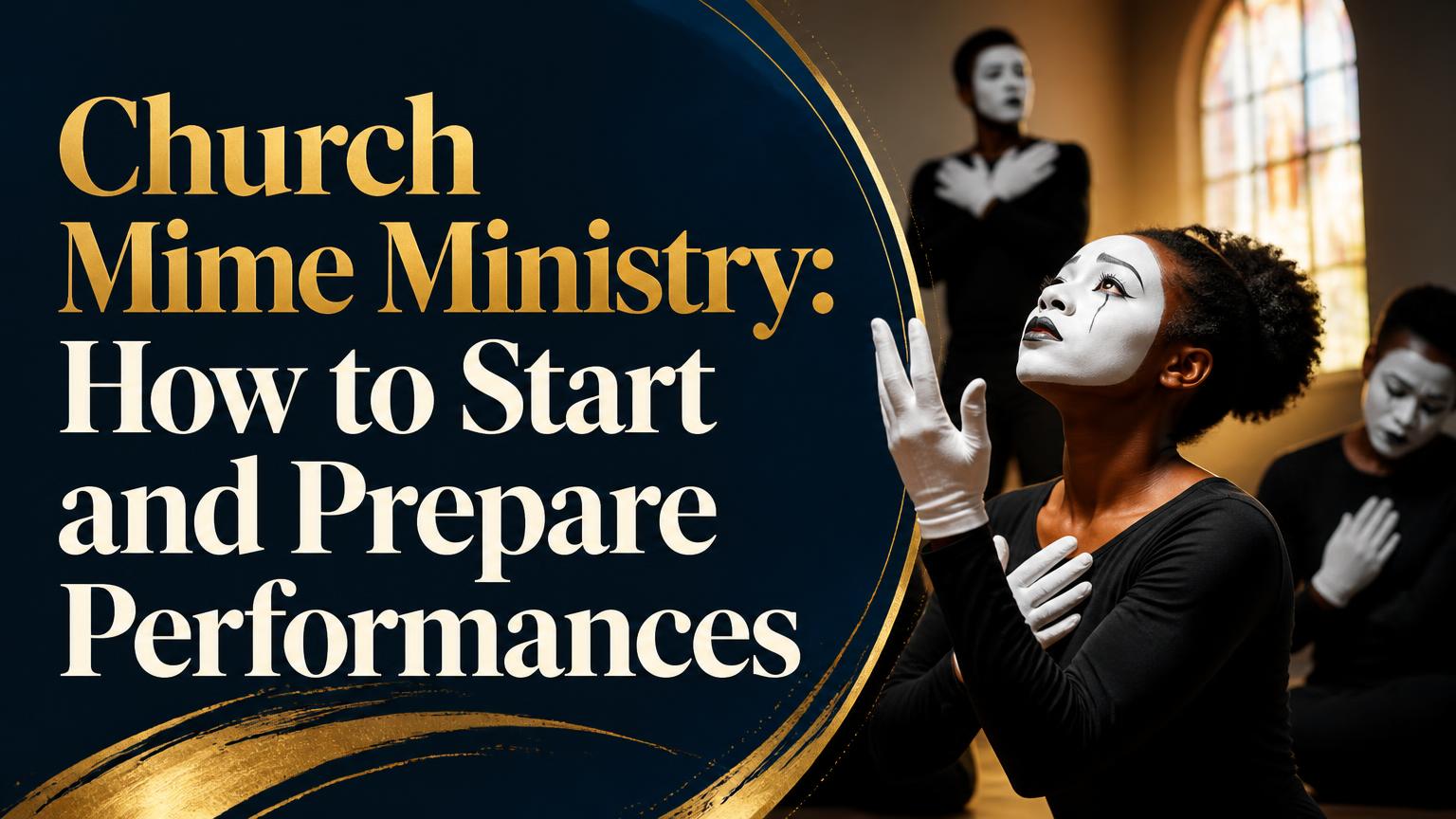
A church mime ministry uses silent, expressive movement, facial expression, posture, and carefully chosen music to communicate a biblical message or support congregational worship. It can portray Scripture, illustrate a testimony, address spiritual themes, or present the gospel in a form that engages people visually. Starting one successfully requires more than learning dramatic gestures: the ministry needs spiritual purpose, pastoral accountability, trained performers, suitable material, disciplined rehearsal, and thoughtful integration with the church’s wider mission.
Church Mime Ministry: How to Start and Prepare Performances
A strong church mime ministry begins with a clear ministry purpose and ends with a performance that is understandable, reverent, technically prepared, and pastorally appropriate. The following process provides a practical framework from the first conversation with church leadership through the final presentation.
Establish the Ministry’s Purpose and Accountability
Begin by defining what the ministry is intended to accomplish. A group might support worship services, present biblical stories, minister during youth events, communicate evangelistic themes, or serve in outreach settings. These purposes can overlap, but identifying the primary aim helps determine the team’s music, movement style, performance length, and audience.
The ministry should operate under appropriate pastoral or ministry leadership rather than functioning as an independent performance club. Church leaders can help evaluate whether a proposed presentation fits the church’s doctrine, worship practices, age group, and public setting. They can also provide guidance when a performance addresses grief, abuse, addiction, spiritual warfare, or other sensitive subjects.
A written purpose statement can keep the group focused. For example: “The mime ministry uses disciplined visual communication to help the church understand biblical truth and respond to God in worship.” This does not replace prayer or spiritual discernment, but it gives the team a standard for evaluating opportunities.
Ground the Ministry in Worship and Edification
The Bible does not prescribe modern church mime as a specific ministry office or performance format. Therefore, a church should not claim that every mime presentation is automatically biblical. Instead, the ministry should be evaluated by broader scriptural principles: worship, truth, humility, order, service, and the strengthening of other believers.
Romans 12:1 presents worship as the offering of the whole person to God, while 1 Corinthians 12:4–7 describes different gifts being used for the common good. First Corinthians 14:26 emphasizes that gathered ministry should build up the church. These passages support the responsible use of artistic gifts, but they also challenge performers to place ministry above attention, applause, or personal status.
Colossians 3:16 connects worship with teaching and encouragement. A mime presentation may communicate through movement rather than speech, yet it should still convey a coherent and truthful message. The group should ask, “What should the audience understand, feel, or consider after watching this?” If the answer is only that the performance looked impressive, the ministry needs a clearer spiritual purpose.
Form and Train the Team
Recruit people who are willing to learn, practice, receive correction, and serve consistently. Natural expressiveness can help, but reliability and humility are more valuable than raw talent. A team may include performers, choreographers, music editors, costume coordinators, stage managers, and people who pray with participants or help with pastoral follow-up.
Training should cover more than choreography. Performers need instruction in posture, facial expression, hand positions, levels, directional focus, spacing, rhythm, transitions, and emotional restraint. They should learn how to communicate clearly without exaggerating every movement. Mime depends on precision: a small change in the eyes, shoulders, or angle of the head can alter the meaning of a scene.
Establish basic expectations from the beginning. These may include punctuality, regular attendance, appropriate clothing, confidentiality, spiritual maturity, and willingness to submit to leadership. For minors, follow the church’s child-protection policies, supervision requirements, transportation procedures, and permission rules. A ministry that communicates grace publicly should also practice responsibility privately.
Select Music and Clarify the Message
Choose music because it supports the message, not simply because it is popular, dramatic, or emotionally powerful. Listen carefully to the lyrics and consider their theological accuracy, emotional tone, length, tempo changes, and suitability for the audience. A song about surrender may require movements that show resistance, recognition, and response; a song about the cross may require restraint rather than theatrical excess.
Reduce the presentation to one central message. A short performance cannot explain every aspect of Christian discipleship, spiritual conflict, or redemption. Write a simple sentence such as, “God’s grace restores a person who has been trapped by shame,” or, “Following Christ requires releasing control.” Every major movement should serve that sentence.
The ministry should also distinguish between biblical text and artistic interpretation. If the performance portrays a biblical event, the team should know which elements come from Scripture and which are imaginative additions. This prevents an illustration from being mistaken for a direct biblical account and encourages performers to handle sacred themes carefully.
Build the Performance From a Storyboard
Before rehearsing full choreography, divide the music or presentation into sections. Mark the opening image, major lyrical or musical changes, emotional turning points, climax, and ending. Then assign a clear action or visual idea to each section. A storyboard can be written in ordinary language: isolation, temptation, collapse, hearing truth, surrender, restoration, and service.
Use visual contrast deliberately. Stillness can communicate despair, attention, submission, or anticipation. Repeated gestures can represent temptation, bondage, prayer, or a recurring decision. Changes in formation can show separation, conflict, community, or reconciliation. These choices give the performance a visual vocabulary instead of producing a sequence of unrelated motions.
Keep the story understandable to someone who has never seen the team before. Avoid introducing too many symbols at once. If a rope represents bondage, for example, the audience should be able to recognize how the rope functions and when freedom occurs. Symbolism is useful only when the surrounding movement makes its meaning reasonably clear.
Rehearse Expression, Timing, and Transitions
Start with the message and major scenes before teaching every hand movement. Once the structure is clear, refine the choreography in sections. Rehearse slowly without music, then with counted beats, and finally with the actual track. This progression helps performers understand spacing and intention rather than merely copying a recording.
Record practices when appropriate and review them as a team. Look for delayed reactions, uneven levels, accidental smiles, blocked sightlines, unsafe lifts, and movements that communicate something different from what was intended. Performers should also practice looking at the correct focal point. If one person represents God, a threat, or another character, the audience should be able to recognize that relationship through eye direction and body orientation.
Transitions deserve special attention. Many presentations are strong during their main gestures but become confusing when performers move into new formations. Decide whether each transition should be visible, hidden in darkness, integrated into the choreography, or eliminated. Finish rehearsals with full run-throughs so the team learns endurance and maintains concentration until the final pose.
Prepare Costumes, Makeup, and Stagecraft
Costumes should create visual unity without becoming a distraction. Coordinated colors, modest movement-friendly clothing, and simple accessories are often more effective than elaborate outfits. Traditional white-face makeup and black clothing are recognizable conventions, but they are not requirements for Christian mime. A church may use them, adapt them, or avoid them according to its setting and message.
Test makeup under the actual lighting whenever possible. Products should be suitable for skin contact, removed properly, and not shared in ways that create hygiene problems. Performers with allergies or sensitivities need safe alternatives. Costumes should allow comfortable movement, secure closures, and clear visibility; loose fabric, slippery shoes, or obstructive accessories can create avoidable hazards.
Check the stage, sound system, lighting, entrances, exits, and audience sightlines before the service. Confirm who starts the music, who signals the performers, and what happens if the track fails. A technically simple presentation still benefits from a written run sheet and a backup copy of the music.
Evaluate and Present With Pastoral Care
Before public presentation, show the performance to a trusted leader or small review group. Ask whether the message is clear, whether any movement could be misunderstood, whether the emotional intensity suits the setting, and whether the conclusion points people toward a constructive response. A performance about brokenness should not leave people with despair when the ministry intends to communicate hope.
Avoid manipulating an audience through excessive volume, frightening imagery, or emotionally coercive staging. The goal is not to force a visible response but to communicate faithfully and create space for reflection, prayer, preaching, or conversation. If the presentation involves trauma, death, self-harm, or abuse, leaders should prepare appropriate pastoral support rather than treating the subject only as dramatic material.
Afterward, evaluate both artistic quality and ministry fruit. Did the audience understand the central idea? Did the performance fit the service? Were performers spiritually and physically prepared? Honest evaluation helps the team improve without turning ministry into a competition for applause.
What Makes a Church Mime Ministry Different From Entertainment?
Entertainment primarily seeks to hold attention, produce enjoyment, or create an emotional experience. A church mime ministry may use many of the same artistic tools—music, movement, staging, symbolism, and dramatic tension—but its purpose includes worship, instruction, encouragement, testimony, or outreach. That purpose changes how the team chooses material and measures success.
A polished performance is valuable, but technical quality cannot compensate for a confused message or self-focused presentation. At the same time, spiritual sincerity does not excuse poor preparation. Biblical ministry involves both right motives and responsible stewardship. A group can pray earnestly and still need to correct weak timing, unclear symbolism, unsafe choreography, or inappropriate music.
The ministry should also avoid making mime the center of a service simply because it is visually different. It works best when it supports the church’s larger communication rather than competing with preaching, prayer, congregational singing, or personal ministry. A short, clear presentation may serve worship better than an extended performance that dominates the gathering.
A Practical Preparation Schedule
Begin several weeks in advance when possible. During the first stage, clarify the purpose, select the music, obtain leadership approval, and write the central message. Next, create the storyboard and teach the major formations. After that, refine gestures, facial expression, transitions, and timing. Reserve the final rehearsals for full run-throughs, technical testing, costume checks, and corrections rather than learning entirely new material.
Use a simple final checklist:
- Is the biblical or spiritual message accurate and understandable?
- Does every major movement support the central idea?
- Are the music, lyrics, and performance length appropriate?
- Can every performer be seen from the audience?
- Are costumes, makeup, props, and footwear safe?
- Has the team practiced entrances, exits, and unexpected problems?
- Does church leadership know what the presentation communicates?
- Is someone available for prayer or pastoral conversations afterward?
This process protects the team from last-minute confusion and protects the audience from a presentation that feels unfinished. It also gives performers confidence because they know both the artistic plan and the ministry purpose.
Common Problems in Church Mime Ministry
One frequent problem is movement without meaning. Performers may copy dramatic gestures from videos or other groups without understanding what those gestures communicate. The correction is to define the intention behind each sequence and remove motions that do not advance the story.
Another problem is allowing the music to carry the entire message. A powerful song can create emotion while the choreography remains vague. The team should test the presentation without sound and ask whether the visual story still has a recognizable structure. Mime should complement the music, not depend entirely on it.
Overcrowding is also common. Too many performers, props, symbols, or scene changes can make a short presentation difficult to follow. Simplicity often produces greater clarity. A small team with consistent movement may communicate more effectively than a large group with weak spacing and competing actions.
Finally, leaders should watch for pride, comparison, and pressure to perform beyond a person’s readiness. Ministry teams need room for growth and correction. The aim is faithful service, not the creation of a star performer or the demand that every presentation produce a dramatic public response.
Conclusion
A church mime ministry can communicate biblical truth through disciplined silence, expressive movement, music, and visual storytelling. Its effectiveness depends on more than dramatic ability. The team must define its purpose, submit to wise church leadership, choose material carefully, develop a clear message, rehearse with precision, prepare the technical details, and evaluate the ministry’s pastoral effect. Scripture does not make mime a special category of worship, but it does call believers to use their gifts for God’s glory and the strengthening of others. When artistic excellence serves that purpose rather than replacing it, mime can become a meaningful part of the church’s ministry.