
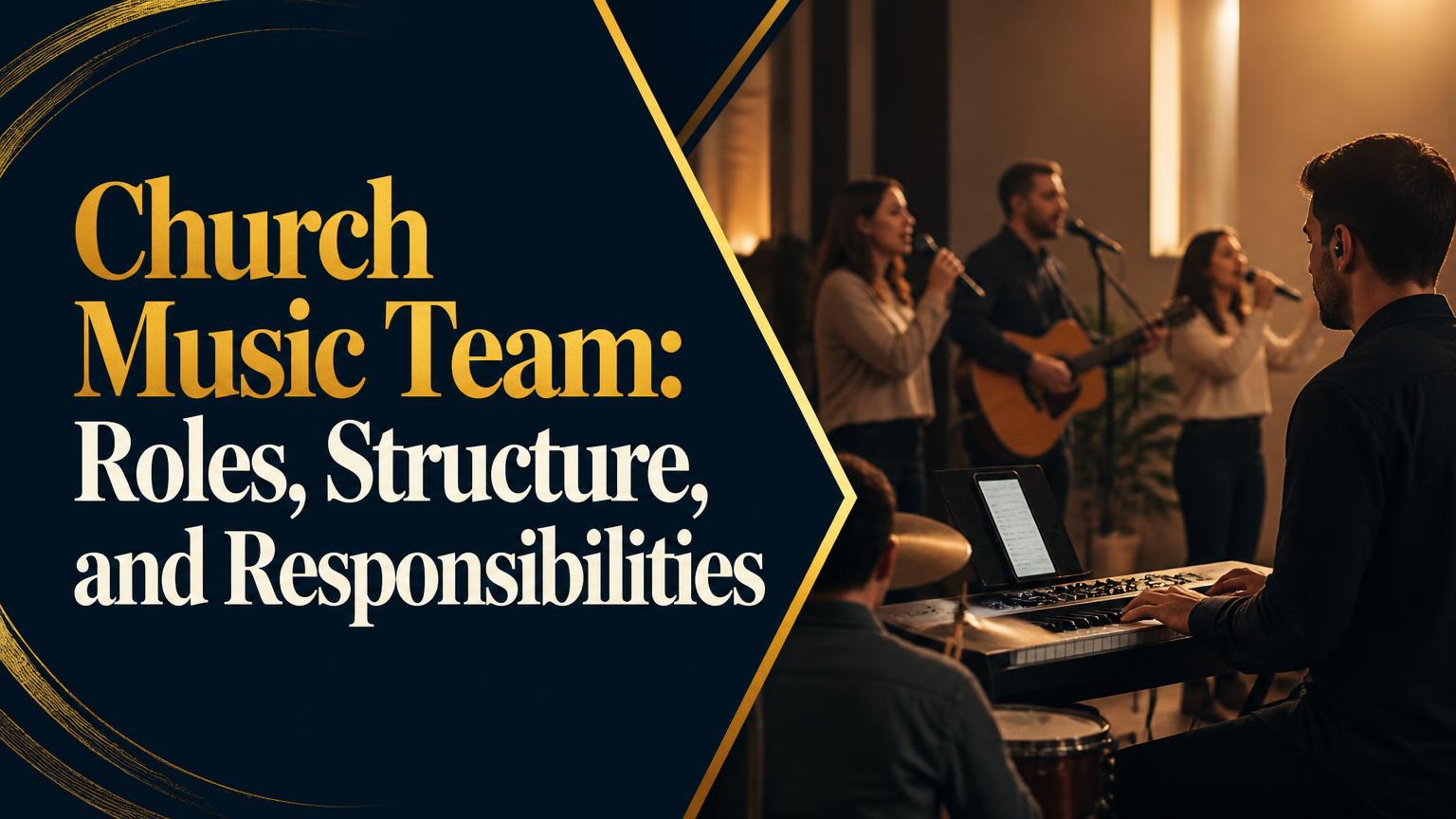
A church music team is a group of musicians, singers, worship leaders, and technical workers who help the congregation participate in Christian worship through music. Its work involves far more than selecting songs or performing accurately. A healthy team prepares carefully, supports congregational singing, serves the church’s theological and pastoral mission, and works cooperatively with pastors and other ministry leaders. The exact structure varies by church size, tradition, budget, and available volunteers, but the central responsibility remains the same: to serve the congregation rather than draw attention primarily to the platform.
Church Music Team Roles, Structure, and Responsibilities
Its Purpose Goes Beyond Musical Performance
The primary purpose of a church music team is to help the gathered church sing, listen, respond, and reflect on biblical truth. Ephesians 5:19 and Colossians 3:16 connect Christian singing with encouragement, teaching, and mutual instruction. This means the team is not simply providing background music for a service. It is helping the congregation express faith together.
That purpose also establishes an important boundary: the team does not replace the congregation as the worshiping body. A skilled vocalist may lead confidently, and a capable band may create an appropriate musical atmosphere, but congregational participation remains central. Music should make it easier for people to sing and understand the message, not turn worship into a concert in which most people become spectators.
The word worship also covers more than music. Romans 12:1 describes the whole life of believers as an offering to God. Consequently, a church music team should understand its ministry as one part of the church’s broader worship, teaching, pastoral care, and mission.
The Main Roles on a Church Music Team
Titles differ among churches, and one person may hold several responsibilities. In a smaller congregation, the worship leader may choose songs, play an instrument, lead rehearsals, organize volunteers, and coordinate with the pastor. In a larger church, these tasks may be divided among several people.
Common roles include:
- Worship or music leader: Selects and arranges songs, leads rehearsals, communicates with the pastor, guides transitions, and helps the team serve the service’s overall purpose.
- Vocalists: Lead or support the melody, model congregational singing, blend with other voices, and communicate lyrics clearly rather than competing for attention.
- Instrumentalists: Provide harmonic, rhythmic, and melodic support. Their responsibility includes playing appropriate parts, following the arrangement, and leaving space for the congregation.
- Choir members or ensemble singers: Contribute collective vocal strength and may support special music, seasonal services, or particular worship traditions.
- Audio and production volunteers: Manage microphones, monitors, sound levels, presentation software, livestream elements, and other technical details that affect participation.
- Pastoral or ministry liaison: Connects the music team with the pastor and service planners so that songs, readings, prayers, and sermons form a coherent service.
These roles are interdependent. A technically strong band cannot compensate for unclear leadership, poor lyrics, or an unprepared sound system. Likewise, a thoughtful song plan can be weakened if musicians do not know the arrangements or if the congregation cannot hear the words.
How Team Structure Changes by Church Size
A small church may operate effectively with a simple structure: one coordinator, a rotating group of singers and musicians, and a volunteer handling sound. The same person may lead music one week and play an instrument the next. Simplicity is not a weakness if responsibilities are clear and the team prepares consistently.
A medium-sized church may use a scheduled roster, several instrumentalists, multiple vocalists, and a production team. A music director or worship coordinator can manage song planning, volunteer scheduling, rehearsals, and communication, while the pastor or service planner provides theological and pastoral direction.
A larger church may have several worship teams, a choir, production specialists, an administrative coordinator, and a ministry director. It may also use different teams across multiple services or campuses. This structure requires clear lines of authority, shared musical standards, documented procedures, and intentional development of new leaders.
Churches should not copy a large-church structure simply because it appears professional. The best structure is proportionate to the congregation’s needs and resources. A complicated hierarchy can burden a small volunteer team, while an informal system can create confusion in a large ministry.
How Responsibilities Work Across a Church Service
Responsibilities Before the Service
Preparation begins with choosing music that fits the church’s doctrine, the service theme, the congregation’s ability to sing, and the emotional and pastoral context. Song selection should consider theological accuracy, understandable language, singable melodies, appropriate vocal range, and a healthy balance between familiar and newer material.
The leader should distribute lyrics, chord charts, recordings, schedules, and other information early enough for people to prepare. Rehearsals should address more than whether everyone knows the notes. The team should practice entrances, endings, transitions, dynamics, harmonies, microphone technique, and communication cues.
Preparation also includes checking instruments, cables, microphones, monitors, presentation slides, and backup plans. Prayer can properly form part of preparation, but it should not be used as a substitute for organization. Dependence on God and responsible planning belong together.
Responsibilities During the Service
During the service, the team should lead with attentiveness rather than follow a rigid plan without regard for what is happening. The music leader may need to shorten a song, repeat a section, adjust a transition, or respond to a pastoral instruction. Such changes should serve the congregation, not showcase the leader’s ability to improvise.
Musicians and vocalists should listen to one another, follow the designated leader, maintain appropriate volume, and avoid unnecessary embellishment. The sound team has a particularly important responsibility: lyrics must be intelligible, the congregation must be able to hear itself sing, and technical choices should support participation rather than overwhelm it.
The team should also respect the service’s other elements. A musical transition that consistently interrupts Scripture reading, prayer, preaching, or communion reveals a planning problem, even if the music itself is attractive.
Responsibilities After the Service
Afterward, the team should evaluate both musical execution and congregational service. Useful questions include: Could people hear and sing? Were the lyrics clear? Did the arrangements support the congregation? Were transitions confusing? Did anyone become overloaded or overlooked?
The team also needs to maintain equipment, update song files, record useful notes, schedule future volunteers, and communicate changes promptly. Leaders should address problems directly but constructively. A missed cue or weak rehearsal should be corrected without humiliating the person involved.
Post-service care includes pastoral awareness. Volunteers may experience exhaustion, conflict, insecurity, or discouragement. A church music team becomes healthier when leaders notice these pressures and provide rotation, encouragement, training, and appropriate rest.
How to Build a Healthy Church Music Team
Recruit Character, Teachability, and Competence
Musical skill matters because poor preparation can distract the congregation, but skill alone is not enough. Churches should look for reliability, humility, willingness to receive correction, emotional maturity, and agreement with the church’s basic beliefs and ministry direction.
The New Testament does not provide a modern audition rubric for bands, choirs, or worship leaders. It does, however, repeatedly emphasize Christian character, service, self-control, and the use of gifts for the good of others. Those principles should shape recruitment. A gifted person who resists teamwork or treats the platform as personal status may damage the ministry more than an average musician who serves faithfully.
Auditions can help identify musical ability and fit, but they should not become a public ranking system. A wise process explains expectations, offers feedback, and creates appropriate opportunities for people who need more training before serving publicly.
Establish Clear Planning and Rehearsal Practices
A healthy team knows who selects songs, who approves arrangements, who schedules volunteers, who communicates with the pastor, and who makes final decisions during a service. Unclear authority produces duplicated work, last-minute changes, and avoidable tension.
Rehearsals should begin with materials that are already available and reasonably organized. The team should spend its time solving musical and service-related issues rather than discovering the song for the first time. A useful rehearsal may include a full run-through, focused work on difficult sections, sound checks, transitions, and a final review of the service order.
Planning should also include reasonable rotation. Using the same few dependable people every week may appear efficient, but it can produce burnout and prevent others from developing. Rotation works best when standards remain clear and less experienced volunteers receive coaching rather than being placed into situations for which they are unprepared.
Create a Culture of Service and Accountability
Team culture is shaped by what leaders praise, tolerate, and correct. If attention goes mainly to impressive solos, appearance, or platform visibility, volunteers may conclude that performance matters more than service. Leaders should recognize preparation, cooperation, reliability, and the ability to make room for others.
Accountability should be specific and fair. A musician who repeatedly arrives unprepared needs a direct conversation, while a volunteer who makes an occasional mistake needs encouragement and practical help. Teams should also establish expectations concerning punctuality, communication, attire, substance use, conflict resolution, safeguarding, and respectful conduct.
Healthy culture includes room for disagreement. People may have different musical preferences, but decisions should be evaluated by shared standards: biblical faithfulness, congregational usefulness, pastoral wisdom, technical feasibility, and the church’s stated ministry direction.
Biblical Foundations for Church Music Teams
The New Testament emphasizes singing, mutual encouragement, thanksgiving, and orderly participation, but it does not prescribe one contemporary structure for a church music team. Scripture does not require a particular number of musicians, a specific genre, or a fixed distinction between a band and a choir. Christian traditions therefore differ legitimately in instrumentation, musical style, leadership models, and the amount of music included in a service.
Colossians 3:16 presents singing as a way believers teach and encourage one another, while 1 Corinthians 14:26–40 places congregational gatherings under the principles of edification, order, and peace. These passages suggest that church music should communicate truth, strengthen the body, and remain intelligible and appropriately organized. They do not justify treating musical excellence as irrelevant, but they do place excellence within the larger purpose of building up the church.
The biblical question is therefore not simply whether a team sounds impressive. It is whether the team’s content is faithful, its conduct is consistent with Christian service, and its musical choices help the congregation participate meaningfully. The answer may look different in a rural congregation, a historic liturgical church, a multilingual congregation, or a contemporary church, while the underlying principles remain applicable.
Common Problems and Better Practices
Treating the Team as Performers
A performance-centered team may focus on stage presence, technical complexity, or emotional impact while giving too little attention to congregational singing. This often results in arrangements that are difficult to follow, excessive volume, or frequent musical changes that keep people from participating.
The remedy is to evaluate songs from the congregation’s perspective. Can ordinary worshipers hear the melody? Can they understand the words? Does the arrangement leave room for their voices? A team can be musically excellent while remaining visibly and functionally supportive.
Leaving Responsibilities Unclear
Confusion about who chooses songs, leads rehearsals, handles sound, approves changes, or communicates schedules creates frustration. Volunteers may receive conflicting instructions or assume someone else has completed an important task.
A written role description and a simple service-planning process solve many of these problems. The structure does not need to be bureaucratic. It needs to identify decision-makers, deadlines, communication channels, and the person responsible for final coordination.
Relying on Talent Instead of Preparation
Experienced musicians can sometimes hide weak preparation, but they cannot eliminate its consequences. Unrehearsed transitions, incorrect lyrics, poor sound levels, and uncertain leadership distract both the team and the congregation.
Regular rehearsal, advance communication, song libraries, substitute plans, and periodic training provide a more reliable foundation. Preparation also reduces anxiety, enabling leaders to respond calmly when an unexpected problem occurs.
Conclusion
A church music team exists to serve the gathered church through prepared, faithful, and congregationally focused music. Its responsibilities include selecting appropriate songs, developing musicians and singers, coordinating technical work, supporting the wider service, caring for volunteers, and evaluating its ministry honestly. The structure may range from a small volunteer group to a large department with multiple teams, but size does not determine health.
The strongest teams hold musical excellence and spiritual humility together. They recognize that good sound, accurate playing, and thoughtful arrangements matter because they help people participate—not because the platform deserves attention for its own sake. When leadership, preparation, biblical purpose, and pastoral care work together, a church music team becomes a dependable ministry of teaching, encouragement, and shared worship.