
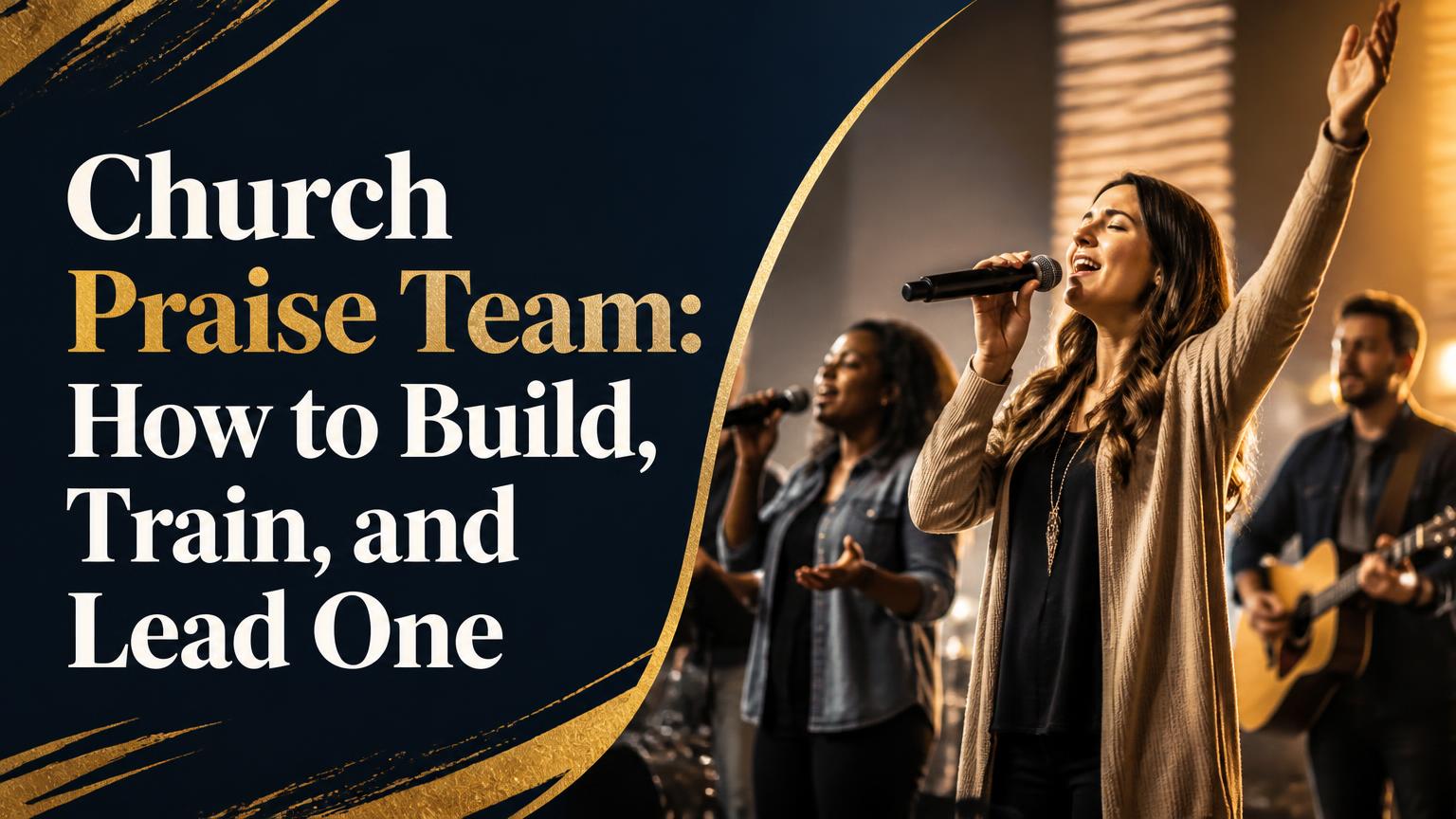
A church praise team is more than a group of capable singers and musicians. It is a ministry entrusted with helping the congregation respond to God through corporate song, prayer, Scripture, and attentive participation. Building one well requires more than recruiting talent: leaders must establish a clear purpose, choose people with spiritual maturity and musical ability, train them consistently, and create a culture marked by humility, preparation, unity, and pastoral accountability. The strongest teams support congregational worship rather than turning worship into a stage performance.
How to Build, Train, and Lead a Church Praise Team
Define the Team’s Purpose and Scope
A church praise team usually refers to the singers and musicians who help lead congregational worship. In some churches, “praise team” means the vocalists alone; in others, it includes the entire worship ministry, including instrumentalists, sound personnel, service planners, and worship leaders. Define the term locally so people understand their responsibilities.
The team’s primary purpose is to serve the gathered church. It should help people sing truth, remember the character and work of God, express praise and repentance, and participate together. The team is not a substitute for congregational worship, and its success should not be measured mainly by applause, visible emotion, or musical difficulty.
This purpose has practical consequences. Song choices should be singable, the volume should allow the congregation to hear itself, and arrangements should support the meaning of the words. Psalm 100:1–2 connects joyful worship with serving the Lord, while Colossians 3:16 presents singing as a way believers teach and encourage one another. Those passages frame music as ministry to God and to the gathered community.
Recruit for Character, Commitment, and Skill
Recruitment should consider three related qualities: Christian character, reliable commitment, and musical competence. Skill matters because an unprepared team can distract the congregation, but skill alone cannot sustain a healthy ministry. A gifted person who resists correction, creates conflict, or treats the platform as personal visibility may damage the team more than a less experienced person who is teachable and dependable.
Create a simple process rather than choosing people informally. Explain the team’s expectations, invite interested members to participate in an audition or informal evaluation, and allow pastoral or ministry leaders to consider a person’s conduct within the church. The process need not be competitive or intimidating. Its purpose is to place people where they can serve faithfully and grow appropriately.
Recruitment also involves knowing when not to schedule someone. A person may have genuine musical ability but need time to address unresolved relational, spiritual, or commitment concerns. That decision should be communicated respectfully and, where appropriate, accompanied by a clear path for development. Being declined for a particular role is not a judgment on a person’s value or standing before God.
Establish Roles, Expectations, and Accountability
A praise team functions more effectively when responsibilities are explicit. Depending on the church’s size, roles may include worship leader, vocalists, instrumentalists, service or song coordinator, rehearsal leader, and someone responsible for communication and scheduling. One person may hold several roles, but the responsibilities should still be named.
Written expectations can cover attendance, preparation, clothing, stage conduct, communication, use of personal equipment, responding to correction, and procedures for finding a substitute. They should also explain how songs are selected and who approves arrangements. Clear standards reduce misunderstandings and prevent decisions from appearing personal or arbitrary.
Accountability should be pastoral rather than merely disciplinary. Leaders need authority to address repeated lateness, poor preparation, interpersonal conflict, or inappropriate platform behavior, but correction should aim at restoration and growth. Matthew 18:15–17 gives a framework for addressing personal offenses directly and progressively. Churches should also protect volunteers from unclear authority by identifying who makes final decisions about worship services.
Train Musical Ability and Spiritual Understanding
Training should develop both musicianship and ministry judgment. Musical training may include pitch, harmony, rhythm, breath control, microphone technique, dynamics, transitions, arrangement, listening, and playing or singing without overpowering others. Instrumentalists should learn to support the song rather than fill every space, while vocalists should learn blend, phrasing, and when to sing or remain silent.
Spiritual training should help team members understand the words they lead. They should know the biblical ideas behind common worship themes such as holiness, grace, lament, confession, thanksgiving, resurrection, and hope. This prevents worship from becoming the repetition of emotionally powerful phrases without theological understanding. It also helps leaders choose songs that are truthful, pastorally appropriate, and consistent with the church’s teaching.
Training can happen through regular rehearsals, occasional workshops, one-to-one coaching, and brief evaluations after services. Feedback should be specific: “The second verse became too loud for the congregation to sing” is more useful than “The song did not feel right.” Leaders should distinguish correctable musical problems from matters of preference, since not every stylistic disagreement is a ministry failure.
Plan Rehearsals That Prepare People to Serve
A rehearsal should do more than run through songs from beginning to end. Send the song list, keys, charts, recordings, and any special instructions early enough for team members to prepare individually. Begin by clarifying the service flow, then work on difficult transitions, endings, harmonies, tempo changes, and moments that require the team to follow a leader rather than a fixed arrangement.
A useful rehearsal may include a brief prayer and Scripture, but spiritual language should not replace preparation. If the team repeatedly arrives unprepared and uses prayer to cover avoidable problems, the rehearsal becomes frustrating for everyone. Conversely, a technically efficient rehearsal that never considers the congregation’s spiritual and pastoral needs is incomplete.
End by identifying unresolved issues: a song that needs a lower key, an instrumental entrance that remains unclear, or a transition that requires a spoken introduction. A short debrief after the service can address what helped the congregation participate and what created confusion. Keep criticism focused on observable actions, and recognize improvement as well as problems.
Lead the Service With Humility and Awareness
During the service, the worship leader must pay attention to more than the planned set list. The leader watches the congregation, listens to the team, follows the service plan, and responds appropriately to pastoral direction. Flexibility does not mean improvising constantly. It means recognizing when a transition needs more space, when a song is not connecting, or when the service should move forward rather than become extended.
A worship leader should give clear cues, use a microphone carefully, and avoid unnecessary talking. Spoken moments should clarify the purpose of a song, connect it with Scripture, or help the congregation participate. They should not become a second sermon or draw attention to the leader’s private spiritual experience.
Leadership also includes knowing when to defer to the pastor or service leader. A praise team is part of the church’s wider ministry, not an independent authority within it. Coordination with preaching, communion, prayer, baptism, and other elements helps the service communicate one coherent message.
Build a Healthy Praise Team Culture
A healthy culture develops when people are valued as disciples and servants rather than treated as replaceable performers. Leaders should learn team members’ strengths, limitations, availability, and personal circumstances. They should schedule people sustainably, make room for rest, and avoid building the ministry around one unusually gifted individual. Overdependence on a single person creates vulnerability and limits future leadership.
Humility must apply to every role. A lead vocalist is not more spiritually important than a background singer, and a technically skilled musician does not have greater worth than someone serving quietly. Philippians 2:3–4 calls believers to reject selfish ambition and consider the interests of others. In practice, that means sharing opportunities, receiving correction, honoring less visible work, and refusing to measure ministry value by platform time.
Unity does not require identical personalities or musical preferences. It requires a shared submission to the church’s mission. Differences over musical style should be discussed in terms of congregational participation, theological clarity, pastoral wisdom, and the church’s context—not simply personal taste. Leaders who explain decisions clearly can preserve trust even when not everyone gets the arrangement or song they prefer.
Choose Songs With Theological and Pastoral Wisdom
A song should be evaluated by more than melody or popularity. Consider whether its words are biblically faithful, understandable, singable, appropriate for the congregation, and suited to the service’s purpose. Some songs are excellent for corporate singing; others may work better as special music because their range, complexity, or arrangement makes congregational participation difficult.
Pay attention to who is speaking in the lyrics. A song may address God directly, declare truth to the congregation, describe personal experience, or express a prayer. Each can have a place, but the team should not present private testimony as though every worshiper must share the same emotional experience. Songs of lament and weakness are also biblically appropriate. The Psalms include grief, confession, waiting, trust, and joy, giving churches a broader vocabulary than celebration alone.
Consider the congregation’s actual range and ability. A song that sits too high, changes keys repeatedly, or depends on intricate vocal parts may sound impressive while discouraging participation. The goal is not to eliminate musical excellence but to direct excellence toward clear, shared worship.
Avoid Common Praise Team Problems
One common problem is confusing visible intensity with spiritual depth. Loud music, raised hands, tears, or spontaneous speech may accompany sincere worship, but none provides a complete measure of faithfulness. A quiet service can be deeply reverent, and an energetic service can still be self-focused. Leaders should evaluate whether the church is hearing truth and participating meaningfully rather than trying to manufacture a particular emotional response.
Another problem is allowing platform status to outrun character. Public gifting can attract admiration, which makes boundaries and accountability necessary. Churches should not excuse arrogance, manipulation, inappropriate relationships, or persistent unreliability because someone sings or plays exceptionally well.
Burnout is also preventable. Constant rotation without development exhausts a small group, while using the same people every week prevents others from growing. A healthy schedule balances continuity with rest and creates supervised opportunities for newer members. When a team member steps away, leaders should treat the transition pastorally rather than framing it as disloyalty.
Finally, avoid measuring the team only by technical polish. Musical mistakes should be corrected, but the deeper questions are whether members are becoming more faithful servants, whether the congregation can participate, and whether the team strengthens the church’s witness and unity.
A Practical Path for Starting or Strengthening a Team
Begin by assessing the church’s current situation. Identify available singers and musicians, the congregation’s musical range, existing equipment, leadership authority, rehearsal space, and the number of services requiring coverage. This prevents the church from adopting a structure designed for a much larger congregation.
Next, write a short ministry description and expectations document. Recruit a manageable initial team, establish a service schedule, and choose a small collection of songs that the congregation can learn. Consistency is more valuable than constant novelty during the early stages.
During the first several months, schedule regular rehearsals and brief post-service reviews. Develop at least one additional person who can lead rehearsals or services, and provide individual coaching where needed. Review the ministry after a defined period by asking whether preparation has improved, participation is growing, communication is clear, and the team’s culture reflects humility and mutual care.
Conclusion
A church praise team is strongest when musical ability serves congregational worship rather than replacing it. Building one requires careful recruitment, clear expectations, dependable preparation, theological understanding, pastoral oversight, and a culture where humility matters more than visibility. Training should address both technical skill and spiritual maturity, while leadership should combine preparation with attentiveness during the service. When a team helps the church sing truth together, supports the wider ministry of the congregation, and remains accountable to godly leadership, it becomes more than a platform ensemble: it becomes a faithful ministry of the local church.