
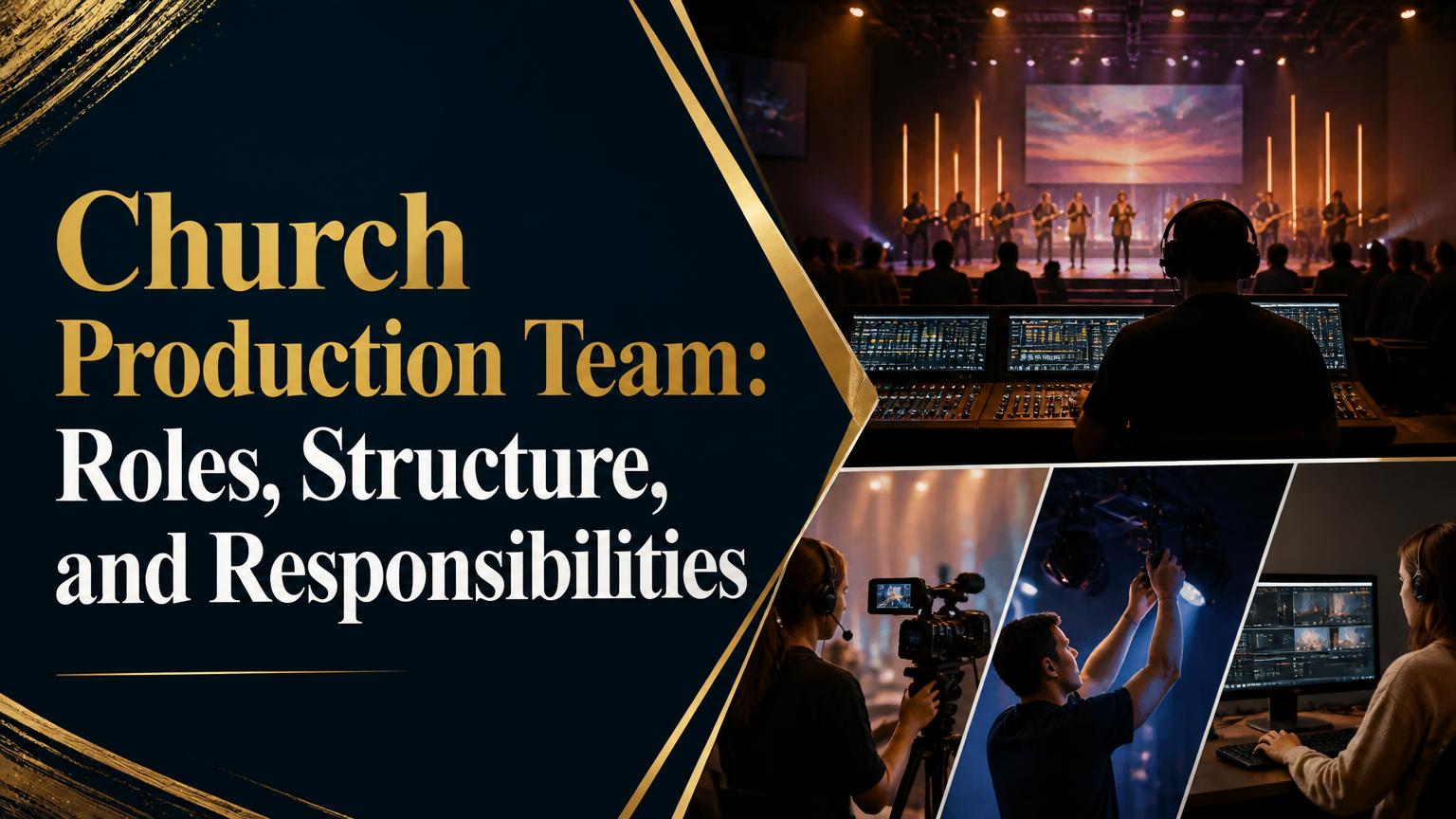
A church production team turns a service plan into a clear, reliable, and participatory gathering. Its work may include sound, projection, livestreaming, lighting, cameras, stage coordination, recording, and technical preparation. The team is not merely a collection of people who operate equipment; it connects ministry leaders, musicians, speakers, volunteers, and technology so that the congregation can hear, see, and follow what is happening. A strong team combines technical skill with preparation, communication, humility, safety, and a commitment to support the purpose of the service rather than draw attention to itself.
Church Production Team Roles, Structure, and Responsibilities
A church production team is responsible for preparing and operating the technical environment before, during, and after a service. Its exact structure depends on the church’s size, service style, facilities, and use of technology. A small congregation may assign several responsibilities to one person, while a larger church may divide them among specialized departments.
The most effective teams define responsibilities clearly while remaining flexible. Technical roles overlap during a service, but every major task should have an accountable owner.
Production Director or Technical Director
The production director oversees the complete technical plan for a service or event. This person coordinates with pastors, worship leaders, speakers, musicians, service producers, and volunteers to understand the order of service and identify technical requirements.
Typical responsibilities include creating schedules, assigning positions, confirming equipment, leading rehearsals, resolving conflicts, and making decisions when problems arise. During the service, the technical director may supervise the entire team or operate as a technical director who calls camera shots, transitions, lighting changes, or presentation cues.
This role requires more than equipment knowledge. The leader must prioritize calmly, communicate clearly, delegate effectively, and understand when a technical improvement would help the service and when it would simply add distraction.
Audio Team
The audio team makes speech, music, congregational participation, and recorded material understandable and balanced. Common responsibilities include setting up microphones, checking wireless frequencies, placing and connecting instruments, mixing the front-of-house sound, managing monitor mixes, and recording or sending audio to a livestream.
The front-of-house mix serves people in the room, while monitor mixes help musicians and speakers hear what they need. A livestream or recording may require a separate mix because microphones and instruments that sound balanced in the room may not translate well through cameras or online devices.
Audio operators also monitor feedback, distortion, dead batteries, cable faults, and excessive volume. Good audio is often noticed most when it fails, so careful preparation and unobtrusive correction are central responsibilities.
Video, Streaming, and Presentation Team
This team manages what people see on screens and online. Its work can include operating cameras, switching camera feeds, displaying lyrics and Scripture, preparing sermon slides, adding lower-thirds, managing confidence monitors, recording services, and monitoring the livestream.
Presentation operators must verify every slide, spelling, Scripture reference, video file, and font before the service begins. Camera operators need to understand the service flow so they can frame speakers, musicians, baptisms, or other important moments without creating unnecessary movement.
Streaming also introduces additional responsibilities, including internet reliability, audio synchronization, encoding, privacy, and online viewer experience. A technically impressive stream cannot compensate for unclear audio or poorly timed presentation cues, so the team must coordinate rather than treat each task as an isolated assignment.
Lighting, Stage, and Equipment Team
Lighting helps people see speakers and musicians, establishes visual focus, supports transitions, and contributes to the atmosphere of a service. The lighting team may program scenes, operate a lighting console, focus fixtures, replace lamps or fixtures, and coordinate lighting changes with the service producer.
Stage and equipment responsibilities may include arranging chairs, music stands, instruments, lecterns, cables, communion elements, backdrops, and other physical resources. The team must keep walkways clear, secure equipment, reduce trip hazards, and make changes quietly when possible.
These responsibilities often overlap with facilities or worship departments. The important issue is not which department owns a task but whether someone has been assigned to complete and verify it.
Service Producer or Stage Manager
A service producer focuses on the service as a sequence of planned moments. This person works from a rundown that identifies songs, readings, announcements, videos, sermon segments, transitions, and expected cues. The producer communicates timing and changes to the production team, worship leaders, speakers, and stage personnel.
A stage manager may coordinate movement behind the scenes, cue speakers and musicians, manage entrances and exits, and communicate through headsets. In a small church, the production director may perform both roles. In a larger church, separating them allows one person to manage the service flow while another supervises technical execution.
This role prevents the team from operating as a group of unrelated technicians. It connects the technical plan to the human rhythm of the service.
How Should a Church Production Team Be Structured?
The right structure depends less on the size of the equipment inventory than on the complexity and frequency of the church’s services. A church with one weekly gathering may need a coordinator, an audio operator, and a presentation operator. A church with multiple services, a livestream, theatrical elements, or several venues may require department leaders, service producers, camera operators, lighting operators, stage managers, and scheduled backups.
Match Structure to Congregation and Service Complexity
A small church often benefits from cross-trained generalists. One volunteer might run sound, display slides, and help with setup, while another coordinates the service and handles basic troubleshooting. This model keeps the team practical and avoids creating titles without enough work to justify them.
As complexity increases, specialization becomes useful. Multiple services, large worship bands, livestreaming, complex lighting, or several locations can overload generalists. Dividing responsibilities then improves reliability, but only if the departments continue to communicate through shared schedules, rehearsals, and clear reporting lines.
Define Authority and Communication
Every service should have a clearly identified person who can make real-time production decisions. Team members need to know who calls cues, who approves changes, who contacts the worship leader, and who handles emergencies. Without defined authority, several people may give conflicting instructions or hesitate while a problem grows.
Communication may use headsets, messaging platforms, written rundowns, or pre-service meetings. The method matters less than consistency. A useful communication system is brief, respectful, and specific: identify the problem, state the needed action, and avoid unnecessary conversation during critical moments.
Build Primary and Backup Coverage
A dependable team plans for absence, illness, equipment failure, and unexpected changes. Each essential position should have at least one person who can cover it, even if that backup is not yet advanced enough to lead the entire department.
Cross-training also reduces burnout. A church should not depend indefinitely on one person who understands the audio console, livestream system, or lighting network. Documentation, labeled equipment, basic operating checklists, and supervised practice make transitions easier and preserve knowledge when volunteers move away or change responsibilities.
A Reliable Church Service Production Workflow
Production quality is usually determined before the congregation arrives. Preparation begins with reviewing the service order, confirming personnel, checking song keys and arrangements, collecting presentation files, testing videos, charging batteries, inspecting cables, and identifying special requirements such as baptisms, communion, interviews, or guest speakers.
A rehearsal or soundcheck should test the actual service rather than merely confirm that equipment powers on. The team should verify microphone levels, monitor mixes, camera positions, screen content, lighting scenes, livestream audio, and communication channels. During the service, operators follow the agreed plan while remaining ready to adapt. Afterward, they should shut down equipment safely, restore the room, save useful settings, and briefly record problems that need correction before the next gathering.
How to Lead and Develop Church Production Volunteers
Recruit for Reliability and Servanthood
Technical ability is useful, but reliability, teachability, patience, and respect often matter more than prior experience. Volunteers should understand that production work is a ministry of support: the goal is to help people engage with the service, not to showcase personal creativity or technical control.
Recruitment should include a realistic explanation of time commitments, training requirements, early arrival times, and the pressure of live events. Clear expectations prevent volunteers from agreeing to responsibilities they cannot consistently fulfill.
Train Through Supervised Practice
New volunteers learn best through a progression from observation to assisted operation and then independent responsibility. Training should cover the equipment, the service order, communication standards, troubleshooting priorities, and what to do when something goes wrong.
Written checklists are especially valuable for repeatable tasks such as startup, microphone preparation, livestream checks, and shutdown. Training should also include the reason behind each task. A volunteer who understands why gain structure, battery checks, or slide verification matters can make better decisions when conditions change.
Give Feedback Without Creating Fear
Live production involves mistakes, and a culture of blame causes volunteers to hide problems or stop serving. Leaders should review what happened with specific, constructive feedback: what worked, what failed, why it happened, and what procedure could prevent a repeat.
This does not mean ignoring carelessness or unsafe behavior. Accountability remains necessary, but correction should improve competence rather than embarrass people. Celebrating quiet reliability, preparation, and teamwork helps establish the values the church actually wants the production team to practice.
Standards That Protect Ministry and People
A church production team should treat safety, accessibility, privacy, and technical stewardship as part of its responsibility. Secure cables with appropriate methods, keep exits and walkways clear, use ladders and electrical equipment properly, protect hearing, and avoid overloading circuits. Volunteers should know when a problem requires a qualified technician rather than an improvised repair.
Accessibility also deserves deliberate attention. Clear speech, readable text, sufficient contrast, accurate captions when available, and unobstructed sightlines help people participate. Livestreams and recordings require care with children, counseling moments, prayer ministry, and anyone who has not agreed to appear publicly. Churches should establish policies for consent, data storage, music licensing, and the use of images or recordings rather than assuming that every service moment belongs online.
The team should also distinguish excellence from extravagance. More cameras, fixtures, screens, or software do not automatically produce a better service. Equipment is valuable when it solves a real communication problem, improves reliability, or makes participation more accessible. It becomes a distraction when complexity exceeds the team’s ability to operate and maintain it.
Conclusion
A church production team combines people, systems, and technical tools to support a clear and orderly service. Its responsibilities include planning, setup, audio, video, lighting, presentation, streaming, stage coordination, troubleshooting, safety, and post-service review. The structure should match the church’s actual needs, with clear authority, documented processes, trained backups, and room for role overlap where appropriate.
The strongest teams remember that technical excellence is a means rather than the purpose. They prepare carefully, communicate quietly, respond calmly, and serve the congregation without competing for attention. When roles are defined and volunteers are developed thoughtfully, production becomes more dependable—and the church’s worship, teaching, and shared participation can receive the focus they deserve.