
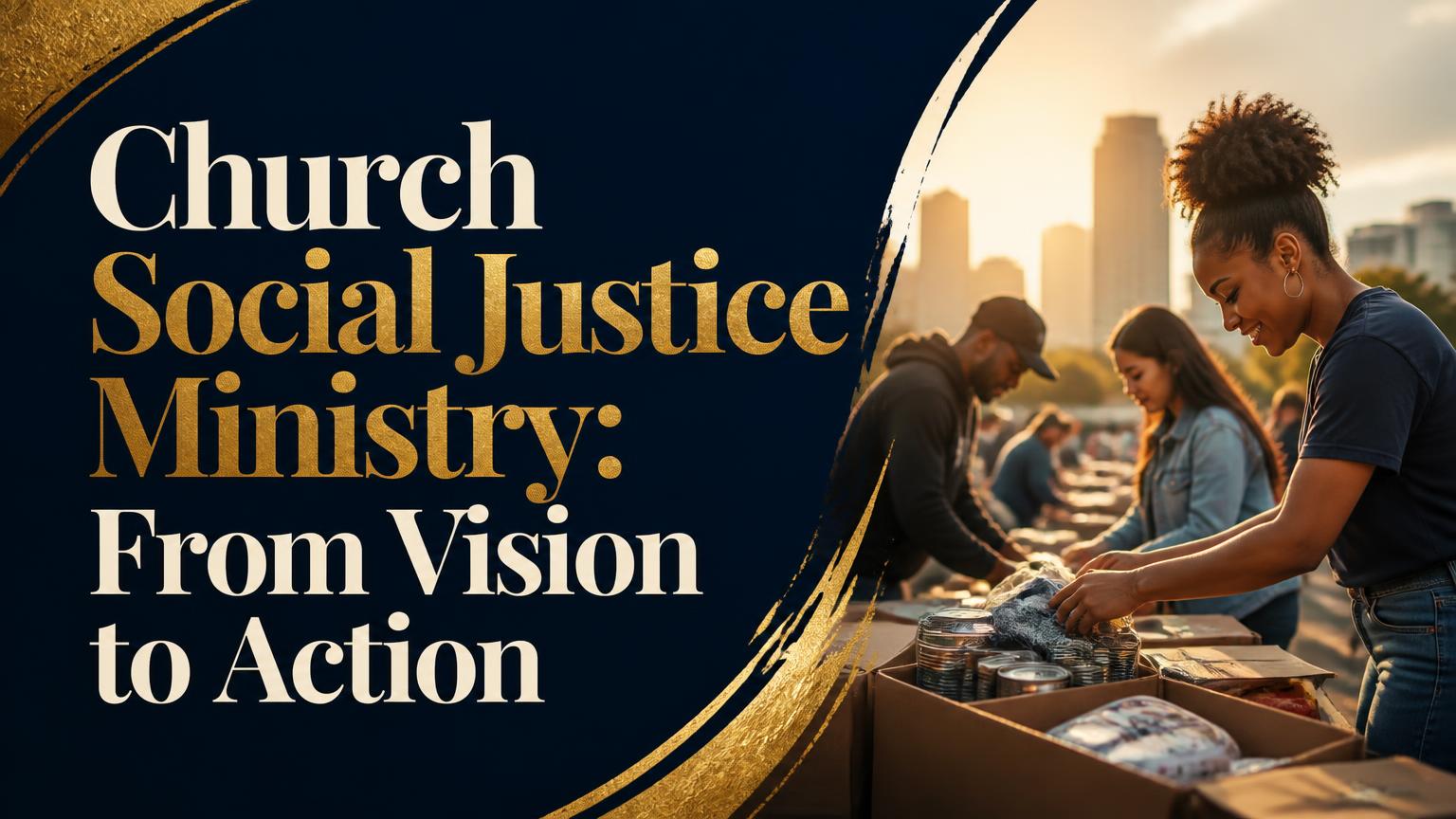
A church social justice ministry organizes a congregation’s biblical concern for justice into sustained, practical action. It may address poverty, racism, housing insecurity, immigration, human trafficking, disability access, unequal treatment, or other conditions that harm human dignity. Effective ministry joins compassion with wise action: it serves people facing immediate need, examines the causes of that need, partners with affected communities, and advocates for fairer practices without reducing Christian faith to political activism. The goal is faithful love of neighbor expressed through both personal service and responsible public witness.
Church Social Justice Ministry: Meaning, Purpose, and Practice
What Church Social Justice Ministry Seeks to Do
A church social justice ministry helps a congregation respond to injustice through service, education, relationship-building, advocacy, and discipleship. Its work may include operating a food pantry, supporting formerly incarcerated people, assisting refugees, mentoring young people, addressing domestic violence, advocating for affordable housing, or challenging discriminatory practices in local institutions.
The ministry is broader than a single program. It gives the church a framework for asking why people are suffering, who is most affected, what resources already exist, and what faithful action would address both immediate needs and contributing conditions. A meal program may relieve hunger today; job training, fair employment advocacy, and support for families may reduce the conditions that repeatedly produce hunger.
Biblical Justice Includes Mercy, Dignity, and Accountability
Biblical justice is grounded in the character of God and expressed through right relationships with God and neighbor. Micah 6:8 joins justice with mercy and humble fellowship with God, while Isaiah 1:17 calls God’s people to seek justice, correct oppression, defend the vulnerable, and plead the case of the widow. These passages show that justice is not merely an abstract political principle. It involves concrete responsibilities toward people who can be ignored, exploited, or denied a fair hearing.
Jesus’ ministry also connected good news with restoration for the poor, oppressed, and excluded, as seen in Luke 4:18–19. Matthew 25:31–46 emphasizes practical care for people in need, and James 2:1–9 condemns favoritism toward the wealthy. Together, these texts challenge churches to treat every person as bearing God-given dignity. They also require humility: Christian justice ministries should examine the church’s own habits, use power responsibly, and remain accountable when their actions unintentionally cause harm.
How It Differs From Charity, Evangelism, and Partisan Politics
Charity often provides direct relief: food, clothing, shelter, financial assistance, or emergency support. Social justice ministry includes that work but also asks whether systems, policies, cultural practices, or institutional decisions are creating predictable and unequal burdens. Charity and justice are therefore not competitors. Immediate assistance protects people in crisis, while justice seeks conditions in which fewer people are placed in crisis.
Social justice ministry also differs from evangelism without being opposed to it. Christian service should not make aid conditional on conversion, attendance, or agreement. The church can proclaim the gospel and serve neighbors with integrity while respecting their freedom and dignity. At the same time, a congregation’s public witness should not become a disguised campaign for a political party. Members may reach different conclusions about policy while sharing biblical commitments to truth, compassion, fairness, and protection of the vulnerable.
Common Areas of Church Social Justice Ministry
A congregation should choose ministry areas based on prayerful discernment, local knowledge, available capacity, and relationships with people directly affected. Common areas include:
- Poverty and economic dignity: food access, emergency assistance, debt support, employment pathways, financial education, and fair-wage advocacy.
- Housing and homelessness: rental assistance, eviction prevention, transitional housing partnerships, and support for people leaving shelters or institutions.
- Racial reconciliation: honest education, relationship-building, institutional self-examination, and action against discriminatory treatment.
- Immigrant and refugee support: language assistance, transportation, legal-service referrals, employment support, and friendship without exploitation.
- Prison and reentry ministry: visitation, mentoring, family support, job preparation, and assistance with housing or identification documents.
- Protection of vulnerable people: domestic-violence response, human-trafficking prevention, child safeguarding, disability inclusion, and elder care.
The strongest ministries do not select issues merely because they are prominent in national debate. They listen locally, identify a specific problem, and commit to work that the congregation can sustain.
How to Build a Church Social Justice Ministry
Discern Local Needs With Community Partners
Begin by listening rather than announcing a solution. Congregational leaders can speak with residents, neighborhood groups, schools, social-service agencies, and people who have direct experience of the issue. Listening helps distinguish a genuine local need from an assumed one and prevents the church from duplicating services that another organization already provides effectively.
People affected by an injustice should have meaningful influence over the ministry’s design. They are not merely recipients of the church’s compassion; they possess knowledge, skills, and agency. A church might discover, for example, that families asking for food assistance primarily need reliable transportation, evening distribution hours, or help navigating benefits. Community partnership turns good intentions into more accurate and respectful action.
Define a Specific Mission and Scope
A ministry needs a clear statement of whom it serves, what problem it addresses, what actions it will take, and what it will not attempt. “Help the community” is too broad to guide decisions. “Provide weekly transportation and job-navigation support for adults recently released from the county jail” gives volunteers, partners, and leaders a workable direction.
Set realistic boundaries around money, volunteer time, professional expertise, confidentiality, and safety. A church should refer legal, medical, mental-health, and domestic-violence cases to qualified professionals rather than improvising. A narrow, reliable ministry usually serves people better than an ambitious program that cannot maintain consistent relationships or follow through on commitments.
Combine Direct Service, Formation, and Advocacy
A balanced ministry normally has three connected dimensions. Direct service meets immediate needs. Congregational formation teaches members to understand the issue, examine assumptions, and develop habits of mercy and justice. Advocacy addresses practices or decisions that contribute to the problem, whether through public education, meetings with decision-makers, institutional reform, or support for effective community campaigns.
The balance will vary by issue and tradition. Advocacy should be informed, truthful, and respectful; it should not exaggerate evidence or treat opponents as enemies. Formation also matters because volunteers may otherwise see service as occasional benevolence rather than a continuing expression of discipleship. Romans 12:9–21 describes love that is sincere, patient, generous, and willing to resist evil without surrendering to vengeance.
Establish Accountability and Measure Faithful Outcomes
Evaluation should examine more than the number of meals served or volunteers recruited. Useful questions include: Did the ministry reach the people it intended to serve? Did participants have genuine voice? Were referrals safe and effective? Did the work reduce barriers, strengthen relationships, or change an unfair practice? Were volunteers trained adequately, and did the congregation learn anything that should alter its priorities?
Quantitative measures can help, but they do not capture every important result. A person obtaining stable housing, reconnecting with family, or gaining confidence to advocate for themselves may represent significant progress even if the outcome is difficult to count. Regular review with community partners can reveal unintended effects and keep the ministry focused on dignity rather than institutional reputation.
Principles That Protect the Integrity of the Ministry
Keep the Gospel and Public Responsibility Together
Church social justice ministry should neither shrink the gospel to political preferences nor use spiritual language to avoid public responsibility. The gospel addresses reconciliation with God, transformed character, love of neighbor, and the treatment of people who are vulnerable or excluded. Those themes naturally have social consequences, although faithful Christians may disagree about the best policy response.
A congregation can state its theological commitments clearly while acknowledging political diversity within the church. It should distinguish biblical convictions from one party’s platform, avoid coercing members into partisan loyalty, and welcome careful moral reasoning. This approach allows the church to speak courageously about injustice without suggesting that every policy proposal has equal biblical authority.
Practice Partnership Rather Than Paternalism
Paternalism occurs when people with greater resources make decisions for others while assuming they know what is best. It can appear in well-intentioned ministries that speak about a neighborhood without listening to residents, publicize vulnerable people’s stories without consent, or treat recipients as projects rather than neighbors.
Partnership requires shared decision-making, informed consent, confidentiality, fair compensation where appropriate, and respect for local leadership. Churches should ask whether their presence increases community capacity or makes organizations dependent on volunteers who may leave. The biblical command to love one’s neighbor requires more than generosity; it requires attentiveness to the neighbor’s actual interests and voice.
Protect People Through Wise Safeguards
Justice work can expose participants and volunteers to serious risks. Ministries serving children, survivors of abuse, immigrants, people experiencing homelessness, or formerly incarcerated people need written safeguarding procedures, background checks where appropriate, transportation rules, confidentiality standards, referral protocols, and trained supervisors. Good motives do not eliminate the possibility of boundary violations or unintended harm.
Churches should also avoid promising services they cannot reliably provide. Consistency matters to people whose lives may already be marked by institutional disappointment. Clear expectations, responsible record-keeping, emergency procedures, and cooperation with qualified agencies make compassion more dependable and protect both the people served and the congregation.
A Practical Path From Vision to Action
A church can move from concern to responsible ministry through a sequence such as this:
- Pray and study Scripture. Identify the biblical convictions that shape the church’s concern, while resisting the temptation to use isolated verses as political slogans.
- Listen to the community. Learn from people directly affected and from organizations already working on the issue.
- Select one defined priority. Choose a need that fits the congregation’s relationships, competence, and sustainable capacity.
- Build a representative team. Include pastoral leadership, practical organizers, people with relevant expertise, and community voices.
- Create a written plan. State goals, responsibilities, budget, timeline, safeguards, partnerships, and methods of evaluation.
- Train volunteers. Cover cultural humility, confidentiality, boundaries, trauma awareness, mandated reporting where applicable, and referral practices.
- Begin with a pilot. A limited initial project allows the church to learn before expanding.
- Review and adapt. Invite honest feedback from participants and partners, then change the ministry when evidence shows that change is needed.
This process turns compassion into stewardship. It also recognizes that faithful ministry is measured by truthfulness, durability, and service to people—not simply by visibility or activity.
Conclusion
A church social justice ministry is a congregation’s organized response to God’s call to pursue justice, show mercy, and protect human dignity. It includes direct care, but it does not stop there; it also examines the conditions that produce repeated harm and equips believers to respond wisely. The most faithful ministries listen before acting, work with rather than over people, maintain clear safeguards, and distinguish Christian conviction from partisan control.
From vision to action, the central task is disciplined love. Churches serve well when they connect Scripture with local knowledge, compassion with accountability, and immediate relief with long-term change. Such ministry does not require solving every social problem. It requires recognizing a real need, accepting responsibility for a defined response, and remaining faithful to the people and communities the church has agreed to serve.