
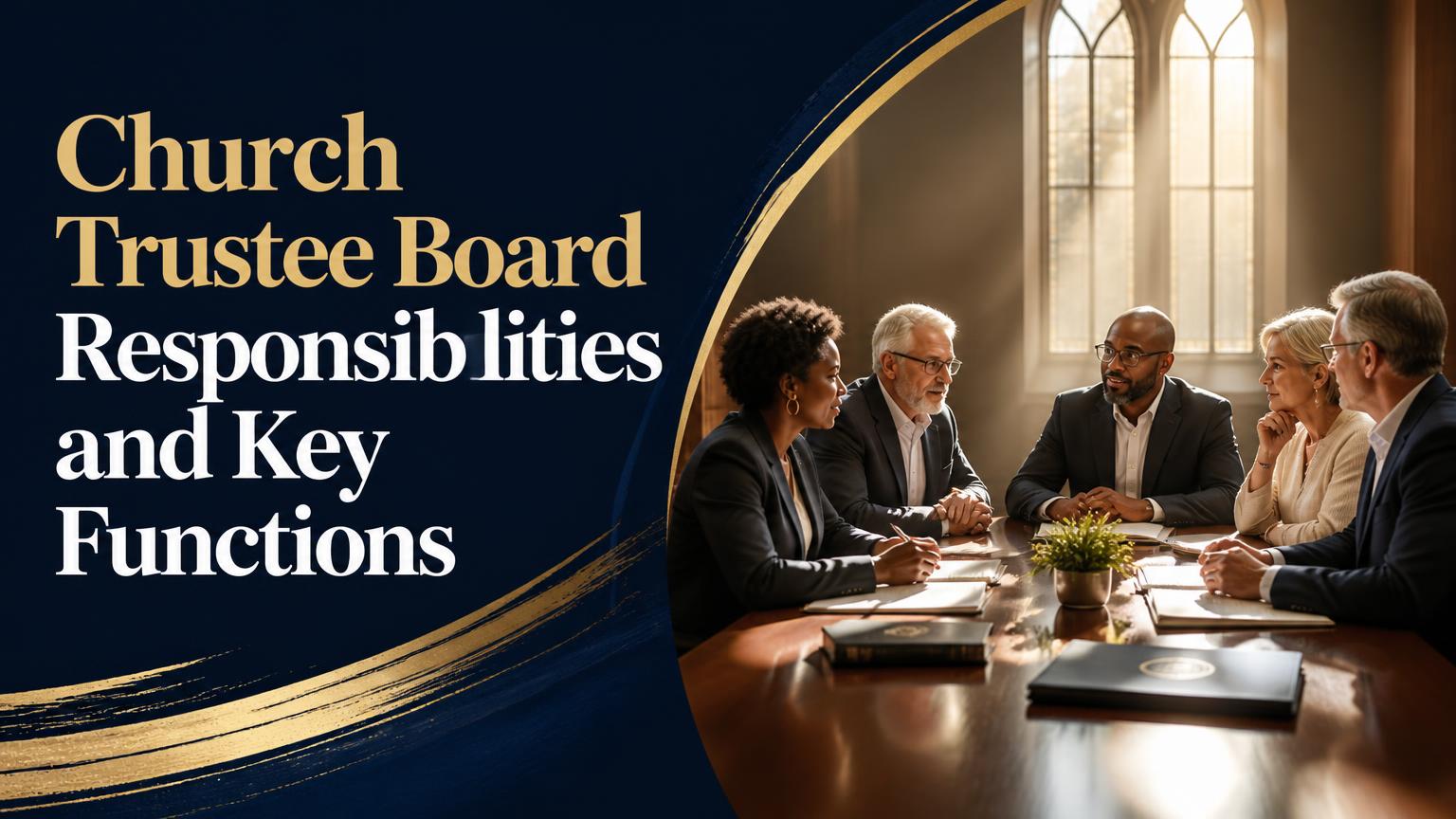
Church trustee boards serve as stewards of a congregation’s legal, financial, physical, and organizational interests. Their work usually includes protecting church property, overseeing finances, maintaining compliance, managing risk, supporting sound policies, and preserving accountability. The exact authority of trustees depends on the church’s bylaws, denomination, governing documents, and local law. A trustee board should therefore support the church’s mission without assuming responsibilities assigned to pastors, elders, deacons, or the congregation.
Church Trustee Board Responsibilities
A trustee board is generally responsible for safeguarding the resources and institutional integrity that allow a church to fulfill its spiritual mission. Trustees do not replace pastoral leadership or determine every ministry decision. Instead, they provide responsible oversight so that the church’s property, money, records, policies, and public obligations are handled faithfully and competently.
Protect Church Property and Legal Interests
One of the most recognizable church trustee board responsibilities is managing and protecting church property. This may include land, buildings, vehicles, equipment, financial accounts, intellectual property, and other assets owned or controlled by the congregation. Trustees may review deeds, leases, purchase agreements, construction contracts, insurance policies, and property-related obligations.
The board should know who has authority to sign contracts, borrow money, sell property, approve major improvements, or enter long-term commitments. In some legal structures, trustees hold property on behalf of the congregation; in others, the church corporation, denomination, or incorporated board holds title. Because these arrangements vary, trustees should follow the church’s governing documents and obtain qualified legal advice when a decision involves substantial property or legal risk.
Provide Financial Oversight and Accountability
Trustees commonly work with the treasurer, finance committee, or church administrator to ensure that financial resources are handled accurately and transparently. Their role may include reviewing budgets, monitoring cash flow, checking financial reports, overseeing bank relationships, approving major expenditures, and confirming that appropriate internal controls exist.
Good oversight does not require every trustee to perform bookkeeping. It does require the board to ask whether duties are separated appropriately, receipts and disbursements are documented, restricted gifts are used for their intended purposes, and financial reports are understandable. Regular review helps detect errors, conflicts of interest, misuse of funds, or financial commitments that the congregation cannot sustain.
Establish Sound Policies and Manage Risk
A trustee board helps the church operate through clear, consistent policies rather than informal arrangements that depend on one person’s memory. Policies may address purchasing, building use, financial authorization, employee supervision, records retention, data security, emergency response, and conflicts of interest.
Risk management is broader than purchasing insurance. Trustees should consider fire and severe-weather preparedness, child and vulnerable-person protection, workplace safety, accessibility, cybersecurity, background-check procedures, and compliance with applicable laws. The board does not need to eliminate every possible risk, which is impossible, but it should identify foreseeable risks and adopt reasonable safeguards.
Maintain Facilities and Support Safe Ministry
Church buildings communicate welcome, but they also create ongoing responsibilities. Trustees may coordinate maintenance, inspections, repairs, utilities, cleaning, accessibility improvements, security, and long-term capital planning. A board that waits until a roof, heating system, or electrical installation fails often forces the church into expensive emergency decisions.
Responsible facility stewardship connects physical maintenance with ministry priorities. For example, repairing unsafe stairs may protect people immediately, while replacing inefficient equipment may reduce future operating costs. Trustees should distinguish routine maintenance from capital projects and communicate clearly when a proposed improvement requires special fundraising, congregational approval, or borrowing.
Support Mission While Respecting Ministry Leadership
Trustees should connect administrative decisions with the church’s mission. A budget, building project, staffing decision, or property use policy affects worship, discipleship, outreach, pastoral care, and community service. The board therefore needs to understand the congregation’s priorities before recommending major commitments.
At the same time, trustees should not use administrative authority to control pastoral ministry unnecessarily. The pastor or elders may lead spiritual direction, preaching, shepherding, and ministry vision, while trustees handle delegated legal and operational responsibilities. Healthy cooperation prevents two opposite problems: trustees becoming a separate power center, or ministry leaders making financial and legal commitments without adequate oversight.
Preserve Records, Continuity, and Congregational Trust
Trustees often help preserve minutes, contracts, deeds, insurance documents, policies, financial approvals, personnel records, and other important information. Accurate records show what the church decided, who had authority, and why a major commitment was made. They also help future leaders avoid repeating mistakes or losing institutional knowledge when volunteers change.
Confidentiality matters, but secrecy does not. Trustees should protect sensitive information while giving the congregation the reports and explanations required by the bylaws and principles of accountability. Trust grows when decisions are documented, conflicts are disclosed, questions receive respectful answers, and leaders explain the difference between confidential matters and information that members have a legitimate right to review.
What Trustees Are—and Are Not
Church trustees are usually fiduciaries or stewards. That means they must act for the benefit of the church rather than for personal advantage. They should exercise reasonable care, follow the organization’s governing documents, disclose conflicts of interest, protect entrusted resources, and make decisions in good faith. Their authority is not unlimited; it comes from the congregation’s bylaws, articles of incorporation, denominational rules, board resolutions, and applicable law.
Trustees are not simply a maintenance crew, although facility care may be part of their work. They are also not owners of church property, personal financial controllers, or an independent authority over the pastor. A trustee may have a legal duty to challenge an unsafe or unauthorized decision, but disagreement should be handled through established procedures rather than personal rivalry. The board’s purpose is faithful stewardship and accountable governance, not status or control.
How Trustee Duties Relate to Other Church Leaders
The most effective churches clarify responsibilities before conflict occurs. Titles differ among denominations, but the following distinctions are common.
Trustees and Pastors
Pastors generally lead preaching, pastoral care, discipleship, worship, and the spiritual direction of the congregation, subject to the church’s polity. Trustees usually oversee legal, financial, property, and administrative matters assigned to them. These areas overlap because ministry decisions have financial and operational consequences.
A pastor should not be expected to manage every contract or building problem, and trustees should not make unilateral spiritual decisions simply because they control a budget. Regular communication allows both groups to consider mission, stewardship, and legal responsibility together.
Trustees and Elders
In churches governed by elders, elders may provide spiritual oversight, doctrinal guidance, discipline, and overall governance. Trustees may serve as a specialized body responsible for property and organizational stewardship. In other churches, elders and trustees may share governance or have overlapping responsibilities.
The governing documents should define who recommends, approves, supervises, and reports on major decisions. Without that clarity, the same issue may be treated as both a spiritual matter and a legal matter, with each group assuming the other has authority.
Trustees and Deacons
Deacons often lead practical service, benevolence, care ministries, hospitality, or congregational assistance. Trustees may provide the financial and policy structure that makes those ministries possible. For example, deacons may identify a need for benevolence while trustees help ensure that funds are budgeted, distributed consistently, and documented appropriately.
Neither role is inherently more spiritual than the other. The distinction concerns function, not importance. Romans 12:4–8 presents different forms of service as parts of one body, a principle that supports cooperation rather than competition among church offices.
Biblical Principles for Church Trustees
The Bible does not prescribe one modern trustee-board structure for every congregation. Churches use different forms of governance because legal systems, denominations, histories, and congregational practices differ. Scripture does, however, provide principles that should shape how trustees exercise authority and handle resources.
Stewardship Requires Faithfulness
First Corinthians 4:2 states that those entrusted with responsibility must be found faithful. For trustees, faithfulness includes accurate reporting, careful spending, honoring donor restrictions, maintaining property, and keeping promises made in the church’s name. Faithfulness is not measured only by large projects or visible sacrifice; it is often seen in consistent attention to details that protect others from avoidable harm.
Jesus’ teaching about responsible stewardship also connects trustworthiness in small matters with responsibility in larger ones (Luke 16:10–12). A board that treats routine approvals, receipts, maintenance records, and meeting minutes carelessly may eventually face serious consequences in larger decisions.
Authority Should Serve Rather Than Dominate
Jesus rejected leadership modeled on domination and taught his followers to lead through service (Mark 10:42–45). That principle applies to trustees. A board has authority, but its authority exists to protect the congregation and advance its mission, not to create personal influence for its members.
Servant leadership does not mean avoiding difficult decisions. Trustees may need to reject an unaffordable project, require financial controls, address unsafe conditions, or challenge an unauthorized commitment. The manner should remain truthful, respectful, and directed toward the church’s good rather than toward winning a personal dispute.
Accountability and Wisdom Belong Together
Proverbs repeatedly links wisdom with counsel, and the New Testament commends orderly, responsible conduct in the church. Trustees should therefore resist both careless independence and paralyzing bureaucracy. Important decisions benefit from appropriate consultation with pastoral leaders, finance personnel, legal or accounting professionals, and the congregation when approval is required.
Accountability also means recognizing limits. A trustee board should not pretend to understand specialized tax, construction, employment, or legal questions without qualified assistance. Seeking advice is not a failure of faith; it is often an expression of humility and prudent stewardship.
Practical Standards for an Effective Trustee Board
A board becomes reliable when responsibilities are translated into repeatable practices. The following standards can help a congregation evaluate whether its trustees are functioning well.
Use Written Duties and Delegated Authority
The church should maintain current bylaws, trustee policies, approval thresholds, role descriptions, and procedures for major decisions. These documents should explain which matters trustees may decide, which require pastoral or elder consultation, and which require congregational approval.
Written authority reduces confusion when leadership changes. It also prevents a board from assuming powers that were never delegated. Policies should be reviewed periodically because changes in law, property, technology, staffing, or denominational requirements may alter the church’s needs.
Meet on a Consistent Schedule
Trustees should meet often enough to review financial reports, maintenance needs, pending contracts, insurance, safety concerns, and upcoming decisions. Meetings should use an agenda, record motions and votes, identify assigned actions, and distinguish decisions from informal discussion.
A predictable meeting rhythm is more effective than gathering only during emergencies. The board should also provide appropriate reports to the congregation and maintain a clear process for members to raise concerns without bypassing every established channel.
Practice Conflicts of Interest and Succession Planning
Trustees should disclose relationships or financial interests that could affect their judgment. A person who may personally benefit from a contract should not control its approval. Recusal, competitive bids, and documented comparisons can protect both the church and the individual from suspicion.
The board should also prepare for turnover. Training new trustees, preserving records, reviewing key contracts, and maintaining a calendar of renewals and inspections prevent essential knowledge from disappearing when a long-serving volunteer steps down.
Conclusion
Church trustee board responsibilities center on faithful stewardship of the congregation’s property, finances, legal obligations, policies, facilities, and institutional trust. Trustees serve best when they protect resources without treating them as personal authority, support pastors and other ministry leaders without taking over their roles, and make decisions through documented, accountable processes. Because trustee powers differ among churches, every board should begin with its governing documents and applicable law, then apply biblical principles of faithfulness, service, wisdom, and accountability to the practical work of governing well.