
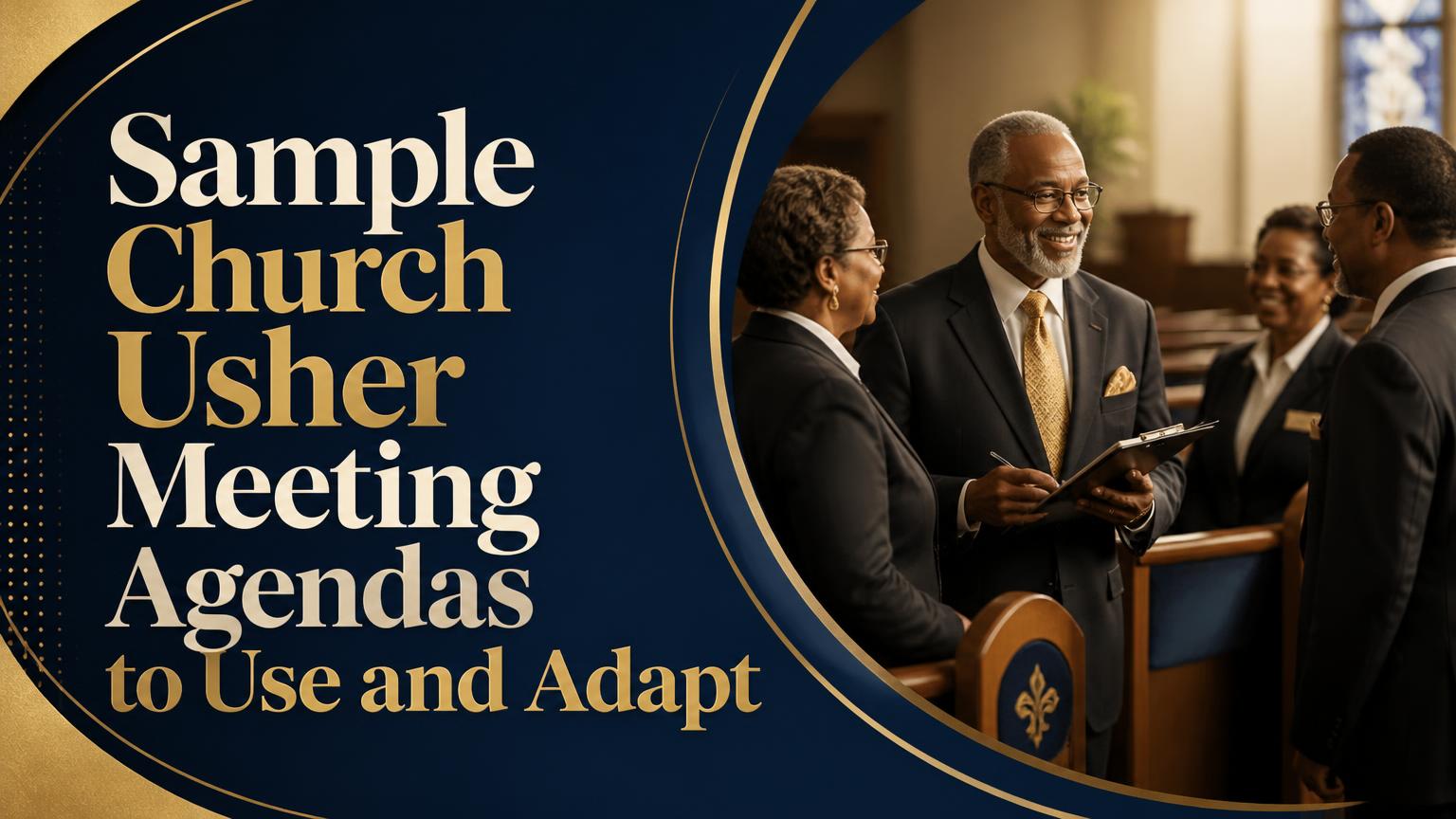
A church usher meeting agenda turns a general team gathering into a focused ministry meeting. It helps ushers prepare for worship services, coordinate responsibilities, review problems constructively, and care for worshipers with consistency and dignity. An effective agenda should address both the spiritual purpose of ushering and practical matters such as seating, offerings, accessibility, emergencies, supplies, and service assignments. The sample agendas below provide adaptable formats for weekly meetings, pre-service huddles, monthly training, and special events.
Church Usher Meeting Agenda: A Ready-to-Use 60-Minute Format
This agenda works well for a weekly or monthly team meeting. Adjust the timing according to the size of the congregation, the number of services, and the responsibilities assigned to ushers in your church. The leader should distribute assignments and any relevant service information before the meeting whenever possible.
Opening Prayer and Ministry Focus — 5 Minutes
Begin with prayer and a brief reminder that ushering is a ministry of welcome, order, attentiveness, and service. Ushers are often among the first people visitors encounter and may assist worshipers during moments of confusion, distress, or practical need. The meeting leader can briefly connect the team’s duties with the church’s larger mission without turning the opening into a long sermon.
This time may also include a short Scripture reading, a prayer for the congregation, or a reminder about confidentiality and kindness. The goal is to establish a servant-minded tone before discussing schedules and procedures.
Review of the Previous Service — 10 Minutes
Discuss what happened during the last service while details are still fresh. Review arrival flow, seating, late arrivals, offering collection, communion procedures, visitor questions, accessibility needs, and any unusual incidents. Focus on observable facts and workable improvements rather than assigning blame.
For example, instead of saying that “the entrance was disorganized,” identify the specific issue: two ushers were assigned to the same door while another entrance had no coverage. Record the solution, such as revising the station chart or appointing a floor captain to monitor coverage.
Upcoming Service Logistics — 15 Minutes
Review everything that could affect the next service. This may include the worship order, expected attendance, guest speakers, baptisms, communion, child dedications, special seating, multiple services, weather conditions, or changes to the building layout.
Confirm when doors open, where bulletins or other materials will be placed, which entrances will be staffed, and how ushers should respond during transitions. If the service includes an offering or other congregational movement, clarify the exact procedure. Clear information prevents ushers from making inconsistent decisions during worship.
Guest Care and Seating Plan — 10 Minutes
Explain how the team will welcome visitors and assist people in finding suitable seating. Discuss reserved sections, overflow areas, wheelchair-accessible locations, seating for families, and procedures for helping late arrivals enter with minimal disruption.
Ushering overlaps with greeting, but the roles are not identical. Greeters generally focus on personal welcome and initial orientation, while ushers often manage seating, service materials, movement, and practical assistance inside the worship space. Churches may combine these roles, but the agenda should make responsibilities clear so visitors are not passed from person to person without help.
Safety, Emergencies, and Accessibility — 10 Minutes
Review the location of exits, first-aid supplies, fire extinguishers, emergency contact procedures, and any building-specific instructions. Ushers should know whom to contact if someone becomes ill, a child is separated from a parent, a disruptive situation develops, or severe weather affects the service.
Safety procedures should emphasize calm communication and appropriate escalation. Ushers should not attempt medical treatment beyond their training, physically confront people, or improvise policies that conflict with the church’s approved procedures. Discuss accessibility as well: keep aisles clear, avoid blocking ramps, make reasonable seating accommodations, and ask people what assistance they prefer rather than assuming.
Assignments, Questions, and Closing Prayer — 10 Minutes
End by confirming each person’s assignment, arrival time, dress expectations, equipment needs, and backup coverage. Assign specific stations or duties rather than simply telling the team to “help where needed.” A written roster might identify entrance ushers, sanctuary ushers, offering teams, accessibility support, parking assistance, and the service captain.
Leave time for questions and repeat any decisions that affect the whole team. Record unresolved issues with a responsible person and a deadline. Close in prayer, especially when the meeting has addressed difficult incidents or sensitive pastoral concerns.
Short Church Usher Meeting Agendas for Different Situations
A full meeting is not necessary before every service. Shorter formats work well when the team already understands its general duties and only needs current information. The key is to preserve the items that affect safety, coverage, and the worshiper experience.
A 15-Minute Pre-Service Huddle
Use this format shortly before the doors open:
- 2 minutes: Prayer and ministry focus
- 3 minutes: Service changes or special events
- 4 minutes: Station assignments and seating information
- 3 minutes: Safety, accessibility, and emergency reminders
- 3 minutes: Questions, supply check, and final confirmation
This huddle should not become a substitute for regular training. Its purpose is immediate coordination. The leader should mention only information that affects that day’s service, such as a visiting congregation, a baptism, reserved seating, unusual weather, or a change in the offering procedure.
A 30-Minute Weekly Team Meeting
A weekly meeting can include five minutes of prayer, ten minutes reviewing the previous service, ten minutes preparing for the next service, and five minutes confirming assignments. This format is appropriate for teams that serve frequently and need regular communication without a lengthy administrative meeting.
Use the review portion to identify one or two improvements rather than discussing every minor detail. If a problem requires policy discussion or extensive training, place it on the agenda for a monthly meeting instead of allowing the weekly meeting to lose focus.
A 60-Minute Monthly Training Meeting
A monthly meeting can combine operational planning with skill development. After reviewing recent services and upcoming events, devote fifteen or twenty minutes to one training topic, such as welcoming visitors, assisting people with disabilities, handling disruptive behavior, responding to medical concerns, managing offerings, or communicating by radio.
Training should be practical and specific. A short role-play can help ushers practice assisting a late arrival or responding when a visitor cannot find an accessible seat. End by documenting any policy questions that require pastoral or administrative clarification.
A Special Event or Holiday Meeting
Christmas services, Easter services, funerals, conferences, concerts, weddings, and community events often require a separate agenda. Review expected attendance, parking and entrances, crowd flow, reserved seating, overflow rooms, restrooms, children’s areas, accessibility, security, and the location of event-specific supplies.
Assign a clearly identified team captain and establish how ushers will communicate during the event. Special services often include people unfamiliar with the building, so the team may need more entrance coverage and clearer directions than a normal Sunday service requires. The agenda should address the event’s actual risks rather than simply repeat the regular weekly plan.
What the Written Agenda Should Contain
A useful written agenda should identify the meeting date, start and end time, leader, location, purpose, and expected participants. It should also include the upcoming service date and any known changes. A simple assignment section can list each usher’s station, arrival time, backup person, and contact method. If the church uses multiple services, distinguish assignments for each service clearly.
Leave space for decisions, action items, responsible people, and deadlines. For example, “Purchase additional aisle signs — facilities coordinator — before next Sunday” is more useful than “Discuss signage.” Keep confidential pastoral or medical information out of a widely distributed agenda. Sensitive matters should be handled privately by the appropriate ministry leader.
The agenda should be detailed enough to guide the meeting but brief enough to use in real time. A one-page document is often sufficient for routine meetings. Attach a building map, seating chart, emergency procedure, or service order when those materials are necessary for the assignment.
Meeting Practices That Improve Usher Ministry
Effective meetings distinguish between training, planning, evaluation, and pastoral care. Planning answers what will happen at the next service. Training develops ability over time. Evaluation identifies what should change. Pastoral care addresses the people and situations behind difficult incidents. Combining these purposes carelessly can make the meeting either too vague or unnecessarily long.
Use specific observations, invite input from ushers who served in different locations, and address problems without humiliating individuals. A team member may notice a blocked exit, a recurring accessibility barrier, or a confusing late-seating practice that leaders have overlooked. Listening carefully improves both procedures and morale.
Every significant decision should have an owner. If the team identifies a need for new signage, revised seating charts, additional training, or a building repair, record who will follow up and when. Review unfinished action items at the next meeting. This simple practice prevents the same concern from appearing repeatedly without resolution.
Conclusion
The best church usher meeting agenda prepares people to serve rather than merely filling time with announcements. It gives the team a shared understanding of the upcoming service, assigns responsibilities clearly, reviews previous experience constructively, and addresses safety and accessibility before problems arise. A 60-minute meeting may be appropriate for planning and training, while a 15-minute huddle may be enough for final coordination before worship begins.
The agenda should always reflect the church’s actual ministry, building, policies, and congregation. Keep the format consistent enough that ushers know what to expect, but adapt the discussion for ordinary services, special events, and changing needs. When preparation is clear and service remains grounded in hospitality, ushers can help create a worship environment that is orderly, welcoming, and attentive to people.