
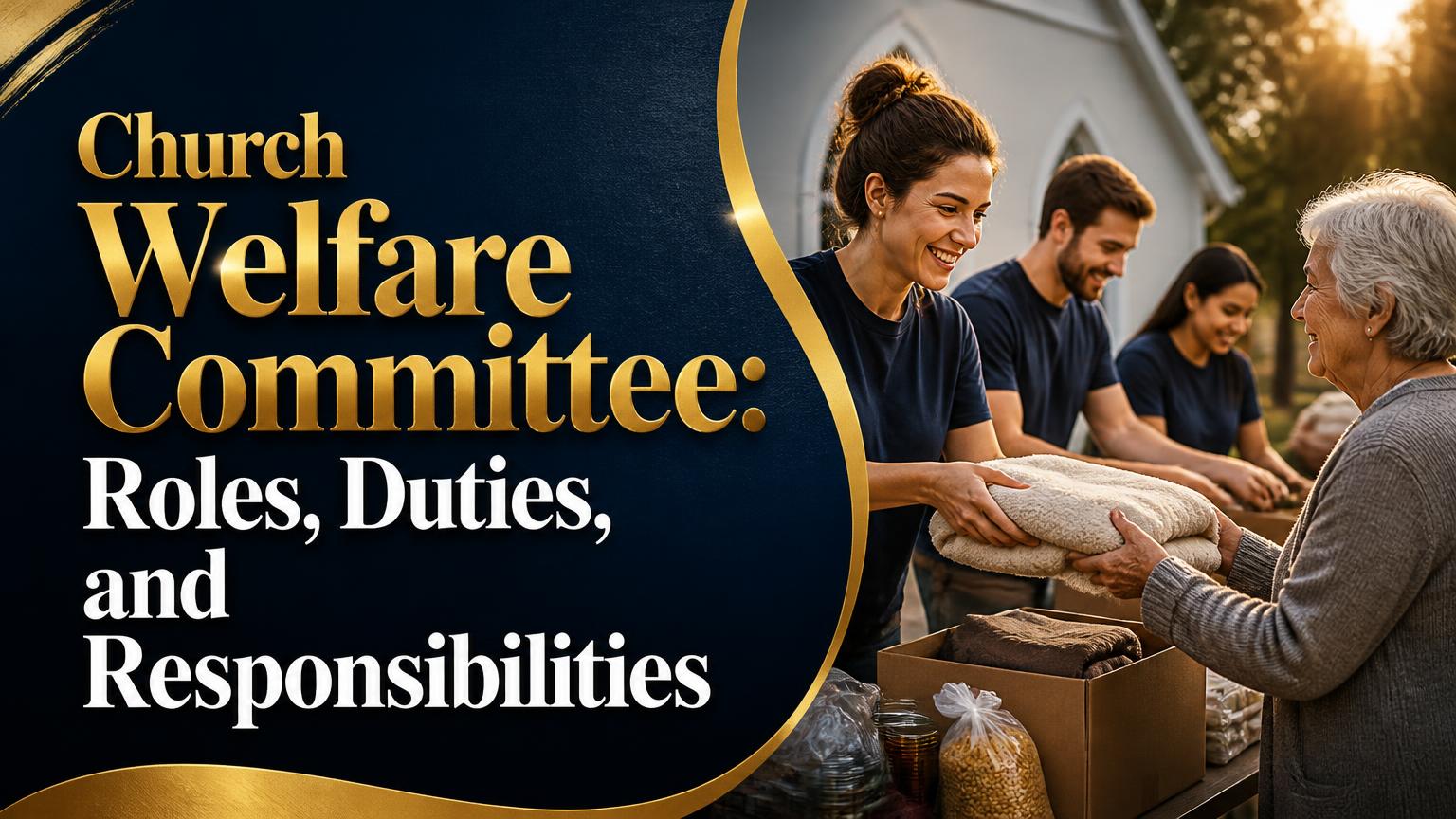
A church welfare committee organizes the congregation’s practical response to people facing hardship. Depending on the denomination and local church structure, it may help with food, housing, medical needs, emergency expenses, visitation, counseling referrals, and support for members experiencing crisis. Its purpose is more than distributing money: the committee seeks to protect dignity, apply church resources wisely, coordinate care, and connect people with lasting help. Because responsibilities differ among churches, a written policy should clarify its authority, membership, funding, confidentiality standards, and relationship to pastors, deacons, trustees, and other ministry teams.
Church Welfare Committee: Roles, Duties, and Responsibilities
What a Church Welfare Committee Is and Why It Exists
A church welfare committee is a ministry team entrusted with responding to legitimate physical, emotional, social, and financial needs within the church and, in some congregations, the wider community. It may operate under the church council, board, deacons, pastoral leadership, or a benevolence ministry. The committee does not replace pastoral care, professional social services, or government assistance; it coordinates the church’s contribution to holistic care.
Its central aim is to provide appropriate help without creating dependency, favoritism, confusion, or misuse of church funds. A sound committee asks both, “What help is needed now?” and “What support or plan could improve this person’s situation over time?” That may mean emergency food today, a referral to a housing agency, transportation to medical treatment, budgeting support, or ongoing pastoral and relational care.
The committee’s exact authority should be approved by the congregation or governing body. Some committees can authorize assistance within a set budget, while others can only investigate needs and make recommendations. This distinction prevents volunteers from making commitments the church has not authorized.
Core Roles and Team Structure
An effective committee normally includes several people with complementary responsibilities rather than relying on one benevolent individual. A chairperson coordinates meetings, assigns cases, communicates with church leadership, and ensures that decisions follow the church’s policies. A secretary or administrator maintains secure records, tracks assistance, prepares agendas, and documents decisions without recording unnecessary personal details.
A treasurer or finance representative verifies available funds, processes payments, and reports expenditures in a form that protects recipients’ privacy. Pastoral representatives provide spiritual discernment and help identify needs, while social-service, medical, counseling, or community-outreach experience can improve referrals and case assessment. In smaller churches, one person may hold several roles, but financial authorization and case decisions should not depend entirely on one individual.
Committee members should understand the difference between compassion and informal decision-making. They are not investigators seeking to shame applicants, nor are they personal patrons distributing their own money. They are stewards of congregational resources who serve people fairly under agreed principles.
Duties in Assessing and Responding to Needs
The committee’s practical duties usually begin when a request is received from a member, pastor, ministry leader, or community contact. Members gather only the information necessary to understand the situation: the immediate need, the amount or type of assistance requested, whether the crisis is temporary or ongoing, what resources have already been tried, and whether there are safety concerns.
Assistance may include:
- Emergency food, clothing, utilities, rent, or transportation
- Support for medical, funeral, or essential household expenses
- Visits and practical care for older adults, people with disabilities, or those who are hospitalized
- Assistance for families facing unemployment, bereavement, domestic crisis, or displacement
- Referrals to counseling, shelters, food banks, legal aid, employment services, or healthcare providers
- Short-term support plans that combine financial assistance with budgeting, job-search, or pastoral follow-up
The response should match the need. A one-time payment may be appropriate for an unexpected crisis, while recurring requests may require a broader plan and outside referral. The committee should not promise that the church can meet every need. It should communicate decisions clearly, explain any limits respectfully, and identify alternatives when assistance cannot be approved.
Responsibilities for Confidentiality, Dignity, and Stewardship
Confidentiality is a central responsibility. Information about a person’s income, health, family conflict, immigration status, or debt should be shared only with people who need it to make or implement a decision. Public prayer requests, committee reports, and congregational announcements should never reveal private details without informed permission.
Dignity also affects the method of assistance. Paying a landlord, utility company, pharmacy, or service provider directly may be wiser than giving cash when the stated need is a specific bill. In other situations, direct assistance may be appropriate. The method should be based on the circumstances and policy, not suspicion or an assumption that every recipient is untrustworthy.
Stewardship requires accurate records, separation of duties, spending limits, periodic review, and transparent financial reporting. The church can report totals and categories of aid without identifying recipients. A welfare committee should also follow safeguarding procedures when children, vulnerable adults, domestic abuse, exploitation, or threats of self-harm are involved. Compassion never requires volunteers to manage dangerous situations alone.
How Requests Should Be Reviewed and Followed Up
A simple, consistent process makes welfare decisions more equitable. First, the committee receives the request and records the date, type of need, urgency, and referral source. Second, an authorized member conducts a respectful assessment. Third, the committee determines whether the request fits its policy, budget, and mission. Fourth, it approves, modifies, delays, or declines the request and records the reason in a secure system.
Urgent safety matters should be escalated immediately to pastoral leaders, emergency services, safeguarding officers, or qualified professionals as appropriate. Financial requests should not be delayed by unnecessary meetings when essential food, medication, shelter, or safety is at risk, provided that emergency authority has been defined in advance.
Follow-up is more than checking whether a payment was made. It may involve asking whether the immediate crisis has stabilized, whether a referral was useful, and whether further support is needed. Follow-up should be supportive rather than intrusive. The committee should close cases when its role has ended while retaining only the records required by church policy and applicable law.
Biblical Foundations for Church Welfare Ministry
The New Testament presents practical care for people in need as part of faithful Christian community life. In Acts 6:1–6, the early church organized the distribution of food to widows and appointed trusted people to oversee the work. The passage illustrates two principles relevant to a welfare committee: vulnerable people should not be neglected, and organized administration can protect fairness while allowing spiritual leaders to fulfill their own responsibilities.
Other passages add necessary balance. Galatians 6:2 calls believers to bear one another’s burdens, while Galatians 6:5 recognizes personal responsibility. James 2:15–16 warns against offering religious words without practical help when someone lacks basic necessities. First Timothy 5 describes particular responsibilities toward widows and emphasizes family care where appropriate. Together, these teachings support generosity that is compassionate, discerning, relational, and orderly.
The Bible does not prescribe one universal “welfare committee” structure. Therefore, churches should avoid presenting a local administrative arrangement as though it were a required biblical office. The enduring principles are care for the vulnerable, impartiality, wise stewardship, personal responsibility, honest work where possible, and protection from neglect or exploitation.
How to Establish an Effective Church Welfare Committee
A church should begin with a written mandate approved by its governing body. The mandate can define the committee’s purpose, eligible forms of assistance, geographic scope, spending authority, emergency procedures, meeting schedule, reporting requirements, and relationship to other ministries. It should also state whether the committee serves only church members or also responds to community needs.
Policies should include objective criteria without treating hardship as a mechanical test. Relevant considerations may include urgency, available resources, household circumstances, previous assistance, safety, and whether another agency is better equipped to help. Criteria should guide judgment rather than encourage humiliating interrogations or automatic rejection of unfamiliar applicants.
Training is equally important. Members should learn basic confidentiality, fraud prevention, safeguarding, trauma-aware communication, referral practices, and financial controls. Churches should maintain a current directory of community resources instead of expecting volunteers to solve complex housing, medical, legal, or mental-health problems themselves. Partnerships extend the church’s ability to help while respecting professional boundaries.
Common Challenges and Wise Boundaries
A committee may encounter repeated requests, incomplete information, family conflicts, substance misuse, domestic abuse, manipulation, or needs beyond the church’s capacity. These situations require neither automatic suspicion nor indiscriminate generosity. Members should verify information proportionately, consult the approved policy, use more than one decision-maker, and seek qualified advice when the matter involves legal, medical, financial, or safeguarding risk.
The committee should also avoid favoritism. Friends of leaders, long-standing members, visitors, and people with little connection to the congregation should be treated according to the same principles, even though the type of help may differ. Assistance should never be used to pressure people into church attendance, religious agreement, personal loyalty, or disclosure of unnecessary information.
Another boundary concerns ongoing dependence. Repeated short-term aid can relieve immediate suffering while leaving the underlying problem untouched. Where appropriate, the committee can combine limited financial help with budgeting assistance, employment referrals, family support, counseling, or public and nonprofit resources. That approach preserves compassion while recognizing that the church cannot become a substitute for every social-service system.
Conclusion
A church welfare committee is a structured expression of Christian care. Its responsibilities commonly include identifying needs, assessing requests, arranging practical assistance, protecting confidentiality, managing funds, making referrals, and following up with people in crisis. The committee serves best when it combines mercy with fairness, generosity with accountability, and immediate relief with attention to longer-term wellbeing.
Because churches differ in size, denomination, and governance, no single model applies everywhere. The strongest committee works within a clear mandate, uses consistent procedures, protects vulnerable people, and respects the roles of pastors, deacons, trustees, professionals, families, and community agencies. Its success is measured not simply by money distributed, but by whether people receive wise, dignified, and appropriate care.