
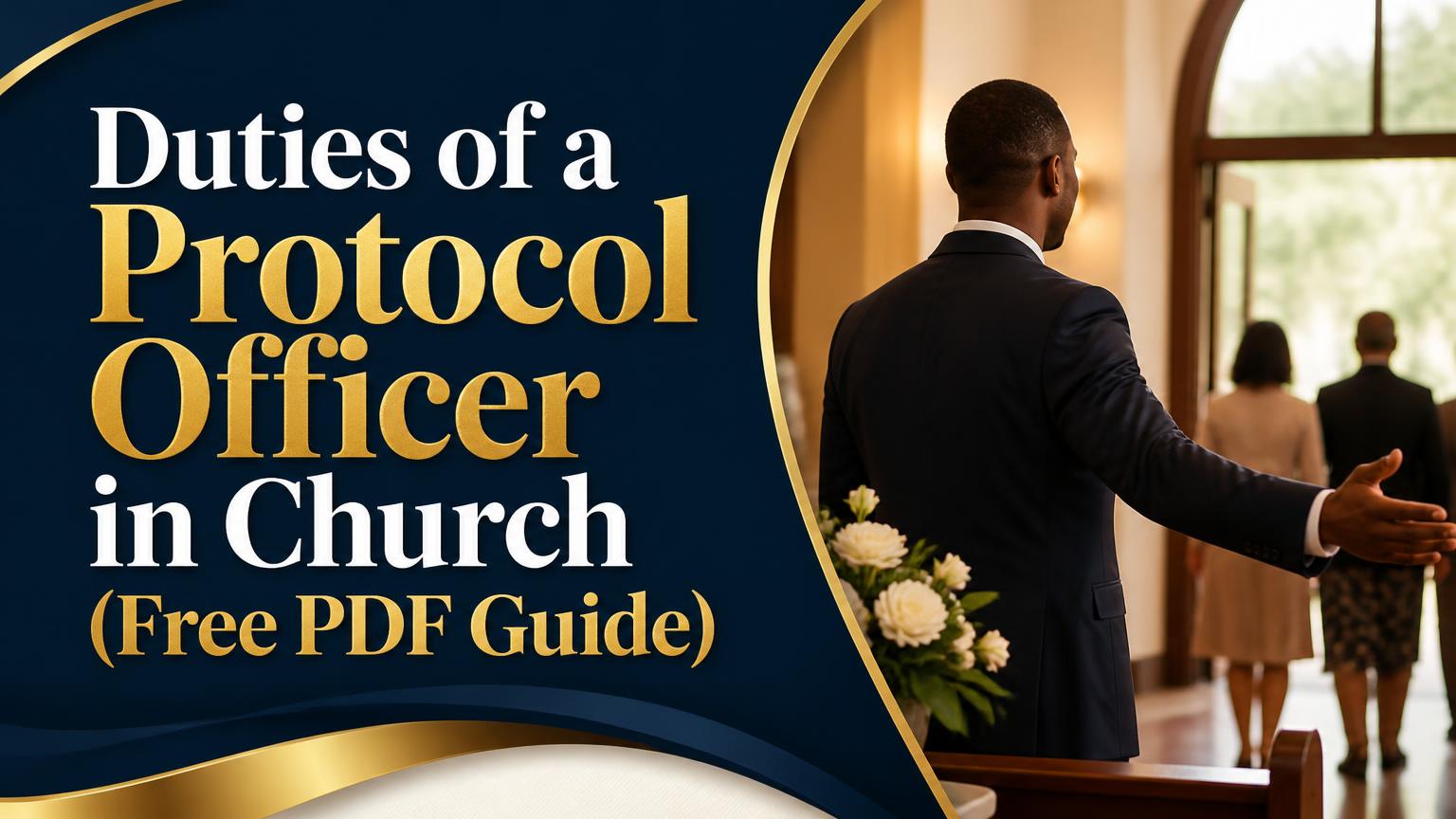
People searching for a Duties of a Protocol Officer in Church PDF usually need more than a short list of responsibilities. They need a clear role description that explains how the officer serves church leadership, welcomes ministers and special guests, protects the order of services, coordinates formal events, and communicates expectations to volunteers. The guide below provides a practical, PDF-ready explanation of the position, including its responsibilities, boundaries, required skills, and a sample job description for a church handbook.
Duties of a Protocol Officer in Church PDF
A church protocol officer coordinates people, procedures, timing, hospitality, and formal arrangements so that services and special events proceed respectfully and efficiently. The role is especially important when a church hosts visiting pastors, government officials, denominational leaders, musicians, guest speakers, or large public gatherings.
Protocol work is not about creating unnecessary ceremony. It is about removing confusion. The officer helps each participant understand where to go, what to do, when to arrive, and whom to contact. Exact responsibilities vary by church size and tradition, so the protocol officer should work under the authority of the pastor, church administrator, or event director.
What the Role Means
A protocol officer is responsible for the organized treatment of people and the orderly conduct of formal church occasions. This may include arranging seating, coordinating entrances and exits, receiving guests, preparing schedules, communicating instructions, and ensuring that people are treated with courtesy and dignity.
The officer often becomes the connection point between church leadership, ushers, worship teams, transport workers, hospitality volunteers, media personnel, security teams, and invited guests. The officer does not usually make independent decisions about worship content or doctrine. Instead, the officer implements approved plans and identifies problems before they disrupt the service.
A useful guiding principle is found in 1 Corinthians 14:40: “Let all things be done decently and in order.” In practice, that means combining organization with humility. Protocol should support worship and ministry rather than draw attention to the officer.
Responsibilities Before a Service or Event
Most protocol work happens before the congregation or guests arrive. Preparation may include:
- Confirming the date, time, venue, dress expectations, and program
- Reviewing the order of service or event schedule
- Preparing seating plans for pastors, speakers, dignitaries, choir members, and participants
- Confirming names, titles, pronunciations, and preferred forms of address
- Communicating arrival times, parking instructions, entrances, holding areas, and departure arrangements
- Coordinating transportation, accommodation, meals, gifts, or honoraria when assigned
- Briefing ushers, greeters, escorts, and other volunteers
- Inspecting the platform, reserved seats, reception area, restrooms, and access routes
- Checking accessibility arrangements for older adults and people with disabilities
- Confirming emergency contacts and procedures with the appropriate team
The officer should prepare a written schedule rather than relying on memory. A simple event brief can list every key person, their arrival time, their role, their point of contact, and any special requirements. This reduces last-minute calls and prevents contradictory instructions.
The officer should also identify likely pressure points. For example, a guest speaker may need a quiet preparation area, a visiting choir may require a separate entrance, or several dignitaries may arrive at the same time. Anticipating these situations is more effective than trying to solve them after the service has begun.
Responsibilities During the Service or Event
During the program, the protocol officer monitors timing, movement, communication, hospitality, and compliance with the approved plan. The officer may receive guests at the entrance, escort them to a waiting area, introduce them to the appropriate leader, and ensure that they are seated at the right time.
Other responsibilities can include coordinating processions, signaling participants when they should move, managing reserved seating, communicating schedule changes, and helping the master of ceremonies or service leader respond to unexpected developments. In a large event, the officer may use radios, messaging groups, written cue sheets, or designated runners.
Good protocol is discreet. The officer should solve problems quietly whenever possible rather than interrupting worship or publicly correcting volunteers. If a schedule must change, the officer should communicate through the proper channel and avoid giving multiple teams conflicting instructions.
The officer must also balance formal arrangements with pastoral sensitivity. A guest may need assistance because of age, illness, language, disability, or unfamiliarity with the church. A reserved seat should never become a reason to embarrass a member or visitor. Respectful explanation and calm alternatives are usually better than public confrontation.
Responsibilities After the Service or Event
Protocol duties continue after the final prayer or closing announcement. The officer may escort guests to transportation, confirm that speakers have received their belongings, supervise departure arrangements, and ensure that no participant is left without assistance.
A short debrief can identify what worked, what caused delays, and what should change next time. The officer may record updated contact details, seating plans, supplier information, volunteer assignments, and guest preferences for future events. Confidential details should be stored securely and shared only with people who need them.
Follow-up also includes thanking guests and volunteers when that responsibility has been assigned. A prompt message, formal letter, or personal acknowledgment helps preserve relationships. The officer should report significant incidents, complaints, safety concerns, or deviations from the approved plan to the supervising leader rather than concealing them.
How the Role Differs From Related Ministries
A protocol officer may work closely with several ministries, but the responsibilities are not identical.
- Ushers welcome attendees, distribute materials, guide seating, assist with offerings, and help maintain order in the congregation.
- Greeters focus primarily on welcoming people and creating a friendly first impression.
- Event coordinators may manage the entire program, including budget, vendors, promotion, registration, and logistics.
- Security personnel address safety risks, access control, emergencies, and threats. A protocol officer may coordinate with security but should not act as a security professional without appropriate training.
- Pastoral leaders provide spiritual oversight and make decisions about worship, discipline, doctrine, and pastoral care.
In a small church, one person may perform several of these functions. Even then, the distinctions remain useful because they clarify accountability. The protocol officer coordinates order and hospitality; the pastor or designated leader retains authority over the church’s ministry decisions.
A Simple Workflow for Every Assignment
A reliable protocol workflow has six stages: receive the assignment, clarify the purpose, prepare the plan, brief the people involved, supervise the event, and complete the follow-up. At the beginning, the officer should ask who has authority, what outcome is expected, which guests require special attention, and what limitations affect the event.
Before the program begins, the officer should review the venue physically rather than depending only on a written schedule. During the event, the officer should remain available without becoming intrusive. Afterward, a brief written report can preserve useful information and create accountability. This process makes protocol repeatable instead of dependent on one person’s memory or personality.
Essential Skills, Boundaries, and Reporting Lines
A capable church protocol officer needs organization, communication, emotional maturity, discretion, punctuality, cultural awareness, and the ability to remain calm under pressure. The officer should be comfortable giving clear instructions without being rude and correcting mistakes without humiliating people. Listening is equally important because guests and volunteers often reveal practical problems that are not visible in the event plan.
The officer should normally report to the pastor, executive pastor, church administrator, protocol director, or event leader named in the church’s structure. The reporting line should be clear before an event begins. Without it, the officer may receive competing instructions from several leaders or assume authority that belongs to someone else.
Several boundaries protect both the church and the officer. Confidential information about guests, travel, security arrangements, health needs, or private conversations should not become public conversation. Protocol should not favor wealthy or influential people in ways that contradict the church’s values. James 2:1–4 warns against showing partiality based on status. Courtesy toward honored guests must exist alongside respect for ordinary members and visitors.
The officer should also know when to escalate a matter. Threats, medical emergencies, safeguarding concerns, financial disputes, serious complaints, and conflicts involving church leadership should be transferred to the appropriate authority. A protocol officer serves the church best by coordinating responsibly, not by attempting to control every situation personally.
PDF-Ready Church Protocol Officer Job Description
The following wording can be copied into a church policy manual, ministry handbook, volunteer guide, or event-planning document and saved as a PDF.
Position: Church Protocol Officer
Reports To: Pastor, Church Administrator, or Designated Event Leader
Purpose of the Position:
The Church Protocol Officer coordinates hospitality, order, communication, seating, movement, and formal arrangements for worship services, conferences, ceremonies, and special church events. The officer helps ensure that members, visitors, ministers, speakers, and invited guests are treated with respect and that approved programs operate smoothly.
Primary Duties:
- Prepare protocol plans, schedules, seating arrangements, guest lists, and event briefs.
- Confirm the names, titles, arrival times, responsibilities, and special needs of participants.
- Welcome and escort visiting ministers, speakers, dignitaries, and other assigned guests.
- Coordinate with ushers, greeters, worship leaders, transportation teams, hospitality workers, media teams, and security personnel.
- Organize entrances, processions, reserved seating, platform access, and departures when required.
- Communicate approved instructions clearly and promptly to volunteers and participants.
- Monitor timing and help resolve logistical problems discreetly.
- Support accessibility, safeguarding, privacy, and appropriate emergency procedures.
- Maintain accurate records of event arrangements and relevant contact information.
- Submit a brief report or debrief after significant services and events.
Expected Standards:
The officer should demonstrate integrity, punctuality, confidentiality, courtesy, fairness, spiritual maturity, cultural sensitivity, and respect for church leadership. The officer should not use the position to seek personal recognition, exercise unauthorized control, or give preferential treatment for private advantage.
Authority and Limits:
The officer may coordinate approved arrangements and direct assigned volunteers during an event. The officer should refer changes involving worship content, doctrine, finances, discipline, safety threats, or pastoral care to the appropriate church leader.
This description can be adapted to the size and tradition of the local church. A congregation that rarely hosts formal events may need only a part-time volunteer coordinator, while a large church or convention may require a protocol department with defined teams for hospitality, transport, seating, communications, and security liaison.
Practical Checklist for a Church Protocol Officer
Before an event, confirm the program, guest list, seating plan, contact persons, arrival instructions, dress expectations, accessibility needs, parking, refreshments, and emergency contacts. Walk through the venue and verify that reserved areas are labeled, pathways are clear, microphones and presentation materials are ready, and volunteers know their assignments.
During the event, remain reachable, observe the schedule, welcome guests, coordinate movements, and communicate changes through one authorized channel. Avoid unnecessary public correction and do not promise services or privileges that leadership has not approved.
Afterward, confirm that guests and participants depart safely, return borrowed items, record problems, thank volunteers, and submit any required report. A checklist is valuable because protocol failures often arise from small omissions rather than from a lack of goodwill.
Conclusion: Serving With Order and Honor
The duties of a protocol officer in church combine administration, hospitality, communication, event coordination, and servant leadership. The officer prepares people and spaces, guides formal movements, supports visiting guests, protects confidentiality, and helps services proceed without avoidable confusion. The position is not primarily about status or ceremony; it is about making it easier for leaders, volunteers, guests, and the congregation to participate well.
A strong protocol officer knows the limits of the role, follows the church’s chain of responsibility, treats people fairly, and handles pressure discreetly. The PDF-ready job description and checklists above can be adapted into a local church policy, volunteer handbook, or event manual and saved as a free PDF for training and future use.