
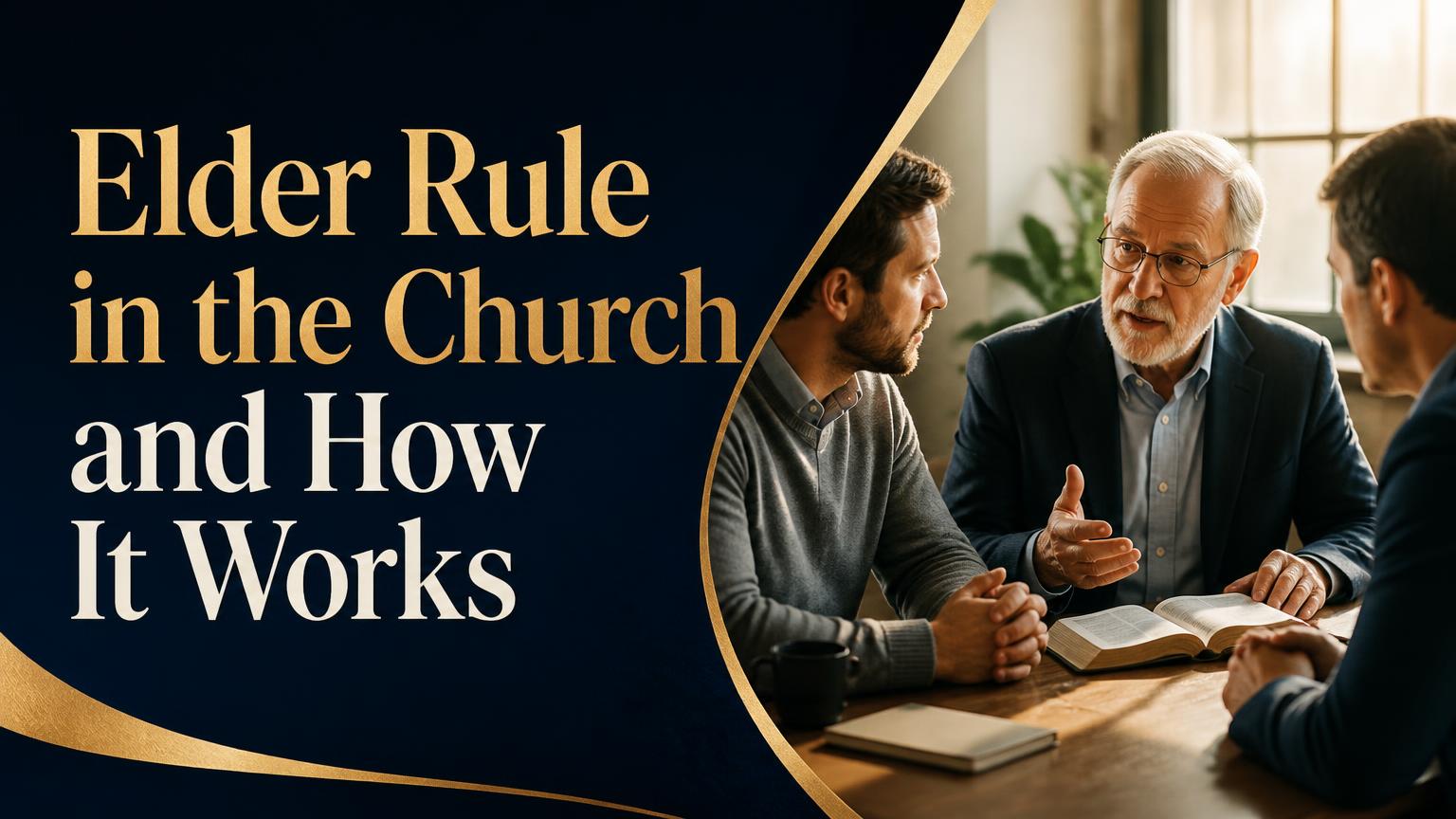
Elder rule is a church-governance model in which qualified elders hold primary responsibility for teaching, spiritual oversight, discipline, and major decisions in a local congregation. It is based on the New Testament pattern of elders shepherding churches, but Christians differ over how much authority elders should exercise and how directly the congregation should participate.
The central issue is not whether leaders are needed. Scripture clearly presents church leadership as necessary. The question is how authority should be shared among elders, pastors, deacons, and the congregation—and what safeguards should prevent leadership from becoming domineering.
What Is Elder Rule?
Elder rule means that a plurality of qualified elders governs a local church under the authority of Jesus Christ and Scripture. Elders are responsible for protecting doctrine, shepherding members, overseeing worship and ministry, addressing serious sin, and making decisions necessary for the church’s health and mission.
The term does not mean that elders may govern according to personal preference. Biblical elder rule is accountable leadership exercised through teaching, prayer, wisdom, and service. The elders’ authority is delegated and limited: Christ is the church’s head, and Scripture is the church’s final standard.
Elder Rule Involves a Plurality of Leaders
The New Testament normally describes local churches as having multiple elders:
- “They had appointed elders for them in every church” (Acts 14:23).
- Paul called for the elders of the church in Ephesus (Acts 20:17).
- Paul instructed Titus to appoint elders in every town (Titus 1:5).
- Peter addressed “the elders among you” and instructed them to shepherd God’s flock (1 Peter 5:1–3).
This pattern matters because shared leadership provides mutual counsel and reduces dependence on one dominant personality. A plurality also allows elders to encourage, correct, and hold one another accountable.
A church may temporarily have only one qualified elder because of its size or circumstances. However, one-person rule is not the normal New Testament pattern. A single pastor who makes every significant decision without meaningful accountability represents a different arrangement from elder plurality.
Elders Are Shepherds, Teachers, and Overseers
The New Testament uses several related descriptions for church leaders. Elders shepherd the flock, overseers watch over the church, and pastors teach and care for believers. These terms emphasize different aspects of the same responsibility rather than necessarily describing separate levels of local authority.
Elders typically oversee:
- Biblical teaching and doctrinal integrity
- Prayer and spiritual care
- The appointment and supervision of ministry leaders
- Church discipline and restoration
- Membership and pastoral care
- Stewardship of the church’s mission and resources
- Major organizational and ministry decisions
First Timothy 5:17 refers to elders who “rule well,” especially those who labor in preaching and teaching. The word “rule” here should not be separated from the New Testament’s repeated emphasis on service, humility, and accountability.
Elder Rule Is Not Authoritarian Rule
Jesus directly rejected the kind of leadership that imitates worldly domination. In Mark 10:42–45, he taught that greatness among his followers is expressed through service, because the Son of Man came “not to be served but to serve.”
Peter gives the same qualification to elders: they must not domineer over those entrusted to them but must be examples to the flock (1 Peter 5:3). Therefore, elder rule does not justify intimidation, secrecy, manipulation, or unquestioned personal control.
Biblical authority persuades through truth and example. It does not demand obedience to an elder’s private opinions simply because that person holds office.
What Is the Biblical Basis for Elder Rule?
The Bible does not use the modern phrase “elder rule,” and it does not provide a detailed constitutional model for every church. Instead, it gives principles about church leadership, qualifications, authority, responsibility, and congregational participation. Churches apply those principles through different traditions.
The Church Is Led by Christ Through His Word
The New Testament identifies Jesus as the head of the church (Ephesians 1:22–23; Colossians 1:18). Elders do not replace Christ’s authority; they serve under it. Their decisions must therefore be tested by Scripture rather than treated as inherently correct.
This distinction establishes an important limit. Elders may apply biblical principles to particular situations, but they may not redefine sin, create doctrines contrary to Scripture, or make personal preferences binding on the conscience as though they were divine commands.
Elders Are Charged With Oversight
Paul told the Ephesian elders to pay careful attention to themselves and to all the flock, because they had been appointed to oversee the church of God (Acts 20:28). Their responsibility included guarding the congregation against false teaching and caring for its members.
First Peter 5:1–4 similarly connects eldership with shepherding, oversight, humility, and accountability to Christ, the “chief Shepherd.” The emphasis is both responsibility and restraint: elders must actively care for the church, but they remain answerable to Christ.
Elders Must Meet Moral and Spiritual Qualifications
The qualifications in 1 Timothy 3:1–7 and Titus 1:5–9 focus primarily on character rather than charisma, wealth, education, or leadership style. An elder should be above reproach, faithful in marriage, self-controlled, hospitable, able to teach, spiritually mature, and respected in the wider community.
Titus also emphasizes holding firmly to trustworthy teaching so that an elder can encourage believers and refute error. These qualifications explain why elder rule is not simply a system for giving power to a board. The office requires tested character, sound doctrine, relational wisdom, and a willingness to serve.
How Elder Rule Works in Practice
The precise operation of elder rule varies by church tradition, but the basic pattern is consistent: elders provide spiritual direction and accountable oversight while the congregation remains responsible for faithful participation.
Elders Make Decisions Together
In a healthy elder-led church, elders normally deliberate together rather than allowing one pastor to control the church. They study Scripture, pray, seek wise counsel, hear relevant concerns, and pursue unity before acting.
Consensus does not mean that every elder has identical preferences. It means that the elders can support a decision in good conscience after honest discussion. Churches may use formal votes among elders, but a vote alone does not guarantee biblical leadership. The quality of the process depends on humility, transparency, and submission to Scripture.
The Congregation Recognizes and Responds to Leadership
Elder rule does not make church members passive. The congregation may recognize qualified elders, affirm leaders, receive biblical teaching, participate in discipline, serve in ministry, and raise concerns when leaders act improperly.
Several passages address the congregation’s relationship to leaders. Believers are instructed to respect those who labor among them and are over them in the Lord (1 Thessalonians 5:12–13). Hebrews 13:17 calls believers to obey and submit to faithful leaders who watch over their souls. These commands assume that leaders are genuinely responsible for the church, but they do not authorize leaders to demand obedience to sinful or abusive commands.
Church traditions differ over whether members formally vote on elders, budgets, property decisions, or major doctrinal changes. Some congregations reserve certain decisions for congregational approval; others entrust nearly all such matters to the elders. The specific structure should be stated clearly in the church’s governing documents.
Elders Work With Deacons and Other Ministry Leaders
Elders and deacons have related but distinct responsibilities. Elders provide spiritual oversight, teaching, and shepherding. Deacons serve the practical needs of the congregation and help organize ministry.
Acts 6 describes the apostles responding to a practical distribution problem by appointing qualified servants so that the apostles could remain devoted to prayer and the ministry of the word. Although the passage does not provide a complete manual for modern church offices, it illustrates the value of distributing responsibilities rather than requiring elders to perform every task.
Staff members, ministry directors, and committees may exercise delegated responsibilities, but delegation does not remove the elders’ duty to supervise the church’s direction and doctrine.
Elder Rule Compared With Other Church-Governance Models
The most useful distinction is between who possesses primary governing authority and how the congregation participates.
| Model | Primary Governing Authority | Typical Congregational Role |
|---|---|---|
| Elder rule or elder-led government | A plurality of elders | Receives leadership and may have limited or substantial approval responsibilities |
| Congregational government | The gathered congregation | Members vote on leaders and significant decisions, often with pastors and elders providing guidance |
| Episcopal government | Bishops or a higher regional authority | Local leaders operate under broader denominational oversight |
| Single-pastor leadership | One pastor or senior leader | Other leaders may advise, but practical authority is concentrated |
These categories often overlap. A Presbyterian church may be governed by a session of elders while also involving members in significant decisions. A Baptist church may practice congregational government but rely heavily on elders or pastors for daily leadership. A church’s label does not always reveal how authority actually functions.
“Elder rule” and “elder-led congregationalism” are therefore not always identical. In a strict elder-rule arrangement, elders make most governing decisions. In an elder-led congregational church, elders lead while the congregation retains formal authority over selected matters, such as recognizing elders, approving major financial commitments, or receiving and removing members.
The Benefits and Risks of Elder Rule
Elder rule can provide stable, spiritually focused leadership, but its success depends on the character and accountability of the elders.
Potential Benefits
A plurality of elders can:
- Provide consistent pastoral care rather than placing every need on one pastor
- Protect the church from doctrinal drift
- Encourage long-term decision-making instead of reaction to popularity
- Use the varied wisdom and gifts of several leaders
- Create mutual accountability among elders
- Clarify who is responsible for shepherding and oversight
The model can also help a church make difficult decisions when popularity and faithfulness do not point in the same direction. Elders are called to seek what is true and beneficial, not merely what is immediately attractive.
Common Risks
Elder rule becomes unhealthy when elders are insulated from correction, conceal information, or treat disagreement as rebellion. Other dangers include:
- Concentration of power in one dominant elder
- Spiritual abuse disguised as submission
- Decision-making without meaningful member input
- Nepotism or favoritism in leadership appointments
- Failure to distinguish biblical commands from personal preferences
- Lack of financial and organizational transparency
- Protecting leaders from legitimate investigation
These risks are not arguments against eldership itself. They show why biblical leadership must include plurality, character qualifications, clear procedures, truthful communication, and meaningful accountability.
What Should a Healthy Elder-Rule Church Look Like?
A healthy church governed by elders should make its authority structure understandable to members. People should know who the elders are, what decisions they make, how leaders are appointed, how concerns are raised, and what process exists for investigating serious accusations.
First Timothy 5:19–20 requires care in handling accusations against elders while also insisting that persistent public sin cannot be ignored. This balance protects leaders from reckless charges without placing them beyond correction.
Healthy elder rule also produces visible pastoral care. Elders should know the people they lead, teach Scripture faithfully, pray for the congregation, visit the suffering, pursue straying members, and correct error with patience. Authority that exists only in meetings and policies, without personal shepherding, falls short of the biblical picture.
The best question is not simply, “Who has the vote?” It is whether the church’s structure helps qualified leaders shepherd faithfully while keeping them accountable to Christ, Scripture, and the people entrusted to them.
Elder rule is a biblical church-governance model when it means qualified elders jointly shepherding a congregation under Christ’s authority and Scripture’s direction. It is not a license for unchecked control. The strongest form of elder rule combines plurality, moral qualifications, servant leadership, clear accountability, congregational participation, and respect for the conscience of believers. The structure matters, but its faithfulness is ultimately measured by whether those who lead actually protect, teach, and serve the church.